Chevrolet Camaro
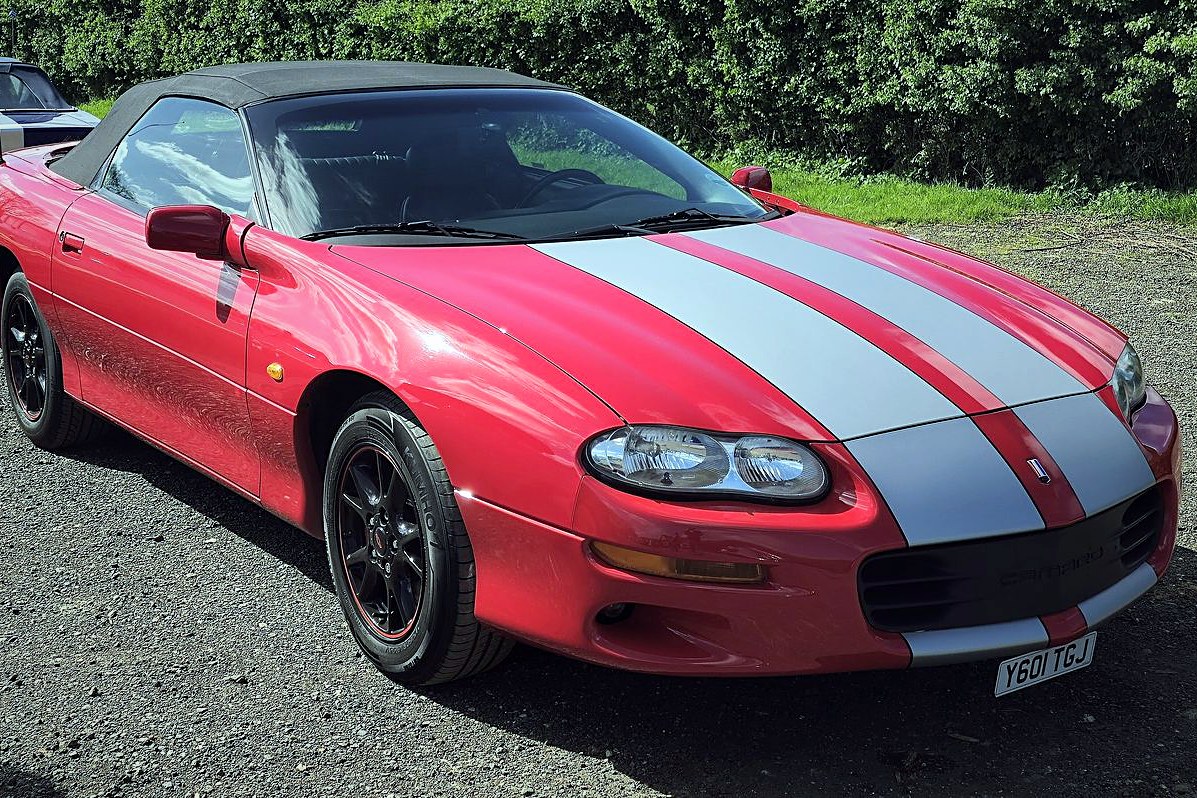
LT1 and LS1 power under the low, aero coupe body.
Made to order: your copy is researched, fact-checked, and typeset to our standard, then delivered within about two weeks. We'll email you the moment it's ready.
About the Chevrolet Camaro (1993-2002)
The fourth-generation Camaro is the last of the traditional F-body cars and the cheapest honest route into a V8, rear-drive American coupe. Built in Quebec through August 2002, it is a low composite body over a live rear axle and a pushrod small-block. The 1998 facelift, nicknamed the catfish for its reshaped nose, brought the aluminium LS1 engine.
The appeal is power per dollar: a Z28 undercuts almost anything with this much straight-line pace, both V8s respond to basic tuning, and parts supply is excellent. The trade-offs are a cramped cabin, poor rear visibility, and cheap interior plastics.
Specifications at a glance
| Years | 1993-2002 (fourth generation, GM F-body) |
| Z28 engine | 5.7 L LT1 iron-block V8 (1993-1997), 5.7 L LS1 aluminium V8 (1998-2002) |
| Z28 output | 275 hp (LT1); 305 hp (LS1 1998-2000); 310 hp (LS1 2001-2002) |
| Z28 torque | 325 lb-ft / 441 Nm (LT1); 340 lb-ft / 461 Nm (LS1 2001-2002) |
| Base engine | 3.4 L V6, 160 hp (1993-1994); 3.8 L V6, 200 hp (1995-2002) |
| Transmissions | 5-speed manual, 4-speed 4L60E automatic, 6-speed T56 manual (V8) |
| Layout | front engine, rear-wheel drive, live rear axle |
Known issues to check before you buy
- Opti-Spark distributor (1993-1997 LT1 only). The optical distributor sits under the water pump, so a weeping pump drips coolant into it and kills it: misfires and hard starting. Replace the pump with the distributor or the new unit dies too.
- 4L60E automatic, 3-4 clutch pack. The known weak point: a clean 1-2 and 2-3 shift, then rpm flare or a neutral feeling going into third. Drive it to top gear at operating temperature.
- T-top leaks and door electrics. Aged T-top seals and hatch weatherstrip let water in: check for damp carpet and rust in the rear floor pans. Water in the doors kills window motors, so cycle both windows.
- LS1 cold-start piston slap (1998-2001). Light knocking for the first minute from cold is a known trait of the short-skirt pistons (tightened for 2002), not a failing bearing. A knock that persists warm is.
- Clutch master cylinder (1999 manual cars). NHTSA recall 99V239000 covered a wrong retaining ring in the hydraulic clutch master cylinder. Ask whether the recall work was done.
Owning one
Running costs are low for the performance, so the question is condition, not mechanics. Buy the driest, most complete car you find. This volume documents the Chevrolet Camaro (1993-2002) specifically: verified specifications, the documented weak points and how to inspect each, the service data, and the parts and owner community that keep them on the road.
Inside this volume
Known issues & a survey guide
The documented weak points for this exact model, how to inspect each, and what a proper fix costs.
Full specifications
Every published figure, engine option, and running change, with the conflicts flagged, not guessed.
Systems & maintenance
Electrical, fuel, cooling, and drivetrain, plus service schedules and torque and fluid data.
Parts & community
Where the parts are, what cross-references, and the clubs and forums that keep the model alive.
Make it your car.
We fold in your year, your engine and options, your refits and modifications, your VIN, and your own car's photo on the cover. The book stops describing the car that left the factory and starts describing the one in your garage.