Honda RC30
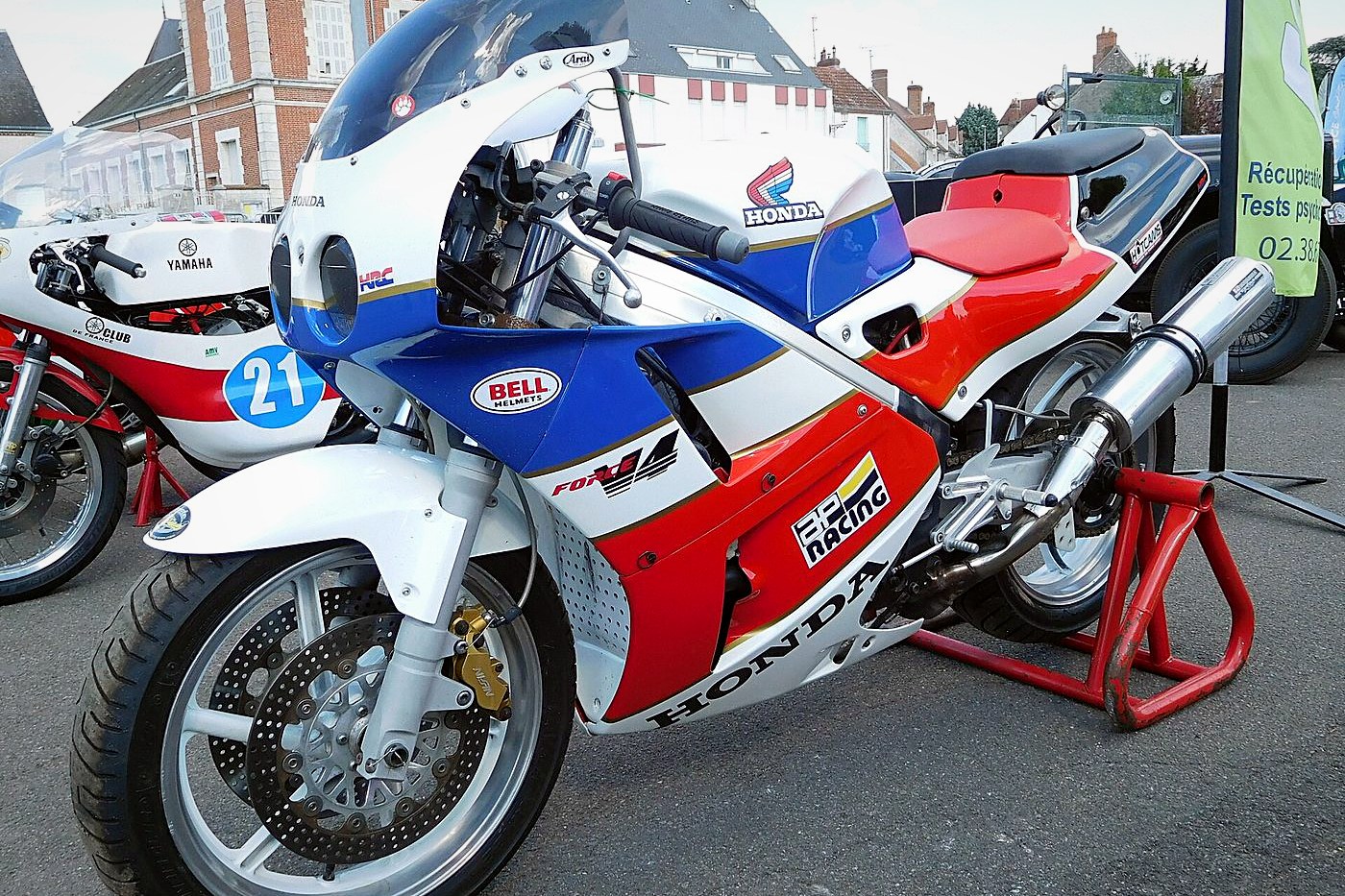
Built to homologate Honda's V4 for World Superbike, the RC30 brought a single-sided swingarm and gear-driven cams to the street in tiny numbers.
Made to order: your copy is researched, fact-checked, and typeset to our standard, then delivered within about two weeks. We'll email you the moment it's ready.
About the Honda RC30 (VFR750R)
The Honda RC30, sold as the VFR750R, is one of the most revered sportbikes ever built. Hand-assembled by Honda Racing (HRC), it existed for one reason: to homologate a machine for the new World Superbike Championship. It succeeded emphatically, winning the first two WSBK titles in 1988 and 1989 with Fred Merkel, and it has been a blue-chip collector's motorcycle ever since.
What makes it special is the engineering. The compact 748cc 90-degree V4 uses gear-driven camshafts rather than chains, titanium connecting rods, and a close-ratio six-speed gearbox. It is wrapped in a twin-spar aluminum frame with a single-sided Pro-Arm swingarm and twin-headlight fairing that still looks purposeful decades later. Roughly 3,000 were built, released first in Japan for 1987, then Europe in 1988, and finally the United States in 1990.
Specifications at a glance
| Model code | RC30 (VFR750R) |
| Years | 1987 to 1990 |
| Engine | 748cc 90-degree V4, DOHC, gear-driven cams |
| Output | about 112 bhp in full-power European trim (Japanese-market bikes were restricted) |
| Gearbox | close-ratio 6-speed, chain final drive |
| Chassis | twin-spar alloy frame, single-sided Pro-Arm swingarm |
| Production | approximately 3,000 units |
Known issues to check before you buy
- Valvetrain and cam condition. Honda's 750 V4s of the era earned a reputation for camshaft wear. The RC30's gear-driven top end is strong, but confirm the valve-clearance and inspection history, and listen for top-end noise.
- Originality is everything. Value hinges on matching numbers and unmolested, original bodywork and components. Track-day modifications and swapped parts sharply reduce a bike's worth.
- Parts scarcity. Body panels, HRC race-kit parts, and model-specific ancillaries are rare and very expensive. Buy the most complete, honest example you can find.
- Charging and consumables. As with any late-1980s Japanese sportbike, check the regulator/rectifier, fork seals, and the age of all rubber and fluids.
Owning one
The RC30 has moved firmly into serious-collectible territory, with good examples commanding sums that reflect its racing pedigree and tiny production run. It is a motorcycle to preserve and ride sparingly rather than a weekend hack. This volume documents the RC30 specifically: verified specifications, the documented weak points and how to inspect each, the service data, and the specialist parts and owner-club network that keeps these bikes correct and running.
Inside this volume
Known issues & a buyer's guide
The documented weak points for this exact model, how to inspect each, and what a proper fix costs.
Full specifications
Every published figure, engine and frame detail, and running change, with the conflicts flagged, not guessed.
Systems & maintenance
Engine, fueling, electrical, and chassis, plus service intervals and torque and fluid data.
Parts & community
Where the parts are, what cross-references, and the clubs and forums that keep the model alive.
Make it your bike.
We fold in your year, your engine and options, your rebuilds and modifications, your VIN, and your own motorcycle's photo on the cover. The book stops describing the bike that left the factory and starts describing the one in your garage.