Beechcraft Baron 55
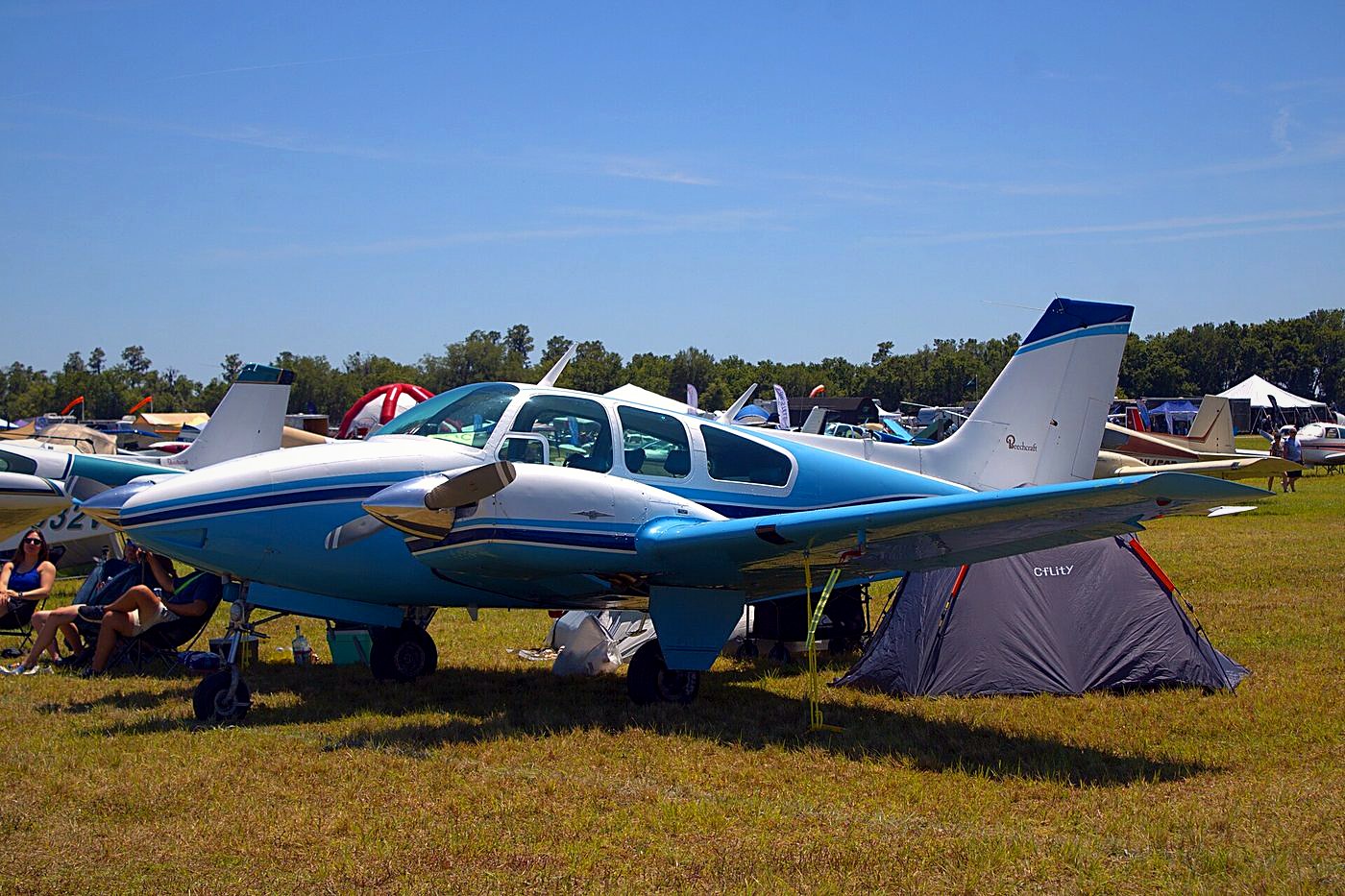
The short-body Baron shares its Bonanza heritage and remains a favorite step-up twin, with parts support through the active American Bonanza Society.
Made to order: your copy is researched, fact-checked, and typeset to our standard, then delivered within about two weeks. We'll email you the moment it's ready.
About the Beechcraft Baron 55 (1961-1982)
The Baron 55 is the airplane that defined the light piston twin. Beech introduced it in 1961 by putting two fuel-injected Continentals and a Bonanza tail on the Travel Air airframe, and it stayed in production for two decades, 3,651 built. The B55 (1964 to 1982) is the one you will see most; the stretched C55, D55, and E55 seat six on 285 hp engines.
The appeal is speed and build quality for the money. A Baron cruises near 190 knots and handles honestly. The cost is two of everything: two overhauls, Beech prices on parts, and a spar inspection that must be current. It remains one of the fastest ways to move four adults.
Specifications at a glance
| Years | 1961 to 1982 |
| Engines | two Continental IO-470-L, 260 hp each; 285 hp IO-520-C on C55 to E55 |
| Cruise | about 190 knots (219 mph), 195 knots with 285 hp |
| Useful load | about 1,800 lb (816 kg); 1,950 lb (885 kg) on 285 hp models |
| Gross weight | 5,100 lb (2,313 kg) B55; 5,300 lb (2,404 kg) C55 to E55 |
| Wingspan | 37 ft 10 in (11.53 m) |
| Number built | 3,651 (all Model 55 variants) |
Known issues to check before you buy
- Wing spar carry-through. AD 90-08-14 requires inspecting the forward spar carry-through at 1,500 hours total time, then every 500 hours; cracks there can mean loss of the airplane. Repair means a kit and 55 to 60 hours of labor.
- IO-520 cases and camshafts. On the C55, D55, and E55, cracked crankcases and broken camshafts recur in service difficulty reports. Continental's heavier cases from the late 1970s helped. Check the case number and look for cracks at the through-bolts.
- Reversed gear and flap switches. On the Model 55 the gear switch sits right of the throttles and the flap switch left, the opposite of most airplanes, which produced a long history of gear-up accidents. Beech never fixed it on the 55.
- Fuel bladders. The wing tanks are rubber bladders that leak at patches and seams. Look for blue avgas stains under the wing and ask when they were replaced.
- Other recurring ADs. AD 89-05-02 covers elevator cracks and can mean a new elevator; prop inspections repeat under AD 97-18-02 (Hartzell, A55/B55) and AD 95-24-05 (McCauley, E55).
Owning one
Plan on 27 gallons per hour with the 260 hp engines, 32 with the 285s, annuals commonly $5,000 to $12,000, and reserves for two overhauls. This volume documents the Beechcraft Baron 55 specifically: verified specifications, the documented weak points and how to inspect each, the service data, and the parts and owner community that keep them flying.
Inside this volume
Known issues & a pre-buy guide
The documented weak points for this exact type, the airworthiness directives and service bulletins that bite, and what a pre-buy should catch.
Full specifications
Every published figure, engine and airframe detail, weights, and performance data, with the conflicts flagged, not guessed.
Systems & maintenance
Powerplant, fuel, electrical, and airframe, plus inspection intervals and the operating numbers that keep it flying.
Parts, shops & type club
Where the parts are, what cross-references, and the type clubs and owner groups that keep the fleet in the air.
Make it your aircraft.
We fold in your year, your engine and avionics, your mods and STCs, your registration, and your own aircraft's photo on the cover. The book stops describing the type that left the factory and starts describing the one in your hangar.