Beechcraft Duchess 76
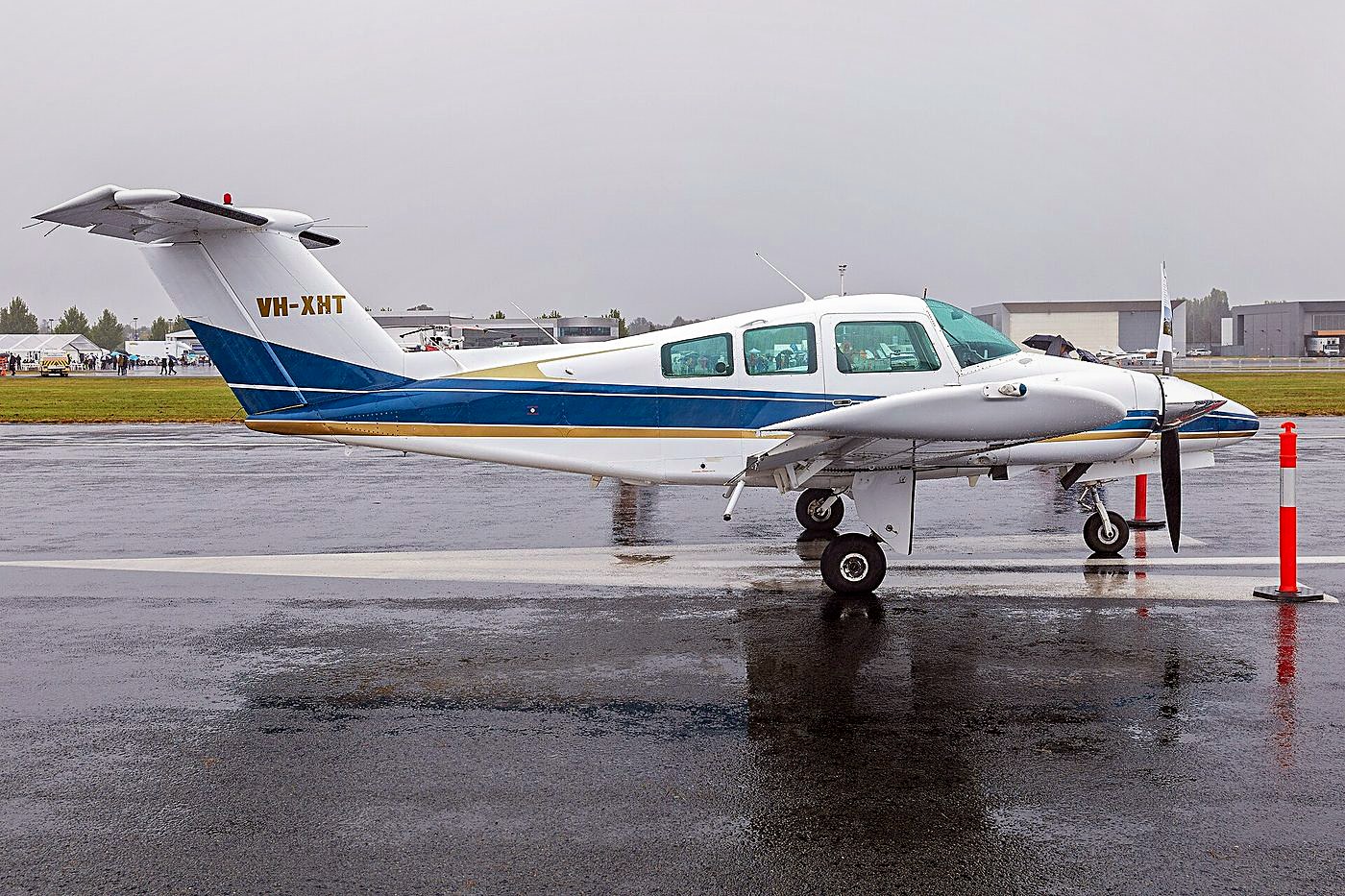
Beechcraft's counter-rotating trainer twin has a T-tail and forgiving handling, and it remains a staple of multi-engine flight schools.
Made to order: your copy is researched, fact-checked, and typeset to our standard, then delivered within about two weeks. We'll email you the moment it's ready.
About the Beechcraft Duchess 76 (1978-1983)
The Duchess is Beechcraft's light twin trainer, a four-seat, all-metal, T-tailed airplane built from 1978 to 1983 to teach multi-engine flying at the company's own Beech Aero Centers. Many US multi-engine ratings were earned in one. The two 180 hp Lycomings turn opposite ways, so neither is the critical engine, which instructors like for engine-out training.
It is the simplest twin Beech sold: carbureted, unsupercharged, and far less demanding to maintain than a Baron or a Cessna 310. The trade is modest capability: fill the 100 gallon tanks and about 650 lb of cabin load is left, and single-engine climb falls to roughly 100 ft per minute above 5,000 ft. Of 437 built, about 270 remain on the US registry.
Specifications at a glance
| Years | 1978 to 1983 |
| Engines | two counter-rotating Lycoming O-360/LO-360-A1G6D |
| Output | 180 hp (134 kW) each |
| Cruise | 158 kt (182 mph) at 10,000 ft, 164 kt max power |
| Empty / gross weight | 2,460 lb / 3,900 lb (1,769 kg) |
| Fuel capacity | 100 US gal (379 L) |
| Wingspan / seats | 38 ft (11.58 m) / four |
| Number built | 437 |
Known issues to check before you buy
- Main landing gear A-frame cracks. AD 97-06-10 requires a dye-penetrant inspection of the main gear A-frames every 100 hours, with no terminating action: cracked parts get scrapped and the inspection still repeats. It is the defining recurring cost, so read the compliance record.
- Engine mount structure. AD 80-19-12 requires visual and dye-penetrant inspection of the engine mounts, cracked ones repaired before further flight. Ask when it was signed off.
- Control system directives. AD 78-20-08 covers the trim tab push rods, AD 80-07-06 the rudder and its trim tab, AD 82-02-03 the elevator control cable. Confirm all three in the logs.
- Starter hang-ups. The starter can stay engaged after the engine fires and destroy itself and the ring gear; AD 79-09-04 addressed starter relay failures. Check for a starter-engaged warning light and ask about ring gear work.
- Gear actuator and accessories. Routine squawks are gear actuator leaks, failed alternators, dead boost pumps, and hydraulic lines chafing at the heater ducts. Cheap parts, but frequent.
Owning one
Nearly every Duchess spent its life as a flight-school airplane: hard hours, but usually thorough maintenance, and simple enough for a good shop to keep honest. This volume documents the Beechcraft Duchess 76 (1978-1983) specifically: verified specifications, the documented weak points and how to inspect each, service data, and the parts and owner community.
Inside this volume
Known issues & a pre-buy guide
The documented weak points for this exact type, the airworthiness directives and service bulletins that bite, and what a pre-buy should catch.
Full specifications
Every published figure, engine and airframe detail, weights, and performance data, with the conflicts flagged, not guessed.
Systems & maintenance
Powerplant, fuel, electrical, and airframe, plus inspection intervals and the operating numbers that keep it flying.
Parts, shops & type club
Where the parts are, what cross-references, and the type clubs and owner groups that keep the fleet in the air.
Make it your aircraft.
We fold in your year, your engine and avionics, your mods and STCs, your registration, and your own aircraft's photo on the cover. The book stops describing the type that left the factory and starts describing the one in your hangar.