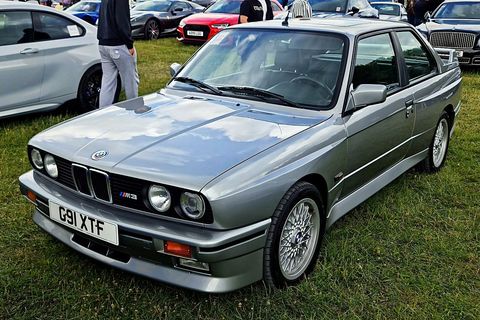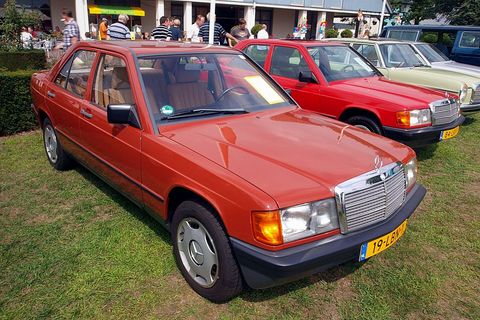
In the mid-1980s, the German Touring Car Championship (DTM) turned into a street fight between two companies that did not usually acknowledge each other's existence. On one side stood the BMW M3, a boxy 3 Series built purely so BMW could go racing. On the other stood the Mercedes-Benz 190E, the compact "Baby Benz" whose hottest version, the Cosworth-headed 2.3-16, was engineered to beat exactly that car. Forty years later the rivalry has moved from the racetrack to the classifieds, and enthusiasts are still choosing sides. If you want an analog, mechanically honest 1980s sport sedan with real motorsport DNA, one of these two belongs in your garage. Here is how they actually compare.
BMW M3 (1986 to 1991)
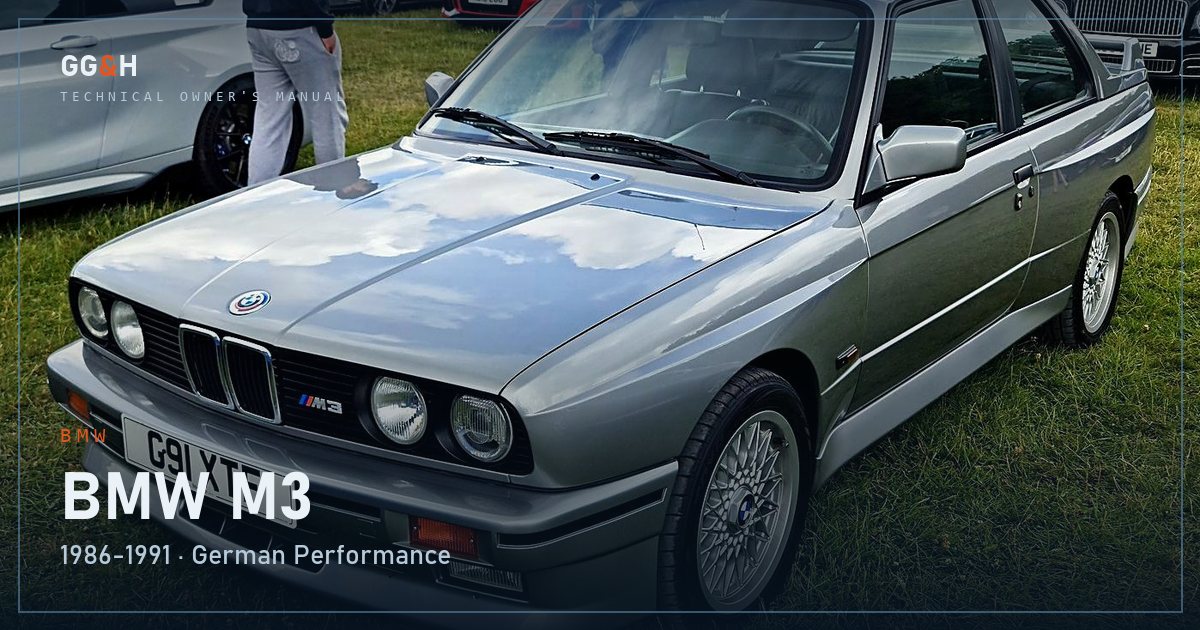
The E30 M3 is a homologation special in the truest sense: BMW needed to build road cars to go touring car racing, so the street M3 got flared box arches, a taller trunk, a steeper rear window, and the high-revving S14 four-cylinder. Nothing about it is subtle once you know what to look for. It steers with an immediacy that modern cars have engineered away, and the engine wants to be worked hard, rewarding revs rather than low-end torque.
Its pedigree is genuine. The E30 M3 became one of the most successful touring cars ever built, and that racing halo is precisely why values have climbed so steeply. An owner should know this is a car that demands maintenance rather than tolerating neglect. The S14 needs valve adjustments and periodic attention to its individual throttle bodies, parts specific to the M3 are expensive and increasingly scarce, and body panels differ from a standard E30, so collision repair is a project. Rust in the usual BMW places is the honest weak point, and prices now put clean examples firmly in collector territory.
Mercedes-Benz 190E (1982 to 1993)
The 190E was Mercedes engineering the small car it had resisted building for decades, and it shows. The W201 chassis is famous for its multi-link rear suspension and a general sense of being over-built, the reason so many survive today. In ordinary four-cylinder or inline-six form it is a comfortable, solid, understated sedan. In 2.3-16 (and later 2.5-16) Cosworth form it is the direct answer to the M3: a 16-valve head developed with Cosworth, close-ratio gearbox, and a subtle body kit that hides real capability.
The 190E's motorsport story runs right alongside the M3's, trading DTM wins through the late 1980s. What an owner should know is that the base cars are the more sensible daily proposition: they are durable and parts are reasonable. The 16-valve cars, by contrast, carry their own costs, since Cosworth-specific components, the self-leveling rear system, and correct trim are hard to source and pricey. The honest weak points are the wiring harness insulation that degrades on 1990s cars, and the reality that a base 190E, while lovely, is not the giant-killer, while the Cosworth version commands money approaching the M3.
How to choose
Be honest about which version you are actually comparing. A standard 190E is a durable, affordable classic Mercedes and the easiest way into this story, but it is not a rival to the M3 in feel or value. The genuine head-to-head is E30 M3 against 190E 2.3-16, and there the decision is about character. The M3 is the sharper, more focused driver's car and the stronger investment, at the cost of higher upkeep and higher entry price. The Cosworth 190E is rarer, more comfortable over distance, and quietly special, a connoisseur's pick that trades a little edge for solidity and a lower profile. Choose the M3 if you want the purest analog driving experience and the blue-chip name. Choose the 190E if you value engineering integrity, everyday usability, and standing slightly apart from the crowd.
Whichever way you lean, both are cars that reward an owner who understands what they are keeping. Garage, Galley & Hangar makes a model-specific owner's reference manual for each of them, covering the maintenance intervals, known weak points, and buying guidance that keep these 1980s icons on the road. Browse both in the Garage catalog.