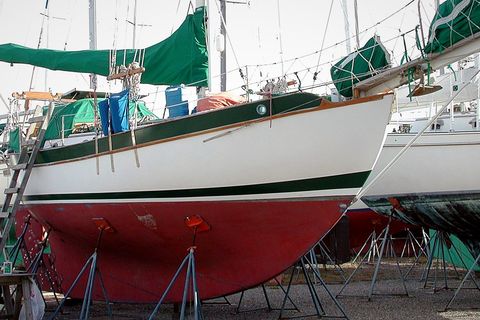
Commissioning has an order, and the order matters more than the list. Everything that must be done while the boat is out of the water comes first, because a seacock you meant to service becomes a haulout once the boat is floating. Everything that needs the engine running comes after she is wet. The sequence below assumes a winter on the hard.
While she is still out of the water
This is the part people rush and regret.
Work the hull first. Inspect the bottom for blisters and damage before the paint goes on, and look closely at the leading edge of the keel and the rudder. Check the rudder for play at the bearing and for any drooping. Sound the hull around through-hulls and any repairs.
Then the through-hulls and seacocks, every one. Each should open and close smoothly, and each should be serviced rather than merely exercised. Replace hose that is hard, cracked or beyond its service life, and confirm every below-waterline hose has two proper clamps. This is the single highest-consequence job on the list, and it can only be done now.
Replace zincs. Service and inspect the propeller, the shaft, the cutless bearing and the shaft seal, whether it is a stuffing box or a dripless unit, and check the coupling and alignment. Bottom paint last, after all of that, and mask the transducers and zincs properly.
The engine, before launch and after
Before she goes in: change the oil and filter if it was not done in the fall, change the fuel filters and the secondary, inspect and replace the impeller, and keep the old one to confirm no blades broke off into the system. Check belts, hoses and clamps by hand, not by eye. Inspect the exhaust elbow and the entire raw water path. Check coolant strength and level, and the gearbox oil.
Refit and load-test the batteries, clean the terminals, and check that the charging system and shore power work.
Then start the engine only once she is in the water, since almost every marine engine needs raw water for cooling. Confirm water at the exhaust in the first seconds, warm it up, and check for leaks of all four kinds: fuel, oil, coolant and exhaust.
Systems
Recommission the freshwater system: flush the antifreeze out thoroughly, sanitize the tanks, check the pump and look for weeping at every fitting. Do the head and the holding tank, replacing hose that has gone permeable, which you can identify with the old rag test.
Test the bilge pumps, both manual and electric, and test each float switch by lifting it rather than by pressing the panel button. Check the propane system end to end: solenoid, locker drain, hose condition, and a leak test at the fittings.
Then the electrics: every light, every instrument, the VHF with a radio check, the windlass, and the navigation lights, which are the ones that fail in winter and that you discover at dusk.
The rig
Ideally inspect the rig with the mast down, which is the only time you can properly look at the masthead, the sheaves and the terminals. If she is stepped, go up in a chair or have a rigger do it.
Look at every swage and terminal for cracks and rust staining, run a cloth up the wire to find broken strands, check the spreader tips and bases, the tangs, and the masthead sheaves. Inspect the chainplates where they enter the deck, and look below for stains at the knees. Check the furler, the gooseneck, the vang and the boom fittings.
Then tune the rig to the builder's guidance, and bend on sails only after inspecting them for chafe and stitching.
Safety gear and paperwork
Check the expiry dates on flares and the fire extinguishers, service the liferaft and inflatable PFDs if they are due, and replace jacklines and tethers that have seen sun. Confirm the EPIRB or PLB registration and battery date. Check the ground tackle, the chain and the bitter end attachment.
Then the paperwork: documentation or registration current, insurance renewed with any conditions met, and the survey up to date if the underwriter wants one.
The shakedown
Make the first sail a deliberate one, close to home. Run the engine hard enough to reach cruise rpm, sail on both tacks, and then check the bilge, which is where a winter's worth of dried-out hose fittings report in. Look in the engine space again once everything is hot.
Write down what you find. That list, plus the maintenance interval planner, is next winter's work list, started in the spring when you still remember.
For the boats we cover, there is a model-specific inspection checklist to take aboard and a full owner's reference manual written around that model's systems and known issues. Start with the inspection checklists or browse the boats catalog.