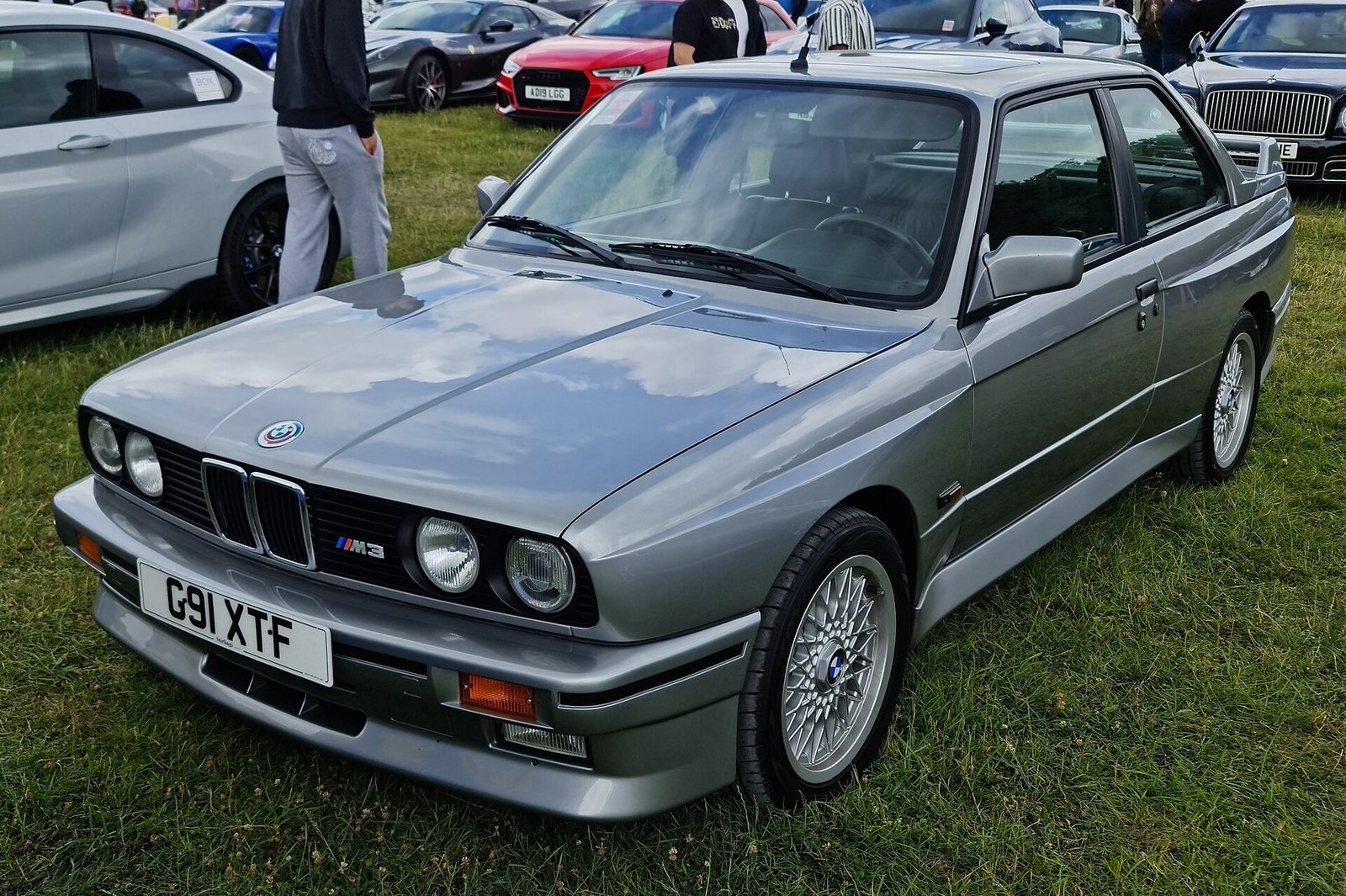
BMW M3
About This Book
This is an owner's reference for the E30 BMW M3, the four-cylinder homologation special that became the most decorated touring car ever built. It is written for the person about to buy one, already living with one, or still saving. Where the sources disagree, and on this car they disagree more often than you would expect, this book says so plainly and sends you back to your own car.
1.1 The car this book is about
The subject is the E30 generation BMW M3: the flared, boxy, four-cylinder coupe BMW Motorsport GmbH built at Munich in the second half of the 1980s, plus the 786 convertibles hand-assembled at Garching on bodies drawn from the ordinary cabriolet line (source: supercarnostalgia.com/blog/bmw-e30-m3).
Start with the one fact that explains everything else. The M3 was not a hot 325i and not a trim level. It was a homologation special: a road car that existed because a rulebook demanded a road car exist. BMW Motorsport wanted to race the 3 Series in FIA Group A touring car competition, and Group A required at least 5,000 road cars a year, built with the same suspension geometry, fender width, aerodynamic aids, engine blocks and cylinder heads as the racing version, and with displacement between 1,600 and 2,500 cc (source: ateupwithmotor.com/model-histories/bmw-e30-m3). The rules also allowed a further Evolution version every twelve months provided a minimum run was built, which is the only reason Evolution cars exist (source: supercarnostalgia.com/blog/bmw-e30-m3-evolution-1). Homologation was granted on 2 March 1987 (source: supercarnostalgia.com/blog/bmw-e30-m3).
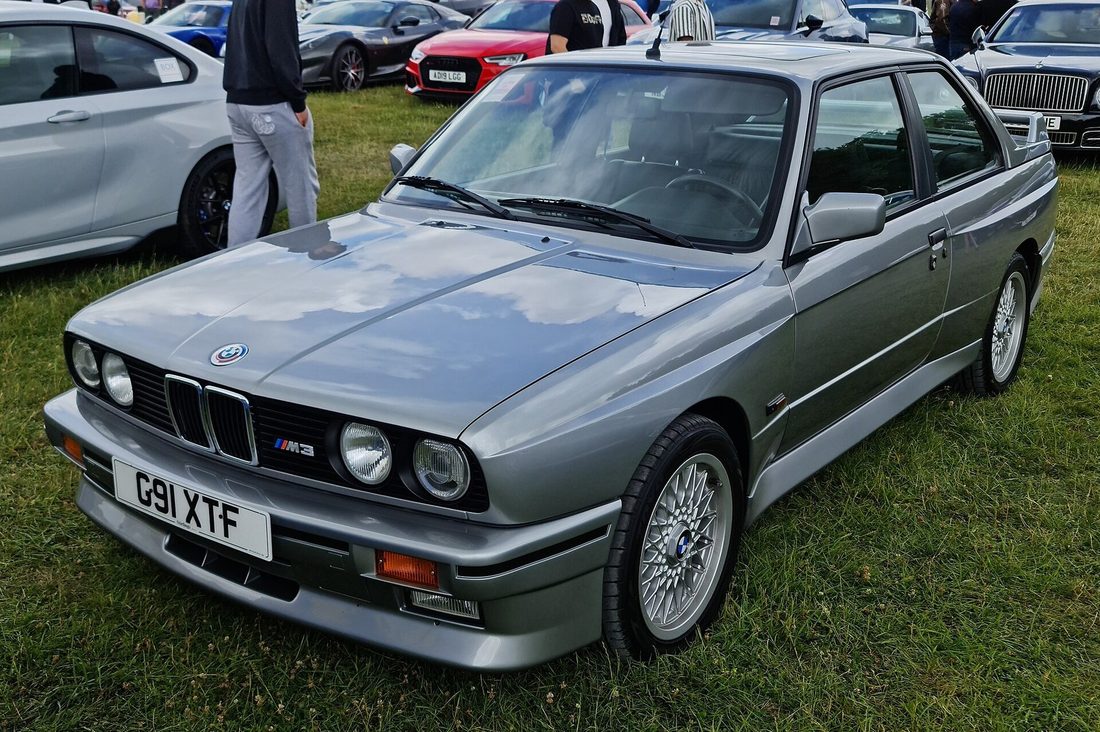
Every strange thing about the car follows from that paragraph. The steel box flares cover racing rubber. The flattened rear window, reprofiled C-pillars and boot lid raised by roughly 40 mm are aerodynamic work on the weakest part of a boxy saloon shape, and they took drag from about 0.38 for a standard 3 Series down to 0.33 (source: en.wikipedia.org/wiki/BMW_M3_(E30)). The screens are bonded rather than rubber-gasketed because bonded glass stiffens the shell. Underneath, the hubs carry five studs where a standard E30 has four, and the front control arm bushings are offset to add caster (source: e30zone.net/e30wiki/index.php/M3). None of it is styling. All of it is a race car requirement BMW had to sell to the public.
The result shares almost no bodywork with an ordinary E30: the usual short list is the bonnet and the roof panel, with different accounts adding the sunroof panel, the door inner skins or the front indicators (source: en.wikipedia.org/wiki/BMW_M3_(E30); source: rmw.lv/car/en/e30-23-m3). Body repair here is therefore a specialist job with model-specific pressings, a panel from a 325i is not a substitute, and the difference between a genuinely rust-free car and a tidy-looking one with corroded sills is measured in tens of thousands.
1.2 What this book is
This is a pre-purchase and ownership reference covering every version of the car, from an early European standard coupe to a 1990 Sport Evolution. It is here to help you identify what is in front of you, judge its condition honestly, keep it properly, and find the parts and people you will need.
It cites as it goes. An inline citation tells you whether you are reading a factory specification, a specialist's published experience or a well-supported owner report, and where a claim rests on one owner's account, this book says so rather than dressing it up as fact.
It is not a factory service manual and does not replace one. The standard workshop reference for the platform, the Bentley BMW 3 Series Service Manual 1984-1990, does not cover the S14S14 engine at all; the companion owners actually use is the Koala Motorsport E30 M3 repair manual (source: s14net.vbulletin.net/forum/s14/general-e30-m3-discussion/1241562-great-e30-m3-repair-manual). Torque figures and clearances appear here so you can spot a wrong number when you see one, but verify them against the manual for your engine and market before a shim is ordered or a head bolt turned.
1.3 What this book is not
It is not a BMW marketing document. This car has real, specific, expensive weaknesses, and they are here in detail. Rust decides these cars, and the areas that rot, the strut towers, sills, jacking points, floor pans, battery tray and boot floor, are the ones specialists describe as extremely difficult to repair well. The S14 runs solid lifters that must be measured and shimmed by hand on a schedule an ordinary service will not catch. Its cam cover gasket weeps onto a hot exhaust manifold, which is a fire hazard rather than an untidiness, and a car in that state should be fixed before it is driven any distance (source: e30zone.net/forum/viewtopic.php?t=151427). Its cylinder head cracks if the engine has ever been overheated, and BMW no longer supplies heads. Most of these cars now have cracked rear subframes.
None of that makes it a bad car. It makes it a car with defined demands, and an owner who knows them is in a completely different position from one who does not.
It is also not a modification guide. The aftermarket is covered honestly, but on a car whose value now rests substantially on originality, a swapped engine removes the thing the car is valued for.
1.4 Why the variant question matters here
Most owner's references can treat a model generation as one car. This one cannot. Establish exactly which M3 you are looking at before you form any other opinion about it.
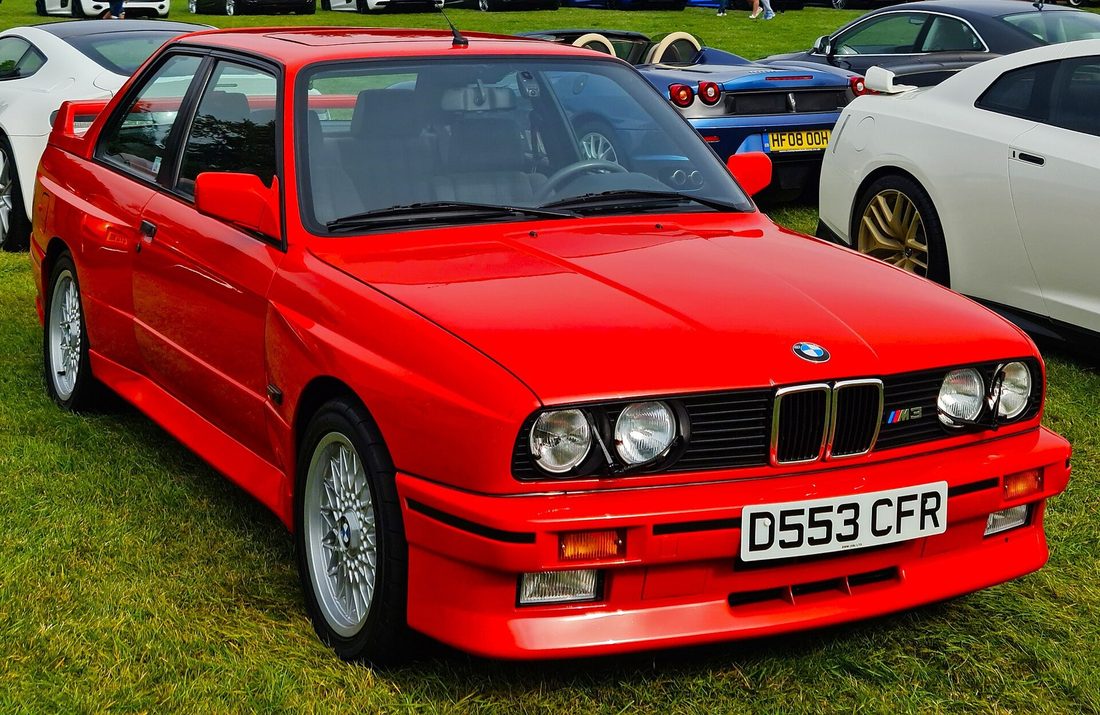
Under a single badge, BMW sold a standard coupe rated 200 PS without a catalytic converter and 195 PS with one, a late standard car lifted to 215 PS from September 1989 on a reprogrammed engine map, 505 Evolution I cars carrying a revised cylinder head and no visual clue at all, 501 Evolution II cars at 220 hp on raised compression, and 600 Sport Evolutions with a larger 2,467 cc engine, deleted equipment, an adjustable splitter and rear wing, and 238 hp (source: e30zone.net/e30wiki/index.php/M3). Alongside those came the named editions, Europameister 88, Johnny Cecotto, Roberto Ravaglia and the French-market Tour de Corse, and the convertible.
Then the market split. A North American car pairs a 4.10 final drive with a wide-ratio gearbox and an overdrive fifth. A European car pairs a taller final drive with a dogleg first gear and a direct 1:1 top, which is the racing arrangement (source: e30zone.net/e30wiki/index.php/M3). Those cars feel different, service differently and are valued differently. No factory right-hand-drive E30 M3 was ever built, whatever a seller tells you.
So the first question is not what a car is worth but what it is, and that is answerable. One European register publishes E30 M3s by chassis number with each car's factory option list, which lets a claimed Evolution be checked before money changes hands (source: m-flight-europe.com/en/bmw-register-der-sondermodelle-en-translation/), and BMW Classic will issue a birth certificate for a chassis. Chapter 2 gives the timeline and identifying features; Chapter 3 gives the numbers to test a claim against.
1.5 Who this book is for
If you are shopping, read Chapter 4 before you look at a single car. On this model the inspection is the purchase decision, and a rotten shell with a fresh engine is a worse buy than a solid shell with a tired one, the opposite of most buyers' instinct. If you already own one, this is a glovebox reference for when a light comes on, a service falls due, or a forum thread frightens you. And if you have simply wanted one since you first saw the arches, the real story is better than the myth, largely because the myth is mostly true.
1.6 How this book is organized
Chapter 2 covers the homologation story, the racing record, the year-by-year changes and how to tell the variants apart. Chapter 3 collects the specifications, and Chapter 4 catalogues what goes wrong, ordered by what it costs you, ending in a full pre-purchase inspection checklist. Chapter 5 takes the S14 and the driveline in depth, including the valve adjustment that defines ownership, and Chapter 6 works through the car by system. Chapter 7 is the service program, Chapter 8 maps a parts supply picture genuinely better than it was ten years ago, and Chapter 9 points you at the forums, registries and specialists who hold the knowledge. Each stands alone, so read them in any order.
1.7 On sources, and on disagreement
This car is unusually badly served by settled fact. Two examples are worth showing now, so that later hedging reads as honesty rather than vagueness.
The first is when production started. One well-known account gives series production as March 1986 to June 1991 (source: en.wikipedia.org/wiki/BMW_M3_(E30)). Others date coupe build from September 1986 (source: supercarnostalgia.com/blog/bmw-e30-m3; source: evo.co.uk/bmw/m3/202684/e30-bmw-m3-bodywork-art-of-speed). The likeliest reconciliation is that the earlier date covers homologation-batch build and the later one customer cars, but no source consulted says so, and this book will not pretend the question is closed.
The second is how many were built. The figure you will see everywhere is 17,970 (source: en.wikipedia.org/wiki/BMW_M3_(E30)), and it reconciles with none of the detailed breakdowns. One granular accounting of regular production, homologation runs and special editions sums to roughly 18,250 coupes before convertibles are added. The same encyclopedia that gives 17,970 lists component figures totalling 10,772. A third source describes 15,578 coupes plus 1,606 Evolution cars plus 786 convertibles; a fourth gives 17,184 coupes including some 3,800 Evolutions, which is irreconcilable with the Evolution runs actually recorded. What can be said safely: a little under 18,000 cars in total, roughly 5,300 to North America, 786 convertibles, and 1,606 across the three Evolution runs. Anyone quoting the grand total to the unit is quoting a convention rather than a count.
The pattern recurs on the valve adjustment interval, the Sport Evolution's compression ratio, the gearbox type number and several capacities. In each case this book gives the best-supported value, names the disagreement, and sends you to verify against your own car. Where a figure could not be established at all, it says so rather than filling the gap with a plausible number.
One specific warning, because it appears in an otherwise useful published engine guide: the S14 has no variable valve timing. Any source discussing VANOS on this engine is describing a different motor, and its figures deserve suspicion even where its fault list is sound.
1.8 A word on voice
This book is written by people who love these cars and does not pretend otherwise. But affection without honesty is advertising, and you deserve better when you are spending serious money and serious weekends on a machine like this.
So the tone is warm and direct. It will tell you when a noise is normal, when it means the wallet is about to open, and when the right answer is to walk away from something lovely. The E30 M3 earned its reputation the hard way, on real circuits against real competition, and the only decent way to honour that is to be straight about what living with one involves.
History and Identity
The E30 M3 exists because a rulebook demanded it and because Mercedes-Benz had already picked a fight. This chapter covers why BMW built the car, who built it, what the regulations physically did to the bodyshell, and how one badge splintered into a dozen meaningfully different cars. It closes with a sequence you can work through to establish exactly which M3 is in front of you, and what the 2026 market says that car is worth.
2.1 The provocation
The E30 M3 is not a fast 3 Series. It is a road car that had to exist so that a race car could exist, and almost everything strange about it follows from that.
The target was Group AGroup A touring car racing and the Deutsche Tourenwagen Meisterschaft. Group A regulations required a manufacturer to build at least 5,000 cars a year sharing "the same suspension geometry, fender width, aerodynamic aids, engine blocks, and cylinder heads" as the racing versions, with displacement between 1,600 and 2,500 cc (source: ateupwithmotor.com/model-histories/bmw-e30-m3). The same rulebook allowed a further Evolution variant every twelve months provided the minimum production run was met, and that clause is the direct mechanism behind the Evolution I, Evolution II and Sport Evolution cars (source: supercarnostalgia.com/blog/bmw-e30-m3-evolution-1).
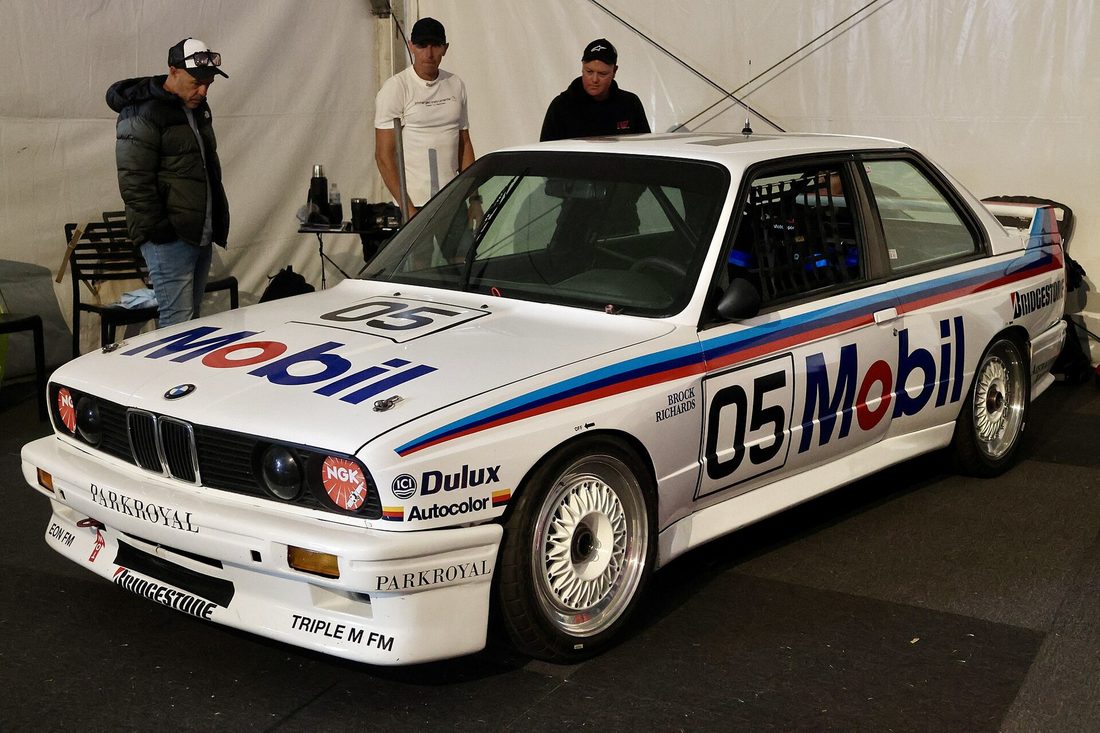
The immediate reason BMW moved when it did was Stuttgart. BMW chairman Eberhard von Kuenheim instructed BMW Motorsport to answer the Mercedes-Benz 190E 2.3-16V, whose Cosworth-built cylinder head had already made an impression in the DTM (source: ateupwithmotor.com/model-histories/bmw-e30-m3). The third car in that argument was the Ford Sierra RS Cosworth, and contemporary opinion holds that of the three "the BMW did the job the best and the most often on the racetracks," carrying the highest state of natural tune because it made its 200 bhp without a turbocharger (source: topgear.com/car-news/retro/which-better-bmw-e30-m3-or-mercedes-190e).
That is the whole origin. A chairman gave an order, a rulebook set the terms, and a small division in Munich had to sell 5,000 road cars to get on the grid.
2.2 The people
Two names carry the project with confidence. The M3 programme ran under BMW Motorsport director Wolfgang-Peter Flohr, with von Kuenheim as the chairman who ordered it (source: ateupwithmotor.com/model-histories/bmw-e30-m3). The engine belongs to Paul Rosche, technical director of BMW Motorsport GmbH, credited with developing the S14S14 "in only two weeks" (source: ateupwithmotor.com/model-histories/bmw-e30-m3). One source goes further and states that von Kuenheim handed Rosche responsibility for the whole M3 model and not only its engine (source: vintauto.com/en/who-was-in-charge-of-the-technical-development-of-the-s14-engine-and-the-m3-e30-model-of-bmw-motorsport-gmbh/).
Rosche's decisive call was cylinder count, and it is worth understanding because it explains how the car drives. BMW had both four-cylinder and six-cylinder engines inside the 1,600 to 2,500 cc window the rules allowed. Rosche chose the four, because a shorter crankshaft is a stiffer crankshaft, and a stiffer crankshaft tolerates higher engine speeds in race tune (source: ateupwithmotor.com/model-histories/bmw-e30-m3). The M3 therefore has a four not because BMW was economising but because the engine was designed around sustained high revs first and road manners second.
One attribution needs handling honestly. Some accounts name Thomas Ammerschlager as the chassis engineer on the project. That claim did not appear in any source consulted for this book, so it is left unverified here rather than repeated as fact. Treat it as a story worth checking rather than a citation.
2.3 What the rulebook did to the body
Group A let a manufacturer race the aerodynamics and the track width it sold. So BMW sold aerodynamics and track width.
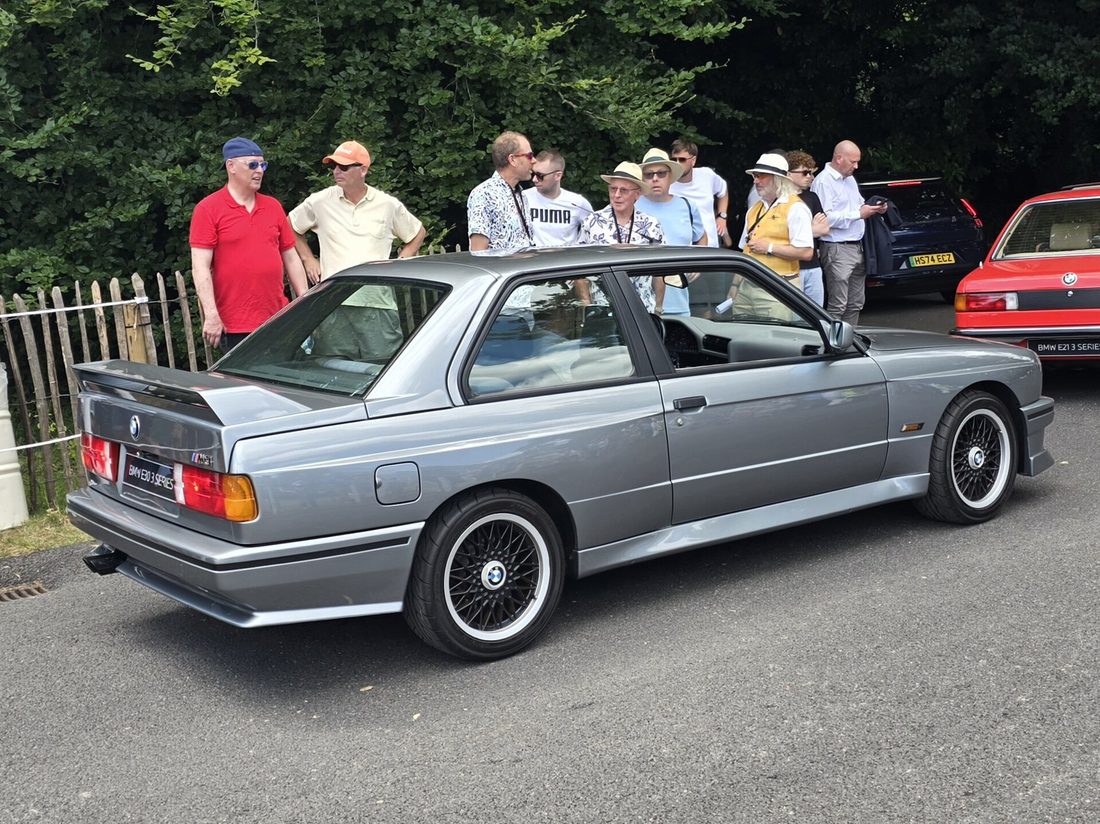
The box-flared arches, front and rear, are pressed steel rather than bolted plastic, and they exist to cover a wider track on wider and taller wheels (source: ateupwithmotor.com/model-histories/bmw-e30-m3). The C-pillars were reprofiled to carry airflow cleanly along the roof edge and turn it toward the rear wing, the rear window was flattened and re-angled, and the boot lid was raised by roughly 40 mm (source: en.wikipedia.org/wiki/BMW_M3_(E30), evo.co.uk/bmw/m3/202684/e30-bmw-m3-bodywork-art-of-speed). Both the windscreen and the rear screen are bonded to their frames rather than rubber-mounted, specifically to stiffen the shell (source: evo.co.uk/bmw/m3/202684/e30-bmw-m3-bodywork-art-of-speed). The front air dam, sill panels and rear spoiler are sheet moulding composite (source: supercarnostalgia.com/blog/bmw-e30-m3). The result was a drag coefficient of 0.33, measured against a standard 3 Series figure quoted as 0.38 in two accounts and 0.39 in a third (source: en.wikipedia.org/wiki/BMW_M3_(E30), ateupwithmotor.com/model-histories/bmw-e30-m3).
The carry-over list is the part every owner should memorise: only the bonnet, the roof panel and the front indicators are shared with a standard E30 (source: evo.co.uk/bmw/m3/202684/e30-bmw-m3-bodywork-art-of-speed). Some accounts add the sunroof panel, and one detailed summary adds the door inner skins (source: en.wikipedia.org/wiki/BMW_M3_(E30), rmw.lv/car/en/e30-23-m3). The variation does not change the conclusion. Twelve body panels are M3-specific, a 325i panel is not a substitute, and because the glass is structural, re-glazing is a body-shop operation here rather than a mobile windscreen job.
2.4 The racing record
The car was homologated for Group A on 2 March 1987, once the 5,000-car requirement had been satisfied (source: supercarnostalgia.com/blog/bmw-e30-m3). It then did what it was built for, comprehensively enough that the E30 M3 is widely described as the most successful touring car in racing history (source: deckorate.net/en-us/blogs/news/bmw-e30-m3-the-homologation-special-that-won-seven-championships-in-one-season).
Its first full season is the one that matters. In 1987 the M3 took three headline titles at once, the World Touring Car Championship, the European Touring Car Championship and the DTM, and added the Italian, French, Australian and Japanese championships in the same year, for a total of seven (source: deckorate.net/en-us/blogs/news/bmw-e30-m3-the-homologation-special-that-won-seven-championships-in-one-season). Roberto Ravaglia was the first and, because the series was not run again in that form, the only World Touring Car Champion. Eric van de Poele took the 1987 DTM, and Ravaglia took the DTM again in 1989 (source: snaplap.net/bmw-m3-e30-jewel-of-the-touring-cars/).
Beyond the championships, the endurance record is the part that dates well: five wins at the Nurburgring 24 Hours (1989, 1990, 1991, 1992 and 1994) and four at Spa (1987, 1988, 1990 and 1992), frequently against cars with significantly larger or turbocharged engines. In rallying the M3 won the 1987 Tour de Corse with Bernard Beguin, effective on asphalt and outclassed by four-wheel-drive rivals on loose surfaces. The full tally adds two ETCC titles (1987 and 1988), two BTCC (1988 and 1991), four Italian Superturismo (1987, 1989, 1990 and 1991), two DTM (1987 and 1989) and one Australian title, plus further regional championships (source: en.wikipedia.org/wiki/BMW_M3_(E30)). Race tune ran to about 300 PS from the 2.3 in 1988 and roughly 379 PS from the 2.5 in 1990, though one history gives the Sport Evolution race figure as 340 hp, so the racing peak is not settled (source: en.wikipedia.org/wiki/BMW_M3_(E30), ateupwithmotor.com/model-histories/bmw-e30-m3).
2.5 Dates, plants and the 1986 question
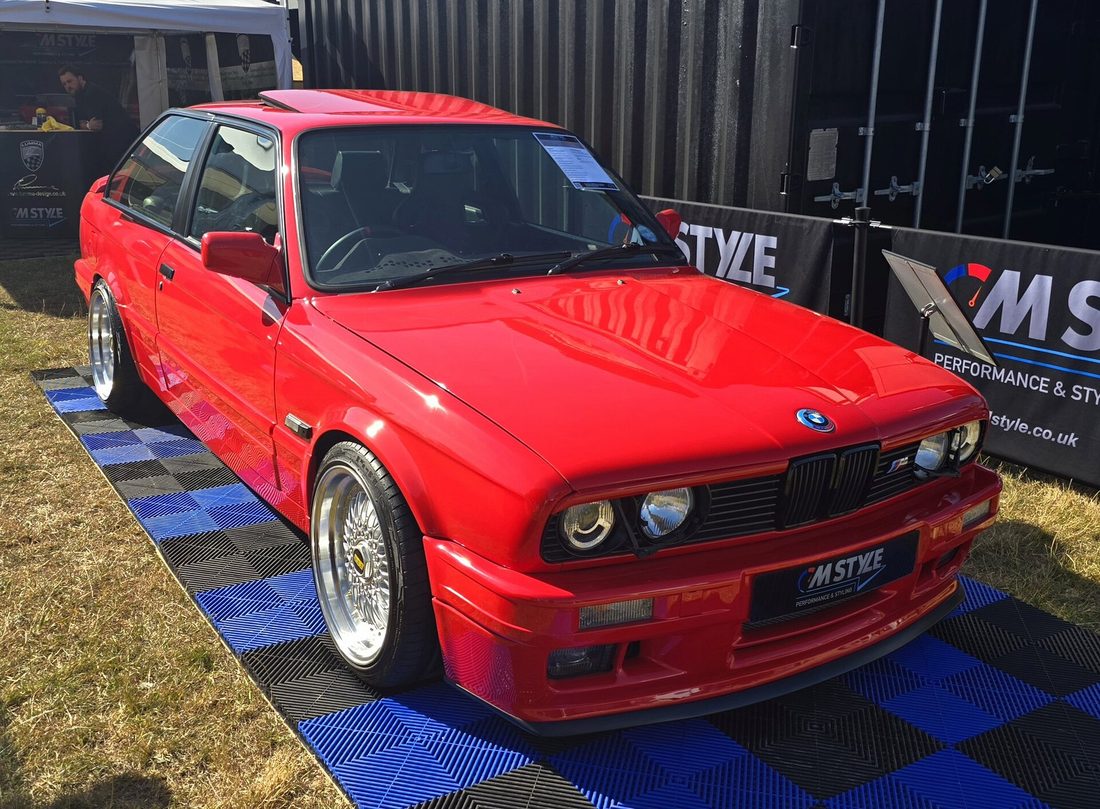
The prototype appeared at the Frankfurt Motor Show in September 1985 (source: en.wikipedia.org/wiki/BMW_M3_(E30)). Coupes were built at Munich. Convertibles were assembled by hand at Garching, where bodies drawn from the normal E30 cabriolet line received the M3 drivetrain, chassis and interior (source: supercarnostalgia.com/blog/bmw-e30-m3, bmw-m.com/en/topics/magazine-article-pool/bmw-m3-e30-convertible.html).
The start date is genuinely disputed. Wikipedia gives series production as March 1986 to June 1991 (source: en.wikipedia.org/wiki/BMW_M3_(E30)). Another source dates coupe production September 1986 to December 1990, with convertibles June 1988 to June 1991 (source: supercarnostalgia.com/blog/bmw-e30-m3), and a third also puts the Munich start at September 1986 (source: evo.co.uk/bmw/m3/202684/e30-bmw-m3-bodywork-art-of-speed). The tidy reconciliation is that March 1986 marks the homologation-batch build and late 1986 the start of customer cars, and the production tables do list European non-catalyst cars from 03/86. But no source consulted says so outright, so treat it as unresolved and go by the build date on the individual car's records.
2.6 The production totals, and why they do not agree
The most commonly cited total is 17,970 cars across all variants (source: en.wikipedia.org/wiki/BMW_M3_(E30)). It does not reconcile with the detailed breakdowns.
Four accountings circulate. The most granular, drawn from BMW M Registry data, gives European non-catalyst 5,187, European catalyst 195 hp 3,544, European catalyst 215 hp 1,914 and North American catalyst 5,300, plus Evolution I 505, Evolution II 501, Sport Evolution 600, Europameister 88 at 148, Cecotto 480, Ravaglia 25 and Tour de Corse 50 (source: e30zone.net/e30wiki/index.php/M3, bmwmregistry.com/model_faq.php?id=8). Those sum to roughly 18,250 coupes before the 786 convertibles are added, overshooting 17,970 substantially, most likely because the special editions are also counted inside the regular runs. Wikipedia's own breakdown is different again and internally short: 4,686 Euro-spec coupes, 5,300 US coupes and 786 convertibles, a total of 10,772 against its own stated 17,970 (source: en.wikipedia.org/wiki/BMW_M3_(E30)). A third gives 15,578 coupes excluding 1,606 Evolution cars, plus 786 convertibles, described as "nearly 18,000" by July 1991 (source: supercarnostalgia.com/blog/bmw-e30-m3). A fourth gives 17,184 coupes including "approximately 3,800 Evolution variants" plus 786 convertibles, and that 3,800 cannot be reconciled with the 1,606 the three Evolution runs actually produce (source: ateupwithmotor.com/model-histories/bmw-e30-m3).
What can be said safely: production was a little under 18,000 cars, roughly 5,300 went to North America, 786 were convertibles, and 1,606 were the three Evolution runs. The precise grand total is disputed, and anyone quoting one exact number is quoting one source rather than the field.
Three smaller conflicts attach to the most valuable cars. The Ravaglia edition is given as 25 units in one place and 26 in another paragraph of the same source (source: e30zone.net/e30wiki/index.php/M3). The Europameister 88 is 148 cars in one source and 150 in another (source: e30zone.net/e30wiki/index.php/M3, supercarnostalgia.com/blog/bmw-e30-m3). And the Cecotto's console plaque numbers each car "out of 505" although 480 were built (source: e30zone.net/e30wiki/index.php/M3), a factory inconsistency rather than a source error, and not evidence that the car in front of you is a fake.
2.7 Every variant, in order
| Variant | Dates | Output | Built |
|---|---|---|---|
| European non-catalyst | 03/86 to 08/89 | 200 PS (147 kW) at 6,750 rpm | 5,187 |
| European catalyst | 05/86 to 05/89 | 195 PS (143 kW) | 3,544 |
| North American catalyst | 03/87 to 12/90 | 195 PS, quoted 192 hp SAE | 5,300 |
| Evolution I | 02/87 to 05/87 | 200 bhp, revised head | 505 |
| Tour de Corse | 1987, France | 200 hp | 50 |
| Evolution II | 03/88 to 06/88 | 220 PS (162 kW) | 501 |
| Convertible | 06/88 to 06/91 | 195 PS, then 215 PS | 786 |
| Europameister 88 | 10/88 to 11/88 | 195 PS | 148 or 150 |
| Johnny Cecotto | 04/89 to 07/89 | 215 PS (211 PS Swiss) | 480 plus 80 Swiss |
| Roberto Ravaglia | 07/89, UK only | 215 PS | 25 or 26 |
| Sport Evolution | 12/89 to 03/90 | 238 hp (175 kW) at 7,000 rpm | 600 |
| European catalyst, late | 09/89 to 12/90 | 215 PS (158 kW) | 1,914 |
Evolution I was left-hand drive only and mechanically identical to a standard car except for a revised cylinder head, identified by an "E" cast into the metal, which allowed higher revs in competition tune. Output stayed at 200 bhp at 6,750 rpm and 176 lb-ft at 4,750 rpm, weight officially unchanged at 1,165 kg, on 7x15 inch BBS cross-spoke wheels, and it is visually indistinguishable from a standard M3 (source: supercarnostalgia.com/blog/bmw-e30-m3-evolution-1, e30zone.net/e30wiki/index.php/M3). The 50 Tour de Corse cars for France used the same E-stamped head and 200 hp, all in Diamond Black with black leather, with two Tour de Corse badges and a numbered console plaque signed by rally drivers Bernard Beguin and Jean-Jacques Lenne (source: e30zone.net/e30wiki/index.php/M3).
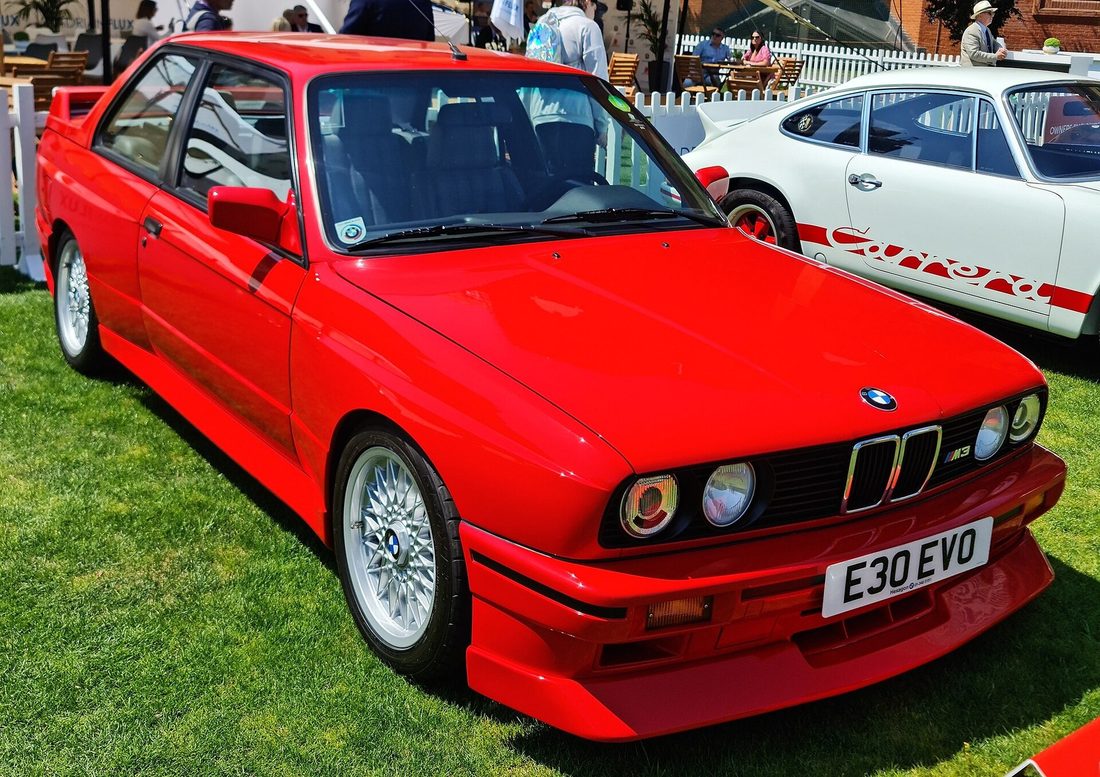
EvolutionEvolution II is where the changes became visible. Compression went from 10.5:1 to 11.0:1 with revised cams and pistons, a more efficient intake and a lightened flywheel, for 220 hp and 181 lb-ft, on a 3.15 final drive. Outside, a deeper front air dam with brake cooling ducts in place of the fog lights, and a rear spoiler with an added trailing flap. Inside, silver cloth with matching leather bolsters and a numbered dash plaque out of 500. Three colours only, Misano Red, Macao Blue metallic and Nogaro Silver metallic, with white cam covers carrying the tri-colour Motorsport logo and 7.5x16 inch wheels standard (source: e30zone.net/e30wiki/index.php/M3, en.wikipedia.org/wiki/BMW_M3_(E30)).
Sport Evolution, sometimes called Evolution III, is the collector car. The engine went to 2,467 cc on a 95 mm bore and roughly 87 mm stroke for 238 hp at 7,000 rpm, with oil-spray nozzles under the pistons, a black cam cover and red plug leads. Outside: enlarged bumper openings, a multi-position adjustable front splitter and an adjustable rear wing, brake cooling ducts, wider and reprofiled front fenders, a redesigned grille, 10 mm lower ride height and a deliberately smaller 62-litre tank. Deleted for weight: power windows, sunroof, on-board computer, air conditioning, interior lights and grab handles. Inside, Recaro seats with integrated headrests in Anthracite M cloth, suede wheel, shift knob and handbrake, red M-logo seatbelts, and two colours only, Jet Black with red bumper stripes or Brilliant Red with black (source: e30zone.net/e30wiki/index.php/M3). List price was 85,000 DM (source: de.motor1.com/news/795957/bmw-m3-sport-evolution-1990/). The deletions were not absolute: the record-setting car sold in July 2026 left the factory with a sliding roof, electric windows and air conditioning restored to order (source: rmsothebys.com/auctions/wp26/lots/r0021-1990-bmw-m3-sport-evolution/). Compression is disputed at 11.0:1 or 10.2:1, so verify before machining anything.
Europameister 88 came in Macao Blue metallic only, with silver extended Nappa leather and pleated door panels, 7.5x16 inch wheels, green-tinted screen, power windows and a console plaque signed by Roberto Ravaglia, at 195 hp (source: e30zone.net/e30wiki/index.php/M3). The Johnny Cecotto was the first car with the 215 hp catalyst engine, identified by a body-colour valve cover, with Evolution II spoilers, thinner rear glass, chrome tailpipes, black-centred 16 inch wheels, on-board computer II and a numbered plaque carrying Cecotto's signature. The 80 Swiss cars ran 211 hp and were not individually numbered despite carrying the plaque (source: e30zone.net/e30wiki/index.php/M3, en.wikipedia.org/wiki/BMW_M3_(E30)). The Roberto Ravaglia edition was the UK-market equivalent at 215 hp, reported as 16 Misano Red, 9 Nogaro Silver and 1 Macao Blue (source: e30zone.net/e30wiki/index.php/M3).
The convertible was the first cabriolet in M history, at 195 hp on launch (200 hp without catalyst) and 215 hp as standard from September 1989, with a quoted 1,360 kg, roughly 160 to 195 kg more than a coupe (source: bmw-m.com/en/topics/magazine-article-pool/bmw-m3-e30-convertible.html, supercarnostalgia.com/blog/bmw-e30-m3). One history states convertibles used the 220 PS engine and were rarely catalysed, which contradicts the better-supported 195-then-215 sequence (source: ateupwithmotor.com/model-histories/bmw-e30-m3). No convertible was sold new in the United States.
2.8 Establishing what is actually in front of you
Work this in order. Each step either confirms the last or exposes it.
1. The claimed stage. Get the seller to name the variant and the market before you look at anything, then test the claim rather than the car. Most misdescription here is optimistic drift, a late standard car called an Evolution because it wears Evolution II spoilers, rather than deliberate fraud.
2. Output consistent with that stage. The ladder is 195 PS catalysed, 200 PS non-catalysed, 215 PS from September 1989 and on the Cecotto and Ravaglia cars, 211 PS on Swiss Cecottos, 220 PS on the Evolution II and 238 hp on the Sport Evolution. A car cannot be a 215 hp European standard coupe and a 1987 build, and it cannot be an Evolution II at 195 hp. Note too that a catalysed Evolution II gives away most of its advantage over a late standard car, so paperwork matters more here than the seat-of-the-pants impression.
3. Displacement. Only the Sport Evolution is 2,467 cc; everything else is 2,302 cc. That is the one variant question a measurement settles outright, and a 95 mm bore against 93.4 mm is a large enough difference to confirm at the head. A 2.0-litre S14B20 exists, but it belongs to the Italian and Portuguese 320iS, so a 1,990 cc car is not an M3 at all.
4. The engine number. Check it against the car's own documentation, then against what the claimed stage requires. This is the step people skip, and it separates a matching-numbers car from a good rebuild on a replacement block. The cluster chip is engine-coded on this car, so a cluster that does not belong points the same way.
5. The final drive and the gearbox. North American cars run a 4.10 final drive with the wide-ratio overdrive box and its conventional H pattern. European cars run 3.25, or 3.15 on the Evolution II and Sport Evolution, with the close-ratio dogleg box, first down and to the left, and a direct 1:1 fifth (source: e30zone.net/e30wiki/index.php/M3, en.wikipedia.org/wiki/BMW_M3_(E30)). Sit in the car and find first gear before you accept anything a seller says about market. A limited-slip differential at 25 percent lock is standard across the range, so its absence is a question, not a specification.
6. The market tells. US cars carry the catalysed engine, bumper-mounted side markers, a third brake light, a 160 mph speedometer, different headlights, and from September 1989 build a driver airbag with knee bolster. Canadian cars have metric instruments and heated seats in all years, with the airbag optional and absent on 1990-91 cars (source: e30zone.net/e30wiki/index.php/M3, supercarnostalgia.com/blog/bmw-e30-m3). US original panels carry VIN stickers, which is a fast originality check on a car claimed to be unrepaired.
7. The documentation, which decides the money. The WBS VIN prefix marks BMW Motorsport GmbH production, with a believed 164 early European non-catalyst cars carrying a regular WBA prefix instead (source: bmwmregistry.com/model_faq.php?id=8). WBSAK prefixes appear on both US cars, under type code AK03, and on European coupes, since an Evolution II sold at auction carried WBSAK010002191882 (source: en.wikipedia.org/wiki/BMW_3_Series_(E30), cars.bonhams.com/auction/29264/lot/129/1988-bmw-e30-m3-evolution-ii-vin-wbsak010002191882/). A complete AK01 / AK03 / AK05 map by market and body style could not be sourced for this book, so do not let anyone reconstruct one for you from guesswork. Two tools do settle provenance. A BMW Classic birth certificate gives factory build data for a specific chassis, as it did for the July 2026 record car, dating final assembly to 20 February 1990. And Mflight Europe e.V. publishes a free online register of all 17,970 chassis numbers with each car's full factory option list, searchable for special equipment, so a claimed Cecotto or Evolution can be checked against the factory record before money moves (source: m-flight-europe.com/en/bmw-register-der-sondermodelle-en-translation/). Finally, the plaques: numbered and signed, the Evolution II out of 500 and the Cecotto out of 505. Variant-specific trim and badging are precisely the parts nobody reproduces, so an edition car missing them is missing value you cannot buy back.
2.9 The market in 2026
The standard coupe averages 75,745 dollars, with a practical trading range from about 65,000 dollars for a high-mileage driver to over 200,000 dollars for a low-mileage, original-paint car with full BMW service history (source: classic.com/m/bmw/3-series/e30/m3/coupe/, classiccarsarena.com/qa/bmw-m3-e30-value-2026). Hagerty puts a 1988 M3 in #3 Good condition at 67,600 dollars, up 5 percent (source: hagerty.com/valuation-tools/bmw/m3/1988/1988-bmw-m3). The US public benchmark remains an 8,000-mile 1988 coupe at 250,000 dollars hammer, 255,000 with commission, on Bring a Trailer (source: thedrive.com/news/35045/this-e30-bmw-m3-just-sold-for-250000-on-bring-a-trailer-your-brain-is-now-on-fire).
Convertibles average 114,109 dollars, highest recorded sale 152,760 pounds, so scarcity has inverted the usual coupe-over-cabriolet hierarchy (source: classic.com/m/bmw/3-series/e30/m3/convertible/, theclassicvaluer.com/cars/bmw/3-series-(e30)-m3-convertible). Sport Evolutions are a separate market: median 155,601 pounds, low 75,040, high 404,375 across 24 recorded sales at an 80 percent sell-through rate, with recent results of 404,375 pounds at RM Sotheby's UK in July 2026, 284,596 in Germany in October 2025 and 75,040 through PistonHeads in April 2025 (source: theclassicvaluer.com/cars/bmw/3-series-(e30)-m3-sport-evolution). That July 2026 car, lot 108 at Woodcote Park, was a Jet Black matching-numbers example with 4,503 km (2,798 miles) that beat its estimate by more than 100,000 pounds, reported variously as roughly 520,000 and 542,000 dollars depending on the exchange rate applied (source: rmsothebys.com/auctions/wp26/lots/r0021-1990-bmw-m3-sport-evolution/, news.dupontregistry.com/blogs/bmw-news/542k-e30-bmw-m3-sport-evolution-sets-new-auction-world-record). Liquidity is high throughout: average days on market for well-priced E30s runs 18 to 25 days, with desirable specifications gone in under 14 (source: automonitor.io/blog/e30-m3-for-sale/).
Set against launch prices of 58,300 DM in Germany and about 34,000 dollars for the better-equipped US car (source: ateupwithmotor.com/model-histories/bmw-e30-m3), the multiples are extreme: a 35,000-dollar 1988 US coupe at 255,000 dollars is roughly seven times nominal, and a Sport Evolution bought at 85,000 DM reaching 404,375 pounds is far beyond that. The lesson runs through this whole book. The spread between a tired car and a documented one is now wider than the cost of almost any repair, which is why the identification sequence above is not pedantry. It is the highest-value hour you will spend on the car.
Glossary
- Abs
- Anti-lock braking system, standard on the E30 M3, which releases and reapplies brake pressure many times a second to stop a wheel locking and skidding under heavy braking.
- Caster
- The forward or rearward tilt of the steering axis seen from the side of the car. More caster increases straight-line stability and self-centring effort; it is set by suspension geometry rather than adjusted like toe.
- Dexron Iii
- An automatic transmission fluid specification. It matters here because some Getrag gearboxes carry an orange label calling for ATF rather than gear oil, and filling one with the wrong fluid is an expensive mistake.
- Din
- The German standard for measuring engine output, quoted in PS. It is measured differently from the American SAE standard, so the same engine reads as a different number in each, which is why one M3 can honestly be described as both 200 PS and 197 hp.
- Dme
- Digital Motor Electronics, BMW's name for the engine control unit. In everyday use it also names the main engine relay that feeds it, which is why a fault described as a DME relay is usually about the relay and not the computer.
- Dogleg
- A gearbox layout placing first gear down and to the left, outside the normal H pattern, so the second-to-third change becomes a straight fore-and-aft movement. Racing practice, inherited by the road car.
- Drag Coefficient
- A dimensionless measure of how easily a shape moves through air, written Cd. Lower is slipperier. The M3's aerodynamic bodywork took it from a standard E30's 0.38 to 0.33.
- Evolution
- A homologation upgrade sold in limited numbers so that its changes became legal for racing. The E30 M3 had three: Evolution I, Evolution II, and the 2.5 litre Sport Evolution.
- Getrag 265
- The close-ratio five-speed manual gearbox fitted to the E30 M3, built by the German transmission maker Getrag and carrying a dogleg first gear. Sources disagree over whether some cars carry the closely related 260.
- Gl-4
- An API gear-oil service rating suited to manual gearboxes. It is deliberately less aggressive than GL-5, which contains more sulphur-phosphorus additive and can attack the yellow metals used in some synchromesh components.
- Group A
- The FIA touring-car category the E30 M3 was built to contest. Its rules required at least 5,000 road cars a year sharing the racing car's suspension geometry, fender width, aerodynamics, engine block and cylinder head, with displacement between 1,600 and 2,500 cc.
- Homologation
- The process of certifying that a model meets a racing category's rules, including its minimum production requirement, before the racing version may compete.
- Homologation Special
- A road car built in the minimum numbers a racing rulebook demands, so the manufacturer can go racing. The E30 M3 is the defining example: its flared arches, raised rear window and bonded screens are competition requirements sold to the public.
- Jacking Point
- The reinforced spot in the sill designed to take a jack or a lift arm. On a car of this age their condition is also a useful proxy: rotten jacking points mean the sill and floor structure around them is compromised.
- Kerb Weight
- The weight of the car with all fluids and a full tank of fuel but without driver, passengers or luggage. Because market equipment varies so much on this model, published kerb weights span nearly 200 kg.
- Leak-Down Test
- A compression-related test in which each cylinder is pressurised with air and the rate of loss measured, and the escaping air listened for, which shows not only that a cylinder is weak but whether it is losing through valves, rings or head gasket.
- Limited-Slip Differential
- A differential that resists a large speed difference between the driven wheels, sending torque to the wheel with grip rather than spinning the unloaded one. The E30 M3 uses a clutch-type unit with 25 percent lock.
- Motronic
- Bosch's integrated engine management system, combining fuel injection and ignition control in a single unit. The E30 M3 uses Motronic ML1.3, in which the ECU controls ignition timing entirely rather than leaving it to mechanical advance.
- Overdrive
- A gear ratio numerically below 1.00:1, so the output shaft turns faster than the input, lowering engine speed at a cruise. The E30 M3's fifth gear is not one, which is part of why the car feels busy at motorway speeds.
- S14
- The BMW Motorsport four-cylinder built for the E30 M3: an M10-derived cast-iron block under a four-valve aluminium twin-cam head developed from BMW's six-cylinder racing head, with solid shim-adjusted valve buckets and individual throttle butterflies.
- Scuttle
- The structural area across the base of the windscreen housing the heater intake and wiper mechanism. Water collects here by design and is meant to drain away.
- Scuttle Drain
- The drain path, including a rubber one-way valve in the engine bulkhead, that carries water out of the scuttle. When it blocks, water backs up onto the battery tray, which is the actual root cause of most battery-tray and bulkhead rot on these cars.
- Semi-Trailing Arm
- The E30's rear suspension layout, each wheel carried on an arm pivoting at an angle between fully trailing and fully transverse, so camber and toe change as the suspension moves.
- Shim
- A precisely ground disc used to set valve clearance on an engine without hydraulic adjustment. The S14 uses 33 mm shims from 3.00 to 4.25 mm in 0.05 mm steps, swapped to bring each valve back into specification.
- Si Board
- The service interval board, the small circuit board in the instrument cluster that drives the service indicator lights. Its onboard batteries eventually die, at which point the service lights behave erratically and the cluster needs the board reworked.
- Smc
- Sheet moulding compound, a glass-reinforced plastic composite. BMW used it for the M3's boot lid and, on some cars, other panels, so parts of this car's bodywork are not steel and cannot be repaired as though they were.
- Solid Lifter
- A valve-train follower with no hydraulic self-adjustment, so clearance must be measured and reset by hand on a schedule. The S14's solid, shim-adjusted buckets are the single fact that most shapes ownership of this car.
- Subframe
- The bolted-in structural frame carrying the rear suspension and differential. On the E30 M3 it is a known crack point, because S14 vibration and stiffer engine mounts load a section BMW never thickened.
- Tensioner Rail
- The sprung guide bearing against the timing chain to keep it taut. It wears, and a worn one is the usual reason for chain rattle on a cold start.
- Valve Seat Recession
- Progressive hammering of the valve seat deeper into the cylinder head, which closes up valve clearance further and eventually holds valves off their seats. It is why S14 clearances drift tight rather than loose, and why neglect ends in burnt valves rather than merely a noisy engine.
- Ventilated Disc
- A brake disc cast as two friction faces separated by internal vanes, so air is pumped through the middle as it turns and heat escapes faster than a solid disc allows. The M3's front discs are ventilated, its rears solid.
- Viscous Fan Clutch
- A temperature-sensitive coupling driving the engine fan through silicone fluid, so the fan freewheels when cool and drives hard when hot. A failed one stops moving air at idle, which on this engine risks the overheat that cracks the head.