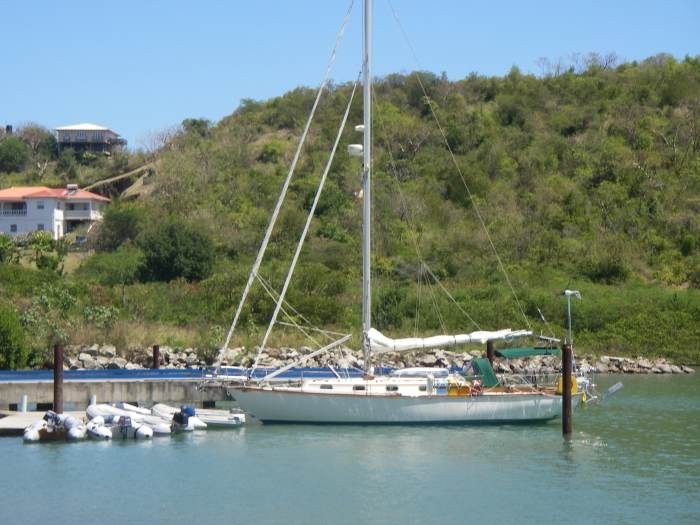
Cape Dory 30
About This Book
This chapter tells you what you are holding, what it can and cannot do for you, and how to make sure the boat in your slip is actually the boat this book describes. Read it first. The Cape Dory 30 wears its name loosely: at least three very different boats have carried some form of "Cape Dory 30" badge, and the internet cheerfully mixes their specifications together. Ten minutes spent here will keep you from ordering the wrong part, chasing the wrong engine, or trusting a number that belongs to a different hull.
1.1 Welcome aboard
You own, or are about to own, one of the most quietly respected small cruisers ever built in America. The Cape Dory 30 is a Carl Alberg design: long overhangs, a narrow 9-foot beam, moderate-to-heavy displacement, and a full keel with the rudder hung on its trailing edge. Cape Dory Yachts built it in East Taunton, Massachusetts, from 1976 to 1986, roughly 363 to 367 hulls in all (source: practical-sailor.com; goodoldboat.com). It was the largest boat in the Cape Dory line when it launched, and it earned a reputation the numbers back up: a heavily built, sea-kindly pocket cruiser that owners have taken offshore, including across the Atlantic.
This book is a working owner's reference, not a brochure and not a sales pitch. It is organized so you can find what you need fast: identity and specifications, systems, known issues and what surveyors look for, maintenance, the engine, and where to source parts and community help. It is written to be honest with you. Where the boat is excellent, this book says so. Where it has a genuine weakness or a design compromise, it says that too, with a source, so you can decide for yourself.
One thing this book is not: a substitute for the boat's own paperwork. Cape Dory changed engines, rigs, steering, tank plumbing, and backing-plate materials across a long production run, and forty-plus years of owner refits mean no two Cape Dory 30s are identical. Everywhere in these pages you will see the phrase verify against your vessel. Take it seriously. Your hull's original owner's manual, its engine plate, and a good surveyor outrank any general statement printed here.
1.2 Correcting the record, up front
Before you read another word about your boat anywhere, unlearn three things that circulate as "common knowledge" and are wrong for the original Cape Dory 30.
It is not fundamentally a masthead sloop. The signature rig of the Cape Dory 30 is a ketch on the early boats, replaced by a cutter as the standard offshore rig later in production, with a sloop available as an option. All three are masthead rigs, and you will absolutely find sloop-rigged CD30s on the market. But the boat's identity rig, the one that defines its look and its sail-handling, is the ketch-then-cutter lineage, not the sloop. The sources do not fully agree on which rig was the "standard" boat in a given year: one review treats the sloop as the base boat, others treat the ketch and then the cutter as standard (source: practical-sailor.com; goodoldboat.com). The safe reading, and the one this book follows: do not assume the rig. Identify which one your hull actually carries before you buy sails, price rigging, or plan a repower, because a cutter adds a staysail stay, a bowsprit, a bobstay, and often running backstays that a sloop simply does not have.
Its engine is small, and probably not what the badge suggests. The typical Cape Dory 30 diesel is a Volvo Penta MD7A, a 13-horsepower two-cylinder fitted from 1977, or a two-cylinder Universal diesel on late (1983-plus) boats, with the earliest hulls carrying a single-cylinder Yanmar of about 12 horsepower that most owners consider underpowered (source: practical-sailor.com). If you have seen this boat listed with a Volvo MD11C or MD17C, treat that with suspicion: those are larger engines (roughly 23 and 36 horsepower) that suited bigger Cape Dorys or that arrived in a CD30 as a repower. Read the plate on your own engine. The engine that is actually bolted under your cockpit governs your parts strategy, and this book's engine chapter is written around the MD7A, the Universal, and the common repower paths, not around a spec sheet.
Its ballast is lead, and it is encapsulated. The Cape Dory 30 carries roughly 4,000 pounds of lead cast into the keel cavity and glassed over, an encapsulated ballast arrangement with no keel bolts (source: practical-sailor.com; bolsadenavegantes.net). That is good news you should not talk yourself out of: there are no keel bolts to corrode or re-torque, and because the ballast is lead rather than iron, water intrusion from a grounding is less destructive than the rust-jacking that plagues iron-ballast boats.
1.3 Signature Cape Dory: how to know you are looking at the real thing
The Cape Dory 30 has a handful of construction traits that, taken together, are unmistakable. Use them to confirm identity and to set your expectations for ownership.
- Bronze everything, by Spartan Marine. The opening ports, deck hardware, and below-waterline seacock fittings are cast bronze from Cape Dory's sister company, Spartan Marine, not the chromed zinc or stamped stainless of its contemporaries (source: practical-sailor.com; islandinstitute.org). This is the boat's charm and its durability, and, as the known-issues chapter details, its single biggest recurring maintenance item.
- Solid hull, cored deck. The hull is solid hand-laid fiberglass with no reported structural failures. The deck, cabin trunk, and cockpit are molded as one piece over an end-grain balsa core (source: practical-sailor.com; goodoldboat.com).
- Full keel, attached rudder. The keel-hung rudder hangs off the aft end of the full keel on bronze gudgeon fittings and a heel shoe, protected and robust, and it makes the boat track beautifully and back down under power unpredictably. Both are true.
- Deck-stepped aluminum mast. A simple untapered aluminum spar sits on the cabintop, its load carried below by a compression post inside the cabin (source: practical-sailor.com).
- Traditional Alberg looks. Spoon bow, long counter, low freeboard, and a lot of exterior teak. The teak is part of the price of the looks.
1.4 Know your hull: a first-day checklist
Before you dig into any other chapter, settle these facts about your specific boat and write them down. Everything else in this book keys off them.
- Hull number and model year. Confirm it is the original Alberg Cape Dory 30 (1976 to 1986), not the Cape Dory 30 Mark II, an entirely different, non-Alberg hull introduced in 1986 that is longer on the waterline and about a foot and a half wider (source: goodoldboat.com). Sources constantly conflate the two. If a "fact" mentions a Westerbeke engine or 70 gallons of water, it likely belongs to the Mark II, not to you.
- Rig. Ketch, cutter, or sloop? Count the masts and look for an inner forestay and bowsprit. This drives sails, rigging, and repower fit.
- Engine. Read the plate. Yanmar single, Volvo MD7A, Universal two-cylinder, or a modern repower (Beta, Yanmar, Universal)? Note whether it drives through a V-drive under the cockpit, which is common and gives famously poor service access.
- Steering. Early boats used a worm-gear steering pedestal with no feedback; later boats used a cable-and-wheel pedestal; many have been converted to a tiller (source: practical-sailor.com). Steering type on a CD30 is not reliably tied to year, so check.
- Refit history. Ask what has been rebedded, repowered, re-rigged, and re-plumbed, and get dates. On a boat this age, documented work is worth real money.
1.5 Check these first
Four items come up on nearly every un-refit Cape Dory 30 and are worth eyeballing before anything else. Each gets full treatment in the known-issues and maintenance chapters; this is only the short list.
- Bronze port and hardware bedding. Look under every port and deck fitting for water staining inside. Original silicone bedding fails and, worse, corrodes the bronze it touches; budget rebedding on essentially any boat that has not had it done, though the exact service life is undocumented (source: capedory.org owner reports).
- Deck core moisture. Expect a surveyor to tap and moisture-meter around every chainplate, stanchion, winch, and the mast step, where water enters the balsa core (source: practical-sailor.com; goodoldboat.com). Localized wet readings are common and usually a contained repair, not a whole-deck recore.
- The hull-to-deck joint. The hull-to-deck joint is not through-bolted along its full length, which is the reviewers' single biggest construction reservation on an otherwise heavily built boat (source: practical-sailor.com). In service the joint has generally held up well; inspect the toerail and joint for leaks and any movement.
- The bilge-draining head and icebox. On the original boats the head sink, the shower, and the icebox all drain into the bilge, an arrangement the reviewers call unacceptable (source: practical-sailor.com). Check the bilge for gray-water odor and whether a previous owner has retrofitted a proper sump.
Two safety notes belong on this same first pass, because they surprise people: the seacock fittings must be greased and exercised or the tapered plugs seize, and a seized seacock is a sinking risk (source: capedory.org); and the lifeline stanchions are only 24 inches tall, a genuine limitation to respect on a boat with an offshore reputation (source: practical-sailor.com).
1.6 A word on liability, in plain language
This book is a reference, assembled from published reviews, owner-community knowledge, and manufacturer material, all cited so you can check it yourself. It is not a survey, not a repair authorization, and not a warranty. Boats are heavy, they float on water, and their systems can hurt you: rigging under load, through-hull fittings, fuel, shore power, and lifting gear all deserve respect and, in most cases, a qualified professional. Nothing here replaces a hands-on inspection of your boat by a competent marine surveyor, a licensed marine electrician for any AC work, or a rigger for anything holding your mast up. Where this book flags a safety-critical item, it is telling you where to look, not certifying that your particular hull is sound. Verify against your vessel, and when in doubt, hire the expert. Used that way, the Cape Dory 30 will reward you for decades, exactly as it has rewarded the owners whose hard-won knowledge fills these pages.
History & Identity
The Cape Dory 30 is a small, heavy, honest boat built the old way, by a company that made its own bronze because it could not buy hardware good enough to suit it. It came from the drawing board of Carl Alberg, one of the last great practitioners of the long-overhang, full-keel cruising type, and it wore the trademark Cape Dory look: spoon bow, long counter, narrow beam, and cast bronze ports that will outlast the boat. It was the biggest boat Cape Dory built when it launched in 1976, and for the next decade it carried couples across oceans. To understand the one in front of you, you need to know who drew it, who built it and how, how its rig changed partway through the run, and, above all, how to tell it apart from a small crowd of similarly-named boats that are not the same boat at all.
Let's take those in order.
2.1 Carl Alberg and the shape of the thing
Before it was a Cape Dory, the CD30 was an idea about hull form, and that idea belonged to Carl Alberg, a Swedish-American naval architect who trained in the John Alden design office in Boston. Alberg spent his career drawing a particular kind of boat: moderate-to-heavy displacement, narrow beam, long overhangs fore and aft, and a full keel running the length of the underbody with the rudder hung on its trailing edge. It is a conservative, traditional, sea-kindly shape, and it is the visual and structural signature of nearly every sailboat Cape Dory built.
The CD30 is a textbook example. It carries a full keel with an attached rudder (you will also hear this called a keel-hung rudder), meaning the rudder is bolted to the aft end of the keel rather than hanging free on its own post the way a modern fin-keel boat's spade rudder does. On the CD30 the blade sits about two feet further forward than a comparable spade rudder would, tucked into the keel's trailing edge where it is protected from grounding, snagged lines, and floating debris. That arrangement is robust and forgiving, and it comes with a well-known trade you will meet the first time you try to back the boat into a slip: a full-keeler like this tracks beautifully in a straight line and steers unpredictably in reverse. That is not a defect. It is the shape doing what the shape does.
Everything else about the boat follows from Alberg's philosophy. The narrow 9-foot beam, the long ends that stretch the 22.83-foot waterline out to a 30.2-foot length overall, the heavy displacement, the low, easy motion in a seaway: these are all deliberate. Alberg was not chasing interior volume or light-air speed. He was drawing a boat that would look after its crew when the weather turned bad. Whether that trade suits you is a question this book will keep coming back to honestly, but it was never an accident.
2.2 Andrew Vavolotis and Cape Dory Yachts
The company that built your boat was the work of one man: Andrew Vavolotis, usually called Andy, who founded Cape Dory Yachts in 1963 in Bridgewater, Massachusetts, and later moved it to a large plant in Taunton and East Taunton, Massachusetts, where the sailboat line was built. Over roughly twenty-eight years the company produced more than 2,800 sailboats ranging from 22 to 45 feet, most of them to Alberg designs, and that consistency of designer is exactly why a marina full of Cape Dorys all look like siblings. The 2,800 figure is commonly cited but round, so treat it as an order of magnitude rather than a precise count.
The detail that most defines Cape Dory as a builder, and the CD30 as a boat, is the bronze. Vavolotis could not buy deck hardware and ports that met his standards, so he built a hardware subsidiary, Spartan Marine, to cast and machine his own. That vertical integration is why a CD30's opening ports, cleats, chocks, turnbuckles, and seacocks are cast bronze rather than the chromed zinc, stamped stainless, or plastic you find on most production boats of the era. By 1984 Spartan was operating out of the 142,000-square-foot East Taunton factory. The bronze is heavy, it is not always beautifully finished, and it is, in the words of one long-running review, "good stuff that will last the life of the boat and then some." When people talk about a Cape Dory being overbuilt, the Spartan bronze is a large part of what they mean, and you will meet it again in nearly every chapter of this book.
The company did not survive the way the boats did. Around 1991 Cape Dory ceased boatbuilding in New England; the name and most of the powerboat designs were sold off, while Vavolotis moved the remaining sailboat operation and the Spartan Marine hardware line to Robinhood, Maine, where Robinhood Marine Center continued limited building and became the de facto factory service point. Sources vary on the exact 1991 date. What matters to you as an owner is that the successor yard and Spartan both still exist, still hold institutional knowledge of these boats, and still cast genuine bronze parts, which is a remarkable thing for a brand that stopped mainstream production more than thirty years ago. The parts and community chapter covers how to reach them.
2.3 How the boat was built
The CD30's construction is a real part of its identity, so it is worth stating plainly what you are actually standing on.
The hull is solid, hand-laid fiberglass, a thick single-skin laminate with no coring below the waterline. Reviewers who have surveyed these boats report no pattern of structural hull failures and describe the layup as robust. The deck, cabin trunk, and cockpit are molded as one piece with an end-grain balsa core, which is the standard construction of the era and carries the standard caution: a cored deck stays sound only as long as water is kept out of it, so on any un-refit CD30 you inspect around every through-deck fitting for a wet core. The known-issues chapter treats that in full.
The ballast is lead, roughly 4,000 pounds of it, cast into the keel cavity and glassed over rather than bolted on. That encapsulated ballast gives a ballast-to-displacement ratio right around 40 percent, and it carries a genuine advantage: there are no keel bolts to corrode, re-torque, or fail, and no keel-to-hull joint to weep or "smile." Because the ballast is lead rather than iron, even a grounding that breaches the encapsulation does not bring the expansive rust-jacking that plagues iron-ballasted boats. A dry, ungrounded CD30 keel is one of the lowest-worry keels afloat.
The one construction criticism that recurs in the reviews concerns the hull-to-deck joint, which is not through-bolted along its full length (there are bolts where the chainplates and stanchions pass through the flange, but not the closely-spaced fasteners a surveyor would prefer to see), and some deck hardware that was bedded on washers rather than proper backing plates. It is worth knowing about, and it is covered in the survey chapter. In practice the field record of these joints has been good, so the fair framing is that the method is dated while the service history is reassuring.
Pull the numbers together and you get a coherent picture. The displacement/length ratio works out to about 375, firmly in the "heavy displacement" band. The sail-area/displacement ratio is a modest 15, which tells you this is not a light-air flyer. The comfort ratio comes out around 33, meaning an easy, sea-kindly motion, and the capsize screening formula value is about 1.67, comfortably under the 2.0 line that is generally treated as the threshold for offshore suitability. Every one of those numbers points the same direction: a heavily built, moderately canvased, sea-kindly pocket offshore cruiser. That is precisely the identity Cape Dory was selling, and the numbers back the marketing.
2.4 The rig: ketch, then cutter, with a sloop option
Here is the part of the CD30's identity that trips up the most people, so it is worth getting exactly right.
The CD30 was offered as a ketch, as a cutter, and as a sloop, and the mix changed over the production run. The catalog even split the boat into rig-specific records you will see quoted: CD30K for the ketch, CD30C for the cutter. The evolution most sources describe runs like this: the early boats carried the ketch rig as the standard offering, and mid-production the more efficient cutter took over as the boat's signature offshore rig, with the ketch and the sloop remaining as options. On the water the cutter is the quicker boat, rated roughly 15 seconds per mile faster than the ketch, while the ketch is the more traditional, "shippier" looking of the two and splits its sail area into smaller, more easily handled pieces on two masts (a main plus a shorter mizzen aft).
The sources do not fully agree on which rig was the "standard" boat. Most describe the ketch as the original standard, giving way to the cutter, with the sloop as an option throughout. One well-regarded systems source instead calls the sloop the standard boat all along, with the ketch as the early-and-least-common variant and the cutter as the added offshore option. The disagreement is worth knowing about, but what every source agrees on, and what you can rely on, is that all three rigs exist, all are masthead rigs, the ketch is the early configuration, the cutter became the favored offshore rig later in the run, and the sloop was available as an option. The one thing to discard is any description of the CD30 as fundamentally a "masthead sloop," which undersells the ketch-then-cutter story that is central to the boat's character. The practical takeaway: identify which rig your specific hull actually carries before you order sails or rigging, because a cutter adds a bowsprit, an inner forestay for a staysail, and often running backstays that a sloop simply does not have, and a ketch adds an entire second mast. The systems chapter walks through each.
2.5 The auxiliary, in brief
The CD30 was a diesel-auxiliary boat throughout, with the engine tucked under the cockpit sole (many installations used a V-drive to fit it into the space, which saves room and costs you service access). The engine you are most likely to find is a two-cylinder Volvo Penta MD7A of about 13 horsepower, the common fitment from 1977 on; the earliest boats carried a single-cylinder Yanmar of around 12 horsepower that was widely considered underpowered, and later boats used a two-cylinder Universal diesel.
One point to correct up front, because it appears in some spec listings: the CD30 was not a factory Volvo MD11C or MD17C boat. Those larger Volvos (roughly 23 and 35 horsepower) belonged to bigger Cape Dorys or arrived later as repowers. If a listing for a CD30 quotes an MD11C or MD17C, treat it as a repower or a spec carried over from a larger sister, and read the actual engine plate before you believe it. Many of these boats have in fact been repowered over the decades with Beta Marine, Yanmar, or Universal replacements. The engine and propulsion chapter, which draws on the published Volvo Penta and Universal service record, covers all of this in the detail it deserves; here it is enough to fix the identity: a small, simple, hard-working diesel under the cockpit, not a big one.
2.6 Where it sits in the Cape Dory line
When the CD30 launched in 1976 it was the largest sailboat in the Cape Dory range, the boat that carried the brand upmarket from its smaller daysailers and pocket cruisers into genuine bluewater territory. It stayed in production through 1986 (a few sources stretch the last hull into 1987), and roughly 363 to 367 hulls were built over that run. The exact production total sits between 363 and 367 depending on which record you consult; either number tells you this was a successful, long-lived model rather than a rare one, and that parts and community support are correspondingly deep.
Its reputation is that of a capable bluewater pocket cruiser, and it earned it. Owners have taken CD30s offshore on serious passages, including transatlantic crossings, and the boat is widely regarded as more seaworthy in rough conditions than lighter, beamier fin-keel boats of the same length. It is also, honestly, slow in light air (that modest sail-area ratio again), cramped below by modern standards on its narrow 9-foot beam, and demanding of teak and bronze upkeep. The fair one-line verdict, the one this book stands behind, is that the CD30 is a stout, sea-kindly, genuinely offshore-capable small cruiser that rewards a sailor who values seaworthiness and craftsmanship over speed and space. Bought with that expectation it will not disappoint you. Bought expecting a roomy, quick coastal cruiser, it will.
2.7 How to tell your boat from the pretenders
More than most boats, the CD30 lives in a crowd of similarly-named and similarly-shaped vessels, and confusing them will cost you real money on parts, sails, and survey assumptions. Sort them out cleanly and keep them sorted.
The Cape Dory 30 Mark II is a different boat. This is the single most important disambiguation in the whole chapter. The Cape Dory 30 Mark II, introduced in 1986, is not an Alberg design. It is a later, in-house effort (some sources attribute it to a Robert Allen-era design) with an entirely different hull: longer on the waterline, roughly a foot and a half wider in the beam, more voluminous, and far more modern below, with a different engine (a freshwater-cooled Westerbeke) and notably better engine access. It shares only the "30" badge and the Cape Dory bronze. When you read a spec sheet, a review, or a broker's listing, confirm which "Cape Dory 30" it describes, because sources conflate the two constantly. A buyer shopping "a Cape Dory 30" is almost always looking at the original 1976 to 1986 Alberg boat this book covers, but never assume it.
The Alberg 30 is a different boat by the same designer. This one confuses people precisely because both are "Alberg 30-footers." The Alberg 30 was built by Whitby (and others) to a Carl Alberg design, but it is not a Cape Dory and it is not the CD30. Compared to the Alberg 30, the CD30 is longer on the waterline, wider, heavier, and roomier below, and the cutter-rigged CD30 slightly outperforms the sloop Alberg 30. Same designer, same era, same traditional look, different boat, different builder, different parts.
The Cape Dory 28 is the smaller Alberg sister. The Cape Dory 28 is a shorter, lighter boat on the same design principles: a full-keel Alberg cruiser one size down. Do not borrow CD30 numbers for it or the reverse.
The Cape Dory 31 and the Cape Dory Cutter are separate, later designs. The Cape Dory 31 and the "Cape Dory Cutter" marketing line (the Intrepid family) are distinct hulls, not rig variants of the 30. Their specifics are less well documented, but the rule is firm: do not treat them as the same boat.
The short version to keep in your head: your boat is the original, Alberg-designed, full-keel Cape Dory 30 built in East Taunton between 1976 and 1986, offered as a ketch, cutter, or sloop, with encapsulated lead ballast and Spartan bronze everywhere. It is not the 1986 Mark II, it is not the Alberg 30, and it is not the 28, the 31, or the Cape Dory Cutter. Get that straight and the rest of this book will line up behind it.
2.8 The bottom line
The Cape Dory 30 is a boat that outlived its company and earned its reputation the hard way, one ocean passage at a time. It is Carl Alberg's traditional full-keel type rendered in thick solid glass by a builder stubborn enough to cast its own bronze, sold as the flagship of an unusually consistent line of small cruisers. Between 1976 and 1986 something like 363 to 367 of them left the East Taunton plant, first as ketches and later as cutters, and the survivors are still crossing oceans because of exactly the choices Alberg and Vavolotis baked into them: heavy displacement, a protected keel-hung rudder, lead ballast with no keel bolts, and hardware built to last the life of the boat and then some. Understand where it came from and what it is, and everything ahead, the specs, the systems, the known issues, the maintenance, reads as the logical expression of one designer's idea of what a small boat should be able to survive.
Glossary
- Abyc
- The American Boat and Yacht Council, which publishes the voluntary safety standards most surveyors and insurers hold boats to.
- Attached Rudder
- A rudder hung directly on the aft edge of a full keel, as on a Carl Alberg design, rather than on a skeg or spade.
- Backing Plate
- A load-spreading plate (metal, thick fiberglass, or plywood) installed on the underside of a deck or hull fitting so the loads from a bolted item, such as a cleat or chainplate, are distributed over a wider area instead of concentrating at the bolt holes.
- Ballast
- Heavy material, usually lead or iron, placed low in the keel to lower the boat's center of gravity and provide the righting force that keeps a sailboat upright and counteracts the heeling force of the wind on the sails.
- Balsa Core
- A layer of lightweight end-grain balsa wood sandwiched between two skins of fiberglass to create a stiff, light composite panel used in decks and sometimes hulls. Its main vulnerability is water intrusion through unsealed fastener holes, which can rot the wood and delaminate the panel.
- Balsa-Cored Deck
- A deck built with a balsa-wood core between fiberglass skins for stiffness; it rots if water reaches the core.
- Barrier Coat
- A series of epoxy coatings applied below the waterline to seal the hull laminate against water absorption and osmotic blistering.
- Beam
- The width of the boat at its widest point.
- Bluewater
- Describing a boat or passage suited to open-ocean sailing rather than coastal waters.
- Bobstay
- A stay (wire or solid rod) from the end of the bowsprit down to the stem at the waterline, countering the upward pull of the headstay on the bowsprit.
- Bowsprit
- A spar projecting forward from the bow that carries the headstay and forward sails, lengthening the effective rig.
- Bronze
- A copper-tin alloy prized on boats for its corrosion resistance, used for ports, seacocks, and hardware on Cape Dory and similar builds.
- Burgee
- A small triangular flag flown to show membership in a yacht club or owners' association.
- Butyl
- A non-hardening butyl-rubber sealing tape used to bed deck hardware and ports so they can be removed later.
- Butyl Tape
- A soft, permanently pliable synthetic rubber sealing tape used as a bedding compound under deck hardware. It never fully cures, so it stays flexible and reusable, and it is favored for bedding fittings because it remains watertight yet allows the fitting to be removed later.
- Capsize Screening Formula
- A simple design ratio (beam divided by the cube root of displacement in cubic feet) used to gauge a boat's resistance to capsize. A value under 2.0 is generally considered acceptable for offshore use; higher numbers suggest a boat more easily knocked down.
- Chainplate
- A strong metal strap or fitting bolted to the hull or a structural bulkhead to which the standing rigging (shrouds and stays) attaches, transferring the enormous loads from the mast and rig into the boat's structure.
- Comfort Ratio
- Ted Brewer's index estimating a boat's motion comfort at sea from its displacement, beam, and waterline.
- Compression Post
- A vertical structural member beneath a deck-stepped mast that carries the mast's downward compression load through the cabin to the keel or a floor structure, preventing the deck from sagging under rig loads.
- Crevice Corrosion
- A localized form of corrosion that attacks stainless steel in tight, oxygen-starved gaps, such as under fittings or inside swage terminals, where the protective oxide layer cannot renew itself. It is a common hidden failure mode in rigging and chainplates.
- Cutless Bearing
- A water-lubricated sleeve bearing, with a grooved rubber inner surface, that supports the propeller shaft where it exits the hull; it wears out and must be replaced periodically.
- Cutter
- A single-masted sailboat that sets two headsails at once (a jib and an inner staysail), dividing the foretriangle for easier handling.
- Deck-Stepped
- A mast that sits on the deck or cabin top rather than passing through to the keel; its load is carried down by a compression post.
- Delamination
- Separation of the bonded layers in a fiberglass laminate or cored panel, often from water intrusion or impact; it shows up as soft spots or a dull sound when tapped.
- Displacement
- The weight of water a boat displaces when floating, which equals the boat's total weight. It is a fundamental measure of a vessel's size and is used in many performance and stability ratios.
- Displacement-Length Ratio
- A number comparing a boat's weight to its waterline length; the Westsail's very high value marks it as heavy.
- Displacement/Length Ratio
- A number comparing a boat's weight to its waterline length; low values indicate a light boat, high values a heavy cruiser.
- Dorade
- A boxed ventilator that admits air below while trapping and draining spray.
- Draft
- The depth of the boat below the waterline, the minimum water it needs to float.
- E
- E, the mainsail foot length, measured along the boom from the aft face of the mast to the black band (the maximum outhaul point).
- Encapsulated Ballast
- Ballast (iron or lead) sealed inside the molded fiberglass keel cavity rather than bolted on, so there are no keel bolts, but a grounding that breaches the glass can let water reach the ballast.
- Fleet
- A regional group of one class's owners who sail, race, and socialize together within a larger association.
- Foretriangle
- The triangular area at the front of the rig bounded by the mast, the forestay, and the deck. Its dimensions (I and J) define the size of the jib or genoa and are used in sail area and rating calculations.
- Full Keel
- A long keel running most of the length of the hull; it gives a trawler directional stability and protects the propeller and rudder, at the cost of maneuverability.
- Galvanic
- Relating to galvanic corrosion, the electrochemical wasting of the less-noble of two dissimilar underwater metals.
- Galvanic Corrosion
- Corrosion that occurs when two dissimilar metals are electrically connected in water (an electrolyte); the less-noble metal corrodes away, which sacrificial anodes are meant to prevent.
- Gasket
- A compressible seal between two parts that keeps out water or air.
- Gelcoat
- The pigmented resin outer layer of a fiberglass hull or deck that provides a smooth, glossy, waterproof finish and protects the underlying laminate from UV and water. It can craze, chalk, or blister with age.
- Glow Plug
- An electric heating element in a diesel that warms the air to aid cold starting.
- Gudgeon
- The fixed socket on the hull or transom that a rudder pintle drops into, forming the rudder hinge.
- Heat Exchanger
- A component in a freshwater-cooled (indirect) engine cooling system where engine coolant is cooled by raw seawater flowing through a bundle of small tubes, transferring heat without the two fluids mixing, much like an automotive radiator cooled by water instead of air.
- Hull Speed
- The theoretical maximum efficient speed of a displacement hull, roughly 1.34 times the square root of the waterline length in feet, beyond which the boat must climb its own bow wave and required power rises steeply.
- Hull-To-Deck Joint
- The seam where the separately molded hull and deck are joined and fastened, typically bedded with sealant and through-bolted or riveted. A common source of leaks and structural concern as boats age.
- Hydrolock
- Engine damage caused when water fills a cylinder; because water cannot compress, the piston stops hard, often bending a connecting rod. On boats it usually comes from seawater backing up the exhaust into the engine.
- I
- I, the rig's foretriangle height, measured from the sheer (deck level) to the top of the forestay fitting.
- Impeller
- The flexible rubber, vaned rotor inside a raw-water pump that draws seawater through the engine's cooling system. Its vanes wear and can shear off, so it is a routine maintenance-replacement item; running the pump dry destroys it quickly.
- Indirect Injection
- A diesel design that injects fuel into a pre-combustion chamber rather than directly into the cylinder; quieter but slightly less efficient.
- J
- J, the foretriangle base, measured horizontally along the deck from the front of the mast to the forestay's attachment at the bow.
- Keel-Hung Rudder
- A rudder mounted on the aft edge of a full keel, well protected and supported along its length.
- Ketch
- A two-masted rig with a smaller mizzen mast stepped forward of the rudder post.
- Kubota
- The Japanese industrial-engine maker whose diesel blocks Universal and Beta marinized, the source of cheap cross-referenced parts.
- Loa
- Length overall: the boat's total length including any bow pulpit or swim platform.
- Lwl
- Load waterline length, the hull length at the waterline, which sets a displacement boat's hull speed.
- Masthead
- The top of the mast; a masthead rig runs the forestay and backstay to the very top, as opposed to a fractional rig.
- Mixing Elbow
- A fitting at the engine's exhaust outlet where cooling raw water is injected into the hot exhaust gas, cooling the exhaust and carrying the water overboard. It is prone to internal carbon and salt buildup and corrosion, and is a common failure point requiring periodic replacement.
- Mizzen
- The shorter after mast of a ketch or yawl, and the sail set on it.
- Moisture Meter
- A handheld instrument that estimates the relative moisture content of a fiberglass laminate or cored panel by sensing its electrical properties. Surveyors use it to find wet deck core or hull areas, though readings are comparative and require experienced interpretation rather than giving an absolute wet/dry verdict.
- Neoprene
- A synthetic rubber used for gaskets, seals, and flexible fittings.
- Opening Port
- A hinged cabin window that can be opened for ventilation, as opposed to a fixed deadlight.
- Orphaned
- Describing a part or whole boat no longer supported by its original maker, so owners must find substitutes or specialists.
- Osmotic Blistering
- The formation of fluid-filled blisters in a fiberglass hull below the waterline when water gradually permeates the gelcoat and reacts with soluble compounds in the laminate, creating acidic fluid pockets. Often called boat pox, it is treated by drying, grinding, and re-laminating the affected areas.
- Owners' Association
- An organized group of owners of the same make or model who share knowledge, parts sources, and events.
- P
- P, the mainsail luff length, measured along the aft face of the mast between the black bands (the maximum hoist of the mainsail).
- Packing Gland
- The adjustable fitting that compresses packing material around the propeller shaft (or rudder post) where it passes through the hull, controlling water intrusion; also called a stuffing box.
- Pintle
- The pin on the rudder that drops into a hull-mounted gudgeon to form the rudder hinge.
- Polysulfide
- A durable, flexible synthetic-rubber marine sealant used for bedding hardware and sealing seams. It adheres well and tolerates movement, but it should not be used on most plastics (such as acrylic ports) because it can attack them.
- Pre-Combustion Chamber
- A small antechamber in an indirect-injection diesel where fuel first ignites.
- Prop Walk
- The sideways thrust a spinning propeller imparts to the stern, most noticeable in reverse, causing the stern to swing to one side. Skippers learn to anticipate and use this predictable effect when maneuvering in close quarters.
- Racor
- A common brand of fuel filter/water separator, so ubiquitous the name is used generically.
- Raw-Water Cooling
- Engine cooling that pumps seawater directly through the engine, as opposed to a closed fresh-water loop; simpler but harder on the block over decades.
- Rendezvous
- An organized gathering of owners of the same type of boat, typically an annual social and technical get-together.
- Sail Area-Displacement Ratio
- A number comparing a boat's sail area to its weight, indicating how easily it is driven.
- Sail-Area/Displacement Ratio
- A number comparing a boat's sail area to its weight, indicating how easily it is driven.
- Seacock
- A robust shutoff valve mounted on a through-hull fitting that allows a below-waterline opening (for cooling water intake, drains, or heads) to be closed, isolating the boat's interior from the sea. Marine seacocks are made of corrosion-resistant bronze or reinforced polymer.
- Sloop
- A sailboat with a single mast carrying one mainsail and one headsail (jib or genoa). It is the most common modern sailboat rig, valued for simplicity and good upwind performance.
- Stanchion
- An upright metal post at the deck edge that supports the lifelines.
- Standing Rigging
- The fixed wires or rods (shrouds and stays) that hold the mast up and in position. Unlike running rigging, it is not routinely adjusted while sailing and is a critical structural system with a finite service life.
- Staysail
- The inner headsail of a cutter, set on the inner forestay between the jib and the mast.
- Stuffing Box
- The fitting where the propeller shaft exits the hull, packed with greased flax or fitted with a seal to keep the sea out while allowing the shaft to spin; also called a packing gland.
- Sump
- The lowest bilge cavity where water collects for the bilge pump.
- Swage
- A wire terminal fitting attached by compressing (swaging) a metal sleeve tightly onto the end of a wire rope under high pressure. Swage terminals are common on standing rigging but can develop cracks or crevice corrosion over time.
- Tapered-Plug Seacock
- A traditional seacock (such as Spartan's) sealed by a tapered bronze plug that can be lapped and greased rather than replaced.
- Thru-Hull
- A fitting that penetrates the hull for an intake or discharge, normally paired with a seacock.
- Tiller
- A lever attached to the rudder head used to steer, as opposed to a wheel.
- Toerail
- The low rail around the deck edge; on many boats it is bolted through the hull-deck joint.
- Turnbuckle
- A threaded fitting at the base of a stay or shroud used to adjust rigging tension.
- V-Drive
- A transmission arrangement that folds the propeller shaft back under the engine, letting the engine sit aft over the shaft; common in tight full-keel installations.
- Waterline
- The line along the hull where it meets the water at design load.
- Worm Gear
- A steering gear using a worm-and-sector drive, as on some Westsail 32 helms.
- Worm-Gear Steering
- A steering system driving the rudder through a worm-and-sector gear, heavy and slow but very strong.
- Zinc
- The common name for a sacrificial anode, a block of zinc bolted to underwater metal that corrodes preferentially to protect propellers, shafts, and other metals from galvanic corrosion. (Also the metal leached out during dezincification of brass.)