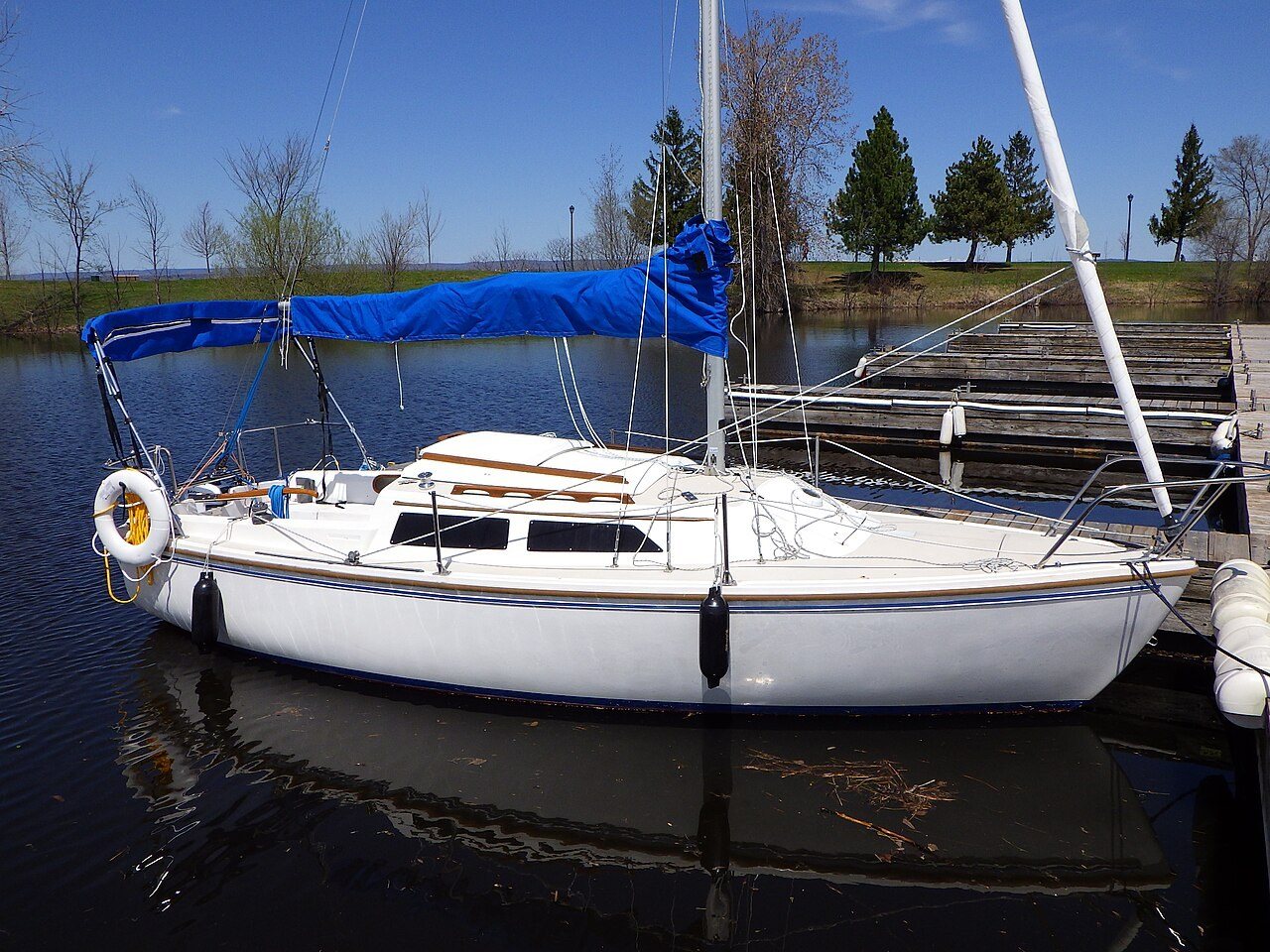
Catalina 22
About This Book
The Catalina 22 is a boat you can own with a driveway, a trailer hitch, and a modest tolerance for weekend wrenching. This book is written for exactly that owner: the person who launches from a ramp, does the work themselves, and wants straight answers about a boat that was built in the thousands and modified by nearly everyone who touched one.
More than 15,000 Catalina 22s were built between 1969 and the mid-1990s, which makes yours one of the most-produced sailboats in history (source: en.wikipedia.org). That is good news and a small headache. The good news is that parts, class support, and hard-won owner knowledge are everywhere. The headache is that "a Catalina 22" is not one boat. It is a family of closely related boats spread across twenty-five years of production, three different keels, an optional raising roof, and a great deal of previous-owner creativity. Before this book can help you maintain, repair, or upgrade your boat, you and I need to agree on which Catalina 22 you actually have.
So that is where we start. Nail down your hull, and every chapter that follows lands on the right details instead of the wrong ones.
1.1 This is a trailer-sailer, and this is a DIY book
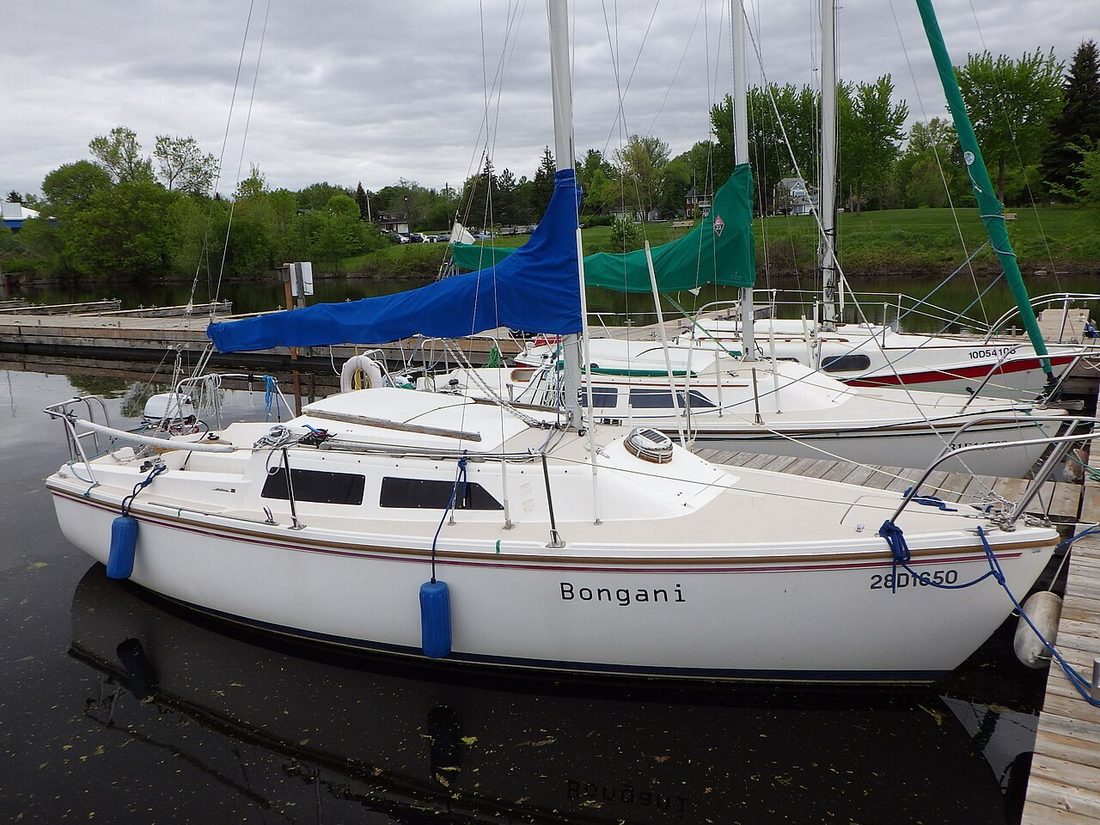
The Catalina 22 was designed by Frank V. Butler as Catalina Yachts' very first model, and its whole reason for existing was trailerability. The retracting keel and the deck-stepped mast on a pivoting tabernacle mean one or two people can rig, launch, sail, recover, and tow the boat home the same day. The full package, boat plus trailer, comes in around 2,500 lb, which "most cars" can tow, though a tow package and some caution are wise for longer hauls (source: practical-sailor.com).
That trailer-sailer nature shapes the entire approach of this book. There is no inboard engine: auxiliary power is a transom-hung outboard, and the chapter on power treats it that way. There is no paid crew and, on a boat worth what a used Catalina 22 is worth, usually no paid surveyor either. A professional survey can cost a meaningful fraction of the boat's value, so the norm on this boat is that you are the surveyor, armed with a moisture meter, a plastic mallet, and a flashlight. This book is written to put those tools in your hands rather than to send you to a yard for every job.
1.2 Step one: identify YOUR boat
There are four questions that sort out which Catalina 22 you own. Answer them before you read another chapter.
1. Which keel? (This changes everything)
Three keels were offered across the production run, and which one is bolted or hung under your hull is the single most important fact about your boat. It sets the draft, the trailer weight, the sailing manners, and, above all, the maintenance burden.
- Swing keel (also called a centerboard keel): a rough cast-iron casting of roughly 450 to 550 lb that pivots up into a trunk inside the hull. Draft is about 5.0 ft with the keel down and just 1 ft 8 in with it raised (source: en.wikipedia.org). This is the true trailer-sailer configuration, the one that "virtually created the trailer-sailer market," and it was chosen by roughly 90% of buyers (source: practical-sailor.com). It is also the one with the defining maintenance system described below.
- Fixed fin keel: a bolted-on fin drawing about 3 ft 6 in, with the best windward pointing of the three. It needs deeper water to launch and float but skips the entire swing-keel mechanism.
- Wing keel: a shoal-draft bulbed keel drawing about 2 ft 6 in, introduced with the mid-1980s redesign. It is the most forgiving on draft and the poorest at pointing. Note that it is not class-legal to retrofit a wing keel onto an older hull (source: catalina22.org).
The shorthand: swing keel launches shallowest and hauls easiest but carries the most mechanism to maintain; fin points best but wants deep water; wing splits the difference on draft. Best pointing to worst runs fin, then swing, then wing.
2. Which generation? (The naming is genuinely tangled)
Here honesty matters more than tidiness, because the sources do not agree, and anyone who tells you the generations are simple is selling something. What everyone agrees on:
- Old-style / "Mark I" / original (1969 to the mid-1980s): the classic boat, with exterior teak, a taller rig, and swing or fixed-fin keel.
- The "New Design" (from 1986, beginning around hull number 13,143): a shorter mast, the added wing-keel option, smoked-plexiglass port lights in place of aluminum-trimmed ones, a relocated forward hatch, and, importantly, a separate above-deck fuel locker (source: en.wikipedia.org).
- The 1995-onward boat with a longer cabin trunk, a beam widened about 8 in, teak eliminated, and a more spacious, cruising-oriented interior (source: sailingmagazine.net).
Where the sources fight is the "Mark" numbering. Wikipedia and Catalina's own usage call the 1995 longer-cabin boat the "Mark II." Sailing magazine instead calls the 1986 boat the "Mark II" and the 1995 boat the "Mark III." The class association sidesteps the whole argument and speaks only of "old-style" versus "new-style," with the split at the 1985/1986 model change. In this book, "Mark II" means the 1995-onward, longer-cabin boat, and the key practical dividing line for parts and inspection is pre-1986 versus 1986-on. If you are ordering parts, order by year and hull number, never by a "Mark" label alone, and verify against the boat in front of you.
3. Pop-top or not?
The pop-top, introduced in 1973, is the raising cabin roof that lifts the coachroof about 10 in on four stainless struts, taking standing headroom from 4 ft 4 in up to 5 ft 7 in at anchor (source: practical-sailor.com). Roughly 90% of boats have it. It is a genuine comfort at the dock and a genuine source of leaks, so knowing whether yours has one, and in what condition its gasket is, matters for both living aboard and keeping water out of the deck.
4. Outboard auxiliary
Your Catalina 22 has no inboard. Auxiliary power is a portable outboard on a bracket at the port quarter of the transom, typically a long-shaft motor in the 3.5 to 6 hp range on a portable 6-gallon tank (source: whichsailboat.com). One safety-relevant wrinkle of vintage: pre-1986 boats stowed the fuel tank inside the cabin, a flaw later corrected with a dedicated, vented cockpit fuel locker (source: practical-sailor.com). If you have an early boat, this is worth addressing.
1.3 The one system to check first [SAFETY]
If you own a swing-keel boat, understand this before you sail it: that half-ton of cast iron is held up and controlled by a small chain of wear parts, and every link deserves your attention. The keel pivots on a pivot pin carried in keel hanger castings, and it is raised and lowered by a wire pennant (the keel cable) running over a turning ball to a winch. The known failures are real, not theoretical: pivot holes that corrode and wallow out until the keel slops side to side; hanger bolts found sheared or missing; cables that part; and cracked, leaking keel trunks where the lock-bolt plate separates from the box. There are documented cases of swing-keel boats sinking from a failed cable and of keels tearing out the bottom of the hull (source: forums.sailboatowners.com).
The practical rule: before every launch, get under the boat on the trailer, about a foot aft of the keel's leading edge, and confirm all four hanger bolts are present, tight, and not rusted or sheared (source: forums.sailboatowners.com). Inspect the pivot, cable, eye bolt, turning ball, winch, and cable hose on a schedule. The maintenance chapter walks the whole chain in detail. This is the boat's defining system, and it is the reason a swing-keel Catalina 22 rewards an owner who inspects and neglects an owner who does not.
1.4 Know-your-hull checklist
Fill this in before going further. Every later chapter assumes you know these answers.
- Keel type: swing / fixed fin / wing (crawl under and look; do not assume).
- Model year and hull number: read the hull identification number; this settles pre-1986 versus 1986-on and orders the right parts.
- Pop-top: yes / no, and gasket condition.
- Fuel tank location: in-cabin (pre-1986) or vented cockpit locker.
- Outboard: horsepower, shaft length (long-shaft preferred), and bracket condition.
- Trailer: present and roadworthy, or not (inspect it like a second boat).
1.5 A word on liability, owner to owner
I have tried to make this book accurate, honest, and specific to the Catalina 22 you actually own. But I have never seen your boat, your keel, your rigging, or your trailer, and the figures here are drawn from decades of varied production and heavy owner modification. Treat every number as a starting point to verify against your own hull, not as gospel. Where sources disagree, I have given you the best-supported reading and told you plainly to confirm it on your own boat rather than trust a false certainty. Sailing, trailering, and working under a suspended half-ton keel carry real risk to life and property, and the responsibility for doing any of it safely rests with you. When a job is beyond your tools or your confidence, or when a safety-critical part is in question, get a qualified professional involved. This book is a knowledgeable companion for a capable owner. It is not a substitute for your own judgment, and it is not a warranty. With that understood, let us go figure out your boat.
History & Identity
The Catalina 22 is the boat that taught a generation how to go sailing. It was small enough to tow behind the family car, cheap enough to own on an ordinary paycheck, and forgiving enough to learn on without scaring anyone off the water. More than fifteen thousand of them were built, which makes it one of the most-produced sailboats in history, and it is fair to say it did more than any other single design to invent the modern trailer-sailer. This chapter is the story of where your boat came from, how it changed over roughly a quarter century of production, and why it earned the loyalty it still commands today.
2.1 One man, one hundred boats, and a very wrong guess
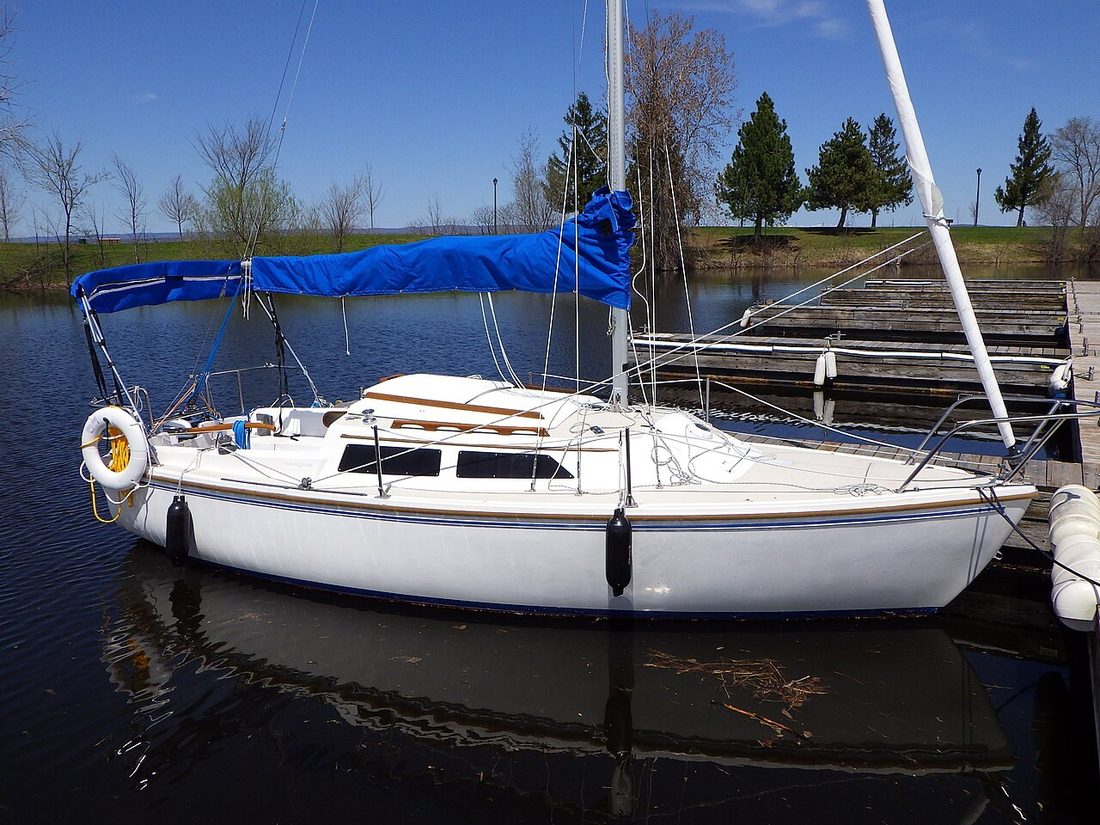
The Catalina 22 was the first model built by Catalina Yachts, and it came off the line in July 1969 in North Hollywood, California. It was designed by Frank V. Butler, the founder of the company, and by every account it was a modest bet. Butler reportedly hoped to build 100 boats "if all went well." He was wrong by more than two orders of magnitude.
By February 1975, hull number 5,000 was complete. By September 1980, hull number 10,000 rolled out, and the boat was by then being produced at plants on both the East and West Coasts of the United States, with licensed or related production also running in England, Australia, and Canada. In 1986, hull number 13,143 began a revised run that the factory called the "New Design." Somewhere around 1994 to 1995, production passed roughly 15,000 hulls. One later source states that hull number 15,000 was delivered in February 1990 rather than the mid-1990s; the milestone dates for the 5,000 / 10,000 / 13,143 hulls are well corroborated, but treat the exact date of the 15,000th boat as unverified until you can confirm it against a factory record.
The headline number itself is not fully settled. Different reputable sources put lifetime production at "more than 15,000," at "over 16,000," or at "over 15,000 units." The honest, defensible phrasing (and the one this book uses) is more than 15,000 hulls. Whichever figure is exactly right, the point is the same: this is one of the best-selling sailboats ever made, and it has been recognized as such. The design was named one of the inaugural members of the American Sailboat Hall of Fame, and it is routinely described as the most commercially successful cruising sailboat of its size.
If you own one of these boats, you are holding a piece of production history. That matters for more than bragging rights, and we will come back to why: the sheer volume is the reason parts, knowledge, and community for your boat are still, decades later, remarkably easy to find.
2.2 What made it different: the trailer-sailer idea
To understand why the Catalina 22 mattered, you have to picture the market it landed in. In 1969, a "cruising sailboat," even a small one, mostly meant a boat that lived in the water, at a mooring or a slip you paid for month after month. Sailing was something you did if you had somewhere to keep a boat.
The Catalina 22 attacked that assumption from three directions at once, and all three reinforced each other.
The first was trailerability. The boat was engineered from the start to be towed. Fully rigged for the road, boat and trailer together weigh in the neighborhood of 2,500 lb, light enough to be pulled by "most cars," though a vehicle with a tow package is the sensible choice for any long haul. The key that unlocked this was the swing keel, a cast-iron keel that pivots up into a trunk inside the hull. With the swing keel retracted, draft drops to about 1 ft 8 in, shallow enough to float the boat off a trailer at a public ramp. Practical Sailor credits the design with having "virtually created the trailer-sailer market," and that is not marketing language, it is a fair reading of what happened. Suddenly the boat did not need a slip. It could live in your driveway and sail a different lake every weekend.
The second was affordability and simplicity. One period description called it "a simple boat providing the basic essentials for first-time sailors or budget-strapped families," and that was exactly the target. There is no inboard engine to buy, winterize, or repair. Auxiliary power is a small outboard hung on the transom. The systems are few and the boat is honest about what it is. For a family stretching to afford a sailboat at all, that simplicity was the whole appeal.
The third was community and class support. This one compounds over time. Because so many were sold, an entire ecosystem grew up around the boat: an active class association, one-design racing fleets across the country, and a parts pipeline that never dried up. When you buy into a boat with 15,000 siblings, you are also buying into every question that has already been asked and answered by the owners ahead of you.
Put those three together and you get the definitive affordable trailerable. Plenty of boats have been one of those things. The Catalina 22 was all three at a price ordinary people could reach, and it arrived at the exact moment the country was ready for it.
2.3 The pop-top: the boat's signature trick
If the swing keel is the Catalina 22's defining feature under the water, the pop-top is its signature feature above it.
Introduced in 1973, the pop-top is a section of the cabin roof that lifts up on four stainless-steel pipe legs, raising the coachroof by roughly 10 inches. The payoff is headroom. With the top down, standing headroom in the cabin is about 4 ft 4 in, which means you are stooping. With the top up, it becomes about 5 ft 7 in, which for most people is the difference between crouching and standing up to cook, change, or move around at anchor. On a boat this small, that is a genuinely clever piece of design, and buyers agreed: roughly 90% of boats sold were fitted with it.
Be honest with yourself about its limits, because owners are. The pop-top is meant for use at anchor or at the dock, not underway, and raising it costs you some structure and storage. It is a fair-weather, at-rest luxury, not a sailing configuration. Later boats improved the mechanism: the Mark II switched the pop-top from pipe struts to hinges for easier operation, and the aftermarket now offers gas-spring lift kits that cut the initial lifting effort dramatically. But the basic idea has been the same since 1973, and it remains one of the most beloved quirks of the class.
2.4 The series: old-style, New Design, and Mark II
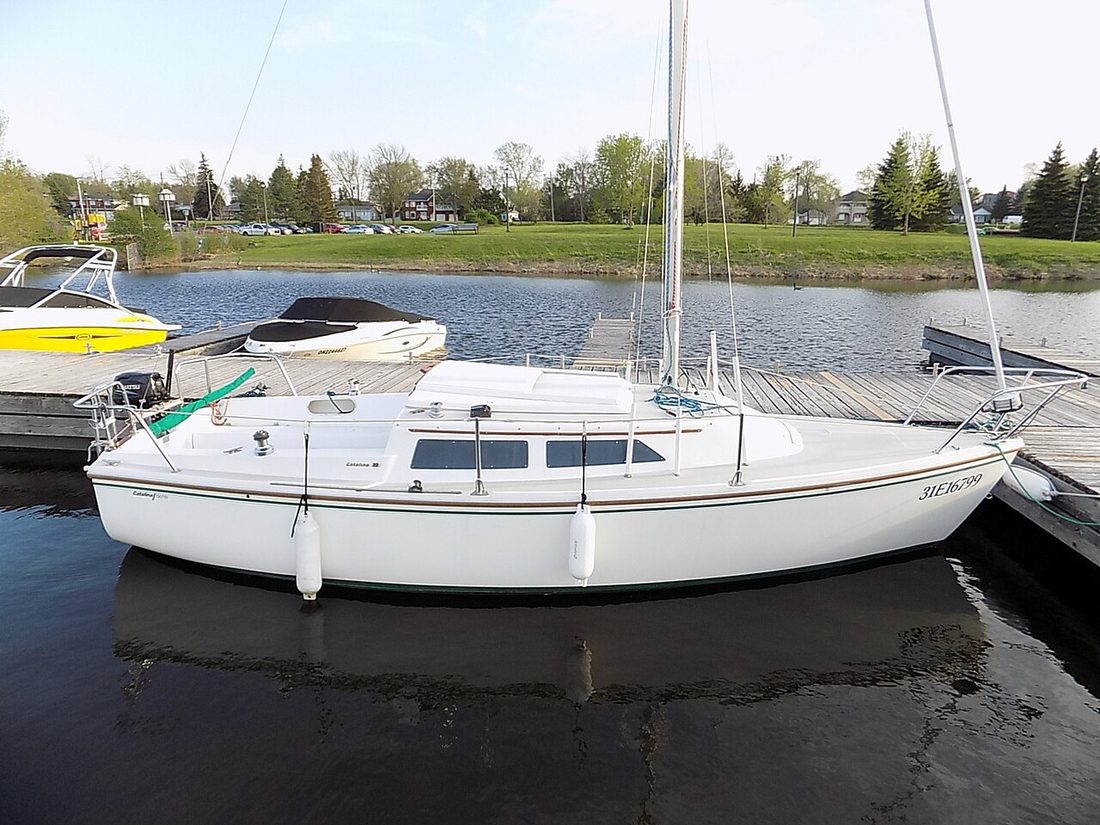
Here is where you need to slow down, because the naming of the Catalina 22's generations is genuinely confusing, and the sources do not agree with each other. The sources genuinely disagree, and rather than pretend it is settled, this book will lay it out plainly and then tell you the convention it follows.
The problem is simple: the boat evolved in stages over about 25 years, and different writers have hung different "Mark" numbers on those stages. The class association, the Catalina 22 National Sailing Association (C22NSA), avoids Mark numbers entirely and uses the plainer language "old-style" and "new-style" instead. That is arguably the safest vocabulary of all. Here is the evolution as best it can be reconciled.
The original boat (1969 to the mid-1980s). Variously called the "Mark I" or the "old-style" boat, this is the classic Catalina 22: exterior teak trim, a taller rig, and a choice of the swing keel or a fixed fin keel. This is the boat most people picture, and versions of the base hull were reportedly produced in parallel right up until 1995, which tells you the later revisions were updates to the same fundamental boat rather than clean-sheet redesigns.
The "New Design" (1986 onward, from hull number 13,143). The C22NSA calls this the "new-style" hull. The changes were meaningful but evolutionary: a shorter mast, the addition of a wing keel option (a shoal-draft keel with bulbed wings, drawing about 2 ft 6 in, offered from 1988), smoked-plexiglass port lights in place of the older aluminum-trimmed ones, interior layout changes, a separate fuel locker and battery compartment, a forward hatch relocated from the foredeck to the cabin house, and an added anchor locker. Importantly, while the rigging was revised, the sail dimensions were unchanged. This is the update that fixed one of the original boat's real flaws: early boats stowed the portable fuel tank inside the cabin, and the New Design finally gave it a proper dedicated locker.
The "Mark II" (1995 onward, around hull number 15,344). This is the longer-cabin, more cruising-oriented boat: a longer cabin trunk, beam widened by about 8 inches, exterior teak eliminated, a more modern and roomier interior, a straighter bow-pulpit rail, and a heavier overall boat. That extra weight made it less competitive in one-design racing but a more comfortable cruiser. You will sometimes see the Mark II listed with a length overall of about 23 ft 8 in in specification databases, but do not be fooled: the hull is essentially the same length as before, and the longer figure comes from the bow pulpit and anchor-roller overhang, not from a longer boat.
Now the disagreement itself, stated plainly. One well-regarded source (sailingmagazine.net) calls the 1986 boat the "Mark II" and the 1995 boat the "Mark III." Other sources, including Wikipedia and Catalina's own general usage, treat 1995 as the Mark II. The C22NSA, as noted, sidesteps the whole argument with "old-style versus new-style." This book adopts the convention that "Mark II" means the 1995-onward, longer-cabin boat, and notes the ambiguity so you are not caught out when a seller, a forum post, or a parts catalog uses the numbers differently. When it matters (and for ordering parts, it matters a great deal), do not trust the Mark number at all: use your hull number and model year, which is how the specialist vendors actually break their catalogs down.
There is one more chapter to the story, though it falls outside this book's core scope. In 2004, Catalina introduced the Catalina 22 Sport (around hull number 15,540), a reissue of the original swing-keel daysailer concept with a modern Selden spar, lighter and simpler, aimed squarely back at daysailing and one-design racing. If your boat is a Classic 22 from the 1969-to-1995 run, the Sport is a cousin, not your boat, but you will see it referenced in the community and occasionally in shared parts listings.
2.5 A racing class and a trailering culture
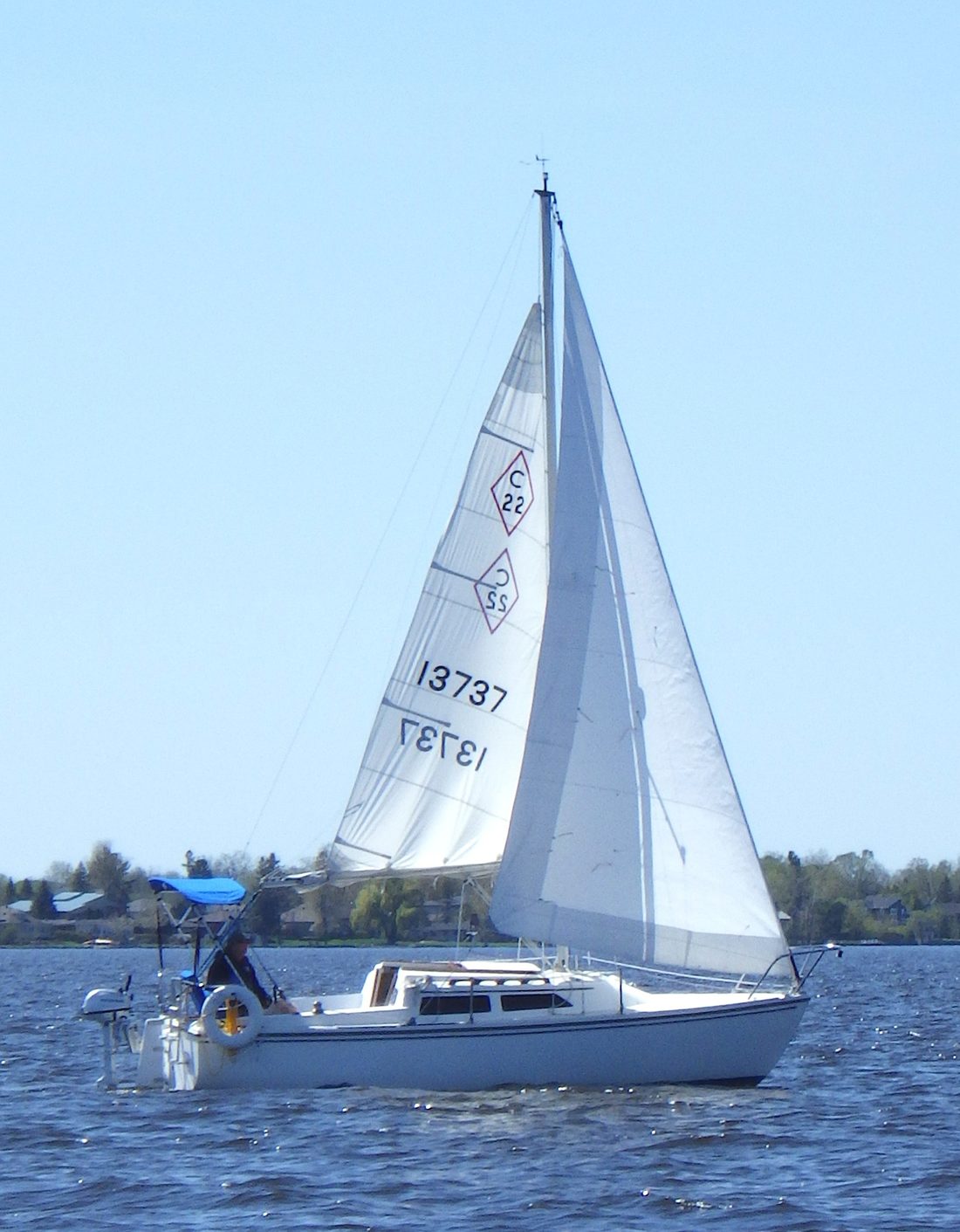
Numbers built a boat; owners built a movement. By 1994, there were roughly 70 one-design racing fleets for the Catalina 22 across the United States. One-design racing is the great equalizer: everyone sails the same boat, so the racing tests the sailor rather than the checkbook, and the swing keel and fixed fin keel boats are even allowed to race together as one class. That accessibility is a big part of why so many fleets took root, and why Sail magazine singled the boat out as a top small cruiser for trailering.
The class is governed by the C22NSA, and calling it merely "active" undersells it. The association has served owners for more than 50 years. It is organized into 12 regions with local fleets and clubs, and it has run a National Championship Regatta for more than 40 years (the 2025 Nationals, for example, were sailed at Lake Worth Sailing Club in Fort Worth, Texas). Reports from the early 2010s put the association at roughly 63 active fleets and around 550 members, so treat those as order-of-magnitude figures rather than a current census, but the direction they point in is unmistakable: this is one of the strongest small-boat class associations in the sport.
For an owner, the real crown jewel is the technical archive. The association's newsletter, MainBrace, has been published since Fall 1972. It maintains a Technical Article Guide indexing more than 700 owner-written technical articles, and a Catalina 22 Technical Manual running past 700 pages. There is very little you can wonder about this boat that someone in this community has not already documented in detail.
That culture spills well beyond racing. Because the boat trailers so easily, its owners are cruisers of a particular, restless kind: they haul to a new lake or coast for a long weekend, rig on the ramp, sail, and tow home. The boat is widely regarded as one that one or two people can rig and launch themselves, with the mast deck-stepped in a tabernacle and often raised single-handed using a gin pole. A crew of two is plenty to sail it. This is a boat built around the idea that sailing should fit into an ordinary life, and the community that formed around it reflects exactly that.
2.6 Honest about what it is
None of this makes the Catalina 22 a thoroughbred, and the people who know it best would be the first to say so. Practical Sailor called it "hardly a sprightly performer," and that is not an insult, it is the design brief. Every choice in the boat is a compromise among trailerability, shoal draft, cockpit room, and price. It sails best in light-to-medium air. Its construction has known soft spots, including a hull-to-deck joint that the same reviewers consider merely adequate for a boat this size. The swing keel that makes it so trailerable also brings its own maintenance list, from keel cables to hanger bolts, which later chapters cover in full.
But the Catalina 22 was never trying to be the fastest or the best-built boat on the water. It was trying to put a real, capable, trailerable cruising sailboat within reach of an ordinary family, and to make owning one easy enough that they would stick with it. Judged against that goal, it is one of the most successful sailboats ever designed. More than 15,000 families agreed, and the community they built is still going strong. That is the boat you own, and understanding what it was built to do is the first step to getting the most out of it.
Glossary
- Abyc
- The American Boat and Yacht Council, which publishes the voluntary safety standards most surveyors and insurers hold boats to.
- Baby Stay
- A short forestay from the mast to the deck, forward of the mast, that steadies the mast and controls its bend.
- Baby Stays
- Short forestays from the mast to the deck that steady the mast and control its bend.
- Backing Plate
- A load-spreading plate (metal, thick fiberglass, or plywood) installed on the underside of a deck or hull fitting so the loads from a bolted item, such as a cleat or chainplate, are distributed over a wider area instead of concentrating at the bolt holes.
- Ballast
- Heavy material, usually lead or iron, placed low in the keel to lower the boat's center of gravity and provide the righting force that keeps a sailboat upright and counteracts the heeling force of the wind on the sails.
- Barrier Coat
- A series of epoxy coatings applied below the waterline to seal the hull laminate against water absorption and osmotic blistering.
- Beam
- The width of the boat at its widest point.
- Bilge
- The lowest inside part of the hull where water collects.
- Boom Vang
- A tackle or strut from the boom down to the mast base that controls boom height and mainsail shape.
- Bunks
- The padded rails on a boat trailer that the hull rests on.
- C22Nsa
- The Catalina 22 National Sailing Association, the model's large and active owners' class association.
- Catalina 22
- The subject of this book: a roughly 22-foot trailerable Catalina sailboat built from 1969, one of the most-produced sailboats ever.
- Catalina Direct
- An independent supplier (catalinadirect.com) that is the dominant source of parts for Catalina sailboats.
- Catalina Yachts
- The California builder, founded by Frank Butler, of the Catalina line of production sailboats.
- Centerboard
- A retractable fin that pivots or slides down through a slot in the hull to increase lateral resistance and reduce leeway when sailing, and retracts to reduce draft for shallow water or trailering. Distinct from a fixed keel, though some boats combine both.
- Chainplate
- A metal fitting bolted to the hull structure to which a shroud or stay attaches.
- Class Association
- An organized group of owners of one model who share knowledge, parts, and one-design racing.
- Clevis Pin
- A pin passed through a fork (clevis) fitting to connect rigging parts, secured by a cotter or ring.
- Compression Post
- A vertical structural member beneath a deck-stepped mast that carries the mast's downward compression load through the cabin to the keel or a floor structure, preventing the deck from sagging under rig loads.
- Deck-Stepped
- A mast that sits on the deck or cabin top rather than passing through to the keel; its load is carried down by a compression post.
- Delamination
- Separation of the bonded layers in a fiberglass laminate or cored panel, often from water intrusion or impact; it shows up as soft spots or a dull sound when tapped.
- Delrin
- A slippery, hard-wearing acetal plastic used for low-friction bushings and slides.
- Displacement
- The weight of water a boat displaces when floating, which equals the boat's total weight. It is a fundamental measure of a vessel's size and is used in many performance and stability ratios.
- Displacement-Hull
- A hull that moves through the water rather than planing over it, limited to its theoretical hull speed.
- Displacement/Length Ratio
- A number comparing a boat's weight to its waterline length; low values indicate a light boat, high values a heavy cruiser.
- Draft
- The depth of the boat below the waterline, the minimum water it needs to float.
- Eye Bolt
- A bolt with a looped head used as a rigging or lifting attachment.
- Eyebolt
- A bolt with a looped head used as a rigging or lifting attachment.
- Fin Keel
- A relatively short, deep ballasted keel attached to the bottom of the hull, offering good upwind performance and maneuverability compared with a long full keel, at the cost of some directional stability and grounding robustness.
- Fixed Fin Keel
- A permanently attached fin-shaped ballast keel, as opposed to a retractable swing keel.
- Foot
- The bottom edge of a sail.
- Forestay
- The forward stay from the mast to the bow that carries the jib and keeps the mast from falling aft.
- Foretriangle
- The triangular area at the front of the rig bounded by the mast, the forestay, and the deck. Its dimensions (I and J) define the size of the jib or genoa and are used in sail area and rating calculations.
- Four-Stroke
- An engine that fires once every two crankshaft revolutions and burns straight gasoline, cleaner and quieter than a two-stroke.
- Fuel-Stabilizer
- An additive that keeps gasoline from gumming and separating during storage.
- Gasket
- A compressible seal between two parts that keeps out water or air.
- Gearcase
- The lower housing of an outboard containing the gears and propeller shaft; also called the lower unit.
- Gelcoat
- The pigmented resin outer layer of a fiberglass hull or deck that provides a smooth, glossy, waterproof finish and protects the underlying laminate from UV and water. It can craze, chalk, or blister with age.
- Genoa
- A large jib that overlaps the mast, giving more sail area in lighter wind.
- Gin Pole
- A temporary strut (often the boom) used as a lever to raise or lower the mast.
- Gooseneck
- The hinged fitting that connects the boom to the mast.
- Gudgeon
- The fixed socket on the hull or transom that a rudder pintle drops into, forming the rudder hinge.
- Gudgeons
- The fixed sockets on the hull or transom that the rudder pintles drop into, forming the rudder hinge.
- Halyard
- A line used to hoist a sail up the mast.
- Hanger
- On a swing-keel boat, the bracket (keel hanger) that holds the pivot pin the keel swings on.
- Hanger Weldment
- The welded steel assembly that carries the swing-keel pivot pin, a corrosion and fatigue point.
- High-Thrust-Prop
- A large-diameter, low-pitch outboard propeller made to push a heavy displacement hull rather than for speed.
- Hull Number
- The unique identifier of an individual hull, used to place its build year within a model's run.
- Hull Speed
- The theoretical maximum efficient speed of a displacement hull, roughly 1.34 times the square root of the waterline length in feet, beyond which the boat must climb its own bow wave and required power rises steeply.
- Hull-Deck Joint
- The seam where the hull and deck moldings are joined, a common source of leaks.
- Hull-Speed
- The theoretical maximum speed of a displacement hull, set by its waterline length.
- Impeller
- The flexible rubber, vaned rotor inside a raw-water pump that draws seawater through the engine's cooling system. Its vanes wear and can shear off, so it is a routine maintenance-replacement item; running the pump dry destroys it quickly.
- Integral Clutch
- A keel-winch feature that holds the keel position without a separate brake.
- Keel Cable
- The wire that raises and lowers a swing keel through the winch, a safety-critical wear item.
- Keel Hanger
- The bracket that carries the pivot pin a swing keel swings on.
- Keel Lock Bolt
- A bolt that locks a swing keel in the down position to stop it clunking and stressing the trunk.
- Keel Trunk
- The fiberglass housing a swing keel retracts into, which can crack if the keel drops against it.
- Keel Turning Ball
- A low-friction ball or roller that guides the keel cable where it turns inside the trunk.
- Kick-Up Rudder
- A rudder whose blade pivots up when it hits bottom, protecting it in shallow water or on the trailer.
- Lewmar
- A British maker of winches, hatches, and deck hardware.
- Loa
- Length overall: the boat's total length including any bow pulpit or swim platform.
- Lower Unit
- The lower housing of an outboard containing the gears and propeller shaft.
- Lower-Unit
- The lower housing of an outboard containing the gears and propeller shaft.
- Luff
- The forward edge of a sail.
- Lwl
- Load waterline length, the hull length at the waterline, which sets a displacement boat's hull speed.
- Mainsheet
- The line that controls the mainsail's trim by adjusting the boom.
- Masthead
- The top of the mast; a masthead rig runs the forestay and backstay to the very top, as opposed to a fractional rig.
- Masthead Sloop
- A single-masted sailboat whose forestay attaches at the top (masthead) of the mast, allowing a large foretriangle and headsail. This contrasts with a fractional rig, where the forestay attaches partway down the mast.
- Meat-Hooks
- Broken strands of wire rigging that stick out and snag, a sign the wire must be replaced.
- Moisture Meter
- A handheld instrument that estimates the relative moisture content of a fiberglass laminate or cored panel by sensing its electrical properties. Surveyors use it to find wet deck core or hull areas, though readings are comparative and require experienced interpretation rather than giving an absolute wet/dry verdict.
- Motor-Well
- A recess in the cockpit or transom that houses an outboard, as an alternative to a transom bracket.
- One-Design
- Racing among identical boats of one model, so results reflect crew skill rather than boat differences.
- Osmotic Blisters
- Water-filled bubbles in a hull's gelcoat caused by osmosis into the laminate.
- Outboard
- A self-contained engine, with its own gearcase and propeller, hung on the transom or in a well.
- Oxidation
- The chalky dulling of gelcoat and metals from sun and weather exposure.
- Pennant
- A short length of line or wire used as an extension or connector, such as a halyard pennant that adds length aloft or a tack pennant that raises a sail's tack above the deck. (Not to be confused with a signal flag of similar spelling.)
- Phrf
- Performance Handicap Racing Fleet, a widely used North American handicapping system that assigns each boat a rating in seconds per mile so that dissimilar boats can race fairly by correcting elapsed times.
- Pintle
- The pin on the rudder that drops into a hull-mounted gudgeon to form the rudder hinge.
- Pintles
- The pins on the rudder that drop into hull-mounted gudgeons to form the rudder hinge.
- Pitch
- The theoretical distance a propeller would move forward in one turn, key to matching a prop to an engine.
- Pivot Pin
- The pin a swing keel rotates on, carried in the keel hanger.
- Pop-Top
- A raising cabin-top section that adds standing headroom at anchor on small cruisers like the Catalina 22.
- Primer-Bulb
- The hand-squeezed bulb in an outboard fuel line used to prime the carburetor before starting.
- Prop-Walk
- The sideways push a turning propeller gives the stern, especially in reverse.
- Propeller
- The bladed screw that drives the boat through the water.
- Quarter Berth
- A berth tucked aft under the cockpit, alongside the engine or lockers.
- Ruddercraft
- A maker of replacement HDPE and foam-core sailboat rudders.
- Running Rigging
- The lines adjusted while sailing (halyards, sheets, control lines), as opposed to the fixed standing rigging.
- Sa/D
- Sail area to displacement ratio, a rough index of how powered-up a boat is for its weight.
- Sail Area
- The total area of a boat's working sails, a measure of its driving power.
- Shroud
- A standing-rigging wire from the mast to the side of the boat that supports the mast athwartships.
- Slide-Away Galley
- A compact galley unit that slides out of the way, used on small cruisers to save space.
- Spreader Bracket
- The fitting that attaches a spreader to the mast; a cast-aluminum version on some boats is a known failure point.
- St Tires
- Special Trailer rated tires, built for trailer loads rather than for a car.
- Standing Rigging
- The fixed wires or rods (shrouds and stays) that hold the mast up and in position. Unlike running rigging, it is not routinely adjusted while sailing and is a critical structural system with a finite service life.
- Swage
- A wire terminal fitting attached by compressing (swaging) a metal sleeve tightly onto the end of a wire rope under high pressure. Swage terminals are common on standing rigging but can develop cracks or crevice corrosion over time.
- Swing Keel
- A pivoting ballast keel that raises into a trunk for shallow water and trailering and lowers for sailing.
- T-Bolt
- A T-headed bolt that slides into a track or slot, used for sail slides and hardware.
- Tabernacle
- A hinged mast-base fitting on deck that lets the mast be pivoted up and down for trailering.
- Tell-Tale
- A small yarn or ribbon on a sail or shroud that shows airflow for trimming; also an outboard's cooling-water stream.
- Tiller
- A lever attached to the rudder head used to steer, as opposed to a wheel.
- Topping Lift
- A line from the masthead to the boom end that holds the boom up when the sail is down.
- Transom
- The flat aft face of the hull, where an outboard bracket or rudder often mounts.
- Turnbuckle
- A threaded fitting at the base of a stay or shroud used to adjust rigging tension.
- Turning Ball
- A low-friction ball that guides the swing-keel cable where it changes direction.
- Two-Stroke
- An engine that fires every crankshaft revolution and burns a gasoline-oil mix, lighter but smokier than a four-stroke.
- V-Berth
- The V-shaped berth in the bow where the hull sides converge.
- Ventilation
- Airflow through the boat or engine space to clear fumes, heat, and moisture.
- Water Pump Impeller
- The flexible rubber vane wheel in a raw-water or outboard pump that moves cooling water; a routine wear item.
- Water-Pump
- The pump that moves cooling water through an engine or outboard.
- Weathercock
- The tendency of a boat to turn its bow into the wind, pronounced on light high-freeboard boats under power.
- Weldment
- A component made of welded metal parts, such as the swing-keel hanger.
- Wheel Bearings
- The bearings in a trailer's hubs, which must be greased and inspected to avoid failure on the road.
- Winch
- A drum-shaped device that gives the crew mechanical purchase to trim a line.
- Wing Keel
- A shoal keel with winglets at its base that recover some of the stability and grip of a deeper keel.
- Zinc Chromate
- A corrosion-inhibiting primer used on metal fittings and inside keel castings.