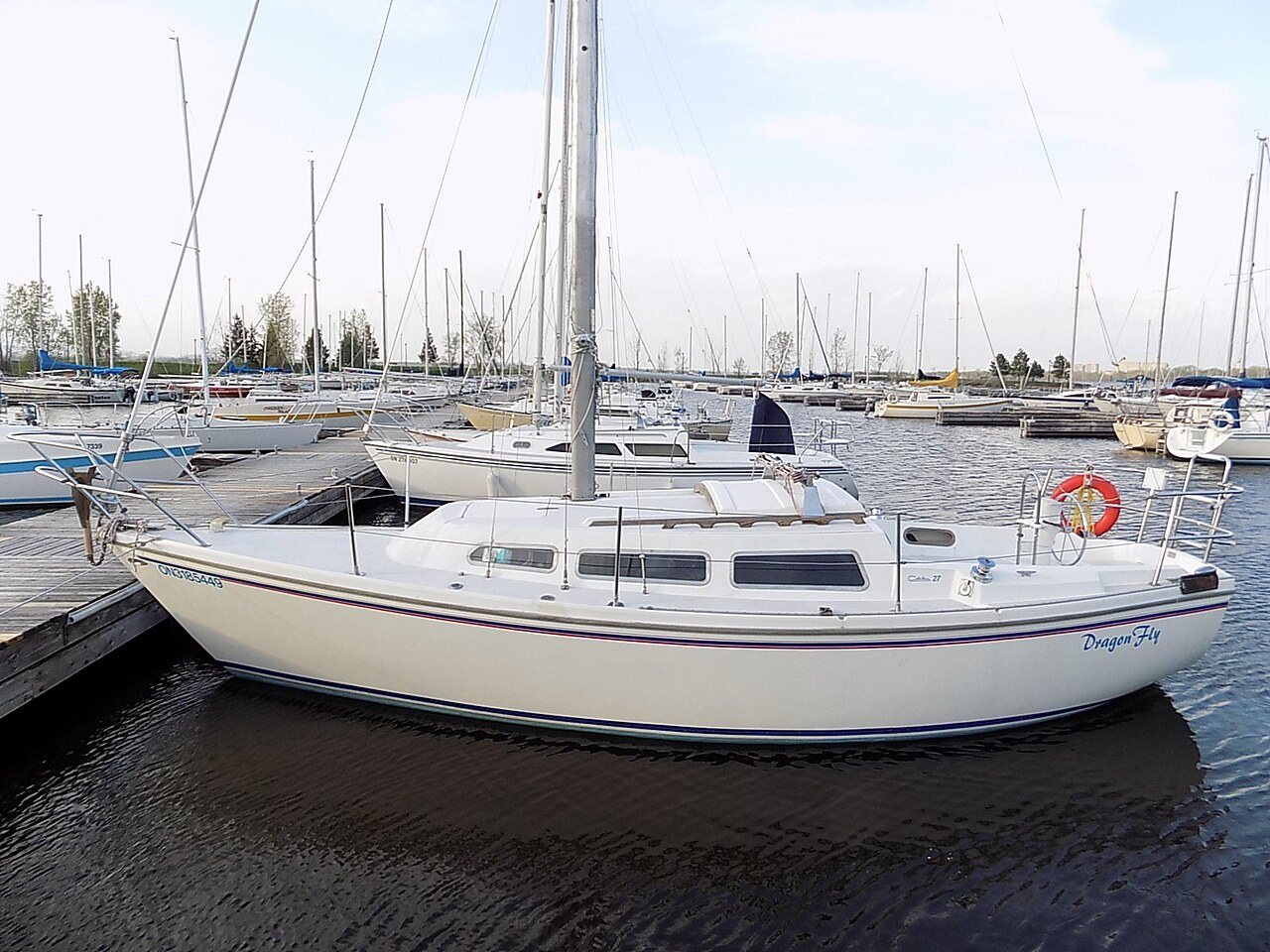
Catalina 27
About This Book
This chapter is your orientation. Before you can maintain, survey, or sail a Catalina 27 well, you have to know exactly which Catalina 27 you own, because Catalina Yachts built this boat for roughly twenty years and changed it constantly along the way. Read this first, pin down your own hull's rig, keel, interior, and engine, then use the rest of the book with those four facts in hand.
Welcome aboard. If you own, are buying, or are simply falling for a Catalina 27, you have picked one of the most successful sailboats in American history. Roughly 6,600 hulls were built between 1971 and 1991, which Practical Sailor calls "undoubtedly the largest production run of any 27-ft sailboat in US history" (source: practical-sailor.com). Frank Butler and Robert Finch designed a boat that reviewers still describe as "the Volkswagen of the boat market: basic, but it will get you where you want to go" (source: practical-sailor.com). That enormous fleet is your single greatest advantage as an owner. Parts, sisterships, forum threads, and hard-won knowledge are everywhere, and specialist suppliers like Catalina Direct still stock nearly every wear item plus purpose-built retrofit kits for this boat's known weak points.
But "the Catalina 27" is not one boat. It is a family of closely related boats spread across a long production run, and the differences between them are not cosmetic. They change how your boat sails, how it is powered, where it sleeps you, and, in a couple of cases, how safe its rig is. So the most useful thing this chapter can do is help you identify your boat along four axes.
1.1 The four questions that define your boat
1. Standard rig or tall rig?
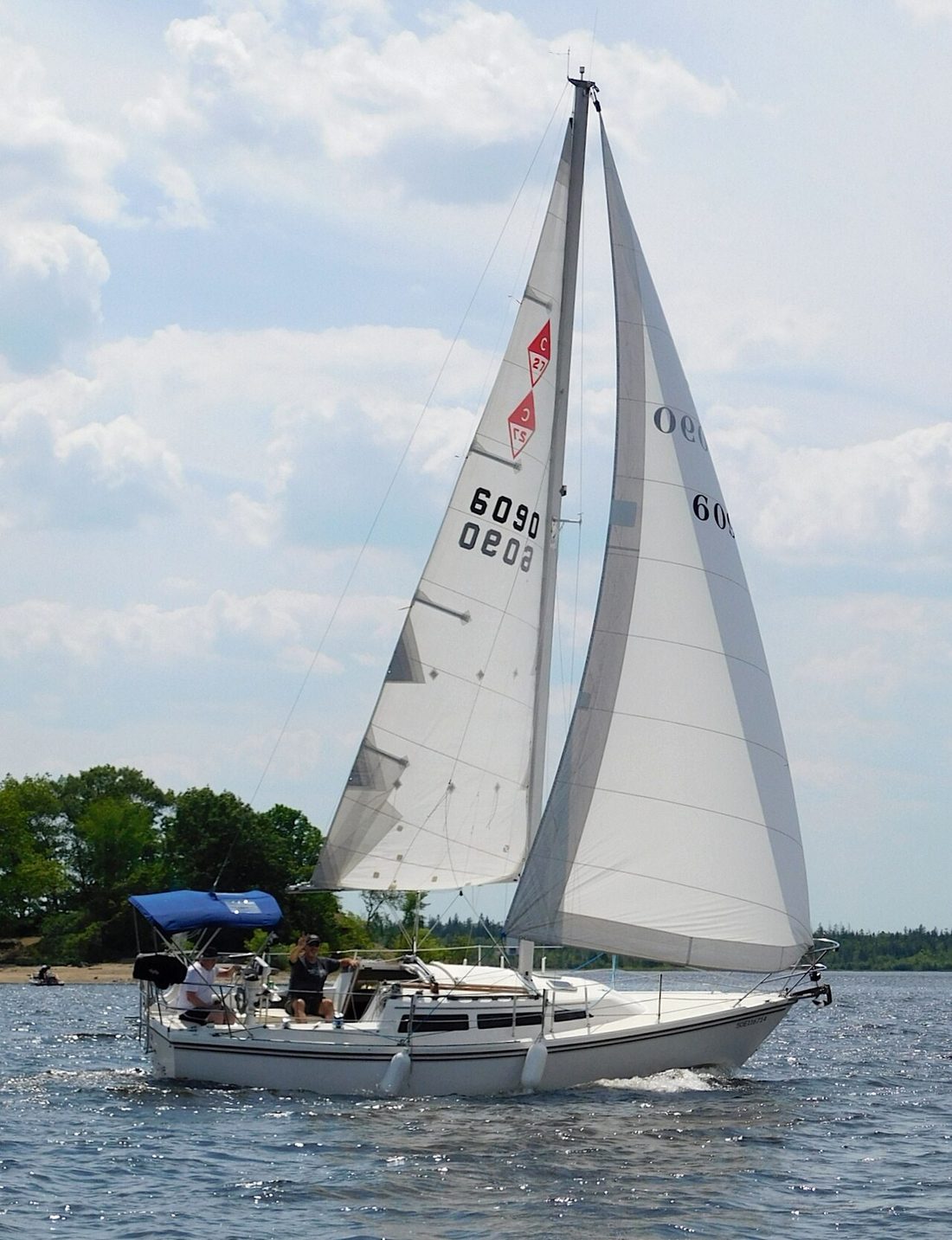
The Catalina 27 is a masthead sloop, and it was offered in two mast heights. The standard rig is the more common configuration and typically carries a 150% genoa for light-air performance (source: practical-sailor.com). The tall rig, introduced later in the run, raises the mast roughly 1.5 to 2 ft higher and adds sail area. SpinSheet reports the taller rig "increased the aspect ratio of the main and increased total sail area by some 24 square feet" (source: spinsheet.com), and Practical Sailor calls it slightly faster and favored in light-air regions (source: practical-sailor.com).
You can tell them apart by the numbers. The standard rig measures roughly I = 34.0 ft, J = 11.25 ft; the tall rig runs closer to I = 36.0 ft, J = 12.2 ft (source: goodoldboat.com). If you have your boat's original sailplan or a rigger's tape measure, those foretriangle dimensions settle it quickly. The combination said to be quickest is the deep keel paired with the tall rig (source: spinsheet.com).
2. Deep keel, shoal keel, or wing keel?
The standard boat is a fixed fin keel drawing 4.0 ft (source: wikipedia.org). Catalina also offered shallower options, and here the record is genuinely mixed. Wikipedia lists a 3.0 ft shoal keel, while SpinSheet and Sailing magazine both describe a 3 ft 5 in wing-keel version introduced in 1979 (source: spinsheet.com; source: sailingmagazine.net). The most likely reconciliation, which you should verify against your own hull rather than assume, is that early shoal boats used a low-aspect shoal fin near 3 ft, and from 1979 Catalina offered a wing keel drawing about 3 ft 5 in. Treat the exact early-shoal figure as unconfirmed until you check it against the Catalina 27/270 Association tech records or a factory spec sheet.
The trade is not free depth. The shoal foil is less efficient, so Catalina made it heavier to keep stability comparable; Practical Sailor cites shoal boats running about 500 lb heavier than deep-keel boats of the same era (source: practical-sailor.com). Measure your draft or read your paperwork before you assume which keel is under you, because it changes both your gunkholing range and your handling.
3. Traditional aft-galley or dinette interior?
Two interiors ran throughout production, and this is the one you can identify just by going below. The traditional layout puts a V-berth forward, an enclosed head, a saloon with two opposing settees, and the galley aft to port; owners tend to prefer it for "better storage and a more reasonable use of space" (source: practical-sailor.com). The dinette layout puts the galley alongside to port, a dinette to starboard, and two quarter berths; the dinette drops to a double for six berths total, which suits cruising, though owners note "the dinette table takes up almost half the cabin all the time" (source: sailboatowners.com). Either way, be realistic about sleeping: reviewers warn the forward V-berth is "too short and too narrow to be comfortable for two," and the quarter berths are "the only decent-size berths on the boat" (source: practical-sailor.com). Count the practical comfortable capacity as two to four.
4. Which engine? Follow the timeline.
Power is the axis that moved the most over twenty years, so match your boat to this progression:
- Outboard first. The earliest boats were outboard-powered through an outboard well, and Catalina kept the outboard option available all the way to 1989 (source: spinsheet.com). A 9.9 to 10 hp outboard is about right to push the hull to speed (source: practical-sailor.com).
- Atomic 4 gas inboard. Catalina added the Universal Atomic 4 gasoline inboard early in the run. Sources split on the exact year, 1972 versus 1973, so read it as early 1970s (source: wikipedia.org; source: spinsheet.com). This compact roughly 30 hp four-cylinder gas engine dominated the inboard fleet through the late 1970s.
- Diesel arrives (late 1970s). The first diesel was a small single-cylinder roughly 6 hp Petter, widely disliked; owners call the boat "grossly underpowered" with it (source: practical-sailor.com).
- Universal diesel (the desirable later inboard). Later production moved to Universal diesel engines of about 11 to 14 hp, described as "far more desirable" than the Petter (source: practical-sailor.com).
So the shorthand is: outboard, then gas Atomic 4, then a brief unloved Petter diesel, then a Universal diesel into the 1980s, with the outboard option persisting to 1989. The precise Atomic-4-to-diesel cutover year and exact Universal model per hull are not firmly pinned in the sources, so confirm yours by looking at the engine, not the model year alone.
1.2 Flag these up front: the rig-safety items
Most of what ages on a Catalina 27 is ordinary and repairable. Three items are different, because the sources tie them directly to lost rigs, and you should know about them before you read another page.
[SAFETY] Original lower-shroud U-bolt chainplates. Some original lower-shroud chainplate U-bolt or eyebolt fittings have failed, "causing the rig to go over the side," and early boats used undersized 3/8 in eyebolts (source: practical-sailor.com). Catalina Direct's U-bolt retrofit kit, which spreads the load over larger backing plates, is "highly recommended" (source: catalinadirect.com). On any older boat, confirm whether this upgrade has been done.
[SAFETY] Cast-aluminum spreader socket fittings. The original cast-aluminum spreader sockets are a known failure point, and "failures of the cast sockets have cost several rigs" (source: practical-sailor.com). The fix is fabricated stainless sockets. Treat any un-replaced original casting as a priority.
[SAFETY] The deck-stepped mast on a wood compression post. The mast lands on the coachroof and its load runs down a compression post to the keel structure, passing through a wooden base that "rots and/or crushes" when water gets in at the mast step (source: sailboatowners.com). Watch for a dished deck at the mast collar, cracks around the step, a sagging headliner, and doors that no longer close square. You cannot fix the deck-side symptom until the rotten wood below is replaced (source: lifeofsailing.com). The book's Known Issues chapter walks the full inspection and repair.
1.3 Know-your-hull checklist
Before you use the rest of this book, write down the answers:
- [ ] Rig: standard or tall? (Check I and J against 34.0/11.25 vs. 36.0/12.2.)
- [ ] Keel: deep 4.0 ft, shoal ~3.0 ft, or wing ~3 ft 5 in? (Measure or verify; note the 1979 wing-keel introduction.)
- [ ] Interior: traditional aft-galley or dinette?
- [ ] Engine: outboard, Atomic 4 gas, Petter diesel, or Universal diesel? (Identify the actual engine, not just the year.)
- [ ] Hull number and model year, so you can resolve the mixed-source items above (the exact keel and engine-year questions) against your specific boat.
- [ ] Rig-safety status: have the lower-shroud chainplates and spreader sockets been upgraded, and is the compression post sound?
Keep those answers somewhere you can find them. Every maintenance interval, part number, and survey note in this book depends on them.
1.4 A word on liability
This book is a reference written from research and owner experience, not a substitute for a professional. The Catalina 27 fleet spans five decades, more than six thousand hulls, and countless owner refits, so no two boats are identical after that many years of water and weather. Nothing here, especially the items marked [SAFETY], replaces a qualified marine surveyor, a licensed rigger, or a certified mechanic inspecting your actual boat. Torque figures, keel-bolt specs, and rig details in these pages carry the same caveat the sources do: verify with the factory or the association before you wrench, and re-check every quantitative claim against a hull-specific professional survey. Where the record conflicts, this book shows you both readings and tells you to confirm. The judgment about whether your boat is safe to sail is yours, made with proper professional help, not ours.
With your four answers in hand, turn the page and let us get specific.
History & Identity
This chapter is the story of where your boat came from and why it matters. The Catalina 27 is not just another small cruiser; it is arguably the most successful 27-footer ever built in America, the boat that taught a generation how to sail, and a near-perfect snapshot of one designer's stubborn idea about what a sailboat should cost. Understanding that story tells you what you actually own: a boat engineered to be affordable and forgiving, built in enormous numbers, and supported so well that a hull launched in the 1970s can still be kept sailing today.
2.1 The boat that outsold everything its size
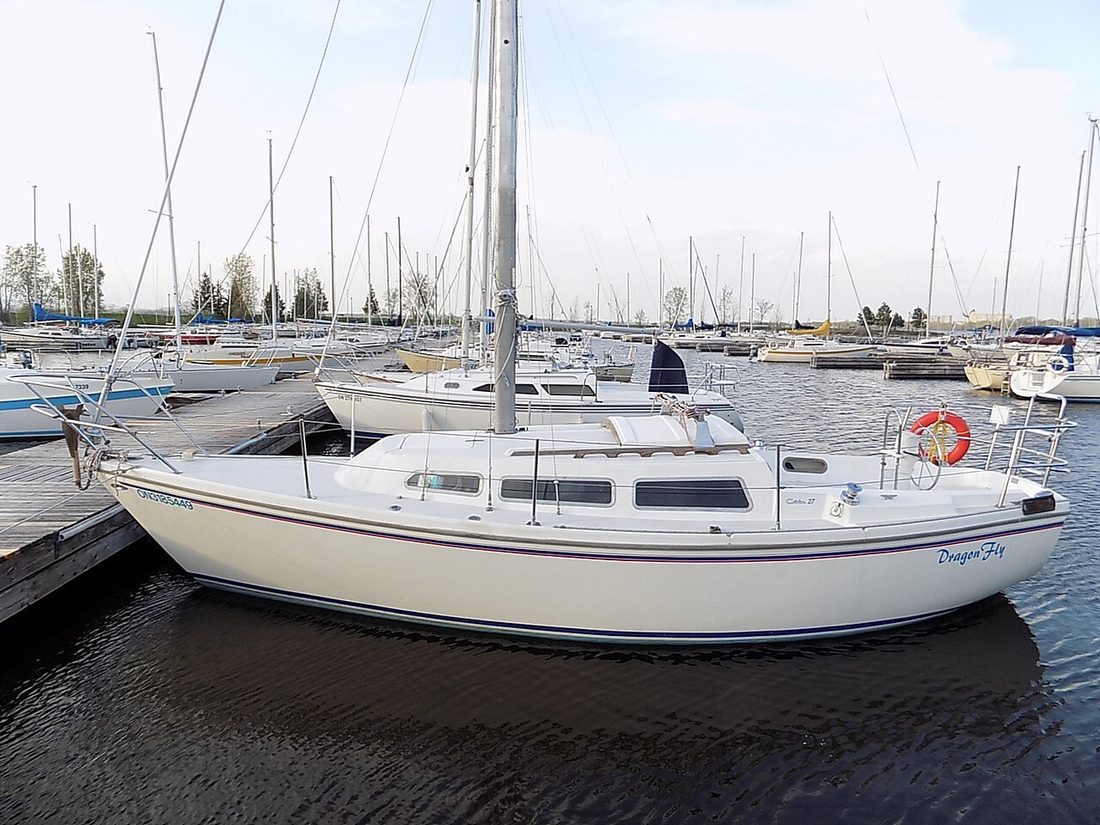
Let us start with the number that defines this boat. Over roughly a twenty-year run, Catalina Yachts built about 6,662 hulls of the Catalina 27 (source: wikipedia.org). Practical Sailor rounds that to "over 6,000" and calls it "undoubtedly the largest production run of any 27-ft sailboat in US history" (source: practical-sailor.com). Sailing magazine goes a step further and describes it as "possibly the best-selling 27-footer of all time" (source: sailingmagazine.net). Whatever superlative you prefer, the point is the same: when you sit in the cockpit of a Catalina 27, you are sitting in one of the most-produced sailboats of its class in history.
That scale is not a trivia-night fact. It is the single most useful thing to know about your boat, because it explains almost everything else in this book. A fleet of more than six thousand nearly identical hulls means parts are still made, wear items are still stocked, forums are still full of people who have solved the exact problem you are facing, and sisterships are tied up in marinas from coast to coast. Rarity is romantic but expensive; ubiquity is unglamorous but cheap to own. The Catalina 27 is the ubiquitous choice, and you benefit from that every time something breaks.
2.2 Frank Butler, Bob Finch, and a lean California yard
The Catalina 27 was designed by Frank V. Butler, the founder of Catalina Yachts, with Robert (Bob) Finch credited as co-designer, and it was built by Catalina Yachts of California (source: wikipedia.org; source: sailingmagazine.net). In Canada, the boat was also produced under license by Cooper Enterprises (source: wikipedia.org), so a Canadian-built hull is part of the same family even though it did not come out of the California yard.
Butler is the key figure, and his philosophy is stamped into every foot of this hull. He ran Catalina as a famously lean, owner-driven operation, "handling design decisions and customer service personally," as Practical Sailor puts it (source: practical-sailor.com). He was not chasing the yachting magazines or the racing trophies. His formula, in Sailing magazine's words, was to build "stylish but definitely affordable boats with semimodern hull shapes and high-volume interiors" (source: sailingmagazine.net). That is a precise description of what you own: a boat with a modern-enough underbody, more interior volume than its length suggests, and a price that undercut nearly everything comparable.
The results of that formula went far beyond this one model. Catalina Yachts went on to build more than 60,000 boats total, more than any other American sailboat company (source: sailingmagazine.net). The Catalina 27 was one of the earliest and most important rungs on that ladder, the boat that proved Butler's "more boat per dollar" bet at volume and helped fund everything that came after it. When people call the Catalina 27 the archetypal affordable first cruiser, they are really describing the whole Catalina approach, distilled into 27 feet.
2.3 Production span: roughly 1971 to 1991
The Catalina 27 was in production for about two decades, from the early 1970s until 1991, when it was discontinued and replaced by the completely redesigned Catalina 270 (source: wikipedia.org; source: practical-sailor.com). That is a remarkably long run for a single model, and it is the reason "the Catalina 27" is better understood as a family of closely related boats than as one fixed design.
The exact start year is not perfectly settled in the record. Wikipedia dates the first hull to 1971, while SpinSheet and sailboatdata describe production or introduction as beginning in 1970 (source: wikipedia.org; source: spinsheet.com). The most sensible reading, and the one this book uses, is that the design was introduced around 1970 and reached volume production in 1971, with 1971 being the first-delivery date most commonly cited. If the precise year matters for your specific hull, resolve it against your hull number and paperwork rather than trusting any single secondary source.
However you date the first boat, the demand that followed is not in dispute. The Catalina 27 sold explosively out of the gate: nearly 1,500 boats in its first three years (source: wikipedia.org), and by 1975 more than 2,000 hulls had been built (source: spinsheet.com). That early momentum is what turned a well-priced newcomer into the class benchmark, and it is why the used fleet is so deep today.
2.4 Why it became the archetypal first cruiser
If you want to understand the identity of this boat, this is the section to sit with. Reviewer after reviewer, writing independently across decades, converges on the same explanation for why the Catalina 27 mattered. It comes down to value, forgiveness, and space.
Value, first and loudest. The most-quoted line about this boat is Practical Sailor's: the Catalina 27 is "the Volkswagen of the boat market: it's basic, but it will get you where you want to go" (source: practical-sailor.com). The same review notes that buyers "could get more boat for their dollar with Catalina than with almost any other boat built," and that they accepted the trade-offs to get it (source: practical-sailor.com). That is the whole pitch in one sentence. This was never meant to be the finest 27-footer afloat. It was meant to be the most boat a normal family could actually afford, and it delivered on that promise so well that it defined the category.
Forgiving and approachable. A first cruiser has to be a boat you are not afraid of, and owners describe the 27 exactly that way. Sailing magazine quotes an owner calling it "a boat you can let your 16-year-old son take out with his friends and not worry about" (source: sailingmagazine.net). That forgiving character, easy to handle and hard to get into serious trouble with in normal conditions, is a large part of why so many sailors learned on this hull.
More accommodations than the length promises. Butler's "high-volume interiors" were not marketing. SpinSheet credits the designers with achieving "spacious accommodations within a 27-foot package that maintained an appealing, yacht-like aesthetic while remaining moderately priced" (source: spinsheet.com), and the boat carries a nominal 6 ft 1 in of headroom on the centerline at the aft end of the cabin (source: practical-sailor.com). Standing headroom in a 27-footer, at that price, is a big part of why families chose it over lower, cheaper boats.
An ecosystem that never went away. Value and volume created something self-reinforcing: an ownership ecosystem that keeps the boat alive. Sailing magazine credits the 27 with delivering "good sailing, comfortable accommodations, one-design fleets and active owner's groups" at value pricing (source: sailingmagazine.net), and that support continues today through the active Catalina 27/270 International Association and a deep parts pipeline via specialist supplier Catalina Direct (source: wikipedia.org; source: catalinadirect.com). Used-market accessibility reinforced the reputation for decades: quality used boats have long been available well under $10,000, typically in a $6,000 to $20,000 range (source: sailingmagazine.net). A boat that is cheap to buy, cheap to fix, and surrounded by people who know it is a boat that keeps getting sailed.
One honest note belongs here, and the book will keep returning to it. The Catalina 27 was "designed for inland sailing and coastal cruising, not ocean passages" (source: wikipedia.org). That is the intended envelope, and you should respect it. It is also true that determined owners have taken these boats far beyond it, completing Caribbean passages and even circumnavigations (source: wikipedia.org). Those voyages are a tribute to the sailors more than a spec of the boat. Read the design intent as the honest baseline and treat anything beyond it as a project you take on with your eyes open.
2.5 One model, many boats: how the 27 changed over twenty years
A twenty-year production run means constant change, and the Catalina 27 changed constantly. None of these changes were dramatic model-year overhauls; they were the steady evolution of a boat that Butler kept tuning to the market. Four axes matter most, and this book treats identifying them as the foundation for everything else. Here they are as history, so you understand how your particular boat fits into the arc of production.
Standard rig and tall rig
The Catalina 27 is a masthead sloop (source: wikipedia.org), and Catalina offered it in two mast heights. The standard rig is the more common configuration and typically carries a 150% genoa for light-air work (source: practical-sailor.com). Later in the run Catalina added a tall rig, which raises the mast roughly 1.5 to 2 ft and increases sail area. SpinSheet reports the taller rig "increased the aspect ratio of the main and increased total sail area by some 24 square feet" (source: spinsheet.com), and Practical Sailor describes it as slightly faster and favored in light-air regions (source: practical-sailor.com). The two rigs are distinguishable by their foretriangle dimensions, with the standard rig near I = 34.0 ft and the tall rig closer to I = 36.0 ft (source: goodoldboat.com). The introduction of the tall rig is a good example of Butler answering a specific complaint, light-air performance, without redesigning the boat.
Deep keel, shoal keel, and the 1979 wing keel
The standard boat is a fixed fin keel drawing 4.0 ft (source: wikipedia.org), and Catalina offered shallower alternatives for owners in thin water. Here the historical record is genuinely mixed, and it is worth understanding why.
Wikipedia lists a 3.0 ft shoal keel, while SpinSheet and Sailing magazine both describe a 3 ft 5 in wing-keel version introduced in 1979 (source: wikipedia.org; source: spinsheet.com; source: sailingmagazine.net). The most likely reconciliation, and one you should confirm against your own hull rather than assume, is that this reflects two different shallow keels across the production run: an earlier low-aspect shoal fin near 3 ft, and from 1979 a wing keel drawing about 3 ft 5 in. Treat the exact early-shoal figure as unconfirmed until you check it against the Catalina 27/270 Association tech records or a factory spec sheet. The 1979 wing keel is a useful historical marker: it dates a boat, and it is a clue to roughly where in the production arc a given hull sits.
The trade-off was never free depth. The shoal foil is less efficient, so Catalina made it heavier to keep stability comparable, and Practical Sailor cites shoal boats running about 500 lb heavier than deep-keel boats of the same era (source: practical-sailor.com). The combination said to be the quickest of all is the deep keel paired with the tall rig (source: spinsheet.com).
Traditional aft-galley and dinette interiors
Two interiors ran throughout production, and unlike the rig and keel, this one you can identify simply by going below. The traditional layout puts a V-berth forward, an enclosed head, a saloon with two opposing settees, and the galley aft to port; owners tend to prefer it for "better storage and a more reasonable use of space" (source: practical-sailor.com). The dinette layout puts the galley alongside to port, a dinette to starboard, and two quarter berths; the dinette drops to a double for six berths total, which suits cruising, though owners note "the dinette table takes up almost half the cabin all the time" (source: sailboatowners.com). That the factory offered both, side by side, for the whole run is itself a piece of the identity story: Butler let the buyer choose between storage-and-space and dine-and-sleep, rather than forcing one vision of how the boat should be used.
The engine timeline
Power is the axis that moved the most over twenty years, and it reads almost like a history of small-boat auxiliary propulsion in miniature. The earliest boats were outboard-powered through an outboard well, and Catalina kept the outboard option available all the way to 1989 (source: spinsheet.com), with a 9.9 to 10 hp outboard about right to push the hull to speed (source: practical-sailor.com).
Early in the run, Catalina added the Universal Atomic 4 gasoline inboard, the classic compact gas engine of its era, a roughly 30 hp four-cylinder. Sources split on the exact introduction year, giving 1972 versus 1973, so read it as the early 1970s and confirm against your own hull if it matters (source: wikipedia.org; source: spinsheet.com). The Atomic 4 dominated the inboard fleet through the late 1970s. Then diesel arrived: the first was a small single-cylinder roughly 6 hp Petter, widely disliked, with owners calling the boat "grossly underpowered" with it (source: practical-sailor.com). Later production moved to the far more desirable Universal diesel engines of about 11 to 14 hp (source: practical-sailor.com). The shorthand for the whole arc is: outboard, then gas Atomic 4, then a brief unloved Petter diesel, then a Universal diesel into the 1980s, with the outboard option persisting to 1989. The engine chapter covers each of these in detail; for identity purposes, the lesson is that model year alone will not tell you what is in the bilge. Look at the actual engine.
2.6 Where the 27 sits in the Catalina line
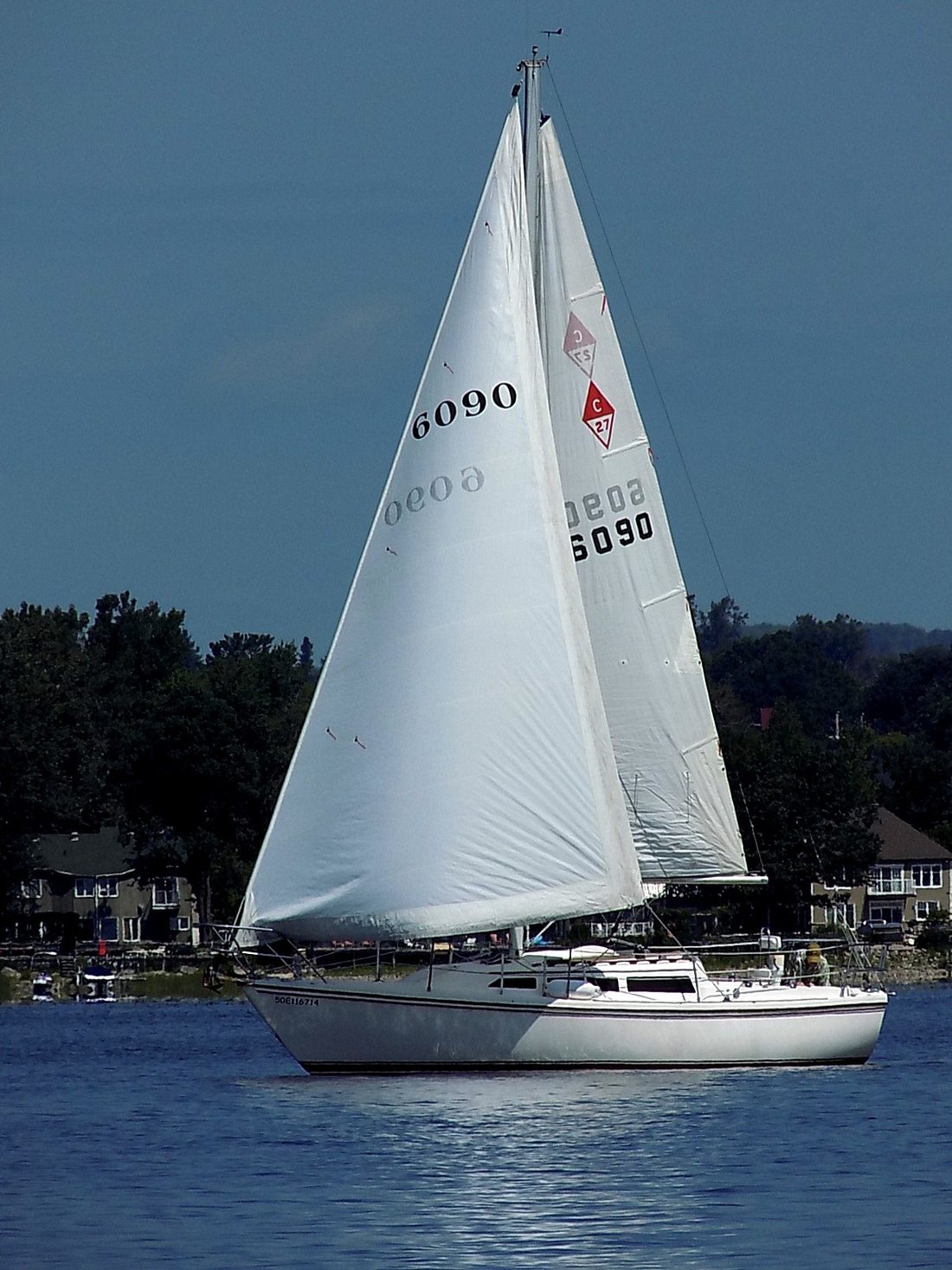
The Catalina 27 did not exist in isolation, and understanding its place in the family sharpens what it is. It was one of the boats that established Butler's high-volume, value-first formula, and its success helped make Catalina the most prolific American sailboat builder, with more than 60,000 boats to its name (source: sailingmagazine.net). In that sense the 27 is a keystone model: not the biggest or the fanciest boat Catalina made, but one of the most important commercially, the proof that affordable, spacious, forgiving boats would sell in enormous numbers.
Its end was not a failure but a handoff. When the Catalina 27 was discontinued in 1991, it was replaced by the completely redesigned Catalina 270 (source: wikipedia.org; source: practical-sailor.com), a newer take on the same slot in the range. The 27 had simply had a two-decade run and earned its retirement. That successor relationship is why you will sometimes see the two boats linked, including in the name of the Catalina 27/270 International Association, which supports both.
2.7 What this history means for you
Everything in the rest of this book flows from the story above. Because the boat was built to a price, some of its original hardware was light, and this book will be candid about the known weak points that come with that heritage, especially the rig-safety items flagged in the About This Book chapter and detailed in Known Issues. Because it was built in such volume and supported so thoroughly, nearly all of those weak points now have well-understood fixes and readily available parts. And because it changed so much across twenty years, the single most valuable thing you can do is pin down exactly which Catalina 27 you own along the four axes above: rig, keel, interior, and engine.
The identity of this boat, in the end, is a paradox that the sources capture again and again. It is basic, and yet owners love it. It is not overbuilt, and yet thousands are still sailing. It was designed for coastal work, and yet a few have crossed oceans. Practical Sailor sums up the loyalty plainly: despite its flaws, "many owners love the boat and say they would buy it again" (source: practical-sailor.com). That is the real legacy of Frank Butler's Volkswagen of the boat market. It got a generation of sailors onto the water at a price they could pay, and it is durable and well-supported enough that it can do the same for you. With that history in hand, turn to the specifications and let us get precise about the numbers.
Glossary
- Ammeter
- A gauge showing charging or discharging current; the Universal M-series factory ammeter wiring is a known fire risk.
- Atomic 4
- The Universal Atomic 4, a 30 hp inline-four gasoline auxiliary engine fitted to many older production sailboats.
- Backfire Flame Arrestor
- A metal-mesh device on a gasoline engine's air intake that stops a carburetor backfire from igniting fumes.
- Backing Plate
- A load-spreading plate (metal, thick fiberglass, or plywood) installed on the underside of a deck or hull fitting so the loads from a bolted item, such as a cleat or chainplate, are distributed over a wider area instead of concentrating at the bolt holes.
- Ballast
- Heavy material, usually lead or iron, placed low in the keel to lower the boat's center of gravity and provide the righting force that keeps a sailboat upright and counteracts the heeling force of the wind on the sails.
- Ballast/Displacement Ratio
- The proportion of a boat's total weight that is ballast; a rough index of stiffness and sail-carrying power (higher is stiffer).
- Barrier Coat
- A series of epoxy coatings applied below the waterline to seal the hull laminate against water absorption and osmotic blistering.
- Battery Switch
- A rotary switch that selects or combines battery banks and isolates the system when off.
- Beam
- The width of the boat at its widest point.
- Bilge Blower
- An electric fan that clears fumes from the bilge and engine space; run it before starting a gasoline engine.
- Blister
- A fluid-filled bubble in a fiberglass hull's gelcoat or laminate, caused by water permeating the resin (osmosis); widespread blistering can indicate laminate saturation.
- Blower
- An electric fan that ventilates the engine compartment; on a gasoline boat it must be run before starting to clear fumes.
- Bulkhead
- A structural partition across the hull that stiffens it and divides the interior; chainplates often attach to bulkheads.
- Buss Bar
- A common metal strip that ties several electrical connections together, such as a ground or positive bus.
- Capsize Screening Formula
- A simple design ratio (beam divided by the cube root of displacement in cubic feet) used to gauge a boat's resistance to capsize. A value under 2.0 is generally considered acceptable for offshore use; higher numbers suggest a boat more easily knocked down.
- Catalina 27
- The subject of this book: a roughly 27-foot Catalina sailboat built 1971 to 1991, the best-selling boat of its size.
- Catalina Direct
- An independent supplier (catalinadirect.com) that is the dominant source of parts for Catalina sailboats.
- Catalina Smile
- The cosmetic crack that opens along the hull-to-keel joint on Catalina and similar boats as the keel bolts and stub flex or corrode.
- Chainplate
- A strong metal strap or fitting bolted to the hull or a structural bulkhead to which the standing rigging (shrouds and stays) attaches, transferring the enormous loads from the mast and rig into the boat's structure.
- Comfort Ratio
- Ted Brewer's index estimating a boat's motion comfort at sea from its displacement, beam, and waterline.
- Compression Post
- A vertical structural member beneath a deck-stepped mast that carries the mast's downward compression load through the cabin to the keel or a floor structure, preventing the deck from sagging under rig loads.
- Crevice Corrosion
- A localized form of corrosion that attacks stainless steel in tight, oxygen-starved gaps, such as under fittings or inside swage terminals, where the protective oxide layer cannot renew itself. It is a common hidden failure mode in rigging and chainplates.
- Cutless Bearing
- A water-lubricated sleeve bearing, with a grooved rubber inner surface, that supports the propeller shaft where it exits the hull; it wears out and must be replaced periodically.
- Deck Core
- The lightweight core (balsa or plywood) between the deck's fiberglass skins; it rots if water gets in around hardware.
- Deck-Stepped
- A mast that sits on the deck or cabin top rather than passing through to the keel; its load is carried down by a compression post.
- Deck-Stepped Mast
- A mast that sits on the deck or cabin top, its load carried down by a compression post, as opposed to keel-stepped.
- Delamination
- Separation of the bonded layers in a fiberglass laminate or cored panel, often from water intrusion or impact; it shows up as soft spots or a dull sound when tapped.
- Dinette
- A cabin layout with a fixed table and convertible settees, as opposed to the traditional aft-galley plan.
- Displacement
- The weight of water a boat displaces when floating, which equals the boat's total weight. It is a fundamental measure of a vessel's size and is used in many performance and stability ratios.
- Displacement/Length Ratio
- A number comparing a boat's weight to its waterline length; low values indicate a light boat, high values a heavy cruiser.
- Draft
- The depth of the boat below the waterline, the minimum water it needs to float.
- Dripless
- A propeller-shaft seal that stops seawater without the steady drip of a traditional stuffing box.
- Exhaust Riser
- A curved, elevated section of the exhaust pipe at the engine that carries exhaust up before it drops to the muffler, keeping cooling water from running back into the engine's cylinders.
- Fin Keel
- A relatively short, deep ballasted keel attached to the bottom of the hull, offering good upwind performance and maneuverability compared with a long full keel, at the cost of some directional stability and grounding robustness.
- Flax Packing
- Traditional wax-impregnated flax rope used to seal a stuffing box around the propeller shaft.
- Foot
- The bottom edge of a sail.
- Foretriangle
- The triangular area at the front of the rig bounded by the mast, the forestay, and the deck. Its dimensions (I and J) define the size of the jib or genoa and are used in sail area and rating calculations.
- Foss Foam
- A maker of replacement foam-core sailboat rudders.
- Fresh-Water Cooling
- An engine cooling system that circulates a closed loop of coolant cooled by seawater through a heat exchanger, as opposed to raw-water cooling.
- Fuel Tank
- The tank holding the boat's gasoline or diesel; older metal tanks corrode and are a common replacement item.
- Gate Valve
- A valve that opens and closes by raising or lowering a wedge-shaped gate. Gate valves are generally unsuitable for below-waterline seacock service because they can fail hidden (the stem corrodes off the gate) and are often made of dezincification-prone brass.
- Gelcoat
- The pigmented resin outer layer of a fiberglass hull or deck that provides a smooth, glossy, waterproof finish and protects the underlying laminate from UV and water. It can craze, chalk, or blister with age.
- Genoa
- A large jib that overlaps the mast, giving more sail area in lighter wind.
- Glow Plug
- An electric heating element in a diesel that warms the air to aid cold starting.
- Group 27
- A common battery case size used for house or starting batteries on small cruisers.
- Halyard
- A line used to hoist a sail up the mast.
- Head
- A marine toilet, and by extension the compartment it sits in.
- Headroom
- The standing height available in the cabin.
- Heat Exchanger
- A component in a freshwater-cooled (indirect) engine cooling system where engine coolant is cooled by raw seawater flowing through a bundle of small tubes, transferring heat without the two fluids mixing, much like an automotive radiator cooled by water instead of air.
- Holding Tank
- The onboard tank that stores sewage (black water) from the marine head until it can be pumped out ashore or discharged legally offshore.
- Hull Speed
- The theoretical maximum efficient speed of a displacement hull, roughly 1.34 times the square root of the waterline length in feet, beyond which the boat must climb its own bow wave and required power rises steeply.
- Indigo Electronics
- A supplier of electronic ignition and parts for the Atomic 4 engine.
- Instrument Panel
- The engine's gauge and switch panel at the helm.
- Keel Bolt
- One of the bolts securing an externally-bolted ballast keel to the hull; a critical structural fastener to inspect and torque-check.
- Keel Stub
- The molded hull structure the external ballast keel bolts to; its core can rot and open the hull-keel joint.
- Kubota Block
- The Kubota industrial engine block a Universal M-series diesel is marinized from, the source of cheap cross-referenced parts.
- Kubota Cross-Reference
- Matching a marine Universal part to its underlying Kubota part number to buy it far cheaper; read the block casting first.
- Loa
- Length overall: the boat's total length including any bow pulpit or swim platform.
- Luff
- The forward edge of a sail.
- Lwl
- Load waterline length, the hull length at the waterline, which sets a displacement boat's hull speed.
- Mast Step
- The fitting or structure the base of the mast sits on, on deck over a compression post or on the keel.
- Masthead Sloop
- A single-masted sailboat whose forestay attaches at the top (masthead) of the mast, allowing a large foretriangle and headsail. This contrasts with a fractional rig, where the forestay attaches partway down the mast.
- Mixing Elbow
- A fitting at the engine's exhaust outlet where cooling raw water is injected into the hot exhaust gas, cooling the exhaust and carrying the water overboard. It is prone to internal carbon and salt buildup and corrosion, and is a common failure point requiring periodic replacement.
- Motor Mount
- The flexible mounts that carry the engine and control vibration and shaft alignment.
- Moyer Marine
- The recognized authority and parts source for the Atomic 4 engine.
- Osmosis
- The process by which water permeates a hull's gelcoat and forms blisters in the laminate.
- Outboard
- A self-contained engine, with its own gearcase and propeller, hung on the transom or in a well.
- Outboard Well
- A recess in the cockpit or hull that houses an outboard motor, as an alternative to a transom bracket.
- Petter
- A British maker of small industrial diesels, one of which was briefly offered in the Catalina 27.
- Phrf
- Performance Handicap Racing Fleet, a widely used North American handicapping system that assigns each boat a rating in seconds per mile so that dissimilar boats can race fairly by correcting elapsed times.
- Points Ignition
- A breaker-point ignition system on a gasoline engine, needing periodic gap and timing adjustment.
- Port Light
- A fixed or opening cabin window; its bedding leaks with age.
- Propeller
- The bladed screw that drives the boat through the water.
- Pump
- A device that moves water or fuel; boats carry bilge, freshwater, and engine cooling pumps.
- Quarter Berth
- A berth tucked aft under the cockpit, alongside the engine or lockers.
- Roller Furling
- A system that rolls a sail around a rotating stay or foil so it can be set or stowed from the cockpit.
- Rudder
- The underwater blade, turned by tiller or wheel, that steers the boat.
- Running Rigging
- The lines adjusted while sailing (halyards, sheets, control lines), as opposed to the fixed standing rigging.
- Sa/D
- Sail area to displacement ratio, a rough index of how powered-up a boat is for its weight.
- Sail Area
- The total area of a boat's working sails, a measure of its driving power.
- Seacock
- A robust shutoff valve mounted on a through-hull fitting that allows a below-waterline opening (for cooling water intake, drains, or heads) to be closed, isolating the boat's interior from the sea. Marine seacocks are made of corrosion-resistant bronze or reinforced polymer.
- Shoal Draft
- A shallower-draft keel option that trades some upwind grip for access to thin water.
- Shoal Keel
- A shallower-draft keel option, trading some upwind performance for access to thinner water.
- Shroud
- A standing-rigging wire from the mast to the side of the boat that supports the mast athwartships.
- Spade Rudder
- A rudder hung on a stock alone, with no skeg or keel support ahead of it.
- Spreader
- A strut that holds a shroud out from the mast to improve its support angle.
- Spreader Bracket
- The fitting that attaches a spreader to the mast; a cast-aluminum version on some boats is a known failure point.
- Spreader Socket
- The fitting that attaches a spreader to the mast; the Catalina 27's cast-aluminum sockets are a known failure point.
- Stanchion
- An upright metal post at the deck edge that supports the lifelines.
- Standard Rig
- The base mast-and-sail configuration, as opposed to the taller tall-rig option.
- Standing Rigging
- The fixed wires or rods (shrouds and stays) that hold the mast up and in position. Unlike running rigging, it is not routinely adjusted while sailing and is a critical structural system with a finite service life.
- Starter
- The electric motor that cranks the engine to start it.
- Stuffing Box
- The fitting where the propeller shaft exits the hull, packed with greased flax or fitted with a seal to keep the sea out while allowing the shaft to spin; also called a packing gland.
- Tabbing
- Fiberglass strips that bond a bulkhead or component to the hull; failed tabbing lets structure move.
- Tall Rig
- A taller mast and larger sail plan offered as an option for lighter-air performance.
- Tang
- A metal fitting on the mast or hull to which a stay or shroud attaches.
- Through-Hull
- A fitting that passes through the hull to connect an inside pipe or hose to the water outside, for intakes and discharges; usually paired with a seacock.
- Tiller
- A lever attached to the rudder head used to steer, as opposed to a wheel.
- Tiller Head
- The fitting that clamps the tiller to the rudder stock.
- Torresen Marine
- A Michigan supplier of Universal and Westerbeke diesel parts.
- Traveler
- An athwartships track and car that positions the mainsheet's lower block, controlling boom angle.
- U-Bolt
- A U-shaped bolt; on the Catalina 27 the original lower-shroud chainplates are U-bolts, a known weak point.
- Universal Diesel
- A Universal-brand marine diesel; the later M-series are marinized Kubota blocks.
- Updraft Carburetor
- A carburetor that feeds the fuel-air mixture upward into the engine, as used on the Atomic 4.
- V-Berth
- The V-shaped berth in the bow where the hull sides converge.
- Waterlift Muffler
- A canister-style marine muffler that collects the cooling water mixed into the exhaust and, as exhaust pressure builds, lifts and pushes that water up and out overboard.
- Wheel Steering
- Steering by a wheel and cable/quadrant gear, as opposed to a tiller.
- Winch
- A drum-shaped device that gives the crew mechanical purchase to trim a line.
- Wing Keel
- A shoal keel with winglets at its base that recover some of the stability and grip of a deeper keel.
- Zinc Anode
- A sacrificial block of zinc attached to underwater metal parts that corrodes in place of them, protecting propellers, shafts, and fittings from galvanic corrosion. It must be inspected and replaced before it is fully consumed.