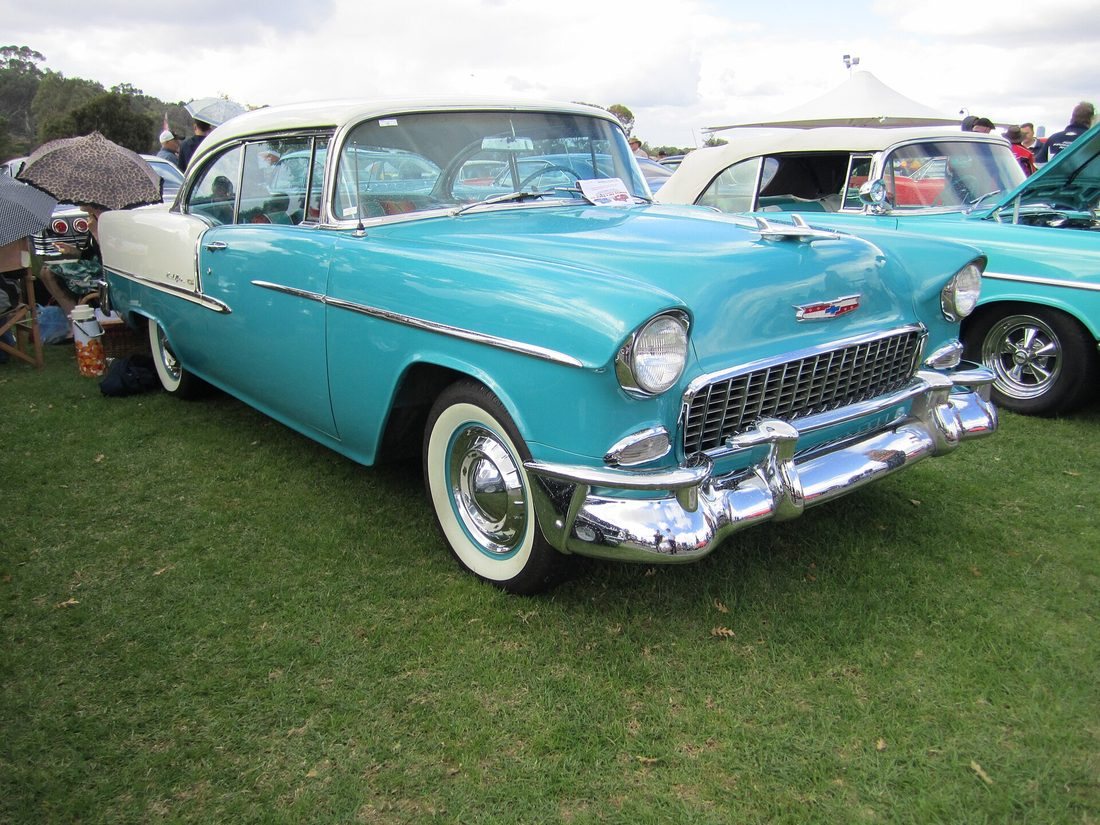
Chevrolet Bel Air
About This Book
This chapter explains what this book is, how it handles facts about a car built seventy years ago, and how to find your way through it. Read it first: five minutes here will tell you which numbers in the chapters that follow you can rely on outright, which ones you must confirm against the car in front of you, and where to begin depending on whether you are shopping for a 1955 Bel Air, learning the one you just bought, or bringing a tired car back to life.
1.1 What This Book Is
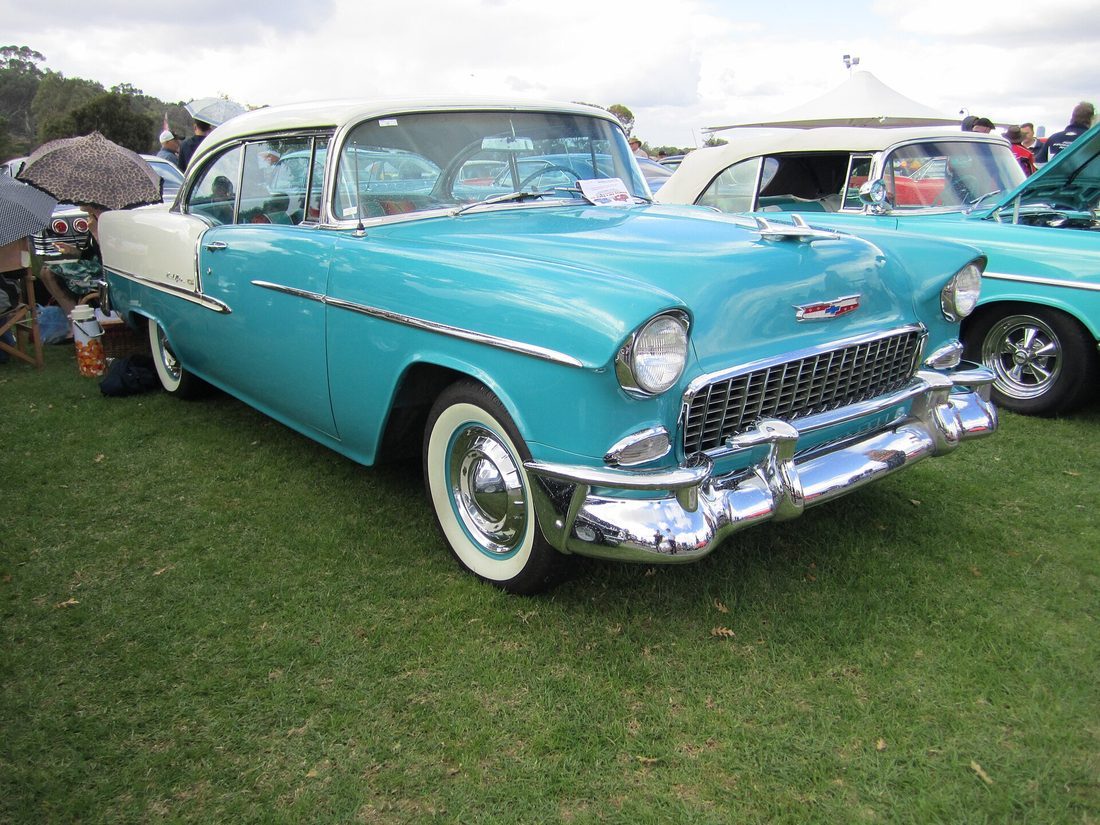
This is an owner's reference for the 1955 Chevrolet Bel Air two-door hardtop, the pillarless "no-post" body Chevrolet called the Sport Coupe. It is not a brochure, and it is not a nostalgia piece, though it was written by people who plainly love these cars. It is a single place that gathers what an owner actually needs: the specifications as the factory built them, the way to tell a real Bel Air V8 hardtop from a re-badged clone, the systems as they came, the known trouble spots, a maintenance rhythm, and a map of where the parts and the knowledge still live. On a car this heavily supported, that last point is a luxury. Almost nothing about a '55 is truly unobtanium, and this book tries to spend your time and money well rather than send you chasing it.
You do not need to read it cover to cover. It is organized so that a question, is my car really a factory V8? or why does it wander at highway speed?, leads you to a chapter, and the chapter leads you to an answer, a way to check it, and usually a realistic cost. Keep it in the glovebox or on the bench. Write in it. The margins are yours.
1.2 The Car in One Paragraph
The 1955 Bel Air is the top trim of Chevrolet's all-new "Tri-Five" car, the first of three years (1955, 1956, 1957) that share a new body, a new box-section frame, and a new 12-volt electrical system. What makes 1955 the landmark is under the hood: the 265-cubic-inch small-block V8, the first of the Chevrolet small-block family and the engine that earned the car its advertising name, "The Hot One." In base two-barrel form it made 162 horsepower; the optional four-barrel Power Pack lifted that to 180, and a late-year Super Power Pack reached about 195. The Sport Coupe body is the glamour two-door: no B-pillar between the door glass and the rear quarter window, so with both windows down the whole side opens up like a convertible with a steel roof. It was a high-volume car when new, roughly 185,000 to 189,000 hardtops built, which is exactly why survivors are plentiful and parts support today is excellent, and yet it sits near the top of the Bel Air desirability ladder alongside the convertible and the Nomad. A driver-quality V8 hardtop today runs in the neighborhood of $25,000 to $35,000, a nicely restored car $55,000 to $80,000, and a concours or heavily optioned example past $90,000. Those are working ranges, not quotes; the market is broad and it moves.
1.3 Reading a Seventy-Year-Old Car's Record
The good news is that the record on a '55 is unusually deep. Chevrolet built these cars by the million, the aftermarket has reproduced almost every part, and enthusiast clubs have been decoding and documenting them for decades. Even so, the specifics deserve care. Period sales literature rounded numbers, later references copied one another, and body-style production figures were never certified by the factory in the first place. Where two respectable sources disagree, and on total production, on Bel Air output, and even on the base V8's advertised horsepower they sometimes do, this book gives you the most commonly cited figure and tells you plainly that the sources vary, so you can weigh it rather than treat it as gospel.
Safety-related numbers carry their source right in the sentence so you can check them yourself before you rely on them. The most important one to absorb early concerns the brakes. The 1955 Bel Air uses four-wheel hydraulic drum brakes on a single hydraulic circuit, with no front discs offered and no redundancy if that one circuit fails; by modern standards the stopping distances are long and the brakes fade under repeated hard use, which is the single biggest safety caveat for anyone driving an unmodified '55, and a front disc conversion is among the most common and worthwhile upgrades owners make [SAFETY] (source: en.wikipedia.org/wiki/1955_Chevrolet). Numbers like that one are flagged where they appear. The rest of the book states its facts plainly and trusts you to verify the ones that matter on your own car.
1.4 How the Chapters Are Organized, and Where to Start
The book runs in the order of an ownership life. First the history and identity: the all-new Tri-Five, the debut of the small-block V8, the designers behind the shape, the one-year-only egg-crate grille that is the fastest way to spot a '55, the Darlington win that made the car a stock-car legend, and where the Sport Coupe sits in the range. Then the specifications: the full spec sheet, the three engines and three transmissions offered, the chassis and suspension, wheels and tires, factory colors and two-tone combinations, and original prices. Then the crucial chapter on identity and authentication: how to read the VIN on the driver's door pillar and the Fisher Body cowl tag on the firewall, because the VIN alone tells you series and V8-versus-six but not body style, and proving a genuine V8 Sport Coupe means cross-checking the VIN, the cowl tag's 1037 style number, and the engine pad stamping together. Then the systems as built, the known issues and inspection points that a car this age develops, and finally maintenance and where parts and community knowledge live today.
Where you start depends on where you stand:
- Shopping for one? Start with history and identity to learn what you are looking at, then go straight to the authentication chapter. On a car this often cloned and re-bodied, the difference between a real factory V8 Bel Air hardtop and a nicely built tribute is worth many thousands of dollars, and it is written on the tags if you know how to read them. Do that before you fall in love.
- Just bought one? Start with the specifications and systems chapters to learn exactly what you own, engine, transmission, axle ratio, then move to maintenance to learn its rhythm. If the car is unmodified, put the brake discussion at the top of your list.
- Restoring one? Read the known-issues chapter to scope the work honestly, then the parts and community chapter before you order anything. The '55 is superbly supported, but reproduction quality varies and correct-for-year details matter, so a little sourcing homework saves real money.
1.5 Verify on YOUR Car
This book describes a typical 1955 Bel Air Sport Coupe. Chevrolet built these by the hundreds of thousands across a dozen assembly plants, optioned them differently, and then turned them loose for seventy years of owners, mechanics, and modifiers. Before you rely on any number in these pages, anchor it to the actual car:
- Read the tags, not the listing. Find the VIN plate on the left front door hinge pillar and the Fisher Body cowl tag on the right side of the firewall under the hood. A VIN beginning "VC55" means a factory V8 Bel Air; a cowl style number of 1037 means the two-door hardtop body. If a seller's "numbers-matching V8 Bel Air hardtop" does not show all three signatures, VIN, cowl tag, and a matching engine pad stamp, ask why.
- Confirm the engine. The 265 V8's assembly stamp is on a pad at the front of the block, ahead of the passenger-side head, and it encodes the year and power level. A six swapped for a small-block, or one small-block swapped for another, is invisible from the driver's seat and decisive at the parts counter. The stamp outranks every document, including this one.
- Measure before you order. Axle ratios, color and trim codes, and options varied car to car. When you need a part or a specification for a job, confirm it against your own car's tags and hardware rather than the generic figure. When this book and your car disagree, the car is right.
1.6 A Note on Customized Editions
Some copies of this book are customized editions, which add a final chapter specific to one particular car: its VIN and cowl-tag decode, its engine and drivetrain, its color and options, its history and the owner's own modifications and records. If your copy carries that chapter, everything in it supersedes the "typical car" described here, because it has already done what this chapter just asked of you. It was verified on the car.
Welcome. It is a good car, honestly described, which is the only way a car this good deserves to be described.
History & Identity
The 1955 Chevrolet was a clean-sheet car in every direction that mattered: new body, new frame, new electrical system, and a new V8 that would go on to become the most-produced engine family in history. Chevrolet called it "The Hot One," and for once the ad copy was honest. Your 2-door hardtop, the Sport Coupe, was the glamour body in the top trim line, the pillarless coupe that put the whole package in its best light.
2.1 The Car That Started Over
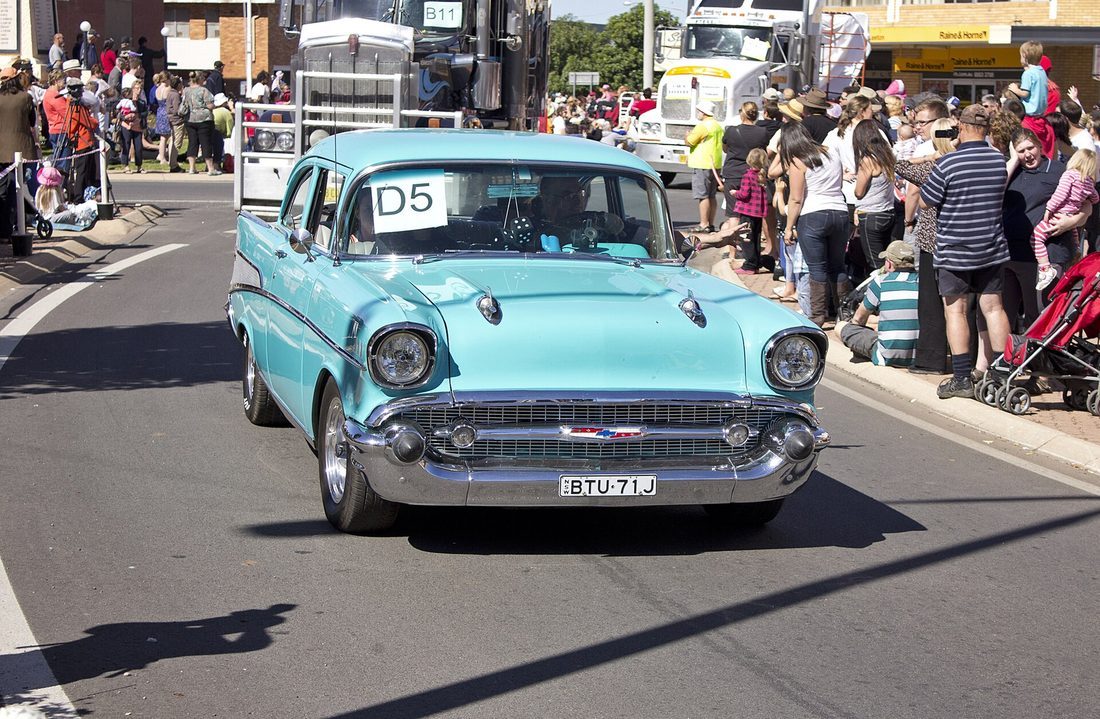
For 1955 Chevrolet did something it rarely did: it threw the old car away and started clean. Out went the rounded, prewar-derived styling of the 1949 through 1954 models. In came a completely new car with a new body, a new box-section frame with an X-member center, a fresh overhead-valve V8, and a 12-volt electrical system in place of the old 6-volt setup (source: en.wikipedia.org/wiki/1955_Chevrolet).
The 1955, 1956, and 1957 Chevrolets share this basic platform, and collectors have long grouped them under one name: the Tri-Five Chevrolets (source: en.wikipedia.org/wiki/Tri-Five). Yours is the first of the three, and in many ways the purest. The styling was crisp and flat-sided, what the trade called a "shoe-box" body, with a wrap-around windshield, hooded headlamps, and jutting triangular taillights. Set beside the bulbous car it replaced, the 1955 looked like it had arrived from a decade further on (source: conceptcarz.com/vehicle/z1859).
Chevrolet wrapped the whole effort in a marketing campaign built around two phrases. The car was "The Hot One," a nod to the new V8, and the styling-and-engineering package was branded "Motoramic," tying it to GM's traveling Motorama show (source: conceptcarz.com/vehicle/z1859). This was the year Chevrolet finally had a credible performance answer to Ford, for the first time in decades (source: automobile-catalog.com).
2.2 The Trim Ladder, and Where the Sport Coupe Sat
Chevrolet sold three trim levels for 1955. In ascending order they were the 150 (the base car, the "One-Fifty"), the 210 ("Two-Ten"), and the Bel Air at the top (source: en.wikipedia.org/wiki/1955_Chevrolet). The Bel Air was the showpiece line, marketed at the time as "the Cadillac of the low-priced field," and it wore the most brightwork: stainless window moldings, full wheel covers, extra chrome, and a nicer interior than anything below it (source: conceptcarz.com/vehicle/z1859).
Within the Bel Air line, buyers could choose from a full spread of body styles for 1955:
- 2-door sedan
- 4-door sedan
- 2-door hardtop, the "Sport Coupe"
- 2-door convertible
- 4-door station wagon (the Beauville)
- Nomad, the 2-door hardtop station wagon, offered on the Bel Air line only
(source: news.classicindustries.com/1955-57-chevy-production-numbers; source: en.wikipedia.org/wiki/1955_Chevrolet)
Your car is the Sport Coupe, and it is worth being precise about what that means. It is the pillarless 2-door hardtop. There is no B-pillar between the door glass and the rear quarter glass, so with both windows rolled down the whole side of the car opens up like a convertible with a steel roof. This "no-post" or "hardtop-convertible" look was the height of 1950s style, and it is the single feature that most distinguishes the Sport Coupe from the plain 2-door sedan. Set against that sedan, the hardtop also carries a shorter, more rakish roofline and a longer rear deck (source: automobile-catalog.com; source: conceptcarz.com/vehicle/z1859).
The hardtop body was offered on both the 210 and the Bel Air. On the Bel Air it was the glamour coupe of the entire range, the body that showed the new styling to its best advantage (source: automobile-catalog.com). That is the car you own: the top trim, in its most stylish two-door form.
2.3 The Small-Block V8: "The Hot One"
The single most important thing about 1955, the thing that made the car a legend rather than merely a handsome redesign, is the engine. The 265-cubic-inch overhead-valve V8 was the first of the small-block family, and the first V8 in a Chevrolet passenger car since the 1917 to 1918 Series D (source: conceptcarz.com/vehicle/z1859; source: automobile-catalog.com).
It was designed under Ed Cole and Harry Barr as a light, inexpensive, high-revving engine built around thin-wall castings. It weighed roughly 40 pounds less than the old inline-six, and some accounts put the saving nearer a hundred pounds, while making more power (source: en.wikipedia.org/wiki/1955_Chevrolet). That combination, more power in a lighter package, is exactly what a young engine wants if it is going to make a name for itself on the street and the track.
It did both. The specifics of the engine range, the horsepower figures and the Power Pack option, belong to the specifications chapter and are covered there in full. What matters to the story of the car is simpler: in 1955 Chevrolet handed ordinary buyers a modern V8 at a low-priced-field price, and nothing in the segment was quite the same afterward. The small-block that launched here went on to become the most-produced automobile engine family in history, which is a large part of why these cars are so heavily supported and so often modified today (source: hagerty.com/media).
2.4 The Designers
The 1955 was styled inside Harley Earl's GM Styling organization. Earl was the vice president of Styling, and he set the direction. The story that survives is that Earl saw the egg-crate grille of a Ferrari at a European show in the fall of 1953 and wanted that look for Chevrolet (source: oldcarsweekly.com).
The design work itself ran through the Chevrolet studio under Clare MacKichan, who headed that studio and led the effort that became the 1955, then went on to handle the 1956 and 1957 facelifts (source: motorcities.org; source: en.wikipedia.org/wiki/Clare_MacKichan). Carl Renner is credited with the roofline work, most famously the distinctive Nomad hardtop-wagon roof with its slanted rear pillar and ribbed top.
There is a wrinkle in the credit worth stating plainly, because you will see it if you read around. Wikipedia's short summary of the 1955 attributes the design to Bill Mitchell. That appears to be an oversimplification: Mitchell rose to run GM Styling later, and the specific 1955 Chevrolet studio work is consistently credited to Earl's direction, with MacKichan leading and Renner on the roofs. Sources differ on exactly where the credit lines fall, but the MacKichan and Renner attribution is the one the design-history sources use, and it is the one this book follows (source: motorcities.org; source: en.wikipedia.org/wiki/1955_Chevrolet).
2.5 The Nomad
One body style deserves its own mention even though it is not the one you own, because it is bound up in the identity of the whole 1955 line. The Bel Air Nomad was a two-door hardtop-styled station wagon, a show-car idea, first shown on a Corvette body at the 1954 Motorama, that Chevrolet productionized onto the full-size 1955 body.
It shared the Sport Coupe's pillarless glamour but wore it on a wagon, with a unique sloped tailgate and a grooved roof. It was the rarest and most expensive Bel Air body style when new, and it is one of the most collectible today (source: en.wikipedia.org/wiki/1955_Chevrolet; source: news.classicindustries.com/1955-57-chevy-production-numbers). If you ever hear a Tri-Five owner talk about a Nomad with a certain reverence, this is why. Your Sport Coupe shares its roofless-looking profile and its top-trim standing, without the wagon's rarity or its price.
2.6 How Many Were Built
Total 1955 Chevrolet passenger-car output was very large, and the sources differ on the exact totals. Even careful references warn that the by-body-style figures are estimates the factory never verified, so it is worth holding these numbers loosely and knowing where they disagree.
For the company as a whole, one widely cited figure puts total 1955 Chevrolet production at 1,704,667 (source: en.wikipedia.org/wiki/1955_Chevrolet), while Classic Industries' breakdown sums to 1,775,952 (source: news.classicindustries.com/1955-57-chevy-production-numbers). The round number everyone reaches for is "about 1.7 million."
For the Bel Air line specifically, one source lists 770,955 cars and Classic Industries lists 800,968, so the honest figure is roughly 770,000 to 800,000 (source: conceptcarz.com/vehicle/z1859; source: news.classicindustries.com/1955-57-chevy-production-numbers).
The Bel Air by body style, with the two source sets side by side, looks like this:
| Body style | conceptcarz | Classic Industries |
|---|---|---|
| 2-door hardtop Sport Coupe | 185,562 | 189,269 |
| 2-door sedan | 168,313 | 168,826 |
| 4-door sedan | not listed | 366,293 |
| Convertible | 41,292 | 42,278 |
| Station wagon (Beauville 4-door) | 24,313 | 25,772 |
| Nomad | 6,103 | 8,530 |
(source: conceptcarz.com/vehicle/z1859; source: news.classicindustries.com/1955-57-chevy-production-numbers)
The reading that matters for an owner is straightforward. The Sport Coupe was a high-volume car when new, roughly 185,000 to 189,000 built, the single best-selling Bel Air body after the 4-door sedan. That is why survivors are relatively plentiful and why parts support today is excellent, even though the Sport Coupe remains one of the most desirable Tri-Five bodies. You own a car that is both sought-after and well supported, which is an unusually happy combination in the old-car world.
2.7 One Year Only: Telling a '55 From a '56 or '57
If you learn one visual fact about your car, make it this one: the 1955 grille is a one-year-only feature, and it is the fastest way to identify a '55 at a glance.
- 1955 wears the egg-crate grille, a narrow chrome grille of small squares, the one Harley Earl drew from that Ferrari. It carries single hooded headlamps, small round parking lights, and simpler side trim than the later cars. The grille was actually controversial inside GM. When early sales lagged in late 1954, there was talk of scrapping it (source: oldcarsweekly.com; source: hagerty.com/media). It stayed, and it is now one of the most recognizable faces of the decade.
- 1956 switched to a full-width grille, with a restyled front and rear, revised side trim, a lower body line, and bigger bumpers. The basic body and chassis carried over unchanged (source: en.wikipedia.org/wiki/1955_Chevrolet; source: hagerty.com/media).
- 1957 was the most heavily restyled of the three. The body was lengthened several inches at the rear, it grew prominent tailfins and the famous "gullwing" front bumper and grille with twin hood rockets, moved to 14-inch wheels, and got the enlarged 283 V8 with optional Ramjet fuel injection (source: en.wikipedia.org/wiki/1957_Chevrolet).
The 1957 is the pop-culture favorite, the car most people picture when they hear "Tri-Five." The 1955 is the one prized by purists, for having the cleanest and most restrained lines of the three years, before the chrome and the fins arrived (source: hagerty.com/media; source: conceptcarz.com/vehicle/z1859). That is the aesthetic case for your car, and it is a strong one.
2.8 Darlington, 1955: Proving "The Hot One"
The new V8 made Chevrolet a stock-car force almost overnight, and the proof came at speed. The landmark result was the 1955 Southern 500 at Darlington, run on September 5, 1955, and won by Herb Thomas in a factory-backed 1955 Chevrolet prepared by the legendary Smokey Yunick. Thomas had switched from Hudson to Chevrolet, and it was his third Southern 500 win (source: en.wikipedia.org/wiki/1955_Southern_500; source: chevyhardcore.com).
It was Chevrolet's first superspeedway victory, and it was a rout: seven of the new Chevy V8s finished in the top 10. The Chevys were lighter than the big Chryslers and Buicks they beat, got better mileage, and famously ran the distance with fewer pit stops and without changing tires (source: chevyhardcore.com; source: macsmotorcitygarage.com). Chevrolet also ran speed and endurance demonstrations at Daytona Beach and Pikes Peak in 1955 as part of the marketing push, but Darlington is the headline.
That day at Darlington is a real part of why your car carries the reputation it does. The "Hot One" slogan was not just copy: the car went out and won on the biggest stock-car stage of the year, and the racing credibility fed straight into the hot-rod and performance image the Tri-Five has never lost.
2.9 Reputation, Then and Now
The Tri-Five, and the 1955 specifically, is one of the defining shapes of 1950s America and a foundational hot-rod and custom platform. The small-block V8 that launched in it became the most-produced automobile engine family ever made, which is a large part of why these cars are so heavily supported and so often modified. Among the three years, the '55 is prized for the cleanest, most restrained styling, and among the '55 bodies the Sport Coupe and the convertible are the most sought-after after the Nomad (source: hagerty.com/media; source: conceptcarz.com/vehicle/z1859).
That desirability shows up in the market. The 2-door hardtop sits, alongside the convertible and the Nomad, at the top of the Bel Air ladder (source: journal.classiccars.com; source: classic.com). Two facts move the price more than almost anything else: a V8 car is worth more than a six, and a documented factory Power Pack or other verified options add value. This is one reason the authentication work in a later chapter, matching VIN, cowl tag, and engine stamp, is worth doing carefully before you buy or sell.
Here is a working read on values for a 1955 Bel Air 2-door hardtop Sport Coupe, arranged in the condition tiers the hobby uses. Treat these as a bracket, not a quote: values differ by source and are genuinely volatile, and the ranges below are synthesized from current listing and auction data because the standard valuation pages are login-gated.
| Condition | Approximate value |
|---|---|
| #4 Fair / driver | roughly $25,000 to $35,000 |
| #3 Good | roughly $35,000 to $50,000 |
| #2 Excellent | roughly $55,000 to $80,000 |
| #1 Concours / show | commonly $90,000 and up |
(source: classiccars.com; source: trifivechevys.com; source: classic.com)
Live-market data backs the spread. Comparables for this body style on classic.com have ranged from roughly $31,000 to more than $155,000 depending on quality, restomod content, and options, and individual dealer asks in the $22,500 to $55,000 band are common for average-to-nice cars (source: classic.com; source: classiccars.com). One further note that will matter if you shop or sell: restomods, cars given a modern drivetrain and brakes, can exceed the value of a stock-restored example. As with any old car, you are buying condition and documentation, not a model year.
2.10 The Portrait
Here is your car, honestly drawn.
The 1955 Bel Air Sport Coupe is the top-trim, pillarless two-door hardtop of the first Tri-Five year: a clean-sheet Chevrolet with a new body, a new frame, a modern 12-volt system, and the 265 small-block V8 that would outlive everything else about the car and become the most-produced engine family in history. It was styled under Harley Earl with Clare MacKichan's studio doing the work, and it wears a one-year-only egg-crate grille that is the surest way to know a '55 from across a parking lot. It won at Darlington the year it was born, and it has never really left the American imagination since.
It was a high-volume car when new, roughly 185,000 to 189,000 Sport Coupes built, which is exactly why it is so well supported and so easy to keep on the road today, and yet it sits near the top of the Bel Air desirability ladder, behind only the rare Nomad and the convertible. Bought with a V8 and honest documentation, it is what it has always been: one of the best-loved shapes of the 1950s, a car that looks the part standing still and earns it moving, and one of the most rewarding classics an owner can put in a garage.
Glossary
- 235 Six
- Chevrolet's 235 cubic inch 'Blue Flame' inline six-cylinder, the standard base engine in the 1955 Bel Air.
- Alternator
- The modern alternating-current charging unit many owners retrofit in place of the original generator for stronger, steadier output, especially at idle.
- Ammeter
- The dash gauge that shows charging or discharging current rather than voltage; standard on the 1955.
- Babbitt
- A soft white-metal bearing material; a knocking, worn-bearing six is said to be 'pounding babbitt.'
- Ball Joint
- The spherical pivot at the spindle in the 1955 front suspension, which replaced the earlier kingpin; a grease-fed wear point that causes wander and clunks when neglected.
- Ball-Pivot Rocker
- The stud-mounted, ball-pivot rocker-arm valvetrain introduced on the 265 small-block, lighter and cheaper than the earlier shaft-mounted rockers.
- Bypass Filter
- A partial-flow oil filter, optional in 1955, that cleans only a fraction of the oil at a time, unlike a modern full-flow filter that passes all the oil through the element.
- Cowl Tag
- The body identification tag riveted to the firewall (cowl), encoding body style, paint, trim, and build data for the car.
- Dc Generator
- The belt-driven direct-current charging device used in 1955, before alternators; it makes little output at idle, so a hot-idling car can run the battery down.
- Hotchkiss
- A rear-drive layout in which the driveshaft carries torque and the leaf springs both suspend and locate the rear axle, taking the driving and braking loads.
- Hotchkiss Drive
- A rear-drive layout in which the driveshaft carries torque and the leaf springs both suspend and locate the rear axle, taking the driving and braking loads.
- Leaf Springs
- The semi-elliptic steel springs that suspend and locate the rear axle on the 1955.
- Matching Numbers
- A car whose major components, above all the engine, carry the numbers showing they are the ones originally installed, which raises collector value.
- Overdrive
- An optional gearset that provides a tall top ratio for relaxed, economical highway cruising below engine peak.
- Overhead-Valve
- An engine design with the valves in the cylinder head, operated by pushrods and rocker arms; the 265 V8 is an overhead-valve (OHV) engine.
- Oversquare
- An engine whose cylinder bore is larger than its piston stroke, a layout that favors higher rpm; the 265 V8 is oversquare.
- Pillarless Hardtop
- A closed body with no B-pillar between the door glass and the rear side glass, so lowering both windows opens the whole side like a convertible with a steel roof.
- Power Pack
- Chevrolet's 1955 performance option that added a four-barrel carburetor and dual exhaust to the 265 V8, raising output to 180 hp.
- Recirculating-Ball
- The steering-gear type used on the 1955, in which ball bearings circulate between the worm and nut to cut friction; it wears to vagueness with age.
- Restomod
- A car restored in appearance but upgraded underneath with modern drivetrain, brakes, or suspension.
- Rope Seal
- The braided rope-type rear main crankshaft seal used on the 265, which tends to seep oil as it ages and hardens.
- Small-Block
- Chevrolet's compact V8 engine family that began with the 1955 265 and became one of the most-produced engines ever made.
- Splash Lubrication
- An older oiling method that relies on dippers flinging oil rather than full pressure to the bearings; the 1955 235 six moved to full-pressure oiling.
- Sport Coupe
- Chevrolet's name for the pillarless two-door hardtop body, the glamour 'no-post' style with no B-pillar between the door glass and rear side glass.
- Stovebolt
- Long-standing nickname for Chevrolet's inline-six engines, and by extension their enthusiast community, from the slotted 'stove-bolt' fasteners of the early sixes.
- Treadle-Vac
- The Bendix vacuum-assisted power-brake booster offered as a 1955 option; it multiplies pedal effort but does not add a second hydraulic circuit.
- Tri-Five
- Collector shorthand for the 1955, 1956, and 1957 Chevrolets, which share the same all-new platform introduced in 1955.
- Undersquare
- An engine whose piston stroke is longer than its bore, a layout that favors low-rpm torque; the 235 six is undersquare.
- V8
- An eight-cylinder engine with two banks of four cylinders set in a V; in 1955 this was the new 265 small-block.
- Wrap-Around Windshield
- The curved 'panoramic' windshield that wraps into the A-pillars, a signature 1955 styling feature.
- X-Member
- The X-shaped central brace in the 1955's box-section frame, which stiffens the chassis but leaves the rockers and floors as the structural edges.
- Zddp
- Zinc dialkyldithiophosphate, an anti-wear oil additive important to flat-tappet engines like these; many modern low-zinc oils need a ZDDP supplement to protect the cam and lifters.