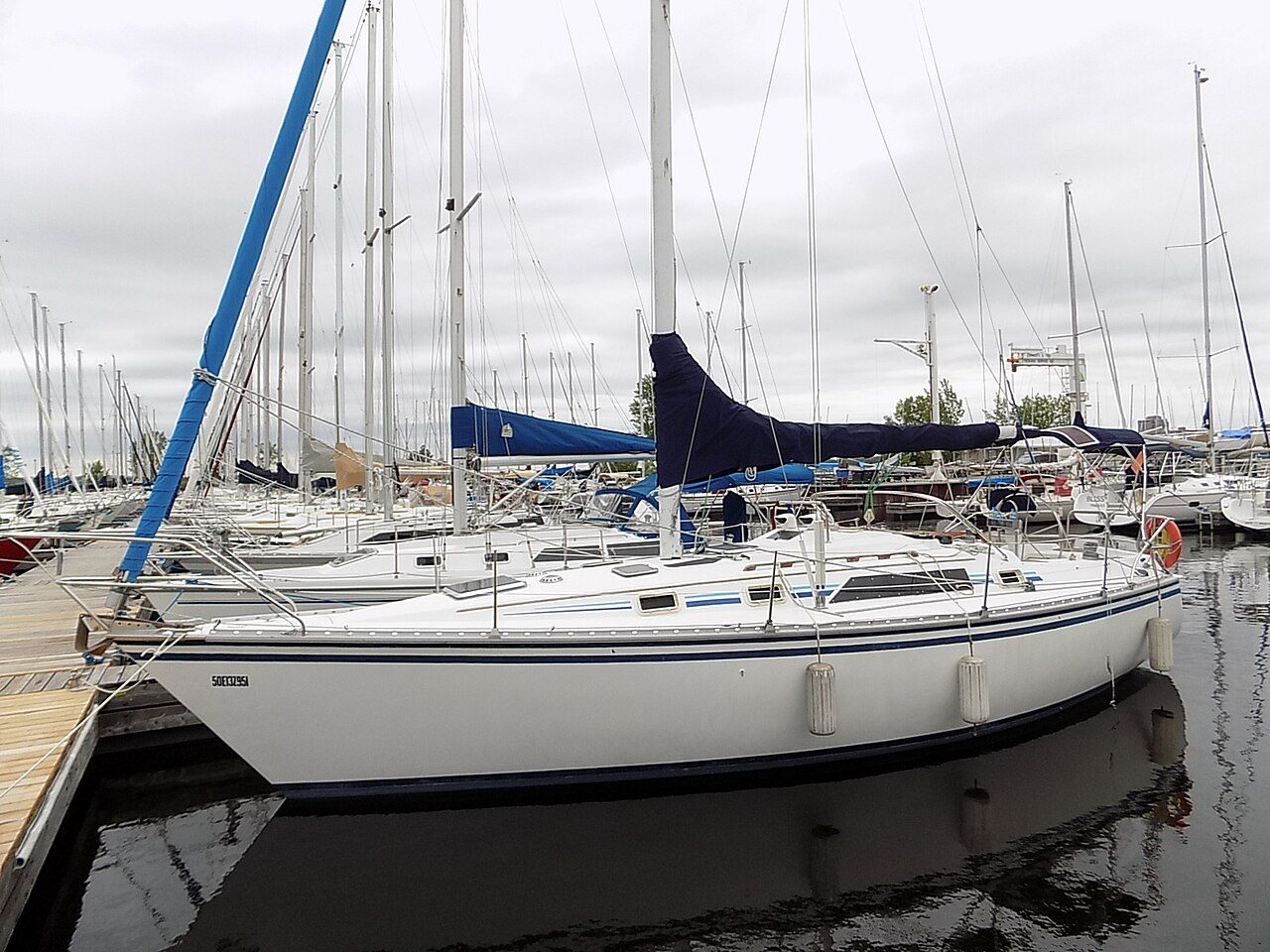
Hunter 34
About This Book
This is a sourced owner's companion to the 1983 through 1987 Hunter 34, written to help you understand, maintain, and make good decisions about your boat. It is not a factory service manual, and it is not a substitute for a qualified surveyor, rigger, or mechanic. Read this chapter first, because before any of the advice that follows can help you, you need to know exactly which Hunter 34 you own.
1.1 What this book is, and what it isn't
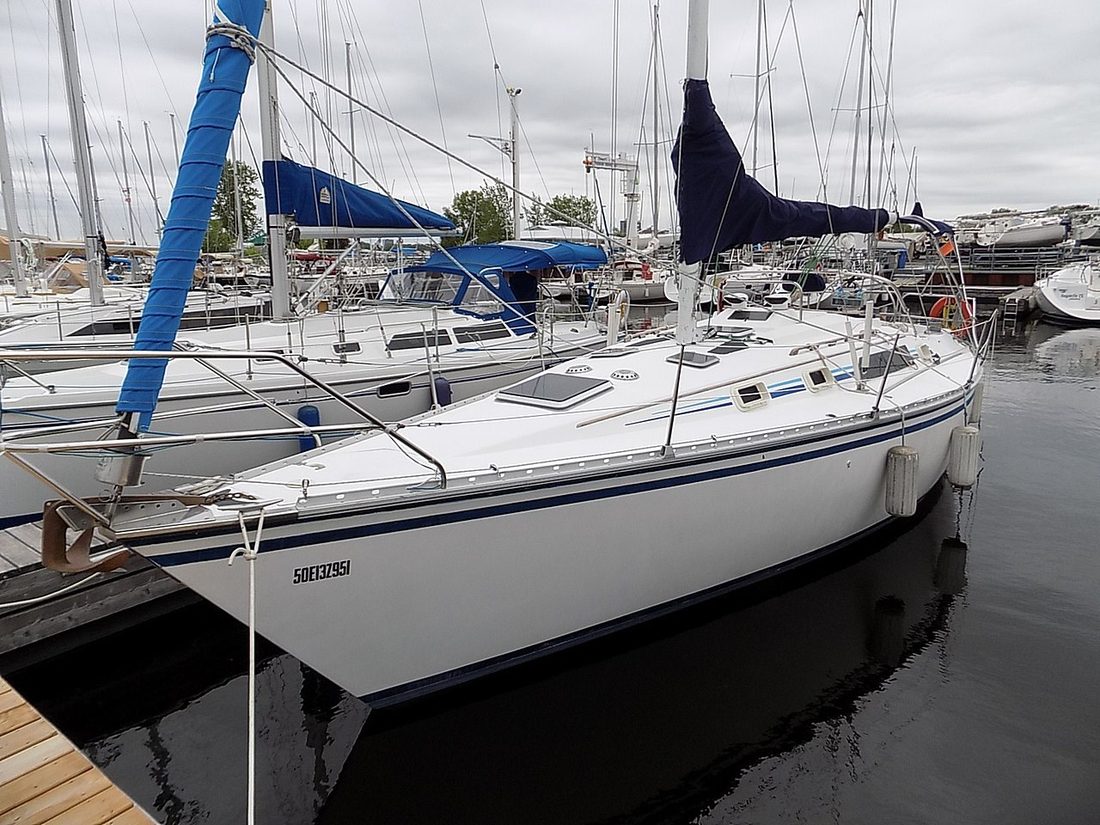
Welcome aboard. Whether you already own a Hunter 34 or you are weighing one at a broker's dock, this book is meant to sit in the chart table and earn its place there.
Here is the honest framing. This is an owner's reference, assembled from the public record: the Practical Sailor used-boat review, the sailboatdata and Wikipedia specification sets, decades of owner discussion on the Sailboat Owners forums, and brokerage listing data. Every factual claim in this book traces back to one of those sources. Where the sources disagree, you will see both numbers and a note to verify. Where only one source exists, the claim is hedged rather than dressed up as settled fact.
What this book is not:
- It is not a factory manual. Hunter Marine did not publish the kind of detailed shop documentation you would get from an automaker, and much of the original paperwork that did exist has scattered over forty years. Where a factory torque spec or wiring diagram would help, we often simply do not have one, and this book will tell you so rather than invent a number.
- It is not a substitute for a professional. A book cannot put a moisture meter on your side deck, borescope your chainplatechainplate anchors, or listen to your Yanmar run under load. When a decision carries real safety or real money, this book will point you to a surveyor, a rigger, or a diesel mechanic, and you should go.
- It is not gospel on your specific hull. Two Hunter 34s built a year apart, kept on opposite coasts, can be genuinely different boats. Use this book to know what to look for. Use your own eyes, and a professional's, to confirm what is actually there.
Think of it as the knowledgeable friend who has read everything, remembers the sources, and will tell you plainly when the answer is "it depends, go check."
1.2 How to use this book
The chapters ahead move from identity to systems to problems to upkeep. You do not have to read them in order, but you should read this chapter in full, because almost every later chapter branches on the questions below. The rudder advice, the ballast figures, the engine access notes, the rig tuning, all of it depends on which version of the boat you have.
A few conventions to know. Measurements are imperial first, metric in parentheses: a draft of 5.50 ft (1.68 m), for example. Where the sources genuinely disagree, you get both values and a nudge to verify on your own boat, and where a claim rests on a single source, often one owner's report, the sentence says so and you should treat it as a lead, not a law. A [SAFETY] flag marks something that can hurt you or sink the boat, and it carries an inline source note so you can weigh the evidence yourself.
1.3 Identify your boat: the four axes
The Hunter 34 was built by Hunter Marine of Alachua, Florida, designed by Cortland Steck, and produced from 1983 to 1987, with something over 800 hulls built in that short run (source: Practical Sailor; treat "800+" as the best available figure, not a factory audit). (You will sometimes see the design credited to John Cherubini. That is a common misattribution. Cherubini shaped Hunter's earlier line; the 34 is a Steck design.) It was the first small Hunter built with a molded hull linerhull liner, a production method that shaped how the boat goes together, and how water hides inside it, but more on that later.
Within that single model name live four real forks. Nail these down and the rest of the book snaps into focus.
1. Keel: deep fin (~5.5 ft) or shoal (~4.25 ft)
The 34 came with one of two cast iron fin keelfin keels. The metal is not perfectly settled: Practical Sailor and the rust reports say iron, while sailboat-cruising lists lead. The iron story is far better corroborated by owners, so this book leads with iron and expects iron-keel maintenance.
- Deep fin: draft 5.50 ft (1.68 m). The upwind performer.
- Shoal keel: draft 4.25 ft (1.30 m), for thin water, carrying roughly 220 lb (100 kg) of extra ballastballast to make up for the higher center of gravity (source: Practical Sailor).
There is no bolt-on wing keel on this boat, whatever a listing may claim. If you see "wing," it almost certainly means the shoal fin, or it means someone is describing a different, later Hunter. Measure your draft or check the haul-out records and know which you have, because it drives your anchorages, your cruising grounds, and your resale.
2. Vintage: pre-1985 or 1985-on
This is the cleanest "which one should I buy" line on the boat. Around 1985, Hunter made two meaningful mid-life changes (source: Practical Sailor):
- The original rudder was both too small and too weak, and owners reported the early blades cracking. A larger, stronger rudder became standard, roughly six inches longer by owner accounts.
- Roughly 450 lb (204 kg) of additional ballast went into later production.
The practical upshot: a 1985 or later boat is the more desirable used buy, with the better rudder and the added stability already built in. A pre-1985 hull is not disqualified, plenty are sailing happily, but you want to confirm whether the rudder was ever upgraded and to read the stability and helm chapters with extra care. The earliest boats also carried the weaker rudder and the less desirable engine, which brings us to the next axis.
3. Engine: Yanmar 3GMF, or an early Westerbeke 21
Most Hunter 34s left the factory with the Yanmar 3GMF, a three-cylinder, fresh-water-cooled diesel of about 22.5 hp. This is the standard and the desirable installation (source: Practical Sailor; Wikipedia lists it generically as "3GM," but 3GMF is the correct fresh-water-cooled designation).
Some of the earliest hulls instead got a Westerbeke 21 diesel, described in the reviews as the less desirable fit, and early boats of either engine drew complaints about vibration. If you are looking at a very early 34, lift the engine-box and read the plate. Knowing your actual engine changes everything downstream: parts, cooling, access, and what a survey should scrutinize.
4. Rig: a masthead B&R that keeps its backstay
This is the single most-confused fact about the boat, so read it twice. The Hunter 34 has a masthead B&R rigB&R rig that retains a standing backstay. It is not the backstayless fractional rig that later Hunters became famous for.
The B&R rig, named for the Swedish engineers Bergstrom and Ridder, uses swept-back spreaders (about 30 degrees on the 34) and diamond stays so that mast geometry carries loads a backstay would otherwise handle. On Hunter's later boats, that lets them drop the backstay entirely and fly a big-roach mainsail. But the 34 is the early, transitional version: it carries a masthead foretriangleforetriangle, meaning the headstay runs to the very top of the mast and the genoa hoists full height. A masthead foretriangle needs a backstay, and the 34 has one (source: Sailboat Owners forums, owner testimony; en.wikipedia.org Hunter 34).
So do not describe your 34 as backstayless, and do not confuse it with the fractional, backstayless Hunter 33.5 / 335 that followed it, or with any 1990s-and-later 34-footer. General B&R write-ups say "no backstay," and at least one owner reports the connection details evolved over the run, so verify what is actually rigged on your masthead rather than assuming. If a boat has a full-hoist genoa and a standing backstay, and was built 1983 to 1987, you are looking at this boat.
1.4 Know your hull: a quick checklist
Before you turn another page, fill in your own answers. Keep them handy; the rest of the book will ask.
- Model year / hull: built 1983 to 1987? Confirm it is the Steck-designed 34, not a later 34-footer or the 335.
- Keel: deep fin (5.50 ft / 1.68 m) or shoal (4.25 ft / 1.30 m)?
- Vintage: pre-1985 or 1985-on? Was the larger rudder fitted?
- Engine: Yanmar 3GMF, or an early Westerbeke 21? Fresh-water cooled confirmed?
- Rig: masthead with a standing backstay confirmed? Spreader sweep noted?
- Keel material: iron assumed; any "smile" or seam crack at the keel-to-hull joint?
If you can answer all six, you are ready for everything that follows.
1.5 A word on liability
This book is a companion, not a command. It gathers what the public record says about a mass-produced boat now four decades old, and it does its honest best to separate what is well established from what is one owner's story. But it has never seen your boat.
Nothing here replaces a qualified marine surveyor, rigger, mechanic, or naval architect. Standing rigging, chainplates, keels, engines, fuel systems, and steering are life-safety items; when this book flags one, that is your cue to bring in a professional and to trust their hands-on inspection over any general statement printed here. Specifications, procedures, and figures may contain errors, may not match your specific hull, and may have been superseded. Verify anything load-bearing before you act on it.
You, and the professionals you hire, are responsible for the safe condition and operation of your vessel. The authors and publisher of Garage, Galley & Hangar accept no liability for any loss, damage, or injury arising from the use of this book. Use it to ask better questions. Go get the real answers on the water.
History & Identity
The Hunter 34 is the boat where Hunter Marine figured out how to build a roomy, affordable cruiser fast, and then sold more than 800 of them in barely three years. She came out of the company's early in-house design shop, carries a rig that looks like the backstayless Hunters that came later but is not one, and she splits neatly into an early version and a better late version around 1985. Understanding where she sits in the Hunter story tells you most of what you need to know before you ever step aboard.
2.1 A Florida boatbuilder with powerboat blood
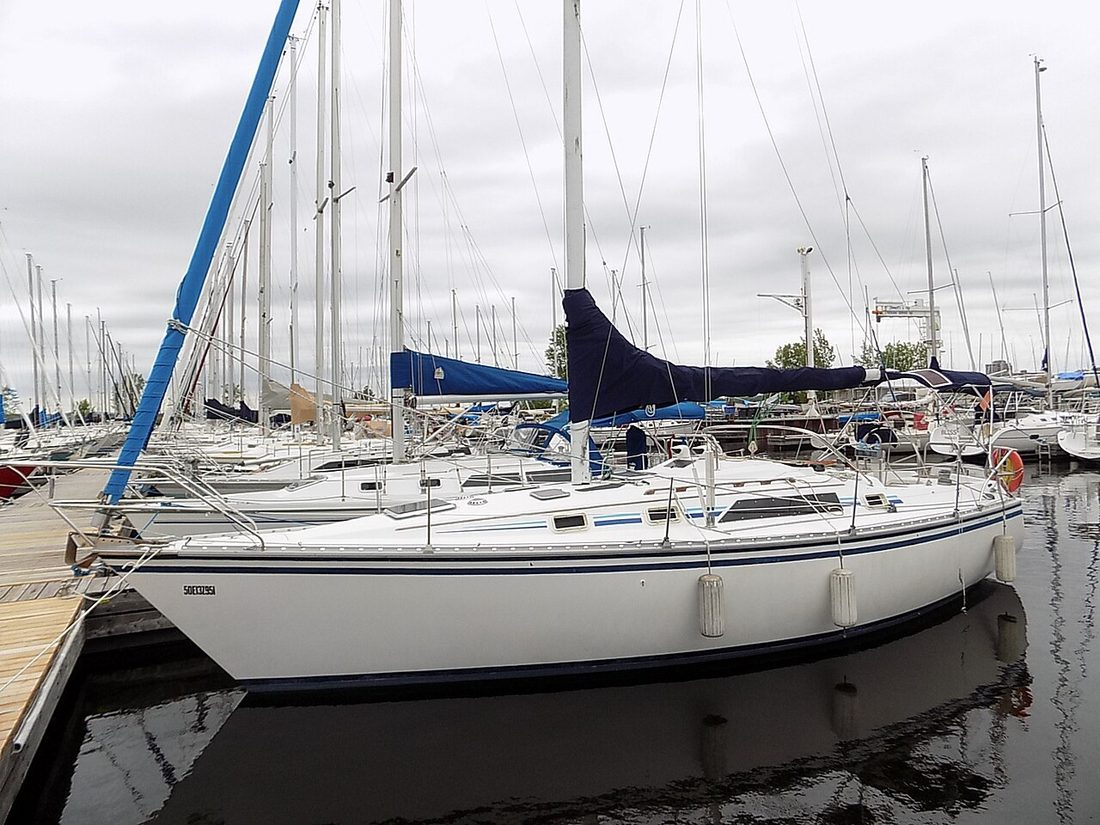
To understand your Hunter 34, start with the family that built her. Hunter Marine was founded in 1973 by Warren Luhrs in Alachua, Florida, and it did not spring up from nothing. The Luhrs name had been in American boatbuilding for two generations. Warren's grandfather, Henry Luhrs, was a German immigrant chandler and shipfitter, and by the early 1960s Henry and his sons John and Warren were turning out over a thousand powerboats a year. When the family expanded the Luhrs Marine Group into sailboats, Hunter Marine was the result.
That powerboat heritage matters more than it might seem. Hunter approached sailboats the way a high-volume powerboat builder approaches its product: build a lot of them, build them efficiently, and price them so an ordinary family can afford one. That philosophy is stamped all over your 34, from the molded interior to the "more boat for the buck" marketing. It is also the source of both the boat's greatest strength (space and value) and its most-criticized weakness (a reputation for being lightly built). (source: en.wikipedia.org/wiki/Hunter_Marine; soundingsonline.com)
Over roughly forty years, Hunter would go on to produce more than 30,000 sailboats across about 99 models, making it one of the largest sailboat builders the United States has ever had. You will sometimes see a much larger figure quoted, on the order of "100,000 hulls," but that number appears to fold in the family's powerboat production as well, so treat 30,000 sailboats as the honest sailboat count. Either way, the scale is the point: your 34 was never a boutique yacht. She was a product, made in volume, and that is not an insult. It is her identity.
2.2 From Cherubini to the in-house team
Hunter's design history breaks into eras, and knowing which era your boat comes from settles a surprising number of arguments.
The company's first model was the Hunter 25 of 1973, designed by John E. Cherubini. Cherubini set Hunter's early design language, and his most respected work for the company was the solidly built Hunter 37 Cutter launched in 1978. For much of the 1970s and into the early 1980s, Cherubini was the outside designer whose hand shaped the line. His reputation for well-regarded, seaworthy boats is strong enough that his name gets attached, sometimes loosely, to a lot of early Hunters.
Here is where you need to be careful, because your 34 sits right at a handoff. By the early-to-mid 1980s Hunter was transitioning from Cherubini's outside work to an in-house design effort, and the key figure in that shop, and the man credited with the Hunter 34, is Cortland Steck. Four independent sources point to Steck as the designer of the 34: sailboatdata, Wikipedia, Practical Sailor, and sailboat-cruising.com. The 34 is a Steck design and an early in-house design, not a Cherubini design.
You will run into two competing claims, so let us weigh both honestly. First, a secondary reference credits the boat's lineage to John Cherubini rather than Steck. This is understandable given how much of Hunter's early identity Cherubini created, and given that the 34 arrived just as the company was moving away from him, but the weight of primary spec sources credits Steck, so that is what we go with. Second, one AI-summarized search result asserted that the 34 "was designed by renowned naval architect Glenn Henderson." That is almost certainly an error, a conflation with Henderson's much later Hunters. Every primary specification source names Steck. Use Steck; treat the Cherubini and Henderson attributions as flags to verify, not as the answer.
For the sake of orientation, here is how the design leadership ran:
- 1973 to early 1980s: John Cherubini, outside designer.
- Early-to-mid 1980s: transition to in-house design. Your Hunter 34, credited to Cortland Steck, is a product of this window.
- 1991 onward: Rob Mazza, a Canadian designer, was brought in to run design and production and created boats like the 29.5 and 336. Later still, Glenn Henderson and an in-house team carried the line through roughly 2010.
Your boat, then, comes from the moment Hunter stopped hiring its design out and started doing it in-house. She is a foundational boat for the company's next thirty years, which is part of why she is worth understanding on her own terms.
2.3 Where the 34 sits in the line
The Hunter 34 was introduced in late 1982 as the second boat of Hunter's "modern" generation, following the flagship Hunter 54. Production ran from 1983 through 1987, and in that short span over 800 boats were built, a strong showing for a boat of this size and era.
A note on that production figure: the "over 800" number traces back to a single source family (Practical Sailor and sailboat-cruising.com share text on this point), so it is the best available figure rather than a factory-audited count. Treat it as "more than 800, give or take," not as a precise hull tally. The exact split between deep-keel and shoal-keel boats, and the precise hull-by-hull totals, are not independently verifiable, so if a broker quotes you a hard number, take it with a grain of salt.
What the 34 represents inside Hunter's factory is genuinely important. She was the first "small" Hunter built with a molded hull liner and molded interior furniture components. Hull liner Instead of assembling the interior from many separate wooden components, Hunter dropped a big molded pan into the hull and had most of the furniture in place at once.
This was a production-efficiency breakthrough, and it defined how Hunter built boats for decades afterward: fast assembly, lower cost, more interior volume delivered for the money. It also came with a lasting downside that you will meet again in later chapters. The liner can trap water between itself and the hull, and it hinders access to the hull's inner surface, the backs of fittings, and parts of the plumbing. When you go looking for a stuffing-box drip or a hull-to-deck fastener, the liner is often what stands between you and the problem. That trade, easy to build versus hard to service, is baked into your boat's DNA.
2.4 The Cruise Pac pitch
Hunter did not just build the 34 cheaply, the company marketed her cheaply and cleverly under the "Cruise Pac" concept. A Cruise Pac boat was delivered fully equipped at a fixed price, with sails, ground tackle, and basic electronics included in the deal. The message was blunt and effective: more boat for the buck, ready to sail, no nickel-and-diming on a long options sheet. Ground tackle
For a first-time buyer stepping up into a 34-foot cruiser, that was an attractive proposition, and it is a large part of why the boat sold so well. It also tells you something about the original owner and how the boat was positioned: this was an entry-level cruiser aimed at families and coastal sailors who wanted space and simplicity, not a semi-custom yacht aimed at connoisseurs. Keep that in mind when you evaluate build quality. You are not looking at a flaw so much as a design brief that was executed exactly as intended. (source: practical-sailor.com; sailboat-cruising.com)
2.5 The rig: masthead B&R with a backstay, and why that matters
If you learn one thing about your Hunter 34's identity, learn this, because it is the single most-confused fact about the boat.
Your 34 has a masthead B&R rig that RETAINS a backstay. She is not the fully backstayless fractional B&R rig that Hunter later became famous for. This is a hybrid unique to these years, and getting it right will save you from buying the wrong parts, reading the wrong forum threads, and misunderstanding how your own boat is tuned.
Let us unpack it. B&R stands for Bergstrom and Ridder, the Swedish engineers behind a rig that uses swept-back spreaders and diamond stays so that mast pre-bend and shroud geometry carry loads that a backstay would normally handle. In its full, mature form, a B&R rig is backstayless, and that is the configuration that became a Hunter trademark on later models.
But your 34 is the early, transitional B&R. She has the B&R signatures, spreaders swept back about 30 degrees and diamond stays, yet she also carries a masthead foretriangle, meaning the headstay runs all the way to the top of the mast and the genoa hoists to the masthead. A masthead foretriangle needs a backstay to balance that forestay load, and so your boat has one. Owners of these boats are explicit about it. In their own words:
"The H-34 does have a B&R rig but it was an earlier version which did have a backstay, with spreaders that are too short and not swept back as much as the rigs with no backstay."
"The 34 Hunter has a full foresail, which indicates a masthead rig. Masthead rigs require backstays."
One 1984-boat owner confirmed the 30-degree spreader sweep and noted that the mast can be temporarily unstepped or craned with the backstay removed at haulout. (source: forums.sailboatowners.com)
Why does this distinction matter so much? Because the classic mental image of a Hunter, the backstayless boat with a big roachy mainsail you physically cannot rig a backstay across, describes the later fractional B&R boats: the 33.5, the Legend series, and everything after. Your 34 is a masthead boat with a more conventional, genoa-driven sail plan and a standing backstay present and doing real work. Do not describe your 34 as backstayless, and do not shop for backstayless-Hunter rigging or advice.
A few practical identity notes that flow from the rig, flagged here and expanded in later chapters. The 34's rig has no forward lower shrouds, no baby stay, and no inner forestay, and on reaches and runs the mainsail will fetch up against the spreaders and shrouds. It is a rig that rewards careful tuning and can frustrate a novice. The mast stands over 51 feet above the waterline, with the forestay running roughly 49 feet, which also confirms the masthead identity: this is a tall, headsail-driven rig, not a short fractional one. (source: practical-sailor.com)
2.6 Two keels, and the ballast question
Your 34 came from the factory with one of two fin-keel options. Note that both are fins. The wing keels, bulb keels, and tandem keels you may have seen on Hunters of this size all belong to the later 33.5 and Legend boats, not to your 34.
- Deep fin keel: draft 5.50 ft (1.68 m), the performance and upwind choice.
- Shoal-draft keel: draft 4.25 ft (1.30 m), for thin-water and gunkholing cruisers. The shoal keel reportedly carried roughly 220 lb of extra ballast to make up for its lower depth and center of gravity.
There is a genuine disagreement over what that ballast is made of, and it is worth settling here because it affects how you survey the boat. Practical Sailor says the keels are iron, and that they left the factory "without adequate protection to avoid rusting," which lines up with a well-documented pattern of keel rust on these boats. Sailboat-cruising.com, by contrast, lists the ballast as lead at 5,000 lb. The iron narrative is the better-corroborated one, supported by multiple owner reports of keel rust and of the hairline crack at the keel-to-hull joint that owners nickname the "Hunter Smile." So lead with iron, and regard the lead figure as the outlier. Either way, the keel-to-hull seam is a survey-worthy area on any 34 you consider.
2.7 Early boat, late boat: the 1985 mid-life update
If you remember one thing for buying, remember this: there is an early Hunter 34 and a better late Hunter 34, and the line falls around 1985.
The 1983 launch boats carried an original rudder that was undersized and prone to cracking, along with somewhat lower ballast. The earliest hulls may also carry a Westerbeke 21 diesel rather than the Yanmar that became standard, and early boats drew engine-vibration complaints. None of this makes an early boat a bad boat, but it is a boat with known first-generation growing pains.
Around 1985, Hunter made two meaningful improvements. A larger, stronger high-performance rudder became standard, curing the weak-rudder problem, and roughly 450 lb of additional ballast was added. Together these changes stiffened the boat and fixed her most nagging structural weak point. The result is clean and simple advice: a 1985-or-later boat is the more desirable used buy, and when you look at any 34, one of your first questions should be whether it is a pre-1985 or a post-1985 hull. (source: practical-sailor.com)
These change points rest mainly on Practical Sailor's reporting, and the exact date the standard engine shifted from Westerbeke to Yanmar is not precisely documented, so treat the "around 1985" boundary as a reliable guide rather than a hard serial-number cutoff.
2.8 The end of the run: enter the Legend 35
The Hunter 34's production life ended the way successful production boats usually do, with a replacement. In late 1986, Hunter introduced the Legend 35, described at the time as replacing "Hunter's hugely popular 34-foot model." That makes 1986 effectively the phase-out year, with the 34 lingering into 1987 as the last few hulls came off the line.
The Legend 35 was a different, larger boat in Hunter's new Legend series, not a facelift of your 34, so do not treat the two as interchangeable. The point for you is timing: your boat closed out an era. She was the production cruiser that proved the molded-liner, Cruise Pac, in-house-design formula worked, and Hunter carried that formula forward into the Legend boats and beyond. (source: spinsheet.com; practical-sailor.com)
2.9 Reputation: roomy, affordable, honestly imperfect
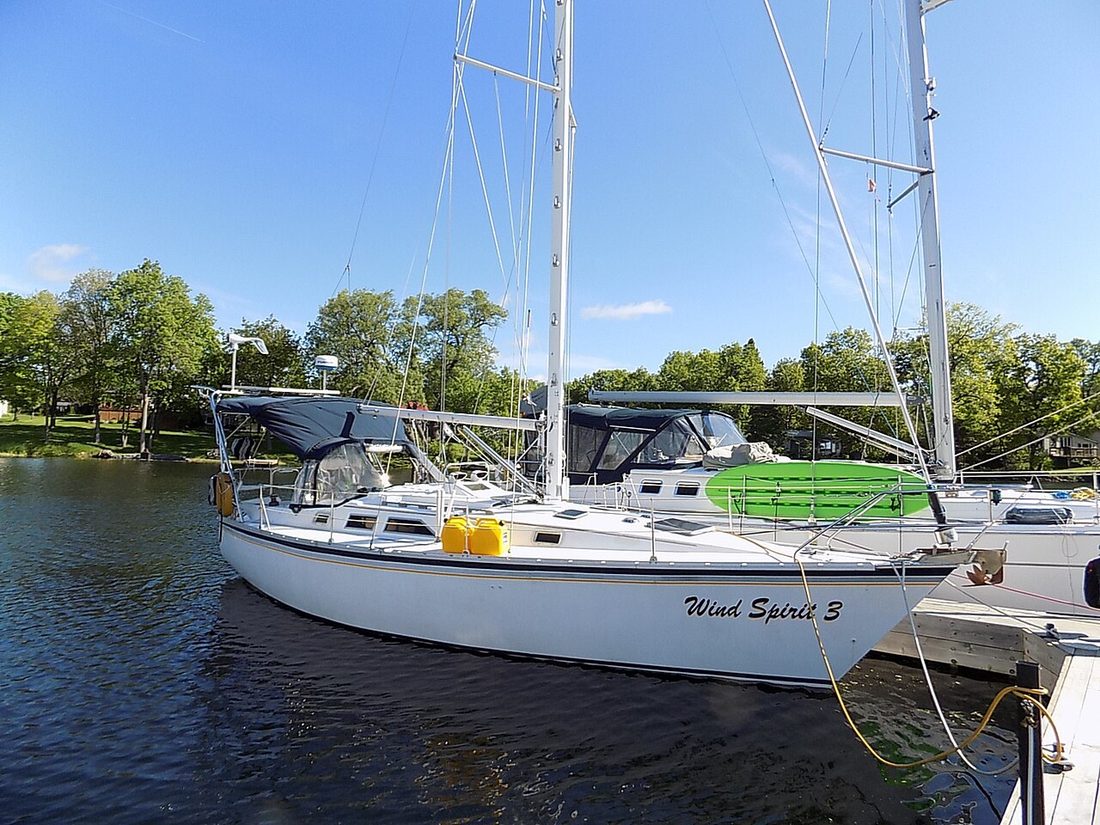
So what kind of boat did all of this add up to? A fast, roomy, affordable coastal cruiser that gives you an unusual amount of interior volume for 34 feet, and that asks you to remember what you bought.
Practical Sailor's verdict is a fair summary: the 34 suits a buyer who wants "a fast, modern small coastal cruiser with maximum room at minimum cost," but "remember that you're buying a mass-produced boat," so do not expect custom quality. On the plus side, these boats are genuinely fast upwind, they offer big interior volume for the length, and owners who moved up from smaller Hunters reported real gains in design and workmanship. The value proposition, more boat for the buck, was real.
She is also tender and lively. Despite a ballast-to-displacement ratio around 42 percent, which on paper reads "stiff," owners describe both keel versions as tippy, wanting a reef by around 15 knots of true wind upwind, with substantial weather helm reported. That tenderness comes from the hull form and the tall masthead rig rather than from any lack of ballast. She is best understood as a competent, roomy coastal cruiser, not a bluewater boat. Her capsize screening number sits right around the 2.0 offshore threshold, which is borderline, and the consensus use case is "coastal cruising and occasional offshore passages rather than extreme blue-water voyaging."
Finally, honesty about the weak points, because they are part of the identity and every one of them is expanded later in this book. The survey checklist for a Hunter 34 includes the original small rudder on pre-1985 boats, iron-keel rust and the "Hunter Smile" seam crack, deck gelcoat voids and blisters with possible outer-laminate separation from the core, light and crack-prone hatches and locker lids, hull-to-deck bolts sometimes left untorqued at the factory, stuffing-box leaks trapped between the liner and hull, a holding-tank system that tends to smell, and a wooden mast compression post that can rot if bilge water is allowed to sit against it.
None of that should scare you off. It should focus you. Your 34 is exactly what she was designed to be: a lot of well-shaped, fast, comfortable coastal boat sold at a price ordinary sailors could reach, built with the efficiency of a company that grew up making powerboats by the thousand. Know her origins, know that she is a masthead B&R boat with a backstay, know whether yours is an early or a late hull, and you already understand her better than most people who walk the dock.
2.10 A quick word on not buying the wrong boat
Because so many later Hunters share numbers close to "34," it is worth pinning down what your boat is not.
- The Hunter 33.5 / "335" (1987 to 1994) is the model that followed in this size class, and it is the opposite rig: a fractional, fully B&R, backstayless sloop. It spun off the Moorings 335 charter boat. If a rig has no backstay, it is not your 34.
- The Hunter 336 (1995, Rob Mazza) is a further, separate update. Different boat.
- The Hunter Legend 35 / 35.5 (1986 on) is the direct successor, a larger Legend-series design.
- The 1990s and 2000s 34-footers, such as the Hunter 340, the Hunter 34-2, and the Marlow-Hunter 34, are entirely separate later designs from the Glenn Henderson era, with different hulls and backstayless fractional rigs.
When a listing says "Hunter 34," confirm two things before you get excited: a 1983 to 1987 build year, and a masthead rig with a backstay. Those two facts together guarantee you are looking at the boat this book is about.
Glossary
- Acr
- An automatic charging relay: a device that joins two battery banks to charge together when a charging source is present, then isolates them so loads on one bank cannot drain the other.
- Alachua
- A small town in north-central Florida, near Gainesville, that has been Hunter's home since the company began.
- B&R Rig
- A rig developed by Swedish engineers Bergstrom and Ridder that uses swept-back spreaders and diamond stays so mast bend and shroud geometry carry loads a backstay would otherwise handle; in full form it needs no backstay at all.
- Ballast
- Heavy material, usually lead or iron, placed low in the keel to lower the boat's center of gravity and provide the righting force that keeps a sailboat upright and counteracts the heeling force of the wind on the sails.
- Barrier Coat
- A series of epoxy coatings applied below the waterline to seal the hull laminate against water absorption and osmotic blistering.
- Borescope
- A slender camera or optical probe passed through a small hole to inspect hidden spaces such as a chainplate cavity or an engine cylinder.
- Chainplate
- A strong metal strap or fitting bolted to the hull or a structural bulkhead to which the standing rigging (shrouds and stays) attaches, transferring the enormous loads from the mast and rig into the boat's structure.
- Chainplate Anchor
- The buried structural fitting a chainplate or its tie rod attaches to below deck; on the Hunter 34 an angle-iron anchor that can corrode where deck leaks reach it.
- Compression Post
- A vertical structural member beneath a deck-stepped mast that carries the mast's downward compression load through the cabin to the keel or a floor structure, preventing the deck from sagging under rig loads.
- Cortland Steck
- The designer credited with the Hunter 34, working in Hunter's early in-house design group in the mid-1980s.
- Crevice Corrosion
- A localized form of corrosion that attacks stainless steel in tight, oxygen-starved gaps, such as under fittings or inside swage terminals, where the protective oxide layer cannot renew itself. It is a common hidden failure mode in rigging and chainplates.
- Cutless Bearing
- A water-lubricated sleeve bearing, with a grooved rubber inner surface, that supports the propeller shaft where it exits the hull; it wears out and must be replaced periodically.
- Decompression Levers
- Small levers on a diesel that hold the valves open to release compression, letting the engine spin freely for hand-cranking or easier starting.
- E
- E, the mainsail foot length, measured along the boom from the aft face of the mast to the black band (the maximum outhaul point).
- Edson
- A long-established American maker of marine steering systems and pedestals.
- Electrolysis
- Loosely, the galvanic or stray-current corrosion of underwater metals; strictly, corrosion driven by an external electrical current rather than simple dissimilar-metal action.
- Fin Keel
- A relatively short, deep ballasted keel attached to the bottom of the hull, offering good upwind performance and maneuverability compared with a long full keel, at the cost of some directional stability and grounding robustness.
- Foretriangle
- The triangular area bounded by the mast, the forestay, and the deck, within which the jib or genoa sets; a masthead foretriangle runs the headstay to the top of the mast.
- Glow Plugs
- Electric heating elements in some diesels that warm the air to aid cold starting; the Yanmar 3GM does not use them.
- Ground Tackle
- The anchor and its associated gear (rode, chain, shackles) used to moor or anchor a boat.
- Heat Exchanger
- A component in a freshwater-cooled (indirect) engine cooling system where engine coolant is cooled by raw seawater flowing through a bundle of small tubes, transferring heat without the two fluids mixing, much like an automotive radiator cooled by water instead of air.
- Hull Liner
- A large one-piece molded fiberglass inner shell dropped into the hull that forms furniture, berths, and cabin surfaces in a single part, instead of building them from separate pieces of wood and glass.
- I
- I, the rig's foretriangle height, measured from the sheer (deck level) to the top of the forestay fitting.
- Impeller
- The flexible rubber, vaned rotor inside a raw-water pump that draws seawater through the engine's cooling system. Its vanes wear and can shear off, so it is a routine maintenance-replacement item; running the pump dry destroys it quickly.
- J
- J, the foretriangle base, measured horizontally along the deck from the front of the mast to the forestay's attachment at the bow.
- John Cherubini
- A noted Hunter designer of the 1970s-80s, sometimes wrongly credited with the Hunter 34, which is attributed to Cortland Steck.
- Keel Bolt
- One of the bolts securing an externally-bolted ballast keel to the hull; a critical structural fastener to inspect and torque-check.
- Keel Smile
- A crack in the hull-to-keel joint that curves in a smile shape, usually appearing at the leading edge of the keel joint. It indicates flexing or a grounding impact and signals that the keel bolts and joint should be inspected.
- Mast
- The vertical spar that supports the sails and rigging. On the Citation 34 it is a masthead configuration, meaning the forestay runs to the very top of the mast.
- Mast Beam
- The transverse structural beam under the deck that supports a deck-stepped mast and carries its compression load down into the hull.
- Masthead
- The top of the mast; a masthead rig runs the forestay and backstay to the very top, as opposed to a fractional rig.
- Mixing Elbow
- A fitting at the engine's exhaust outlet where cooling raw water is injected into the hot exhaust gas, cooling the exhaust and carrying the water overboard. It is prone to internal carbon and salt buildup and corrosion, and is a common failure point requiring periodic replacement.
- Moisture Meter
- A handheld instrument that estimates the relative moisture content of a fiberglass laminate or cored panel by sensing its electrical properties. Surveyors use it to find wet deck core or hull areas, though readings are comparative and require experienced interpretation rather than giving an absolute wet/dry verdict.
- Oem
- Original Equipment Manufacturer, referring to parts or components made by the company that supplied the original item, as opposed to aftermarket substitutes. OEM parts are specified to match factory fit and specification.
- P
- P, the mainsail luff length, measured along the aft face of the mast between the black bands (the maximum hoist of the mainsail).
- Practical Sailor
- An independent sailboat and gear review publication, cited throughout this book as a primary source.
- Racor
- A common brand of fuel filter/water separator, so ubiquitous the name is used generically.
- Raw Water
- The seawater (or lake water) drawn from outside the boat and pumped through the engine's cooling system or heat exchanger, as opposed to the enclosed freshwater coolant. Also the untreated water fed to a watermaker.
- Rig Tension
- The tension set in the standing rigging when tuning the mast, measured with a tension gauge; both too little and too much cause problems.
- Sailboat Owners Forum
- SailboatOwners.com, a large online community with active model-specific boards, including the main Hunter owners' forum.
- Saildrive
- A propulsion system in which the engine drives the propeller through a leg that passes straight down through the hull, similar to the lower unit of an outboard, rather than through a conventional angled shaft and stern gland.
- Sheaves
- The grooved wheels inside blocks or at the masthead over which halyards and other lines run.
- Sloop
- A sailboat with a single mast carrying one mainsail and one headsail (jib or genoa). It is the most common modern sailboat rig, valued for simplicity and good upwind performance.
- Stuffing Box
- The fitting where the propeller shaft exits the hull, packed with greased flax or fitted with a seal to keep the sea out while allowing the shaft to spin; also called a packing gland.
- Swage
- A wire terminal fitting attached by compressing (swaging) a metal sleeve tightly onto the end of a wire rope under high pressure. Swage terminals are common on standing rigging but can develop cracks or crevice corrosion over time.
- Tie Rod
- A tension rod that transfers a load; on the Hunter 34 the stainless rod linking a chainplate to its buried anchor.
- Wikipedia
- The online encyclopedia, used here as a secondary cross-reference for production and specification data.
- Yanmar 3Gmf
- The 22.5 hp three-cylinder fresh-water-cooled Yanmar marine diesel fitted to most Hunter 34s, a member of the same GM family as the 3GM30F.
- Zinc Anode
- A sacrificial block of zinc attached to underwater metal parts that corrodes in place of them, protecting propellers, shafts, and fittings from galvanic corrosion. It must be inspected and replaced before it is fully consumed.