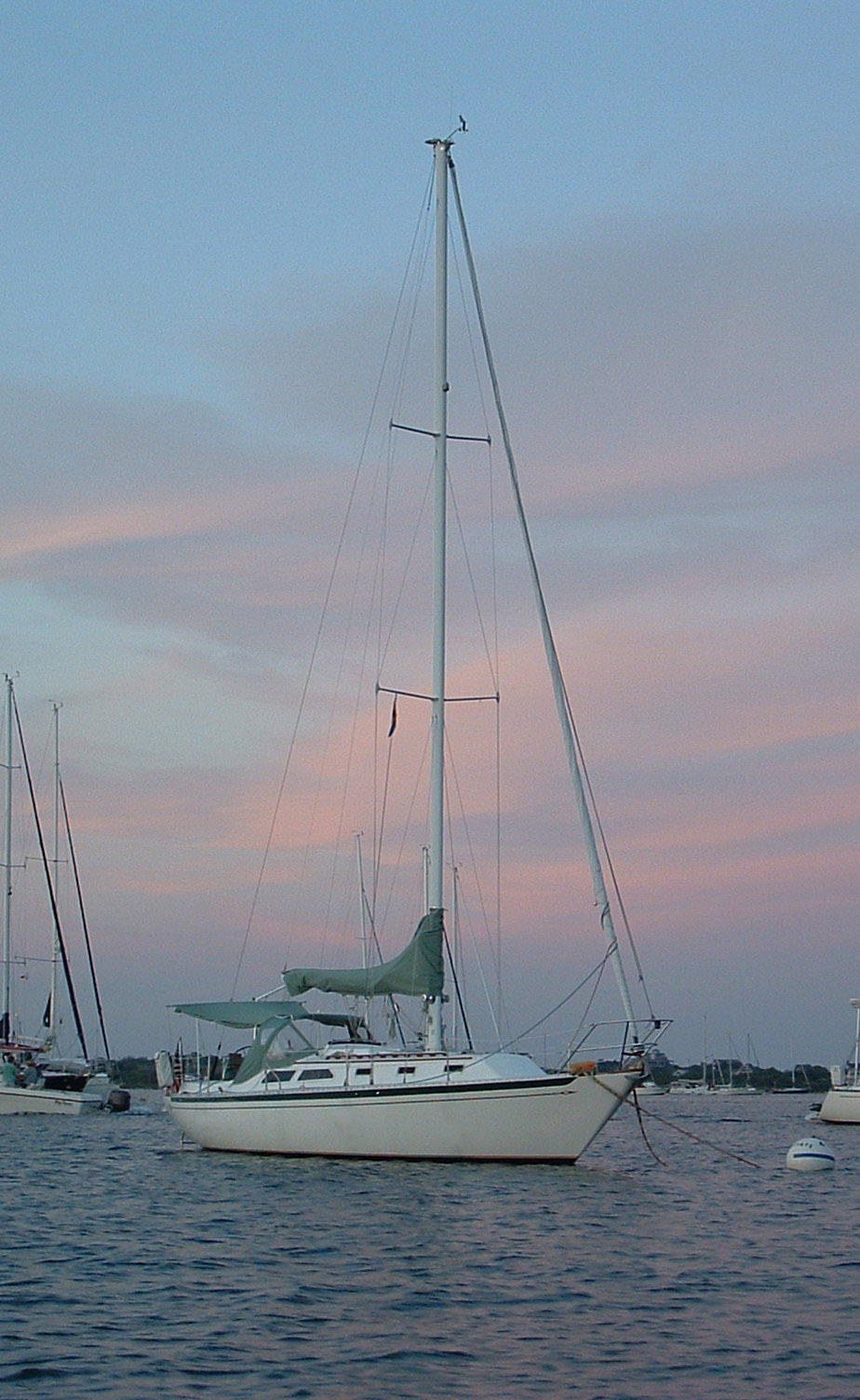
Islander 36
About This Book
This is a sourced owner's companion to the Islander 36: what the boat is, how to tell which version you have, and where to look first before you buy, insure, or trust one offshore. It is not a factory manual, and it does not replace a surveyor, a rigger, or a mechanic. Read this chapter first, then use the rest to know what questions to ask.
1.1 What this book is, and what it isn't
The Islander 36 is one of the most numerous and longest-lived 36-foot production sailboats ever sold in the United States, and it is lucky enough to have an owners' association that has been documenting its quirks for more than fifty years. This book stands on the shoulders of that work. Everything here is drawn from published reviews, the class association's technical archive, forum reports from owners doing the actual repairs, and the standard specification sources. Where those sources disagree, you will see both figures and a note to verify on your own boat. Where a claim rests on a single owner's account, it is hedged as such.
That sourcing discipline is the whole point, so it is worth being blunt about the limits. This is a companion, not a factory manual. Islander Yachts is long gone, closed in 1986, and no complete builder's documentation survives in these sources. Detail changed across a fifteen-year production run, and most of these boats are now forty to fifty years old and have been re-engined, re-tanked, re-wired, and re-rigged at least once. Treat every specification in these pages as an as-built baseline that your specific hull very likely no longer matches.
More important: this book cannot see your boat. It can tell you that the chainplate attachment is the Islander 36's defining structural weak point, but it cannot tell you whether yours is sound. That is a job for a surveyor with a moisture meter, a rigger who will drop and dye-check your fittings, and a diesel mechanic who will run your engine under load. Nothing in this book is a substitute for any of those three people. Use it to know what to look for and what to ask. Then hire the professionals to look.
1.2 How to use this book
Read this chapter to place your boat in the model's history and to fix the check-first items in your mind. Then treat the remaining chapters as reference, not narrative. When your rig feels loose, go to the rigging and mast-step material. When the engine runs hot, the cooling path is laid out step by step. The maintenance chapter carries an interval schedule you can work from season to season.
Two conventions run throughout. First, imperial units lead, with metric in parentheses, because that is how the boat was built and how the fleet talks. Second, safety-critical claims carry an inline source note so you can weigh them, and diesel-specific service lives in the engine chapter rather than being scattered here.
1.3 Identify your boat
Before any of the specifics land, you need to know which Islander 36 you own or are looking at. The boat was built from roughly 1971 into the mid-1980s, and it varied along a handful of axes that genuinely change how you maintain, sail, and insure it.
Year and series. Production ran from 1971 through the company's 1986 closure, with a gap of roughly 1980 to 1983 around the builder's bankruptcy and change of ownership. About 770 hulls is the most-cited total, though the association's own history records a competing claim of slightly more than 1,000 built. Use ~770 as the working figure and know the larger number exists. The practical point is that a 1972 boat and a 1984 boat can differ in engine, tankage, and structural detail, so hull number and year matter. Early boats (roughly 1971 to 1973) in particular carry the least-reinforced version of the structure discussed below.
Keel. The standard boat is a fixed fin keel drawing 6.00 ft (1.83 m), a lead casting bolted to the hull. A shoal keel option drew about 4.9 ft (1.45 to 1.5 m, the spread being rounding). Deep-draft boats sail measurably better, roughly six seconds per mile quicker, which matters in one-design and handicap racing. One wrinkle to verify: most hulls use lead ballast, but some early boats are reported to have iron keels instead, and that changes the corrosion story at the keel bolts. Confirm your keel material.
Rig. The Islander 36 is a masthead sloop with a keel-stepped aluminum spar, double spreaders, and double lower shrouds. Two rigs were offered: the standard rig (I = 45.0 ft) and a tall rig for light-air areas, about two feet taller in the mast (I = 47.0 ft) with correspondingly larger sails and higher loads. Confirm which rig you have before ordering sails or wire, because spreader spacing and standing-rigging lengths differ.
Steering. The boat was designed with a tiller, and most owners have since retrofitted wheel steering, typically an Edson chain-and-cable system to a quadrant on the rudder post. This is worth knowing because on any given boat the wheel gear is an aftermarket installation whose quality varies. Inspect the whole run, not just the pedestal, and keep the emergency tiller aboard and confirm it fits.
Engine. This is the axis that trips up buyers most, because the Islander 36 shipped with at least six different powerplants over its life: the gasoline Universal Atomic 4 and Palmer P-60 on earlier boats, and in diesel the Perkins 4-108, the Westerbeke L-25, a VW-based Pathfinder, and later Yanmars in the 30 to 37 hp range. The classic diesel is the Perkins 4-108, a four-cylinder naturally aspirated engine of about 1.76 L, rated roughly 40 to 50 hp depending on the install (the exact rating quoted for the Islander 36 varies). But do not assume any engine by year. Most surviving boats have been repowered, commonly to Yanmar. Open the hatch and read the data plate.
Interior. The standard layout sleeps six: V-berth forward, head to port, two saloon settees, galley to starboard, and a small navigation station to port, under 6 ft 4 in of headroom. The interior styling, with its elliptical cabin top and integrated liner, is the model's genuine claim to fame and helped push the whole industry toward livable sailboat interiors. That same molded liner can complicate access to the hull for repairs, so factor it in.
1.4 Check these first
Every older boat has a short list of items that decide whether it is a project or a keeper. On the Islander 36, from the known-issues record, these are the ones to put at the top of any survey:
- Chainplates and their bulkheads. This is the single most-cited structural concern on the boat. The narrow shroud base means upwind loads on the weather shrouds can approach the total displacement of the boat, and on early models the chainplates bolt to a plywood bulkhead that is not bonded to the hull
[SAFETY](source: practical-sailor.com). Add chronic leaking at the deck slot, which rots that same bulkhead, and hidden crevice corrosion in the stainless, and you have the boat's defining failure mode. Rust streaks at a chainplate slot are a stop-work item. - The cored deck. The deck is cored, described as half-inch plywood by the primary review and as balsa core in forum discussion; either way, water from deck fittings rots it. Sound the whole deck, concentrating on the mast step, chainplates, stanchion bases, and the toe-rail line. Core rot near the mast partners can lead to a dismasting
[SAFETY](source: practical-sailor.com). - The rudder. The skeg-hung rudder rides in a bronze gudgeon at the base of the skeg, and that lower bearing is prone to electrolysis on under-protected boats. Check for shaft play and bronze-shoe wear with the boat hauled.
- The keel joint and keel bolts. Watch for "the smile," a transverse crack at the hull-keel joint, and inspect the cast-in J-bolts for corrosion. Torque figures in circulation vary widely, so verify for your hull rather than trusting a single number
[SAFETY](source: islander36.org). - The mast step. The keel-stepped mast sits low where salt water collects, and the aluminum mast step corrodes and can "weld" the mast to the step. Slack rig and corrosion powder at the base are the tells.
- The hull-deck joint. Chronic leaks track along the through-bolted hull-deck joint under the aluminum toe rail and surface far from where they entered, feeding the deck-core rot above.
1.5 Know-your-hull checklist
Before you go further, write down the following for your specific boat:
- [ ] Hull number and model year
- [ ] Keel type (deep 6.0 ft or shoal ~4.9 ft) and keel material (lead or iron, verify)
- [ ] Rig type (standard I = 45 ft or tall I = 47 ft)
- [ ] Steering (original tiller or retrofit wheel, and who built the wheel install)
- [ ] Engine make, model, and hours, read off the data plate (original or repowered)
- [ ] Fuel and water tank material and condition (aluminum tanks of this era are end-of-life)
- [ ] Chainplate and bulkhead condition, plus date of last standing-rigging replacement
- [ ] Documented history of deck-core, keel-joint, or mast-step work
1.6 A word on liability
This book is written in good faith from the best sources available, but it is a starting point, not a warranty. Boats are dangerous, rigs come down, keels and rudders fail, and diesel and fuel systems burn. The information here may contain errors, may not apply to your particular hull after fifty years of modification, and can never account for the condition of a boat the authors have never seen. You are responsible for your own vessel and crew. Before you buy, sail hard, go offshore, or carry out any repair described in these pages, have the relevant systems inspected by a qualified surveyor, rigger, or marine mechanic, and follow their judgment over anything written here. Use this book to ask better questions. Use professionals to answer them.
History & Identity
If you own an Islander 36, you own a boat that outlived the company that built it, outsold most of its rivals, and quietly helped change what the inside of a production sailboat is allowed to look like. This chapter tells you where your boat came from: the Costa Mesa builder that changed hands almost as often as it changed molds, the British naval architect who drew the hull between commissions for far grander ocean racers, and the West-Coast owners who turned a mass-market cruiser-racer into one of the longest-running one-design fleets in the country. Knowing that story is not trivia. It explains why your boat sails the way it does, why its interior feels a generation ahead of its build date, and why, decades after the last hull left the plant, there is still an organized community ready to help you keep yours going.
2.1 A boat built to last, from a company that didn't
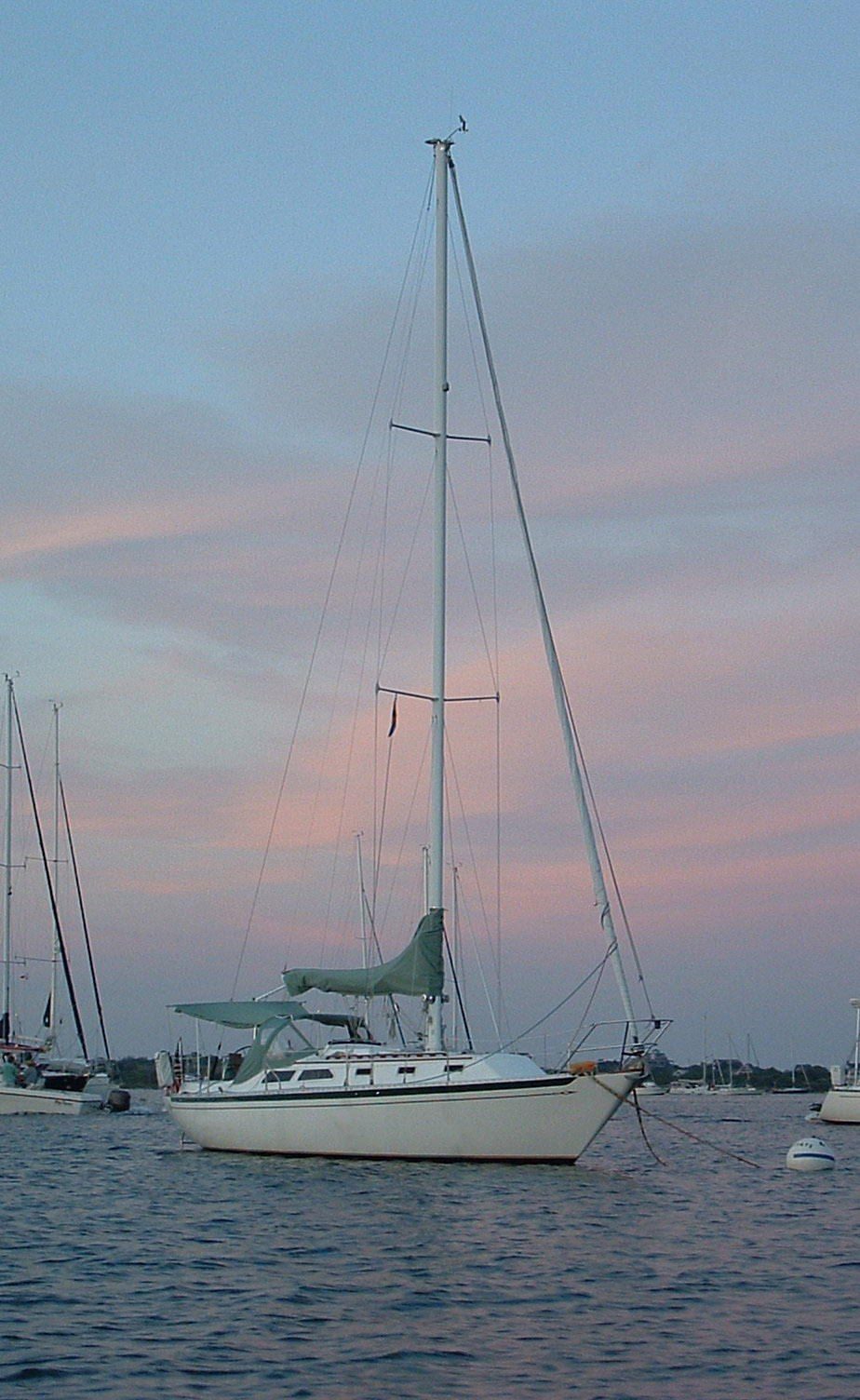
Let us start with the paradox at the center of your boat's history. The Islander 36 is one of the most numerous and longest-lived 36-foot production sailboats ever sold in the United States, built across roughly a decade and a half with something like 770 hulls launched. Yet the company that built it, Islander Yachts, was financially unstable for most of that run, changing owners repeatedly and finally closing its doors in 1986. The boat was the steady thing. The business around it was not.
That contrast matters for you as an owner because it shapes what "factory support" means today, which is to say it means almost nothing, and what the owners' community means, which is to say it means almost everything. But we will get to the living fleet later. First, the story of how your boat came to be.
2.2 Islander Yachts and the Wayfarer lineage
The company traces back to a man named Joseph McGlasson, who in the mid-1950s designed and built the original wooden 24-foot "Catalina Islander." That little wooden boat is the source of the "Islander" name your 36 still carries. In 1961 McGlasson partnered with a firm called Glass Laminates to build the boat in fiberglass, and by 1963 the operation had incorporated as Wayfarer Yacht Corp., with McGlasson as principal owner and designer.
From there, ownership churned in a way that tells you a great deal about the era's boatbuilding economics. Two partners, Ralph Brown and Ben Kanter, reportedly bought McGlasson out of bankruptcy for ten thousand dollars in late 1963. The company was sold again in 1968 to a firm called Cosmodyne, then to Radlon Inc. in 1971, after which Cosmodyne regained control, and later still it passed to a group called Mission Marine and Associates. When Mission Marine filed for Chapter 11 bankruptcy in 1979, Fuqua Industries acquired Islander, and it was Fuqua that finally shut the operation down in March 1986.
You will sometimes see secondary accounts compress all of this into "Islander Yachts, later Tradewind Yachts." Treat the Tradewind Yachts name with caution. The owners' association's own detailed history does not foreground it, documenting instead the Cosmodyne, Mission Marine, and Fuqua chain above, so the "Tradewind" label rests on secondary accounts alone and is not one to rely on.
Where your boat was actually built. Production began in Costa Mesa, California, and later moved to a larger facility in Irvine, a plant with roughly 30,000 square feet of offices and 70,000 square feet of production space that opened in 1974. Some popular accounts add that late production shifted to Costa Rica in 1984 before the 1986 closure, but that claim appears only in AI-summarized secondary sources and not clearly in the association's primary history, so the Costa Rica move is doubtful and should not be assumed. For practical purposes, essentially every Islander 36 you will encounter is a product of the Costa Mesa and Irvine run.
One more historical footnote worth carrying with you. When Islander closed, the molds were reportedly purchased by Newport Offshore Yachts in 1986, but it is not known whether any further boats were built from them. So when you date your hull, you are dating it to the 1971-to-mid-1980s California production, full stop.
2.3 The design, and the two men behind it
Here is where the Islander 36 gets genuinely interesting, and where its claim to being a "modern classic" is earned rather than marketed.
The hull and rig were drawn by Alan Gurney, a British-born naval architect who is far better known for large, exotic custom ocean racers than for volume production boats. Gurney's name is attached to Windward Passage, one of the most famous ocean racers of its day, along with yachts named Guinevere and Kittiwake. Against that backdrop, the Islander 36 stands out as one of his relatively few high-volume designs. You are, in a real sense, sailing a Gurney hull that happened to be built by the hundreds instead of one at a time.
But the boat was a collaboration, and the collaborator is the reason your interior looks the way it does. Industrial designer Joe Artese created the deck and the interior while Gurney supplied the hull and rig, and Islander's president, Ken Smith, was credited with introducing the boat to the sailing public. Artese did things that were unusual for a production sailboat of the early 1970s. He used the segment of an ellipse, rather than the usual circle, to form the cabin trunk, and he sloped the cabin sides for ergonomic improvement. The result was an interior that felt designed rather than merely assembled.
How big a deal was that? The naval architect Robert Perry, no easy grader, later wrote that Artese's interior work "forced designers to incorporate architecture and interior design into boats," transforming the sailboat interior from what he called a "boy's cabin in the woods" into something closer to a "condo." That is a striking claim, and it is the strongest single hook in your boat's story: the Islander 36 is not just another fiberglass sloop from the 1970s. It is a landmark in production-interior design, a boat that helped push the whole industry toward the livable, architectural interiors that buyers now take for granted.
What the design was aiming at. The boat was drawn in the early years of the IOR, the rating system that dominated offshore racing in that era, but Gurney and Islander deliberately built it as a balanced, seaworthy family boat rather than a rule-beater. The stated goal was a boat that was fast yet seaworthy, comfortable for family cruising, and competitive in club racing. Its measured IOR Mark I rating was 27.9, and reviewers are candid that it "was not a particularly fast or successful IOR boat." Yet under PHRF, the handicap system most club sailors actually race under, it proved reasonably competitive. That gap, mediocre under IOR but strong under PHRF and as a one-design, is precisely what let it endure as a cruiser-racer long after the IOR fleet it was born into faded away.
2.4 How many, and over what years
Two numbers matter to an owner: when your boat was built, and how many siblings it has.
The years. Most sources place the production run from 1971 through 1985, and the company's 1986 closure is sometimes used to stretch the window to 1971 through 1986. There is one wrinkle you should know about, because it affects hull dating: the association notes a production gap roughly from 1980 to 1983, which lines up neatly with the Mission Marine bankruptcy of 1979 and the subsequent Fuqua takeover. In other words, boats were not rolling out steadily every single year. If your hull dates to the early 1980s, that gap is part of why examples from those years are relatively scarce.
How many. The record genuinely disagrees here, and you should know both figures. The most commonly cited number is roughly 770 hulls, described variously as "approximately 770 units" and "a reported 770 hulls." Practical Sailor's used-boat review says "more than 750 were constructed," which is consistent with the ~770 figure. Against that, the association's own history records a competing claim that "slightly more than 1000" boats left the Costa Mesa plant. We treat 770 as the headline figure, since it is the most widely corroborated, while noting honestly that a roughly 1,000 count exists in the association's narrative and may reflect a looser total or a different counting method. Verify against your hull number and the association's records if the exact figure matters to you.
There is a useful sanity check buried in the fleet's history. The San Francisco association records that by spring 1979, 560 boats had been launched. That fits a ~770 total spread across 1971 to 1985 with a slow early-1980s stretch, and it is one more reason to trust the ~770 figure over the ~1,000 one.
A note on how much work each boat took. Each Islander 36 reportedly averaged around 700 labor hours to build, a high figure for a production boat of its day, attributed to its complicated interior liner and secondary molds. That number is not just a builder's statistic. It is direct evidence of how interior-heavy this design was, and it connects straight back to the Artese interior that made the boat's reputation. You are the beneficiary of those 700 hours every time you go below.
2.5 Series and year-to-year variation
The Islander 36 was not a single frozen design, and if you are shopping or comparing notes with other owners, a few variations are worth knowing.
The most important is keel. Your boat came with either a deep fin keel, drawing about 6 feet, or an optional shoal keel drawing closer to 4 feet 9 inches. The keel was usually a lead casting bolted to the hull, though both Good Old Boat's review and the class association's keel-bolt page report cast-iron keels rather than lead on some hulls, most likely genuine year-to-year variation. Treat the keel material as an open question to confirm on the specific boat when you inspect it, because it changes the corrosion story at the keel bolts. The two draft options are not just a cruising convenience. Deep-draft boats are reportedly about six seconds per mile faster, which is meaningful when you are racing one-design or under PHRF against your own class.
There is also a tall rig variant documented alongside the standard rig in the association's own rig-dimension records and in independent saildata sources. So when you compare mast heights or sail areas with another owner, confirm which rig you are each talking about before you conclude anything is wrong with your numbers.
And of course there is the engine, which changed substantially over the production life. Because the powerplant depends so heavily on year and options, the engine story gets its own full chapter later in this book. For now, know only that early boats often carried a gasoline Universal Atomic 4, that the Perkins 4-108 diesel became the signature optional engine, and that later boats appeared with Westerbeke, Pathfinder, and Yanmar diesels. Do not assume anything about your boat's engine from its model name alone. Check the boat.
2.6 What the boat is, in plain terms
Strip away the history and here is the boat itself. The Islander 36 is a masthead sloop with a hull of solid, single-skin fiberglass and a plywood-cored deck, a fin keel of bolted-on lead, and a skeg-mounted rudder turning on a stainless stock in a bronze bearing, all steered by a wheel. It measures a touch over 36 feet on deck with a LWL of about 28 feet 3 inches, a beam of 11 feet 2 inches, and a displacement around 13,450 pounds with roughly 5,450 pounds of lead ballast. That works out to a ballast ratio near 40 percent, which makes the boat moderately stiff, and a displacement-to-length ratio in the moderate range that marks it as a modest-displacement cruiser rather than either a heavy bluewater boat or a light-air sportboat.
Down below, the standard layout sleeps six, with a V-berth forward, a head to port just aft of the bow cabin, a main saloon with two settees, a galley to starboard, and a navigation station to port. Headroom is a generous 6 feet 4 inches, which is a big part of why the boat feels roomy for its length, though the 6-foot-4 figure comes from a single secondary source and should be taken as approximate to the inch even if it is clearly in the right neighborhood.
The honest word from reviewers is that the boat sails better than it stows. On the water it is rated "very quick and responsive," with good tracking and stability, it points well, and it is fast on a reach and stable on a run. Below and in the cockpit, the same reviews flag real compromises: poor ventilation, a cramped navigation station tucked under the sidedeck, a small galley with a sloping sole, a deep cockpit that limits helm visibility, small cockpit drains, and no bridgedeck. Those are not deal-breakers, and later chapters will help you live with or improve several of them, but they are part of the honest identity of the boat, and you should know them going in.
2.7 The living fleet: why this boat is not really an orphan
Now for the part of the identity that sets the Islander 36 apart from nearly every other out-of-production 1970s cruiser-racer. Most boats of this vintage are orphans, supported only by scattered forum posts and luck. Yours is not, because of the Islander 36 Association.
The association formed on November 17, 1973, organized by Lou Zevanov at Coyote Point Yacht Club, with Wayne Hallenbeck elected as its first commodore. It has been running ever since. As of 2026 it is celebrating its 52nd year, which makes it one of the longest-running single-model owner associations in the United States. This is not a dead archive. The association's site carries a current-year race schedule, current-year race results, a working-cruise calendar, and an up-to-date officer roster, with a sitting commodore and an active events calendar including seasonal cruises on San Francisco Bay.
The geographic heart of the fleet is San Francisco Bay, where the core racing unit is known as Fleet One and where the boat has proven especially well suited to local conditions. Membership is open nationally, but the active, in-person fleet is concentrated on the West Coast and in Northern California. The association's own historical narrative has referenced on the order of 150 boats in the Bay and Delta area, though you should treat that as a historical figure rather than a verified current census, since the association does not publish a live boat count.
One-design racing is still real. This is not nostalgia. The one-design class continues, with an I-36 Nationals Regatta first held in October 2003, run by the San Francisco Yacht Club as part of its fall one-design program, and Islander 36s regularly take podium positions in PHRF racing, particularly on the Bay. A 2010 association newsletter referenced an active core of purpose-built one-design boats still racing, though that specific count comes via an AI summary and is best treated as approximate. The larger point stands: decades after the builder closed, people still line these boats up on a start line and race them against each other.
What the association does for you. In practice it functions as a de-facto parts and knowledge clearinghouse for an out-of-production boat, which is exactly the resource an orphaned-brand owner usually lacks. It maintains a technical and maintenance archive, a vendors directory, member buy-and-sell listings, a newsletter with back issues spanning decades, blueprint and rig-dimension records, PHRF and performance data, and even a ship's store with burgees and half-hull models. When you have a question about your boat that this manual does not answer, the association is very often the place that will.
2.8 Where it sits in the Islander line, and why you should care
The Islander 36 was the standout of a broad Islander range that stretched across many sizes, and it earned its place through the combination this chapter has traced: a respected Gurney hull, a genuinely influential Artese interior, a keel-and-rig menu flexible enough to suit both cruisers and racers, and a build volume large enough to seed a lasting community. Other Islanders came and went. This one became the model the brand is remembered for, and the one with the organized fleet still behind it.
For you, the takeaway is practical, not sentimental. You own a boat with a real design pedigree, a well-documented history, a large pool of sister ships to compare against, and an unusually strong support network for its age. That combination is why the Islander 36 is fairly called a modern classic cruiser-racer: roomy, good-sailing, affordable, and, thanks to the people who never stopped racing and maintaining them, still very much alive. The rest of this book is about keeping your example that way.
Glossary
- Alternator
- The engine-driven generator that charges the batteries while the engine runs.
- Backstay
- The stay from the masthead to the stern that keeps the mast from falling forward and controls forestay tension.
- Baffle
- An internal partition in a tank that slows the sloshing of liquid.
- Ballast
- Heavy material, usually lead or iron, placed low in the keel to lower the boat's center of gravity and provide the righting force that keeps a sailboat upright and counteracts the heeling force of the wind on the sails.
- Balsa Core
- A layer of lightweight end-grain balsa wood sandwiched between two skins of fiberglass to create a stiff, light composite panel used in decks and sometimes hulls. Its main vulnerability is water intrusion through unsealed fastener holes, which can rot the wood and delaminate the panel.
- Barrier Coat
- A series of epoxy coatings applied below the waterline to seal the hull laminate against water absorption and osmotic blistering.
- Blister
- A fluid-filled bubble in a fiberglass hull's gelcoat or laminate, caused by water permeating the resin (osmosis); widespread blistering can indicate laminate saturation.
- Bridge Deck
- A raised sill between the cockpit and companionway that keeps a flooded cockpit from draining below.
- Bulkhead
- A structural partition across the hull that stiffens it and divides the interior; chainplates often attach to bulkheads.
- Cabin Trunk
- The raised structure above the deck that gives headroom in the cabin.
- Chainplate
- A strong metal strap or fitting bolted to the hull or a structural bulkhead to which the standing rigging (shrouds and stays) attaches, transferring the enormous loads from the mast and rig into the boat's structure.
- Chainplates
- A strong metal strap or fitting bolted to the hull or a structural bulkhead to which the standing rigging (shrouds and stays) attaches, transferring the enormous loads from the mast and rig into the boat's structure.
- Clevis Pin
- A pin passed through a fork (clevis) fitting to connect rigging parts, secured by a cotter or ring.
- Core
- A lightweight material (balsa, plywood, or foam) sandwiched between fiberglass skins to stiffen a deck or hull panel without much added weight; if water gets in, the core can rot or delaminate.
- Crevice Corrosion
- A localized form of corrosion that attacks stainless steel in tight, oxygen-starved gaps, such as under fittings or inside swage terminals, where the protective oxide layer cannot renew itself. It is a common hidden failure mode in rigging and chainplates.
- Cruiser-Racer
- A boat designed to both cruise comfortably and race respectably, as opposed to a dedicated racer or cruiser.
- Cutless Bearing
- A water-lubricated sleeve bearing, with a grooved rubber inner surface, that supports the propeller shaft where it exits the hull; it wears out and must be replaced periodically.
- Damper Plate
- A spring-cushioned disc between the engine flywheel and the transmission that absorbs torsional shock and vibration; a worn one causes rattling in neutral.
- Delamination
- Separation of the bonded layers in a fiberglass laminate or cored panel, often from water intrusion or impact; it shows up as soft spots or a dull sound when tapped.
- Displacement-To-Length Ratio
- A number comparing a boat's weight to its waterline length; low is light, high is heavy.
- Dorade
- A boxed ventilator that admits air below while trapping and draining spray.
- Dripless Seal
- A shaft seal that stops seawater at the propeller shaft without the steady drip of a traditional stuffing box.
- E
- E, the mainsail foot length, measured along the boom from the aft face of the mast to the black band (the maximum outhaul point).
- Emergency Tiller
- A simple lever or bar that fits directly onto the rudder post to steer the boat by hand if the main steering system fails.
- Exhaust Elbow
- The metal fitting where cooling water joins the engine's exhaust; it corrodes internally and is a common failure point.
- Fin Keel
- A relatively short, deep ballasted keel attached to the bottom of the hull, offering good upwind performance and maneuverability compared with a long full keel, at the cost of some directional stability and grounding robustness.
- Furler
- A device that rolls a sail around a stay or foil for setting and stowing.
- Gelcoat
- The pigmented resin outer layer of a fiberglass hull or deck that provides a smooth, glossy, waterproof finish and protects the underlying laminate from UV and water. It can craze, chalk, or blister with age.
- Genoa
- A large jib that overlaps the mast, giving more sail area in lighter wind.
- Gudgeon
- The fixed socket on the hull or transom that a rudder pintle drops into, forming the rudder hinge.
- Half-Hull
- A carved half-model of a hull, used historically for design and now as a decorative award.
- Heat Exchanger
- A component in a freshwater-cooled (indirect) engine cooling system where engine coolant is cooled by raw seawater flowing through a bundle of small tubes, transferring heat without the two fluids mixing, much like an automotive radiator cooled by water instead of air.
- Holding Tank
- The onboard tank that stores sewage (black water) from the marine head until it can be pumped out ashore or discharged legally offshore.
- Hull-Deck Joint
- The seam where the hull and deck moldings are joined, a common source of leaks.
- I
- I, the rig's foretriangle height, measured from the sheer (deck level) to the top of the forestay fitting.
- Impeller
- The flexible rubber, vaned rotor inside a raw-water pump that draws seawater through the engine's cooling system. Its vanes wear and can shear off, so it is a routine maintenance-replacement item; running the pump dry destroys it quickly.
- Injector
- The nozzle that sprays atomized fuel into a diesel cylinder.
- Ior
- The International Offshore Rule, a 1970s-80s racing handicap rule that shaped many hull designs of the era.
- J
- J, the foretriangle base, measured horizontally along the deck from the front of the mast to the forestay's attachment at the bow.
- Keel Bolt
- One of the bolts securing an externally-bolted ballast keel to the hull; a critical structural fastener to inspect and torque-check.
- Lift Pump
- The pump that draws fuel from the tank and feeds the engine's injection system.
- Lwl
- Load waterline length, the hull length at the waterline, which sets a displacement boat's hull speed.
- Mast Partners
- The reinforced deck opening that supports a keel-stepped mast where it passes through the deck.
- Mast Step
- The fitting or structure the base of the mast sits on, on deck over a compression post or on the keel.
- Masthead
- The top of the mast; a masthead rig runs the forestay and backstay to the very top, as opposed to a fractional rig.
- Masthead Sloop
- A single-masted sailboat whose forestay attaches at the top (masthead) of the mast, allowing a large foretriangle and headsail. This contrasts with a fractional rig, where the forestay attaches partway down the mast.
- Meat-Hook
- A broken strand of wire rigging that sticks out and snags, a sign the wire needs replacing.
- Moisture Meter
- A handheld instrument that estimates the relative moisture content of a fiberglass laminate or cored panel by sensing its electrical properties. Surveyors use it to find wet deck core or hull areas, though readings are comparative and require experienced interpretation rather than giving an absolute wet/dry verdict.
- Oem
- Original Equipment Manufacturer, referring to parts or components made by the company that supplied the original item, as opposed to aftermarket substitutes. OEM parts are specified to match factory fit and specification.
- Oil Cooler
- A small heat exchanger that cools engine or transmission oil.
- One-Design
- Racing among identical boats of one model, so results reflect crew skill rather than boat differences.
- Osmotic Blistering
- The formation of fluid-filled blisters in a fiberglass hull below the waterline when water gradually permeates the gelcoat and reacts with soluble compounds in the laminate, creating acidic fluid pockets. Often called boat pox, it is treated by drying, grinding, and re-laminating the affected areas.
- P
- P, the mainsail luff length, measured along the aft face of the mast between the black bands (the maximum hoist of the mainsail).
- Packing Gland
- The adjustable fitting that compresses packing material around the propeller shaft (or rudder post) where it passes through the hull, controlling water intrusion; also called a stuffing box.
- Perkins 4-108
- The Perkins 4.108, a British four-cylinder roughly 50 hp marine diesel widely fitted to 1970s-80s cruisers.
- Phrf
- Performance Handicap Racing Fleet, a widely used North American handicapping system that assigns each boat a rating in seconds per mile so that dissimilar boats can race fairly by correcting elapsed times.
- Quadrant
- A fan- or pie-shaped fitting clamped to the top of the rudder post that steering cables or a ram act on to turn the rudder.
- Racor
- A common brand of fuel filter/water separator, so ubiquitous the name is used generically.
- Raw Water
- The seawater (or lake water) drawn from outside the boat and pumped through the engine's cooling system or heat exchanger, as opposed to the enclosed freshwater coolant. Also the untreated water fed to a watermaker.
- Raw-Water Pump
- The engine-driven pump that draws seawater for cooling; its rubber impeller is a routine wear item.
- Rear Main Seal
- The seal around the back of the engine's crankshaft; a chronic slow-weep point on the Perkins 4-108.
- Roller Furler
- A device that rolls a headsail around a rotating foil for setting and stowing from the cockpit.
- Roller Furling
- A system that rolls a sail around a rotating stay or foil so it can be set or stowed from the cockpit.
- Rudder
- The underwater blade, turned by tiller or wheel, that steers the boat.
- Rudder Log
- The tube through the hull that the rudder stock passes through, carrying its bearing.
- Rudder Stock
- The shaft that connects the rudder blade to the steering gear and passes through the hull.
- Running Rigging
- The lines adjusted while sailing (halyards, sheets, control lines), as opposed to the fixed standing rigging.
- Salvage
- Reclaiming usable parts from a wrecked or parted-out boat, a key source for orphaned models.
- Seacock
- A robust shutoff valve mounted on a through-hull fitting that allows a below-waterline opening (for cooling water intake, drains, or heads) to be closed, isolating the boat's interior from the sea. Marine seacocks are made of corrosion-resistant bronze or reinforced polymer.
- Self-Tailing
- A winch with a jaw that grips the line so it can be trimmed without a second person tailing.
- Shoal Keel
- A shallower-draft keel option, trading some upwind performance for access to thinner water.
- Shroud
- A standing-rigging wire from the mast to the side of the boat that supports the mast athwartships.
- Shrouds
- The standing-rigging wires that support the mast athwartships, from the mast to the chainplates.
- Skeg
- A fixed fin ahead of the rudder that supports and protects it.
- Skeg-Hung Rudder
- A rudder mounted on the trailing edge of a skeg, better protected than a spade rudder.
- Sloop
- A sailboat with a single mast carrying one mainsail and one headsail (jib or genoa). It is the most common modern sailboat rig, valued for simplicity and good upwind performance.
- Spinnaker
- A large, light downwind sail set flying ahead of the boat.
- Spreaders
- Horizontal struts projecting from the mast that hold the upper shrouds outboard, changing their angle to the mast so they better resist the mast's tendency to bend or buckle under rig loads. Also called crosstrees.
- Standing Rigging
- The fixed wires or rods (shrouds and stays) that hold the mast up and in position. Unlike running rigging, it is not routinely adjusted while sailing and is a critical structural system with a finite service life.
- Stuffing Box
- The fitting where the propeller shaft exits the hull, packed with greased flax or fitted with a seal to keep the sea out while allowing the shaft to spin; also called a packing gland.
- Swage
- A wire terminal fitting attached by compressing (swaging) a metal sleeve tightly onto the end of a wire rope under high pressure. Swage terminals are common on standing rigging but can develop cracks or crevice corrosion over time.
- Tabbing
- Fiberglass strips that bond a bulkhead or component to the hull; failed tabbing lets structure move.
- Tall Rig
- A taller mast and larger sail plan offered as an option for lighter-air performance.
- The Smile
- The cosmetic crack that opens along the hull-to-keel joint as the keel bolts and stub flex or corrode.
- Tiller
- A lever attached to the rudder head used to steer, as opposed to a wheel.
- Toe Rail
- The low rail, of aluminum or wood, running along the outer edge of the deck. It gives footing when the boat heels, helps keep gear and crew aboard, and often provides attachment points for blocks and fenders.
- Toerail
- The low rail around the deck edge; on many boats it is bolted through the hull-deck joint.
- Transmission
- The gearbox behind the engine that provides ahead, neutral, and astern.
- Traveler
- An athwartships track and car that positions the mainsheet's lower block, controlling boom angle.
- Turnbuckle
- A threaded fitting at the base of a stay or shroud used to adjust rigging tension.
- Universal Atomic 4
- The Universal Atomic 4, a 30 hp inline-four gasoline auxiliary engine fitted to many older sailboats.
- V-Berth
- The V-shaped berth in the bow where the hull sides converge.
- Water Separator
- A filter (such as a Racor) that removes water and debris from fuel before the engine.
- Zinc
- The common name for a sacrificial anode, a block of zinc bolted to underwater metal that corrodes preferentially to protect propellers, shafts, and other metals from galvanic corrosion. (Also the metal leached out during dezincification of brass.)