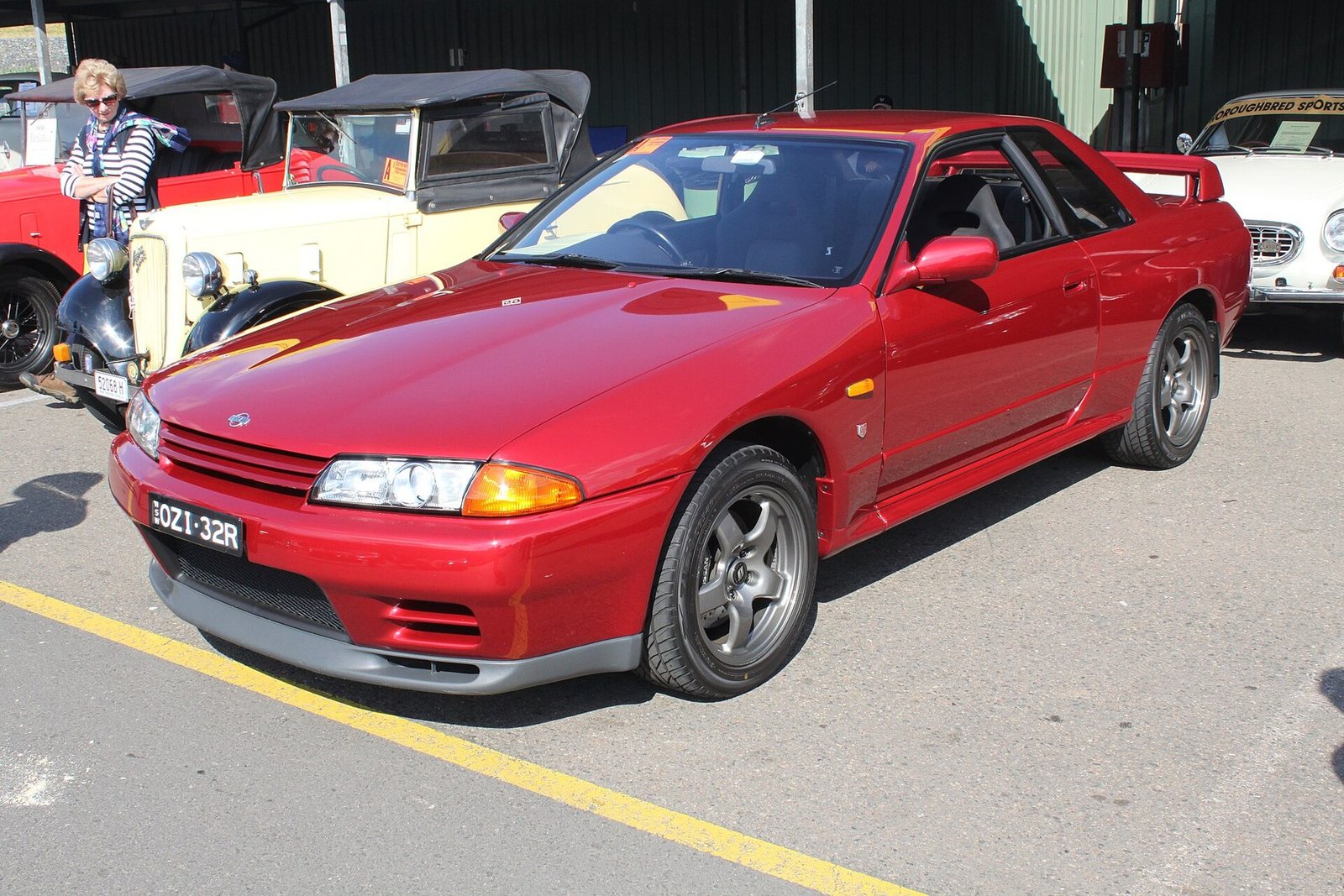
Nissan Skyline GT-R
About This Book
This is a working reference for the Nissan Skyline GT-R built from 1989 to 1994, the car Nissan's own paperwork calls the BNR32. It is written for the person who owns one, is about to buy one, or has to keep one running thirty-five years after the last one was built. Its method matters as much as its content: every claim carries its source, disagreements between sources are printed rather than averaged, and the figures that could not be sourced are named as holes rather than filled with plausible numbers.
1.1 What this car is
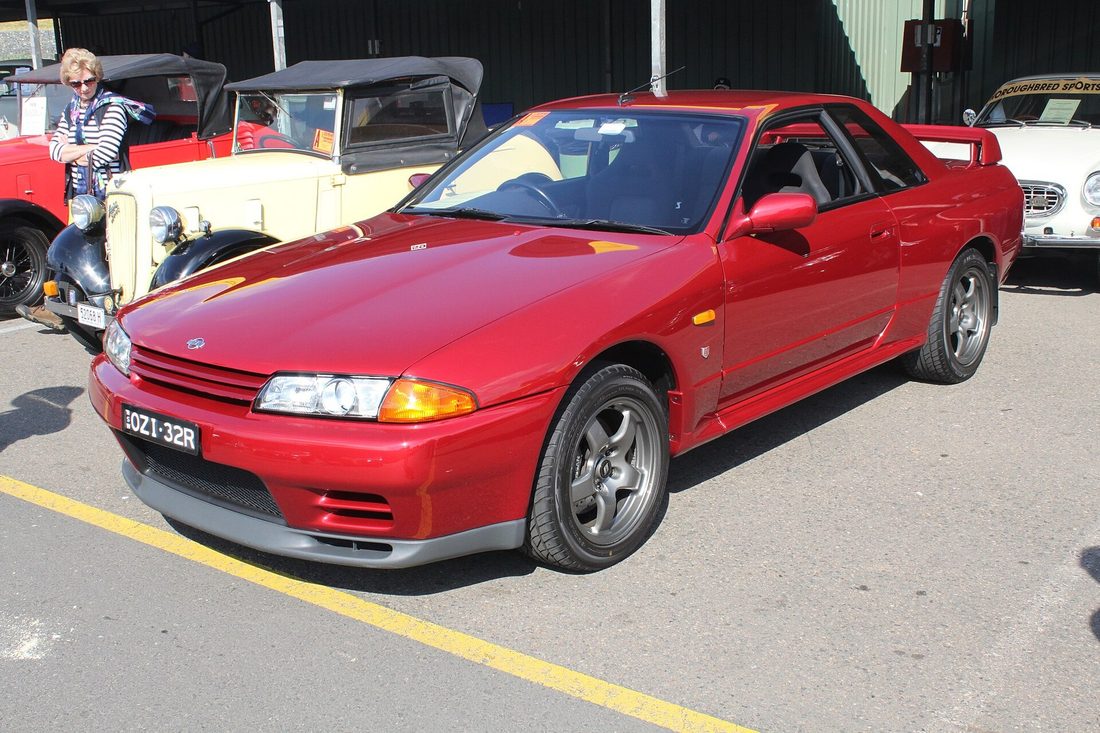
The R32 GT-R was not a road car with a racing programme bolted on afterwards. It was a Group A touring car that Nissan was obliged to sell to the public, and the numbers follow from a rulebook rather than from a road. Group A multiplied turbocharged displacement by 1.7, so 2,568 cc counted as 4,365.6 cc and put the car in the 4.0 to 4.5 litre class at a 1,260 kg minimum weight, where 2.8 litres would have crossed into the next band and cost 80 kg (source: gtrusablog.com/2020/05/nothing-came-close-group-bnr32.html). The engine capacity, the tyre width, the all-wheel drive and the weight target were all answers to that document. The car then won 29 races from 29 starts in the All Japan Touring Car Championship across four seasons (source: ja.wikipedia.org/wiki/日産・スカイラインGT-R_BNR32).
Even the brochure figure is paperwork rather than engineering. Every R32 GT-R was rated at 280 PS, the ceiling of a Japanese manufacturers' gentlemen's agreement that had no testing authority, no independent verification and no penalty, so manufacturers simply declared the number (source: autoevolution.com/news/the-japanese-gentlemen-s-agreement-on-horsepower-a-failed-rule-of-self-restraint-229607.html). The proof sits inside Nissan's own range, where the same engines in the export Fairlady Z and Infiniti Q45 were rated at 300 PS while the domestic cars were held to 280 (source: ja.wikipedia.org/wiki/日産・スカイラインGT-R_BNR32).
1.2 Why it needs a book of its own
Three reasons, none of them sentimental.
The first is that this car changed on build dates rather than model years. The 20 August 1991 minor change added side impact beams, revised the crankshaft and widened the oil pump drive; 3 February 1993 moved the whole range from a push to a pull clutch, improved the synchromesh and introduced the V-spec; 14 February 1994 brought the V-spec II (source: ja.wikipedia.org/wiki/日産・スカイラインGT-R_BNR32). A figure that is right for a 1990 car is often wrong for a 1993 one, which is why nothing in this book is averaged into a single column.
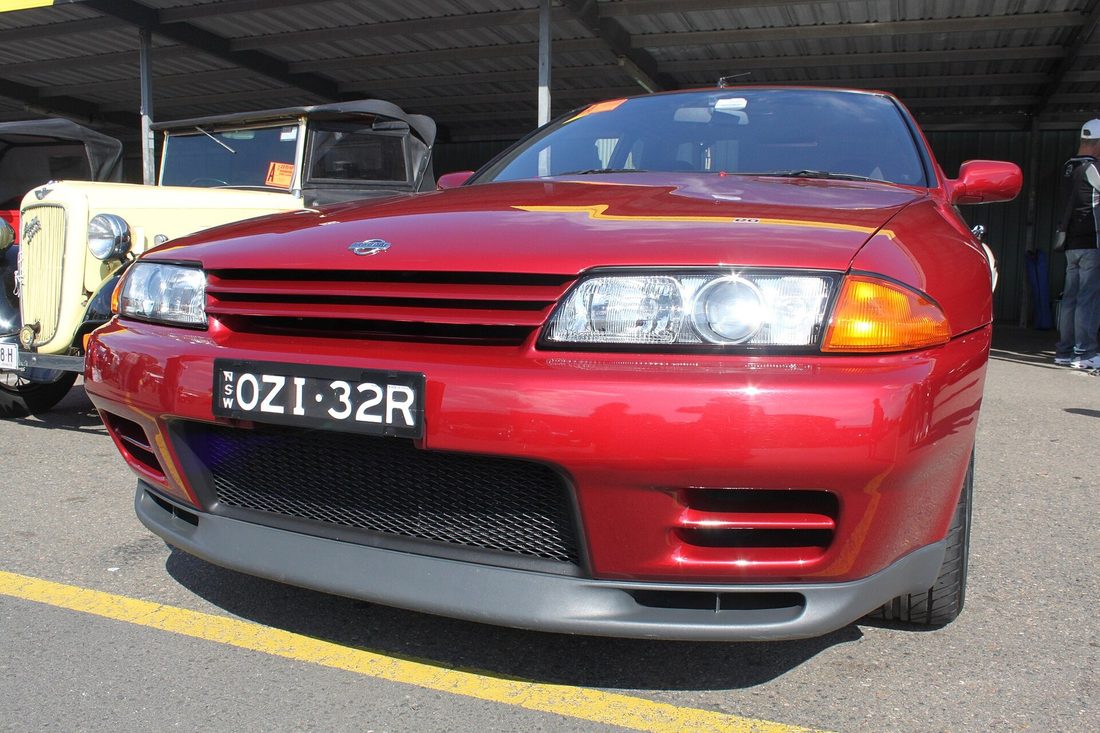
The second is that a Japanese-market R32 has no 17-character VIN. It carries a Nissan chassis code and a six-digit number, and the number stamped into the body near the firewall outranks the information plate, because a plate can be removed or replaced (source: gtrusablog.com/2013/03/nissan-skyline-r32-serial-or-chassis.html). Generic decoders return nothing, and a Skyline wearing GT-R panels is still not a BNR32.
The third is a loss. gtr-registry.com, the database nearly every production figure and build date in circulation passes through, has returned no response since 2025, and the man who paid for its hosting says the host claims the data was deleted (sources: gtrusablog.com/2016/03/gt-r-registry.html; gtrlife.com/threads/gtr-registry-down.328455/). The reference that used to settle a question about one specific car is simply gone, which changes how every number downstream of it should be read.
1.3 What to carry into a viewing
Two mechanical findings outrank everything else, and both belong in a pre-purchase inspection rather than in a hopeful first month of ownership. Chapter 04 owns the procedures, the chassis bands and the costs; this chapter only insists that you do not skip them.
The first is the oil pump drive. The RB26DETT drives its oil pump directly off the nose of the crankshaft: no chain, no gear train, just two flats machined into the crank snout with the pump's inner gear sitting on them (source: gtrusablog.com/2024/10/broken-oil-pumps-rb26dett-how-to-fix.html). On early cranks that engagement band is so narrow that a used crank shows only a small shiny witness patch, because that strip is the only part carrying torque (source: gtrusablog.com/2018/01/oil-pumps-on-rb-series-engine-true-or.html). Torque reversal, not steady drive, is what breaks it, and when it breaks the documented end state is a connecting rod through the block. Nissan widened the drive during the run, but wider is not cured: asked directly about post-1991 cars, the importer who has handled them since the 1990s said "The wider drives still can split. Its better than the early stuff, but still has some issues at high RPM" (source: gtrusablog.com/2014/05/r32-nissan-skyline-gt-r-buyers-guide.html).
The second is the turbine wheel material. Standard cars shipped with silicon nitride ceramic turbine wheels, light and quick to spool and brittle (source: motrs.au/nissan/skyline-r32-r34/workshop/ceramic-turbo-wheel-failure-all-models). Factory boost is about 10 psi, roughly the first hash mark on the dash gauge, and a buried needle means about 14 psi, at which point "It might run for years, it might snap the exhaust wheel off next week" (source: gtrusablog.com/2014/05/r32-nissan-skyline-gt-r-buyers-guide.html). Only the NISMO homologation car and N1 cars built after February 1992 left the factory with metal wheels (same source). This is the cheapest catastrophic risk on the car to buy your way out of, because steel wheels remove the failure mode outright.
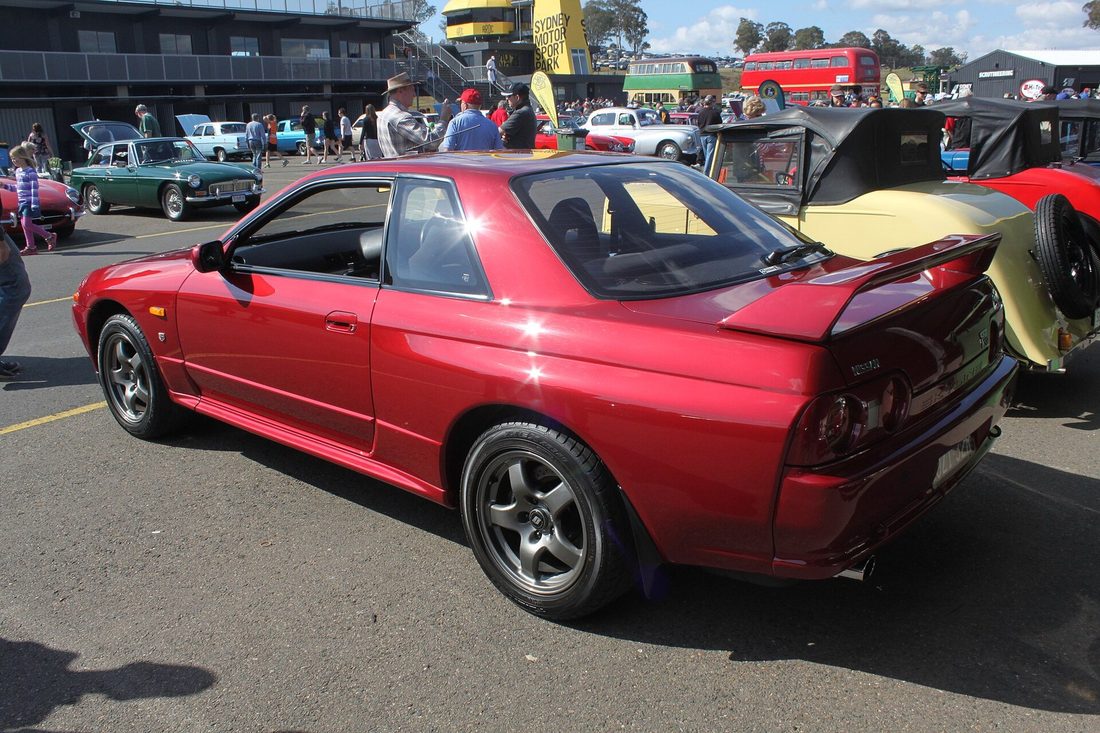
Behind those two sit the walk-aways rather than the price adjustments. Identity and paperwork come first, because the stamping has to match the plate, the export certificate, the import file and the registration. Then rust, which re-prices the whole car: complete outer sills can no longer be bought, and getting anyone to fabricate one is difficult because the panel is large and multi-curved (source: gtr.co.uk/threads/91-r32gtr-rotten-sills.202385/). On a Japanese car the primary condition document is the domestic auction sheet, not the Western advertisement (source: jdmbuysell.com/learn/nissan/skyline/r32/).
1.4 How this book handles a source
The standard is stated once and applied everywhere. Every factual claim carries its source inline. Where two sources disagree, both figures are printed with their provenance and the reasoning that favours one, rather than a quiet average. Where a figure could not be sourced, it is named as a gap. Four real examples from the chapters that follow will teach you how to read the rest of the book.
The part that does not exist. Two widely read sources describe the factory oil pump drive as a collar over the crank snout retained by a roll pin, and advise budgeting for failure of "the stock collar" (sources: motrs.au/nissan/skyline-r32-r34/workshop/oil-pump-drive-collar-failure-r32-r33-critical; jdmbuysell.com/learn/nissan/skyline/r32/). No such part was ever fitted. A crank collar is the aftermarket repair, machined onto the crank, not something you can unbolt and inspect (source: gtrusablog.com/2024/10/broken-oil-pumps-rb26dett-how-to-fix.html). A reader following that advice would look for a component that is not there and conclude the car was fine.
The number its own row disproves. A frequently referenced torque table renders the wheel nut figure as "98 to 188 N-m (10 to 12 kg-m, 72 to 87 ft-lb)" (source: gtrusablog.com/2020/03/nissan-skyline-gt-r-and-rb26-bolt.html). The other two columns settle it, because 10 to 12 kg-m is 98 to 118 N-m and 72 to 87 lb-ft. The 188 is a transcription error, and on an aluminium wheel it is a broken stud rather than a rounding error. This book prints 98 to 118 N-m and says why.
The gearbox that never existed. There is no six-speed R32. Every BNR32 uses the Nissan FS5R30A five-speed, and the transmission model is printed on the factory information plate (source: gtrusablog.com/2013/04/nissan-skyline-gt-r-information-plate.html). A high-traffic specification page nonetheless publishes six ratios, adding a sixth of 0.634 that came from another vehicle (source: projectjdm.org/wiki/specs/r32-gtr), and three other well-read sources call the box a Getrag, which was an R34 part (source: gtrusablog.com/2017/12/fs5r30a-nissan-skyline-gt-r-transmission.html). That is not trivia. It decides what a reader orders.
The missing register. Because gtr-registry.com is offline, every Registry-derived production figure in circulation is now second hand, cited here to the source that reproduced its tables rather than to the Registry itself (source: gtrusablog.com/2016/03/gt-r-registry.html). Five totals circulate for one model, and the variant runs differ by more than a hundred cars (source: gtrusablog.com/2016/08/series-ii-nissan-skyline-gt-r-r32.html). Chapter 02 prints the disagreement instead of picking a winner, because the structural reason for it is documented: skipped numbers, parallel number sequences, preproduction cars and cars completed out of numerical order (source: gtrusablog.com/2013/03/nissan-skyline-r32-serial-or-chassis.html).
1.5 What this book does not contain
Said once, here, so nothing later comes as a surprise.
No factory mileage or kilometre maintenance table for the BNR32 could be sourced. Photographic scans of the factory manual's torque, clearance and alignment tables were obtained and are printed as the manual-grade figures they are, but no scan of a service interval table was. So the endlessly repeated "timing belt every 100,000 km" is not asserted anywhere in this book as a factory figure, and the intervals that do appear are identified as a specialist importer's table built on Nissan's replacement cycles for the era (source: gtrusablog.com/2016/09/how-much-maintenance-does-stock-r32-need.html).
Several specifications are gaps rather than answers. No factory brake caliper, carrier or hose torque was sourced, and none is printed. Neither the factory minimum thickness for the rear disc, the pad wear limit, the caliper bleed sequence nor the manual's own brake fluid specification could be reached, so the disc limits given are an aftermarket rotor maker's published figures and are labelled as such. Factory injector resistance in ohms is not published in any source consulted. Neither is the fluid capacity of the ATTESA E-TS hydraulic circuit, a cold oil pressure specification, a factory inspection interval for valve clearance, or the reverse gear ratio. No 2026 labour rate or job price could be sourced from an RB26 specialist, so this book prints none. Import pathways for Canada and Australia are left open rather than written from memory.
1.6 How this book is organised
Chapter 02 is history and identity: the homologation brief, the racing record, the variants and what mechanically separates them, the production figures that refuse to agree, how to authenticate a car, the import and legal position, and the 2026 market.
Chapter 03 is the specification reference, broken out by variant and build date rather than averaged, ending with a plain list of what could not be established.
Chapter 04 is the known issues survey: the four faults that decide a purchase, then the rest by system, closing with a seven-block pre-purchase inspection checklist and a method for weighing what it turns up.
Chapter 05 is the engine and driveline on their own terms: why 2,568 cc, the turbochargers, the 280 PS question, the oiling system that decides whether the engine survives, the failure ladder as boost rises, and the gearbox, transfer case and differentials that carry what it makes.
Chapter 06 is systems and diagnosis, which on a car this old means finding the box, finding the diode and counting the flashes. Its most valuable page explains why an anti-lock brake fault lights the four-wheel-drive lamp, and why owners chasing that lamp are often chasing the wrong system.
Chapter 07 is maintenance: what the factory manual actually gives, the specialist schedule that fills the gap, and the jobs that keep this particular car alive, with the manual's torque, clearance and alignment tables reproduced.
Chapter 08 is parts and sourcing, which begins with the NISMO Heritage Parts programme and the single most valuable habit it teaches, which is buying the part while it is listed.
Chapter 09 is the community and the wider record: which archive answers which question, the registry that vanished, where the factory manual can still be downloaded, and the specialist workshops worth the premium.
1.7 Safety, and verifying against your own car
Some of what follows can hurt you or destroy the car. The accumulator in the ATTESA E-TS circuit is a charged pressure vessel and must be bled down before it is unscrewed. Super HICAS is a steering system, so anything done to it is a modification to steering. Cross-drilled factory rotors crack, and a cracked rotor on a thirty-five year old car is a brake failure risk. Corrosion at a subframe or suspension mounting point is a structural failure risk under load, not a cosmetic problem. Items of that kind are flagged in the text where they arise.
This book is not a substitute for the factory service manual, and that manual is free: the 1989 to 1994 R32 GT-R workshop manual is hosted on the Internet Archive (source: archive.org/details/nissan-skyline-r-32-gtr-factory-workshop-manual-model-years-1989-to-1994-chassis-codes-r-32). Anything you are about to torque, bleed, wire or reassemble belongs there first. Every torque figure and procedure printed here must be verified against your own car and its documentation, because this model changed during production without always announcing it: Nissan modified the electronic control unit, the cylinder block and the turbine sizing at points that never reached a press release (source: gtrusablog.com/2014/05/r32-nissan-skyline-gt-r-buyers-guide.html). Where the car in front of you disagrees with this book, the car is right.
History and Identity
The R32 GT-R was not a road car with a racing programme attached. It was a Group A touring car Nissan was obliged to sell to the public, and almost every number here, the displacement, the kerb weight, the tyre width, the output on the brochure, exists because a rulebook or a trade association said so. This chapter covers the homologation brief, the racing record, the variants and what separates them mechanically, the production figures that refuse to agree, how to authenticate a car, and what an R32 is worth in 2026.
2.1 The brief: build something that can win
The Group A programme came first. "The entire GT-X project was aimed at building a Skyline that could win under Group A rules" (source: gtrusablog.com/2020/05/nothing-came-close-group-bnr32.html). Development sat inside Nissan's "901 movement", the goal of world-class handling and performance by 1990, and the Japanese record calls the BNR32 "the culmination of the 901 movement" (source: ja.wikipedia.org/wiki/日産・スカイラインGT-R_BNR32). Naganori Ito had succeeded Dr Shinichiro Sakurai in 1985 as the engineer responsible for Nissan's sports cars, and GT-X started in May 1986 with the GT-R name kept quiet, partly because Nissan's finances after the Plaza Accord made reviving it a hard sell (source: gtrusablog.com/2020/05/nothing-came-close-group-bnr32.html).
The displacement is the clearest case of the rulebook doing the engineering. Nissan first ran a 2.4-litre twin-turbo RB, then found the all-wheel-drive hardware added roughly 100 kg (220 lb), so capacity rose to 2.6 litres. Group A multiplied turbocharged displacement by 1.7, and 2,568 cc (156.7 cu in) times 1.7 is 4,365.6 cc, landing the car in the 4.0 to 4.5 litre class at a 1,260 kg (2,778 lb) minimum; 2.8 litres would have crossed into the next band at 1,340 kg (2,954 lb), an 80 kg (176 lb) penalty (source: gtrusablog.com/2020/05/nothing-came-close-group-bnr32.html). English Wikipedia frames the same choice as placing the car "in the 4,500cc class and enabling 11-inch-wide tires" (source: en.wikipedia.org/wiki/Nissan_Skyline_GT-R), adding the tyre consequence but stating the class boundary differently. Japanese displacement tax, which stepped up sharply above 2.0 litres, was a third reason to go well past the line (source: ja.wikipedia.org/wiki/日産・スカイラインGT-R_BNR32).
The sixteen-year gap has a simple cause. The previous GT-R, the KPGC110, was killed after roughly three months because its S20 engine could not meet the 1973 Japanese emissions rules; 197 were built and 195 sold (source: ja.wikipedia.org/wiki/日産・スカイラインGT-R). The R32 Skyline was announced on 22 May 1989 and the four-wheel-drive models including the GT-R went on sale 21 August 1989, one history giving 24 August as the production start instead (sources: ja.wikipedia.org/wiki/日産・スカイラインGT-R_BNR32; gtrusablog.com/2009/08/r32-nissan-skyline-gt-r-specifications.html; retrocardispatch.substack.com/p/nissan-skyline-gt-r-r32-19891994). Nissan's own chronology says 21 August, and that is the date used here.
2.2 The racing record
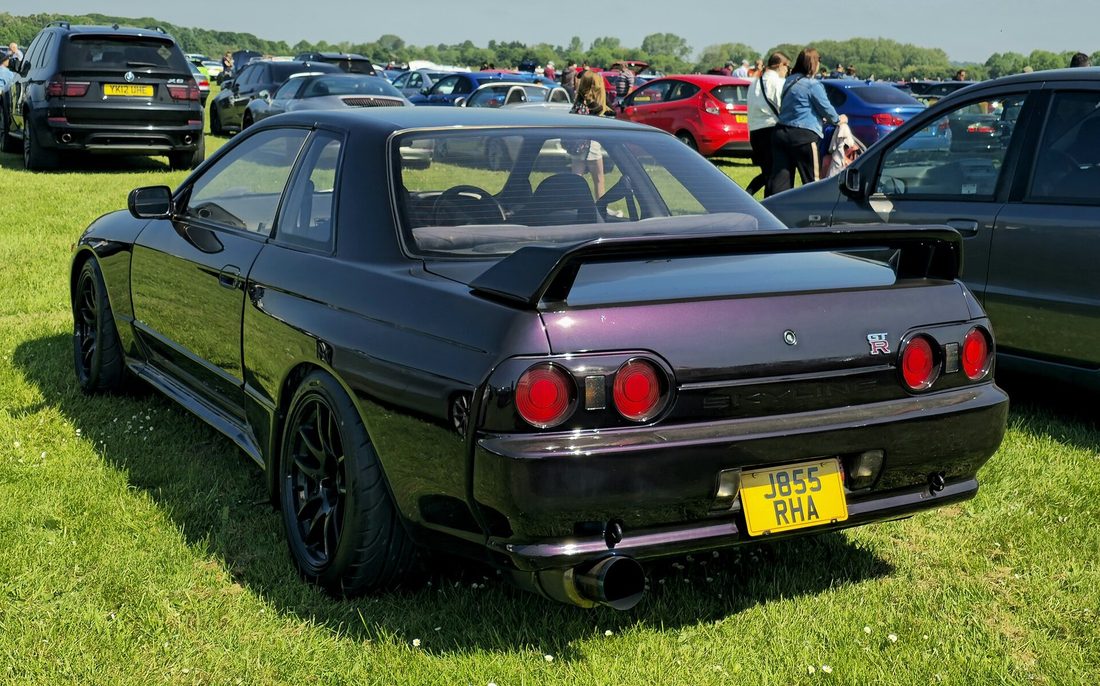
In the All Japan Touring Car Championship the R32 won 29 races from 29 starts across four seasons, a figure on which the English, Japanese and specialist sources agree (sources: en.wikipedia.org/wiki/Nissan_Skyline_GT-R; ja.wikipedia.org/wiki/日産・スカイラインGT-R_BNR32; gtrusablog.com/2020/05/nothing-came-close-group-bnr32.html).
| Season | Races | GT-R wins | Champion |
|---|---|---|---|
| 1990 | 6 | 6 | Kazuyoshi Hoshino, 5 wins |
| 1991 | 6 | 6 | Masahiro Hasemi, 3 wins |
| 1992 | 8 | 8 | Masahiro Hasemi, 2 wins |
| 1993 | 9 | 9 | Masahiko Kageyama, 4 wins |
(source: ja.wikipedia.org/wiki/日産・スカイラインGT-R_BNR32)
The debut was round one at West Japan Circuit on 18 March 1990, a 300 km race watched by 41,000 people. The Calsonic car of Hoshino and Suzuki took pole, cut nearly two seconds off the course record, had lapped the entire field by quarter distance, and won. By 1993 Group A Class 1 in Japan was effectively a one-make series, and the final Group A race, the Intertec at Fuji, drew 94,500 spectators (sources: ja.wikipedia.org/wiki/日産・スカイラインGT-R_BNR32; gtrusablog.com/2020/05/nothing-came-close-group-bnr32.html).
The endurance record is less quoted and more impressive. In the Japanese N1 series the car won the 1990 Fuji 6 Hours, then five from six in 1991, seven from seven in 1992, and eight from eight in both 1993 and 1994. At Spa it swept the Group N podium in 1990 and won outright in 1991 with the works ZEXEL car of Naoki Hattori, Anders Olofsson and David Brabham, by more than twenty laps and ahead of the Porsche 911 and BMW M3 Evolution. Add a Group N class win at the 1991 Nürburgring 24 Hours and the 1993 Spanish Touring Car title for Luis Perez-Sala (sources: ja.wikipedia.org/wiki/日産・スカイラインGT-R_BNR32; en.wikipedia.org/wiki/Nissan_Skyline_GT-R).
Australia produced the most repeated error. Titles went to Jim Richards in 1990 and 1991, Mark Skaife in 1992, and Glenn Seton in a Ford in 1993 (source: en.wikipedia.org/wiki/Australian_Touring_Car_Championship), and the familiar claim of three straight ATCC titles with the R32 is wrong. Richards won the 1990 title on 102 points using both the HR31 Skyline GTS-R and the new R32: he won the opening round at Amaroo Park in the HR31, Skaife debuted the R32 at Mallala in round six, and Richards first raced it at Wanneroo in round seven before dominating the Oran Park finale with it (source: en.wikipedia.org/wiki/1990_Australian_Touring_Car_Championship). 1990 is a shared-car season, so the clean R32 titles are 1991 and 1992.
Bathurst 1991, the Tooheys 1000 of 6 October, went to Richards and Skaife for Gibson Motorsport: 161 laps in 6h 19m 14.80s, a race record that stood until 2010, with Skaife taking pole, the win and the fastest lap (source: en.wikipedia.org/wiki/1991_Tooheys_1000). They won again in 1992, against a pop-off valve nominally limiting the car to 450 bhp and 140 kg (309 lb) of ballast, though team boss Fred Gibson admitted years later that it was actually running around 600 bhp (source: en.wikipedia.org/wiki/1992_Tooheys_1000). For 1993 Australia moved its premier class to Class 2 Super Touring, banning turbocharging and all-wheel drive, a wholesale category change rather than a GT-R-specific ban (source: ja.wikipedia.org/wiki/日産・スカイラインGT-R_BNR32).
One number needs care. Development testing at the Nordschleife produced 8 minutes 30 seconds on the first trip and later 8 minutes 20 seconds, against a target of beating the Porsche 944's 8:45 (source: gtrusablog.com/2020/05/nothing-came-close-group-bnr32.html). English Wikipedia reports a Best Motoring figure of 8:22.38 in 1989 (source: en.wikipedia.org/wiki/Nissan_Skyline_GT-R), while the Japanese record gives no figure at all (source: ja.wikipedia.org/wiki/日産・スカイラインGT-R_BNR32). No timing sheet supports 8:22.38, so this book places the testing in the 8:20 to 8:30 band and treats the precise figure as unsupported.
2.3 Variants, and what actually separates them
GT-R standard, 21 August 1989, 4,445,000 yen: RB26DETT, ceramic-turbine twin turbos, the Nissan FS5R30A five-speed, ATTESA E-TS, Super HICAS, Sumitomo four-piston front and two-piston rear calipers on 296 mm (11.7 in) front and 297 mm (11.7 in) rear vented discs, and 16 x 8J forged alloys on 225/50R16 (sources: gtrusablog.com/2009/08/r32-nissan-skyline-gt-r-specifications.html; ja.wikipedia.org/wiki/日産・スカイラインGT-R_BNR32).
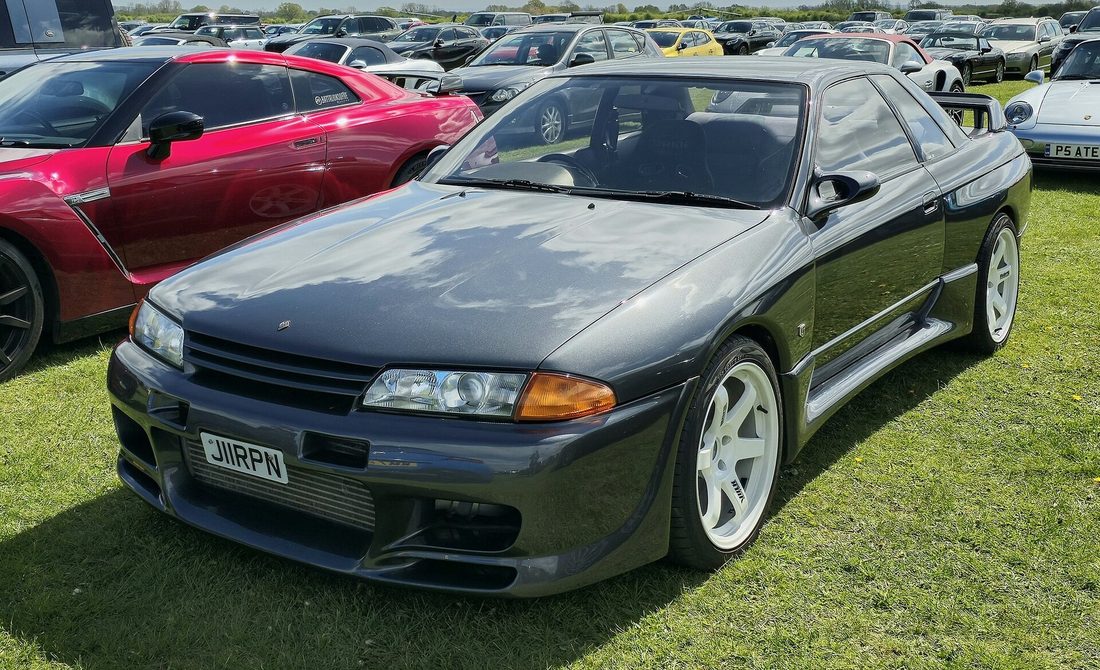
GT-R Nismo, the Group A Evolution homologation car, 1,400 kg (3,086 lb), Gun Grey Metallic KH2 only, model code KBNR32RXFSL-RA. Metal turbine wheels in place of ceramic, model-specific exhaust manifolds, aluminium panels, extra bumper openings and a hood-top moulding for airflow, and ABS, air conditioning, audio, rear wiper and intercooler grille all deleted. Two dates circulate, 22 February and 11 March 1990, the likely reading being press release then on-sale date one week before the race debut (sources: ja.wikipedia.org/wiki/日産・スカイラインGT-R_BNR32; en.wikipedia.org/wiki/Nissan_Skyline_GT-R). The price is a real conflict: the Japanese price list puts the Nismo at 4,441,000 yen, four thousand yen less than the standard car (source: gtrusablog.com/2009/08/r32-nissan-skyline-gt-r-specifications.html), while English Wikipedia says it carried a 235,500 yen premium (source: en.wikipedia.org/wiki/Nissan_Skyline_GT-R). Both cannot be right, and the deleted equipment argues for the lower figure.
GT-R N1, 19 July 1991, the endurance base car in Crystal White 326 sprayed thin to save weight. N1-specification RB26 with increased cylinder block wall thickness for durability under raised output, Nismo wheels, muffler and strut brace, enlarged rotors with the cross-drilling deleted and cooling ducts added, cheap twin rectangular halogen lamps in place of the projectors, and ABS, air conditioning, audio and rear wiper deleted. N1 cars received metal turbine wheels after February 1992 (sources: ja.wikipedia.org/wiki/日産・スカイラインGT-R_BNR32; gtrusablog.com/2014/05/r32-nissan-skyline-gt-r-buyers-guide.html).
GT-R V-specV-spec, 3 February 1993, 5,260,000 yen. Brembo four-piston front and two-piston rear calipers, front rotor up from 296 mm to 324 mm (11.7 to 12.8 in) and rear from 297 mm to 300 mm (11.7 to 11.8 in), the first Brembo fitment on a Japanese production car, 17-inch BBS forged wheels, revised suspension settings, and a revised ATTESA E-TS control pattern (source: ja.wikipedia.org/wiki/日産・スカイラインGT-R_BNR32). That last item is the strongest argument for treating the V-spec as mechanically distinct rather than a wheel and brake package, and Nissan's own release calls it a package option at introduction rather than a standalone grade. Tyre size is disputed: 225/50R17 in the Japanese record, 225/45R17 in English Wikipedia, and 245/45R17 in one database, the last being the V-spec II size (sources: ja.wikipedia.org/wiki/日産・スカイラインGT-R_BNR32; en.wikipedia.org/wiki/Nissan_Skyline_GT-R; projectjdm.org/wiki/specs/r32-gtr). The 50-series figure fits the V-spec II's news being the adoption of 45-series tyres.
GT-R V-spec II, 14 February 1994, same price, on 245/45R17 Bridgestone Potenza RE010; that size had not been approved in Japan when the V-spec launched. V-spec N1 and V-spec II N1 rolled the N1 package onto the current V-spec base, so they gained the Brembos. Outside the catalogue, roughly 100 cars were knocked-down assembled at Nissan Australia's Clayton plant in 1991 with 17-digit VINs beginning 6F4, though that passage carries an invalid-source tag on its own article and needs corroborating (source: ja.wikipedia.org/wiki/日産・スカイラインGT-R_BNR32). Fourteen police cars were built in paint code 2M8 (source: gtrusablog.com/2009/08/r32-nissan-skyline-gt-r-specifications.html).
2.4 The car changed on build dates, not model years
This is the correct spine for identifying a car, and it is Nissan's own record of what it decided to improve.
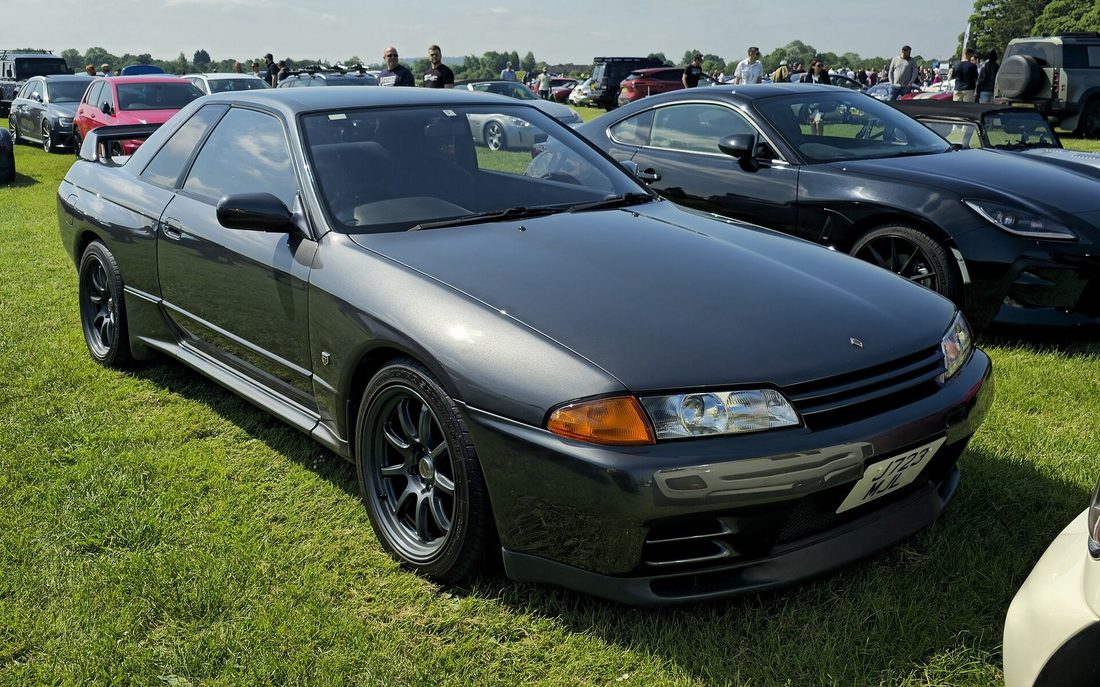
- 21 August 1989. 1,430 kg (3,153 lb), projector headlamps with H3C bulbs, narrow oil pump drive, smooth interior surrounds, push-type clutch, no side impact beams, no airbag.
- 20 August 1991, first minor change. Side impact beams and a collapsible steering pad add a claimed 50 kg (110 lb) to 1,480 kg (3,263 lb); headlamp bulb H3C to H1; oil pump drive widened; crankshaft revised; block partly reinforced and partly lightened; rear caliper seal revised; interior surrounds smooth to textured; a driver's airbag becomes a rare option (sources: gtrusablog.com/2016/08/series-ii-nissan-skyline-gt-r-r32.html; ja.wikipedia.org/wiki/日産・スカイラインGT-R_BNR32).
- 3 February 1993, second minor change. Clutch push to pull across the whole GT-R range, synchromesh improved, rear differential cover fin removed, V-spec and V-spec N1 added (source: gtrusablog.com/2015/11/push-vs-pull-clutch-nissan-skyline-gt-r.html).
- 14 February 1994. V-spec II on sale; the 1994 model year also changed the rear differential cover to the Laurel type.
- 13 October 1994 last V-spec, BNR32-313609. 20 October 1994 last V-spec II, BNR32-313930. 7 November 1994 last car of all, BNR32-314649, sales ending that December (sources: ja.wikipedia.org/wiki/日産・スカイラインGT-R_BNR32; gtrusablog.com/2009/08/r32-nissan-skyline-gt-r-specifications.html).
Nissan also admitted changing the ECU, the cylinder block and turbine sizing at points without announcement, and spot welding was reportedly reduced after 1994 (source: gtrusablog.com/2014/05/r32-nissan-skyline-gt-r-buyers-guide.html). One widely mirrored end date, "May 1993", is an error, since the same source lists a February 1994 V-spec II (source: skylinebible.blogspot.com/p/bnr32.html).
280 PS, and the paperwork that proves it was politics
Every R32 GT-R was rated at 206 kW, 280 PS, 276 hp at 6,800 rpm, with 353 N.m (36.0 kgf.m, 260 lb-ft) at 4,400 rpm (sources: ja.wikipedia.org/wiki/日産・スカイラインGT-R_BNR32; carfolio.com/nissan-skyline-gt-r-11627). That is the ceiling of the Japanese manufacturers' gentlemen's agreement, which capped declared output at 280 PS with no testing authority, no independent verification and no penalty, so manufacturers simply declared the number (source: autoevolution.com/news/the-japanese-gentlemen-s-agreement-on-horsepower-a-failed-rule-of-self-restraint-229607.html).
The cleanest evidence that the cap was political sits in the Japanese-language record. The R32 GT-R was to have launched as one of Japan's first 300 PS trio alongside the Z32 Fairlady Z and the Infiniti Q45, and all three were held to 280 PS domestically by the agreement. The export versions of the Z32 and the Q45 were rated at 300 PS (source: ja.wikipedia.org/wiki/日産・スカイラインGT-R_BNR32). Same engines, same year, two numbers depending on which market's paperwork they were filed under.
There was headroom because factory boost was about 0.78 kg/cm2, roughly 11 psi, and the most honest framing found is conditional: "At 8 psi the engines make horsepower in the 276 horsepower, 280 ps range. With more boost, they make more power" (sources: gtrusablog.com/2020/05/nothing-came-close-group-bnr32.html; gtrusablog.com/2007/11/rb26dett-information-myths-truths.html). Community figures circulate at 300 PS, 310 bhp, and 320 to 330 PS (sources: collectingcars.com/articles/nissan-skyline-r32-gt-r-price-what-to-pay; jdmbuysell.com/learn/nissan/skyline/r32/), but none is a controlled, corrected, repeatable measurement of a stock car, and the same writers routinely swap wheel horsepower for crank PS inside one paragraph. Treat 320 PS as consensus, not measurement.
2.5 Production numbers, and why they will not settle
Five totals circulate for one model. 43,937 from the GTR Registry, also carried by English Wikipedia. 43,934 from the Japanese GT-R Magazine. 43,906 from one specialist's own arithmetic over the published chassis ranges. 43,661 in the Japanese infobox, explicitly labelled units sold and sourced to Takahashi and Murayama's 2006 owner's bible. And 43,934 offered elsewhere as the figure for all R32 Skyline trims, which cannot be true at the same time as 43,937 GT-Rs alone (sources: gtrusablog.com/2016/08/series-ii-nissan-skyline-gt-r-r32.html; en.wikipedia.org/wiki/Nissan_Skyline_GT-R; ja.wikipedia.org/wiki/日産・スカイラインGT-R_BNR32; jdmbuysell.com/learn/nissan/skyline/r32/).
The variants are worse. There are three V-spec figures, 1,396, 1,453 and 1,460, and three V-spec II figures, 1,303, 1,306 and 1,369 (sources: en.wikipedia.org/wiki/Nissan_Skyline_GT-R; gtrusablog.com/2016/08/series-ii-nissan-skyline-gt-r-r32.html; skylinebible.blogspot.com/p/bnr32.html). N1 production is 228 per GT-R Magazine and 245 per the Registry, and annual output diverges by hundreds: 1990 is 8,426 in one register against 9,232 in the other, 1994 is 7,465 against 8,301 (source: gtrusablog.com/2016/08/series-ii-nissan-skyline-gt-r-r32.html). Only the Nismo is agreed, at 560, and even there the familiar "500 sold, 60 kept for racing" split is now doubted by the man who used the 560 figure in a successful federal application: "I am not convinced the 60 for racing part is actually true. I may have repeated it myself because it was the accepted story at the time" (source: gtrusablog.com/2026/07/motorex-nhtsa-and-what-really-happened.html).
The structural reason is worth quoting: "Nissan FAST records, published production totals, monthly registrations and surviving cars do not always agree. There are skipped numbers, parallel number sequences, preproduction cars, development cars, cars completed out of numerical order and other abnormalities" (source: gtrusablog.com/2013/03/nissan-skyline-r32-serial-or-chassis.html). The R32 ran at least four parallel number blocks, restarting at 100001 for the Nismo, 212001 in August 1991 and 300001 in 1993, with ten cars built out of numerical order across 1990 and 1991 (source: gtrusablog.com/2016/08/series-ii-nissan-skyline-gt-r-r32.html). Add the difference between built and retailed, which is what separates 43,934 from 43,661, and the spread is explained without anybody being dishonest. This book prints the disagreement rather than an average.
One caution changes how every figure downstream should be read. gtr-registry.com, the reference nearly all these numbers pass through, is dead. Connection attempts failed outright in August 2026, and the community timeline records it down since 26 August 2025 and still down in April 2026. The specialist who funded its hosting says the money was never forwarded to the host, that it is now a legal dispute, and that the host claims all Registry data was deleted (sources: gtrusablog.com/2016/03/gt-r-registry.html; gtrlife.com/threads/gtr-registry-down.328455/). Every Registry figure here is second hand, from sources that reproduced its tables while it was live, and there is currently no way to check any of them at source.
2.6 Identifying and authenticating a car
A Japanese-market R32 has no 17-character VIN. It carries a Nissan chassis code and a six-digit sequential number, in the form BNR32-000054. The 17-character format was standardised in the United States from the 1980 model year under 49 CFR Part 565 and never applied to a car built for Japan, so a short number is not a defective VIN. The prefix is the identity: B is the RB26DETT, N is ATTESA E-TS plus Super HICAS, R is Skyline. HCR32, HNR32, ECR32 and ENR32 are other R32s, and stated bluntly, "an HCR32, HNR32 or another Skyline fitted with GT-R panels and parts is still not a BNR32 GT-R" (sources: gtrusablog.com/2013/03/nissan-skyline-r32-serial-or-chassis.html; ja.wikipedia.org/wiki/日産・スカイラインGT-R_BNR32).
The number is stamped into the body in the engine compartment near the firewall, and that stamping outranks the Nissan information plate, the blue plate, because a plate can be removed, damaged or replaced. A genuine plate should read a model code such as KBNR32RXFSLRA alongside RB26, 2568 cc and FS5R30A, in which grade B marks a V-spec on 17-inch wheels, grade X the standard car on 16-inch, and an RA suffix a Nismo (sources: gtrusablog.com/2013/03/nissan-skyline-r32-serial-or-chassis.html; gtrusablog.com/2013/04/nissan-skyline-gt-r-information-plate.html). Displacement on the plate is not a model year: 1998 cc means a 1,998 cc engine.
The inspection is documentary as much as physical. Look for factory character shapes and consistent spacing, no grinding, welding, filler or fresh paint at the stamping, and a number matching the plate, the Japanese export certificate, and the import, title and registration records. Factory stampings are not cosmetically perfect, so one odd character is not proof of tampering but does deserve a look. Australian, New Zealand and Canadian compliance plates and locally assigned 17-character numbers are legitimate, but an assigned number is not the Nissan chassis number and the two must never be substituted for one another (source: gtrusablog.com/2013/03/nissan-skyline-r32-serial-or-chassis.html).
Chassis ranges bracket the build changes, and the site publishing them contradicts itself. Series 1 runs from BNR32-000051, given as 000054 elsewhere, to 017467; the Nismo block is 100001 to 100560, quoted elsewhere as 100000 to 100560; Series 2 from August 1991 runs 212001 to 223299, or 210001 to 223300 in a dedicated article; Series 3 runs 300001 to 314649 (sources: gtrusablog.com/2009/08/r32-nissan-skyline-gt-r-specifications.html; gtrusablog.com/2016/08/series-ii-nissan-skyline-gt-r-r32.html). A number beginning 0 predates the August 1991 change; a number beginning 3 is a late car. The widely mirrored claim that the last car is BNR32-005083 is a miscopied year row, since 005083 ends 1989 (source: gtrusablog.com/2014/05/r32-nissan-skyline-gt-r-buyers-guide.html).
2.7 Import and legality in 2026
In the United States a vehicle at least 25 years old may be permanently imported without regard to the FMVSS in force when it was built, under 49 USC 30112, administered through Box 1 of the HS-7 Declaration. Eligibility began in August 2014, rolling by build date, so by 2026 every BNR32 is past the threshold; one circulating source saying 2015 is wrong (sources: gtrusablog.com/2013/03/nissan-skyline-r32-serial-or-chassis.html; visionnissangreece.com/nissan-skyline-us-import-guide). The exemption settles safety only: "EPA rules, state registration requirements and California emissions requirements still need to be handled correctly" (source: gtrusablog.com/2026/07/motorex-nhtsa-and-what-really-happened.html). A 25-year car should be titled on its original Nissan chassis number, and nobody should invent a 17-character number, add zeros or fit a homemade plate (source: gtrusablog.com/2013/03/nissan-skyline-r32-serial-or-chassis.html).
That is one story. The other is MotoRex, and it means two R32s in the same street can have wholly different federal files. The path was not a loophole but the Registered Importer eligibility route under 49 USC 30141(a)(1)(B), which lets NHTSA find a nonconforming vehicle eligible if its safety features comply or can be altered to comply. An R33 Skyline, not a GT-R, was destructively crash tested at MGA Research in Wisconsin, and the decision of 19 January 2000 held that "1990 through 1999 Nissan GTS and GTR passenger cars are eligible for importation into the United States". The first bond release, for an R32 GT-R nicknamed McNasty, came on 15 November 1999, before that decision was published, and a confidential addendum to the file, VCP 17, covered proprietary compliance parts including an airbag carrying a JK/MotoRex part number. Then the business collapsed, with cars unfinished and the emissions contractor unpaid. NHTSA proposed partial rescission in 2005 and in March 2006 rescinded VCP 17, replacing it with VCP 32, which covered only certain R33 GTS and GT-R cars built between 1 January 1996 and 30 June 1998. The R32 and R34 were removed from future eligibility, NHTSA's public position being that it had received inaccurate information (source: gtrusablog.com/2026/07/motorex-nhtsa-and-what-really-happened.html).
The residue matters to a buyer. Cars imported under VCP 17 still circulate carrying MotoRex-specific compliance parts, converted mph speedometers, MotoRex-numbered airbags, door reinforcement and Registered Importer labels, on paperwork tied to a rescinded eligibility number. Separately, the ordinary R32 GT-R went onto NHTSA's list of vehicles not eligible for Show or Display, while the limited-production Nismo R32 was approved for Show or Display on its own merits on an accepted production figure of 560 (source: gtrusablog.com/2026/07/motorex-nhtsa-and-what-really-happened.html). Any pre-2014 United States R32 needs its file read rather than assumed.
Great Britain has no age bar: an import declaration, VAT and duty at the border, notifying HMRC within fourteen days, Individual Vehicle Approval, then registration, tax and insurance (sources: gov.uk/importing-vehicles-into-the-uk; gov.uk/vehicle-approval). An R32 is not yet a historic vehicle, since MOT exemption applies at forty years, reached between 2029 and 2034, and the historic tax class currently stops at vehicles built before 1 January 1986, so in 2026 an R32 pays vehicle tax and needs an MOT (source: gov.uk/historic-vehicles). Canada and Australia are deliberately left open: neither government's guidance could be retrieved during research for this book, so rather than write those paragraphs from memory, a reader importing into either country must confirm the current pathway with the Registrar of Imported Vehicles in Canada or the Department of Infrastructure in Australia.
2.8 The 2026 market
Dealer guide ranges as of March 2026 put a good standard car at roughly 25,000 to 40,000 pounds in the United Kingdom, 38,000 to 45,000 euros in Europe, and most often A$45,000 to A$70,000 in Australia and New Zealand, with Nismo, V-spec and V-spec II averages "often reaching around" 75,000 pounds in Britain. Named results include A$82,500 for a Nismo in May 2024, A$91,500 for a low-mileage V-spec II in November 2024, and A$150,500 for an N1 in February 2025 (source: collectingcars.com/articles/nissan-skyline-r32-gt-r-price-what-to-pay). In the United States clean documented cars are quoted at 50,000 to 90,000 dollars, entry cars at 45,000 to 60,000 (source: jdmbuysell.com/learn/nissan/skyline/r32/), against an aggregator average of 56,634 dollars (source: classic.com/m/nissan/skyline/r32/gt-r).
Variant drives the spread first, and the step is large: an N1 at A$150,500 against a standard car near A$40,000 is a nearly four-times range inside one model. Then originality, because "most imported R32/R33/R34 cars have been tuned by prior owners; tune quality varies wildly, and chassis abuse history is often unknowable" (source: jdmbuysell.com/learn/nissan/skyline/r32/). Then documentation, where "provenance and a detailed service history remain the primary drivers of value", then verifiable low mileage. Behind all of it, United States buyers under the 25-year rule now compete for the best British and European cars, pulling those markets up (source: collectingcars.com/articles/nissan-skyline-r32-gt-r-price-what-to-pay).
The last value driver is specific to this car and returns to where the chapter started. Whether the stamping, the plate, the export certificate and the import file all tell the same story, and whether the car is a genuine BNR32 rather than a converted HCR32, moves the price more than any modification on it (source: gtrusablog.com/2013/03/nissan-skyline-r32-serial-or-chassis.html). With the registry everybody used to check that question now offline, the paperwork in the folder is worth more in 2026 than it was in 2024.
Glossary
- 280 Ps
- The output figure every Japanese performance car of this era was rated at, whatever it actually made. It is a ceiling agreed between manufacturers rather than a measurement, and export versions of the same engines were rated higher.
- A-Lsd
- Nissan's active limited-slip differential, fitted at the rear and controlled electronically rather than purely mechanically. It works with the all-wheel-drive system rather than independently of it.
- Abs
- Anti-lock braking system. On this car its fault codes live inside the all-wheel-drive control unit and it shares wheel-speed sensors with it, so a brake fault lights the 4WD lamp and owners chase the wrong system.
- Accumulator
- The nitrogen-charged vessel holding hydraulic pressure for the all-wheel-drive clutch pack. It decays with age, and a decayed one is the usual real cause of the pressure switch fault code.
- Afm
- Air flow meter, the sensor telling the engine management how much air is entering. This engine uses two, and their output voltage range is the first thing to read when it runs badly.
- Attesa E-Ts
- Nissan's electronically controlled all-wheel-drive system, which sends torque forward through a hydraulically clamped clutch pack according to wheel speed and lateral load. On this generation the line pressure can fall to zero, so a failed system leaves the car very nearly rear-wheel drive.
- Auction Sheet
- The inspection document a Japanese auction house issues with a car, grading condition and mapping damage onto a diagram. For an imported car it is often the only independent record of its history and can be retrieved after the sale.
- Bnr32
- Nissan's chassis code for the R32 GT-R, as against HCR32 and ECR32 for the lesser Skylines. The code is stamped on the car, and a chassis number that does not begin BNR32 is not a GT-R whatever the badges say.
- Cas
- Crank angle sensor, an optical unit driven off the back of the exhaust camshaft, telling the ECU where the engine is in its rotation. Its faults come and go, presenting as misfire, power loss or an intermittent no-start.
- Ceramic Turbine
- The factory exhaust turbine wheel material on standard cars, light and quick to spool and prone to disintegrating above roughly factory boost. Establishing whether a car has ceramic or steel wheels is one of the two most consequential checks on an R32.
- Consult
- Nissan's dealer diagnostic system. This car predates OBD-II, so without Consult the diagnostic route is the ECU's own LED blink codes, read by counting flashes.
- Crank Collar
- An aftermarket collar pressed onto the crankshaft nose to spread the load driving the oil pump. It is the common fix for the oil pump drive problem, though the complete answer is a spline drive conversion.
- Dry Sump
- A lubrication system storing oil in a remote tank with a scavenge pump returning it, so pickup is reliable under sustained cornering load. It is the thorough answer to this engine's oil supply problem and the expensive one.
- Ecu
- Engine control unit, the computer managing fuel and ignition. It carries a self-diagnosis mode with an on-board LED, which is how faults are read on a car with no OBD-II port.
- End Float
- The permitted fore and aft movement of the crankshaft in its thrust bearing. Worth measuring while the gearbox is out, because there is no documented epidemic of thrust failure on this engine and measuring is cheaper than assuming either way.
- Fpcm
- Fuel pump control module, which drops pump voltage at low load and runs it at full voltage under boost. It is a known weak point, and its wiring is what owners upgrade before the pump itself.
- Fs5R30A
- The five-speed manual gearbox fitted to every R32 GT-R. There is no factory six-speed for this car, and the box is Nissan's own rather than the Getrag unit that arrived with the R34.
- G-Sensor
- The lateral and longitudinal accelerometer the all-wheel-drive system reads to decide how much torque to send forward. It sits in the centre console area and a failed one puts the system into a default state.
- Gentlemen'S Agreement
- The voluntary understanding among Japanese manufacturers to rate no road car above 280 PS. It means a Japanese-market output figure of this era is a limit rather than a measurement.
- Gl-4
- An API gear-oil rating with a moderate additive load, correct for a synchromesh gearbox. The heavier GL-5 additive package is for hypoid axles and can attack the yellow metals in synchromesh unless the product is specifically designed for both.
- Group A
- The international touring car category this car was built to win, which required a production run to homologate. Almost every unusual thing about the R32 GT-R exists because of that rulebook rather than because of road-car logic.
- Homologation
- Certifying that a model meets a racing category's rules, including any minimum production requirement, before the competition version may compete.
- Individual Throttle Bodies
- One throttle butterfly per cylinder rather than a single shared throttle. It gives sharper response and even distribution, and it makes balancing and synchronising part of ordinary servicing.
- Interference Engine
- An engine in which the valves and pistons occupy the same space at different moments, so a failed camshaft drive lets them collide. The RB26 is one, which is why belt service is a condition of ownership rather than an option.
- Kerb Weight
- The weight of the car with fluids but no driver or luggage. Published figures for this car differ by around 50 kg because sources rarely state their basis.
- Kg-M
- Kilogram-metre, the torque unit used in Japanese service data. Confusing it with newton-metres is how the widely republished wheel-nut figure of 188 N-m entered circulation when the correct value is about 98 to 118.
- Leakdown Test
- A test that pressurises each cylinder and measures the rate of loss while listening for where it escapes, so it shows not just that a cylinder is weak but whether valves, rings or the head gasket are at fault. Specialists trust it over a compression test.
- Mls Gasket
- A multi-layer steel head gasket, used in place of the factory composite gasket when boost rises. It is the standard companion to head studs in any serious rebuild.
- Multi-Link
- A suspension layout using several separate links per wheel to control camber and toe independently through travel. This car uses one at both ends, which is part of why its alignment drifts as bushes age.
- N1
- The homologation specification built for Japanese national racing, with different turbochargers, a strengthened block and no cross-drilled brake rotors. N1 cars from February 1992 carry steel turbine wheels rather than ceramic.
- Nismo Heritage
- Nissan's programme reissuing discontinued genuine parts for this car through NISMO. It is batch production rather than standing supply, so a part listed today can be unavailable next year at three times the launch price.
- Nismo Heritage Parts
- See NISMO Heritage: the reissued genuine parts programme covering this model.
- Nissan Fast
- Nissan's dealer parts information system, which resolves part numbers and original configuration from a chassis number. On a car whose correct part depends on build date, it is what keeps a parts order honest.
- Nos
- New old stock, meaning genuine factory parts made years ago and never sold. For the panels and glass that Heritage does not cover, NOS is often the only genuine option.
- Oil Pump Drive
- The connection between the crankshaft nose and the oil pump, machined as flats on the crank rather than as a separate collar. Its failure mode is the pump inner gear cracking, and it is the single most consequential thing to establish about any R32 engine.
- Parallel Twin Turbochargers
- Two equally sized turbochargers each fed by three cylinders and working together throughout the rev range, as against a sequential arrangement where one hands over to two. It is a simpler system than the sequential type and gives this engine its even delivery.
- Proxy Bidder
- An agent who bids at a Japanese auction on a foreign buyer's behalf and handles export. For a car never sold outside Japan in numbers, the proxy channel is the main supply of both cars and used parts.
- Ps
- Pferdestarke, metric horsepower, the unit Japanese output figures are quoted in. One PS is slightly less than one SAE horsepower, so a PS figure always reads a little higher than the same engine's hp figure.
- Pull-Type Clutch
- A clutch release arrangement in which the fork pulls the release bearing away from the pressure plate rather than pushing it. This car changed from push to pull on 3 February 1993, so clutch parts split at that date.
- Rb26Dett
- The 2,568 cc twin-turbocharged inline-six built for this car, with six individual throttle bodies and six coils. It was designed to be raced at far more than its rated output, which is why it responds to boost and why its weak points are so specific.
- Ring Land
- The section of piston material between the ring grooves. It is the limit on stock internals under boost, which is why forged pistons are the first internal change in any serious build.
- Scotchlok
- A splice connector that pierces a wire's insulation to make a joint. It is the signature of amateur wiring, and finding them in an engine bay tells you what standard the rest of the work was done to.
- Seibi Techo
- The Japanese service record booklet kept with a car, stamped at each service. On an imported car it is the closest thing to documented history and worth having translated.
- Shim Under Bucket
- A valve adjustment layout with the clearance shim beneath the bucket, so the camshafts come out to change one. The RB26 uses it, which makes a valve clearance job substantially more work than on a shim-over-bucket engine.
- Show Or Display
- A United States exemption allowing import of a vehicle of technological or historical significance, with mileage restrictions. Ordinary R32 GT-Rs were placed on the ineligible list while the Nismo received its own approval, so two R32s can have entirely different federal files.
- Spline Drive
- A conversion replacing the flats on the crank nose with a splined coupling to drive the oil pump. It is the only fix that removes the failure mode rather than reducing it.
- Super Hicas
- Nissan's rear-wheel steering system, which turns the rear wheels through about one degree to settle the car. Accounts of its phase behaviour disagree, and deleting it is a steering modification whose execution quality is the whole story.
- Thermostat
- The temperature-controlled valve that governs coolant flow to the radiator. No factory opening temperature for this engine was found in accessible service data, so the figure that circulates should be read as a parts-catalogue number.
- V-Spec
- The 1993 specification adding Brembo brakes, the active rear differential and a revised all-wheel-drive calibration, followed by the V-spec II on wider tyres. It is a genuine mechanical specification rather than a trim level.
- Wastegate
- The valve bypassing exhaust gas around the turbine to cap boost pressure. On a car with ceramic turbine wheels its condition is an engine-safety matter rather than a performance one.
- Wheel-Speed Sensor
- The sensor reading the rotational speed of each wheel. On this car the all-wheel-drive and anti-lock systems share them, which is why one failed sensor lights two warnings.