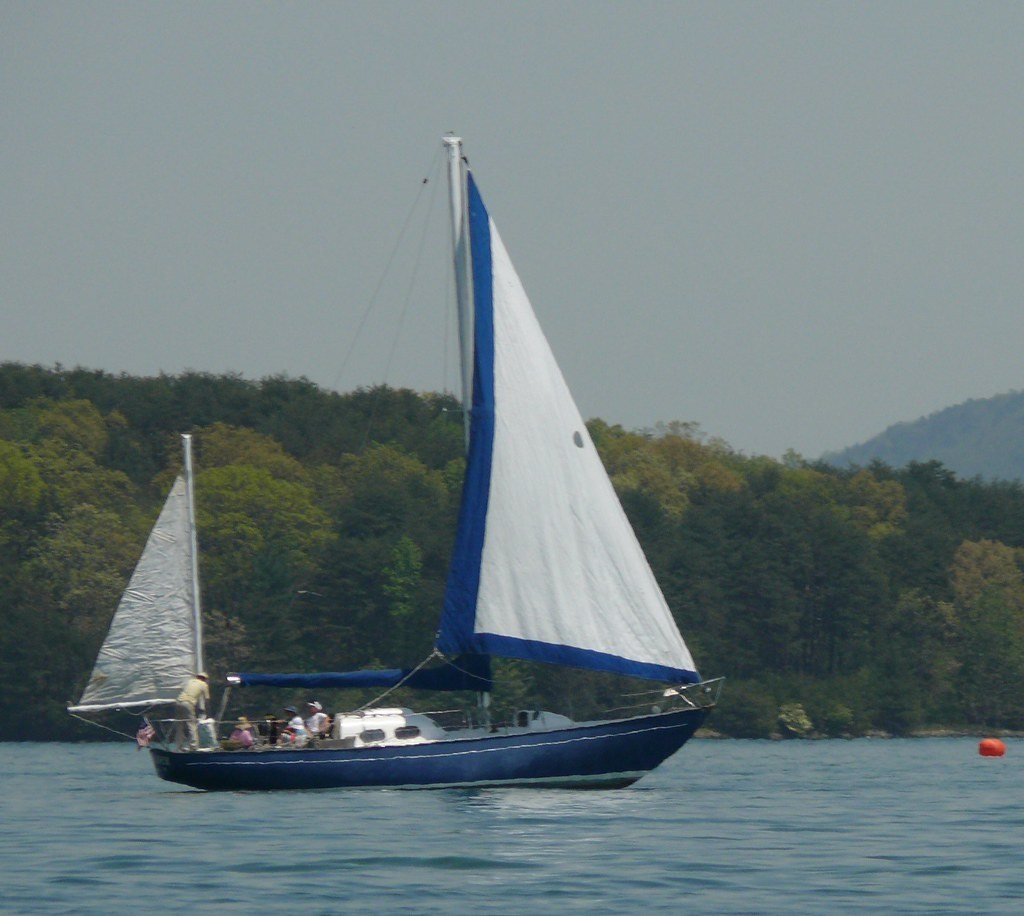
Pearson Triton
About This Book
The Pearson Triton is not one boat. It is a family of roughly 700 fiberglass cruisers built between 1959 and 1967, split across two American factories that made meaningfully different boats, evolved through several rigs, and have since spent six decades being repaired, re-rigged, re-engined, and rebuilt by owners. This chapter is about figuring out which Triton is actually yours, and setting your expectations for what owning a sixty-plus-year-old classic really asks of you.
Welcome aboard. Whether you already own a Triton, you are circling one on a broker's listing, or you are staring at a tired hull propped in someone's side yard with a "make offer" sign zip-tied to a stanchion, this book is meant to be the reference you keep within reach. It gathers what is known about the boat's history, its systems, its known weaknesses, and its maintenance into one place, organized so you can find the answer you need without wading through decades of scattered forum threads.
But before any of that is useful, you have to know what you are looking at. And with a Triton, that is genuinely a question worth asking.
1.1 Why "your" Triton is the right question
The Triton was one of the first mass-production fiberglass auxiliary sailboats, designed by Carl Alberg and launched to a sensation at the January 1959 New York Boat Show. That much is settled. What surprises most new owners is how much the boats differ from one another. Three things drive the variation: which factory built the boat, how the boat was rigged, and what sixty-plus years of owners have done to it since.
Get those three straight and the rest of this book snaps into focus. Skip them and you will read advice meant for a different boat than the one in your slip.
The defining fork: East vs West
This is the single most important distinction in Triton ownership, so we lead with it.
Most Tritons, on the order of 500 to 600 hulls, were built by Pearson Yachts in Rhode Island (Bristol, then Portsmouth). These are the East Coast boats. A smaller run, roughly 125 to 150 hulls, was built under license by Aeromarine Plastics in Sausalito, California. These are the West Coast, or "Aeromarine," boats. (A further ~60 were built in France by Jouet, which is how the ~700 total reconciles; those are outside this book's scope.) The exact East Coast count is not authoritatively published, so treat the split as approximate.
The two American builds are not merely badges on the same boat. They differ in ways that change how you survey, maintain, and value the hull:
- Deck construction. Pearson (East) boats used an end-grain balsa core to stiffen the decks and cabin top. Aeromarine (West) decks are reported as solid glass with no balsa. This one difference is enormous, because a wet, rotten balsa core is the defining problem of the East Coast Triton, and the West boats largely sidestep it.
- Trim. East boats carry wood: mahogany coamings, grab rails, and exterior brightwork, with a teak-look interior. Aeromarine boats are essentially all fiberglass, with little or no exterior wood. The amount of wood on deck is the fastest visual tell of which coast a boat came from.
- Ports. Early East boats used cast-bronze port frames. Aeromarine boats used frameless portlights.
- Feel. Owners describe the heavier-built Aeromarine boats as stiffer, while the East boats heel earlier and feel more responsive.
One honest caveat: owners caution that both builders changed construction throughout their runs, so these differences are the typical case, not a guarantee. Use the coast to predict wood trim and deck core, then verify the actual construction on the specific boat in front of you rather than assuming from the badge.
The practical takeaway: a West Coast solid-glass-deck boat removes the biggest single Triton risk, while an East Coast boat rewards you with bronze-framed ports and warm wood trim but demands a rigorous deck-core inspection before you buy.
The rig varies. Do not assume "masthead sloop."
You will see the Triton described everywhere as a "masthead sloop." That is not reliably true, and getting it wrong can mean ordering the wrong standing rigging.
The more authoritative reviews report that the original East Coast rig was a taller three-quarter fractional rig sloop, identifiable by jumper struts near the masthead and a forestay that lands below the top of the mast. Later boats were offered with a shorter masthead sloop rig, where the forestay runs all the way to the masthead and there are no jumpers. Aeromarine boats were generally built masthead. A yawl rig was also offered as a factory option, cutting across both coasts.
On top of that, many boats have been re-sparred over sixty years, so the original build does not guarantee what is standing on the boat today. [SAFETY] Do not infer your rig geometry from the model year alone. Look at your actual spar (jumper struts plus a sub-masthead forestay means fractional; forestay to the masthead with no jumpers means masthead) and measure the real stay landings before you order wire (source: practical-sailor.com).
What every Triton shares
For all their variation, the boats share a common skeleton. Every Triton is a heavily built, solid hand-laid fiberglass hull of about 28.3 feet on deck, with a full keel and a keel-hung rudder hung on the aft edge of the keel. Steering is by tiller, not a wheel. Ballast is roughly 3,019 pounds of lead. Displacement is a genuine point of confusion: the design and early figure is about 6,930 pounds, while later and real-world loaded figures run closer to 8,000 to 8,400 pounds, so you will see both quoted.
The standard engine was the Atomic 4, a roughly 30-horsepower four-cylinder gasoline inboard that pushes the boat to its hull speed of a little over six knots. Many surviving Tritons have since been repowered with a small diesel (Beta Marine and Yanmar are the common choices), so confirm what is actually installed before you assume anything about fuel, tanks, or ventilation.
1.2 A sixty-plus-year-old classic, honestly framed
Here is the part we owe you plainly. A Triton is a "plastic classic," and buying one is a restoration-first proposition far more often than it is a turnkey purchase. The good news is that the hull is almost never the problem: the laminate is strong enough that Tritons have circumnavigated and crossed oceans. The sober news is that everything bolted to that hull, cored into it, or plumbed and wired through it has had sixty years to age, and water has had sixty years to find every piece of wood on the boat.
Purchase price, on these boats, is close to trivial next to restoration cost. A "cheap" or even free Triton with wet decks, rotten bulkheads, seized seacocks, a tired engine, and original wiring can absorb $20,000 to $40,000 or more, and one to two years of work, to make right. Those figures come from owner accounts and should be treated as directional, but the shape of the lesson is not in doubt. The single best financial decision you can make is to buy the driest, most complete, most already-refit boat you can find, or to go in with your eyes fully open as a multi-year project. The hull will outlive you. Everything attached to it is the budget.
Check these first
If you are surveying a candidate boat, or auditing the one you own, these are the items that most often decide whether a Triton is a bargain or a money pit. Each gets a full treatment later in the book; this is your short list.
- Deck and cabin-top core (East boats especially). Tap the entire deck with a plastic mallet. A sharp ring is sound; a dull thud is wet, rotten balsa core. Concentrate on chainplate covers, stanchion bases, handrail feet, the mast step, and the cockpit sole. A full recore is the largest single cost on a bad East Coast boat. [SAFETY] (source: practical-sailor.com)
- Chainplates and bulkheads. The chainplate passes through the deck and bolts to a plywood bulkhead. Leaks rot that bulkhead, and a rotted bulkhead can let the rig pull out under load. Pull the cover plates, probe the bulkhead top for softness, and look for water staining below deck. [SAFETY] (source: sailnet.com)
- Mast-beam sag. The deck-stepped mast is carried by a wooden mast beam under the cabin top, and numerous owners report the deck caving under the mast because the original beam is under-built. Sight along the cabin top for a dish at the mast, and check the beam-to-deck contact from inside. [SAFETY] (source: practical-sailor.com)
- Seized bronze seacocks. The original bronze seacocks are commonly found solidly seized, and some raw-water lines were fitted with cheap gate valves that have no place below the waterline. A seacock that will not close is a sinking risk. Operate every one. [SAFETY] (source: triton381.com)
- A tired engine. Determine whether the boat has an original Atomic 4, a rebuilt one, or a diesel repower, and compression-test any gasoline engine. On a gas boat, verify a working blower and ignition-protected electrics. This swings both value and remaining life materially.
- End-of-life wiring. Assume any surviving 1960s DC wiring is at the end of its life and budget a full rewire rather than a repair. Untinned copper, corrosion, and household or automotive wire are the norm on unrefit boats. On a gas boat, ignition-protected components near the engine are not optional. [SAFETY] (source: triton381.com)
1.3 Know your hull
Before you go further in this book, fill in the four facts that unlock the rest of it. Keep them written down.
- Builder / coast. East Coast Pearson (wood trim, likely balsa deck, bronze-framed ports) or West Coast Aeromarine (all fiberglass, solid deck, frameless ports)? Verify on the boat, not the badge.
- Rig. Fractional (jumper struts, sub-masthead forestay), masthead (forestay to the top, no jumpers), or yawl? Confirm by looking at the actual spar.
- Engine. Original Atomic 4 gasoline, rebuilt, or diesel repower? Which diesel, if repowered?
- Hull number. This matters more than on most boats, because several things changed mid-production. Single lower shrouds gave way to double lowers after about hull #120, and external ballast gave way to internal encapsulated lead after about hull #385. The National Triton Association historically maintained a hull registry, though its web presence has moved over the years, so verify the current class-association contact before relying on it.
1.4 A word on how to use this, and a disclaimer
This book is a reference and a companion, not a survey, and certainly not a substitute for one. Every Triton is a sixty-plus-year-old boat with its own history of modification, neglect, and repair, and no book can see the boat you are standing on. Before you buy, before you go offshore, and before you make any decision that touches your rig, your through-hulls, your fuel system, or your life, have the boat inspected by a qualified marine surveyor and, for anything holding the mast up, a qualified rigger. Where these pages mark an item [SAFETY], treat it as exactly that: your rig, your through-hulls, and your fuel system deserve a professional's eyes. Use this book to know what to ask and where to look, and trust the professional on deck with you for the answers about your specific hull.
With that settled, let us get to know the boat.
History & Identity
The Pearson Triton is the little boat that started an industry. Drawn by Carl Alberg, launched by two cousins working out of a rented corner of a Rhode Island mill, and sold in stunning numbers off the floor of the 1959 New York Boat Show, it stands as one of the first mass-production fiberglass cruising sailboats ever built. This chapter tells you where your Triton came from, who built it (there were three builders on two continents, and the differences matter to you), why it earned its place in the American Sailboat Hall of Fame, and why, sixty-odd years on, it remains one of the most beloved and most-restored "plastic classics" afloat. It also does you the honest service of separating the true story from the myth.
2.1 The cousins and the company
The Triton begins with two young cousins and a garage. Clint Pearson (Clinton) and Everett Pearson started building small fiberglass boats in the mid-1950s, at the very dawn of the material's use in pleasure craft. The most detailed account dates the start to May 1955, when Clint began working out of his garage with about $2,000 from his Navy discharge, turning out 8-foot dinghies. Other sources put the company's founding a year later, in 1956, and describe the pair as having "been building rowboats and dinghies since 1956." The discrepancy is minor and easily reconciled: the informal garage start was most likely 1955, with formal incorporation of Pearson Yachts following around 1956. Either way, the point stands. When the Triton was conceived, the Pearsons were not established yacht builders. They were two men learning a brand-new material almost from scratch.
Their early headquarters was humble: leased space in the basement of a textile mill in Bristol, Rhode Island. The Triton would change that quickly. In November 1959, flush with Triton orders, the cousins bought the historic Herreshoff Manufacturing yard, one of the most storied names in American yacht building. Production later moved to nearby Portsmouth, Rhode Island, which is why you will see Triton paperwork list either Bristol or Portsmouth depending on the year.
2.2 The brief and the design
The idea for the boat did not originate with the Pearsons. It came from a Rhode Island yacht broker named Tom Potter, of Jamestown, who believed there was an untapped market for a roughly 28-foot racer-cruiser with genuine stand-up headroom, berths for a family of four, and a price under $10,000. That price target, at a time when a comparable wooden yacht cost far more and demanded far more upkeep, was the whole gamble. Potter is credited by some sources with contributing to the design concept itself, not merely commissioning it.
To draw the boat, the job went to Carl Alberg, a Swedish-born naval architect whose name is now shorthand for a whole family of narrow, sweet-lined, sea-kindly cruisers. Alberg's design is dated 1958. He gave the Triton the traditional look he was known for, lines that owe a clear debt to the Scandinavian folkboat: a narrow hull, low freeboard, long graceful overhangs at bow and stern, a spoon bow, and a trunk cabin lifted by a raised doghouse to buy that hard-won headroom below. It is a design that still looks right on the water decades later, and much of the Triton's enduring emotional pull traces straight back to Alberg's pen.
Alberg's arrangement with Pearson has become part of the boat's folklore. He reportedly sold the plans outright for $75, then negotiated a royalty of roughly $100 per boat built. Given how many Tritons eventually came down the line, the royalty was by far the better end of that deal.
2.3 The 1959 New York Boat Show
The Triton's public debut is the pivotal scene in its story, and it is a good one. The Pearsons had a prototype but very little money. To get the boat to the January 1959 New York (National) Boat Show, they had to borrow funds simply to truck it down from Rhode Island. By one account from the builder's own history, the prototype arrived at the show with its engine still unwired. This was not a polished corporate rollout. It was two cousins betting the company on a single boat and a single weekend.
The bet paid off spectacularly. The Triton was the sensation of the show. Buyers, drawn by the promise of a handsome, capable cruiser that would never need caulking, painting, or the endless wooden-boat maintenance they knew all too well, wrote orders on the spot. Sources put the tally at 16 or 17 boats sold at the show, on the order of $170,000 in orders. "It started us chasing money," Clint Pearson later recalled. The introductory price came in under the target at $9,700. Pearson Yachts went public in April 1959; the stock opened at $1 a share and reached $13 by year's end. Within about ten years, some 700 Tritons would be built.
If you want one moment that marks the beginning of the modern fiberglass production sailboat era, that show floor in early 1959 is a strong candidate.
2.4 Was it really "the first"? An honest answer
You will hear the Triton called "the first fiberglass sailboat," or "the first fiberglass auxiliary," and it is worth being straight with you here, because the truth is a little more careful than the legend.
A fiberglass boat with an inboard engine is what sailors call an auxiliary, a sailboat that carries an engine as a backup to sail. The Triton was not literally the very first such boat ever molded. Practical Sailor, one of the most authoritative reviewers of the type, addresses the claim head-on: "The Triton was the first production fiberglass sailboat auxiliary. Not true." Small numbers of fiberglass auxiliaries predated it.
What the Triton genuinely was, and what no honest source disputes, is one of the first fiberglass auxiliary cruisers to be mass-produced in real volume, and the boat that, more than any single other, launched the fiberglass production sailboat industry. It proved the business case. It showed builders and buyers alike that a molded hull could be turned out by the hundreds, sold at a price ordinary families could reach, and trusted to cross oceans. So when you tell people about your boat, you can say it accurately and still say it proudly: the Triton was among the very first, and it was the one that started the flood. That is a bigger claim than "the first," and it happens to be true.
For its role, the Triton was inducted into the American Sailboat Hall of Fame, a fitting recognition for a design that changed how sailboats are built.
2.5 Three builders, two coasts, one boat
Here is the single most important thing to understand about Triton identity, and it is a point that trips up buyers, brokers, and even some longtime owners. Not all Tritons came from the same factory. There were three builders, spread across two continents, and the differences are not cosmetic footnotes. They affect construction, rig, and the maintenance you will live with.
Pearson Yachts (the East Coast boats). The primary builder, in Bristol and later Portsmouth, Rhode Island. These are the "classic" Tritons most people picture, finished with wood brightwork: teak and mahogany trim and coamings that give the boat its warm, traditional look and, in fairness, its traditional upkeep. Their decks were built with a balsa core, a sandwich of end-grain balsa between fiberglass skins that saves weight and adds stiffness. That core is also the defining vulnerability of the East Coast boats: where water has found its way in over sixty years, the balsa rots and the deck delaminates, and recoring is the signature Triton restoration job. (The construction chapters cover this in detail; for now, just know it is a builder-specific trait.)
Aeromarine Plastics (the West Coast boats). On the other side of the country, in Sausalito, California, Aeromarine Plastics built the Triton under the same design, producing what owners call the "Aeromarine Triton." These boats went a notably different way in construction. They were built with all-fiberglass components and little or no wood trim, and, importantly, with decks of solid glass laminate rather than balsa-cored. That single choice sidesteps the deck-rot problem that haunts the East Coast boats. Many owners regard the Aeromarine hulls and decks as the more solidly built of the two, and Aeromarine boats also tended to carry a masthead rig and a variety of non-standard rig configurations. sailboatdata even lists the Aeromarine Triton as a separate entry from the Pearson boat, which tells you how real the distinction is.
Jouët (the French boats). Finally, roughly 60 Tritons were built under license in France by the yard Jouët. These are largely out of scope for this book, and you are unlikely to encounter one in North America, but they matter for one practical reason: they are part of how the roughly 700-boat total is reconciled.
The takeaway for you as an owner or buyer is simple and worth repeating: before you quote a single specification, a rig type, a deck construction, an amount of exterior wood, find out which lineage your hull belongs to. An East Coast Pearson boat and a West Coast Aeromarine boat can differ in ways that change how you survey, maintain, and value them. This book distinguishes East from West throughout for exactly that reason.
2.6 How many were built? The honest numbers
Everyone agrees on the headline figure and disagrees on the breakdown, so here is the full picture rather than a false precision.
The most-repeated total is roughly 700 Tritons, built across the production run. Practical Sailor says "more than 700 hulls," Wikipedia says "over 700," Soundings says "approximately 700," and the builder's own history says about 700 within ten years. Call it around 700 and you are on safe ground.
The split among builders is where the sources part ways, and it is worth knowing about:
- Aeromarine (West Coast): most sources put this at about 125 to 150 boats. Wikipedia, HandWiki, and sailwiki cite roughly 150; the Pearson Yachts Portal says about 125. The honest range is 125 to 150.
- Jouët (France): about 60 boats.
- Pearson (East Coast): this is the number that is not cleanly published anywhere. If you accept the roughly 700 total and subtract Aeromarine and Jouët, the East Coast Pearson count works out to somewhere in the neighborhood of 500 to 600. You will sometimes see a figure like "~575 East Coast" quoted, and that is a reasonable, defensible estimate, but treat it as an estimate, not a hard fact. Confusingly, the Pearson Yachts Portal itself states "approximately 750 Tritons built by Pearson" plus about 125 Aeromarine, which would push the grand total well past 700 and contradicts the consensus. Rather than pretend the arithmetic is clean, the fair way to say it is this: roughly 700 Tritons were built between 1959 and 1967, the large majority by Pearson in Rhode Island (on the order of 500 to 600), about 125 to 150 by Aeromarine in California, and about 60 in France by Jouët. If precise hull-count matters for your particular boat, the class association's hull ledger is the place to verify it.
2.7 The displacement puzzle
One more number deserves a plain-spoken warning, because you will see it cited two very different ways and both are, in a sense, correct.
Displacement, the weight of water the boat pushes aside and therefore the weight of the boat itself, is quoted for the Triton as either about 6,930 pounds or about 8,000 to 8,400 pounds, and the gap is large enough to matter. The resolution is a design-versus-reality story. The 6,930-pound figure is the design (and early-production, light) number, carried by sailboatdata, Wikipedia, HandWiki, and others. But Practical Sailor reports that displacement "was 6,930 pounds until the last year or so, when it changed to 8,400 pounds," and the Pearson Yachts Portal lists 8,000 pounds. In other words, the real-world and late-production boats are heavier, closer to 8,000 to 8,400 pounds loaded, than the catalog's light 6,930-pound figure.
The practical guidance: do not trust a single displacement number for a Triton. Think of it as a light design displacement around 6,930 pounds and a real, sailing, late-production displacement around 8,000 to 8,400 pounds. Your boat, loaded for cruising with sixty years of added gear, sits at the heavier end. That extra weight is part of why Tritons feel so solid and carry their way through a seaway, and it is worth keeping in mind whenever you read a performance or trailering figure. (The specification chapter breaks the dimensions down fully; the short version is that the Triton is a heavier boat than its lightest published number suggests.)
2.8 Why it became a "plastic classic"
By the numbers alone, the Triton would be a footnote: an early fiberglass cruiser, produced in the hundreds, long out of production. What lifts it into legend is the way owners have loved it, and kept it, for generations.
Part of it is the boat itself. Alberg drew a genuinely good sea boat under that traditional prettiness. The hull is heavily built solid glass, the keel is a full keel that runs most of the length of the boat, and the rudder is keel-hung, hung right off the back of the keel where it is protected and strong. That is offshore architecture, not coastal-cruiser architecture, on a 28-foot boat that cost less than $10,000 new. Owners noticed. The Triton became a favorite of sailors who wanted a small, affordable boat they could refit and trust well offshore.
The proof is in the voyages. The most famous is Atom, a 1963 Pearson Triton sailed by James Baldwin on a 13-year circumnavigation, twice around the world. A 28-foot boat is a small platform for that kind of ambition, and the fact that a Triton has done it, more than once, is a large part of the boat's "small boat, big ocean" mystique. Baldwin's writing about Atom has become a touchstone of the community.
The other half of the Triton's staying power is the culture that grew up around restoring it. Because the boats are now sixty-plus years old and were cheap to buy in project condition, Triton ownership today is overwhelmingly a restoration-first proposition. The boats are inexpensive to acquire and need real work: recoring, systems, engine, cosmetics. A full stem-to-stern rebuild can run something like $20,000 to $40,000 or more over roughly two years, an investment that dwarfs the purchase price and that owners nonetheless take on gladly.
They take it on because they are not doing it alone. The Triton has one of the deepest, most generously documented owner communities of any classic fiberglass boat. The National Triton Association, the class body, dates back to 1966 and has long organized racing and rendezvous around the country. And the online record is extraordinary: the restoration of Triton #381, Glissando, by Tim and Heidi Lackey, is documented online in page-by-page, photo-by-photo detail, from a full balsa deck recore to a rebuilt interior, and stands as arguably the single best Triton restoration reference anywhere. Tim Lackey went on to turn that expertise into a professional restoration business. Between resources like Glissando, Baldwin's Atom writeups, the "plastic classic" restoration forums, and brand-sponsored refit series, nearly every system on the boat has a published rebuild precedent waiting for you. On a Triton, the documentation is very nearly the parts catalog, and that depth is one of the real joys of owning one.
That is the boat you have, or are thinking of taking on. Not the literal first fiberglass sailboat, but one of the first that mattered: a Carl Alberg design, built by the Pearson cousins and by Aeromarine and by Jouët, that helped launch an entire industry and then refused to fade away. The chapters that follow get specific about your particular hull, East Coast or West, and what it takes to keep her sailing. This one is just the reason she is worth it.
Glossary
- Aeromarine
- Aeromarine Plastics, the Massachusetts molder that built the East Coast Tritons for Pearson before production later shifted west.
- Alberg
- Carl Alberg, the Swedish-American naval architect who drew the Triton and many other full-keel classics with fine ends and moderate displacement.
- Atomic 4
- The Universal Atomic 4, a 30 hp inline-four gasoline auxiliary engine fitted to many older production sailboats.
- Auxiliary
- The engine carried by a sailboat for use when there is no wind or in close quarters; a Triton's auxiliary was originally a small gas Atomic 4.
- Backfire Flame Arrestor
- A metal-mesh device on a gasoline engine's air intake that stops a carburetor backfire from igniting fumes.
- Ballast
- Heavy material, usually lead or iron, placed low in the keel to lower the boat's center of gravity and provide the righting force that keeps a sailboat upright and counteracts the heeling force of the wind on the sails.
- Ballast Resistor
- A resistor in a points-ignition circuit that drops voltage to the coil in normal running to protect the points.
- Balsa
- End-grain balsa wood used as a lightweight core between fiberglass skins; strong and stiff dry, but it rots if water reaches it.
- Balsa Core
- A layer of lightweight end-grain balsa wood sandwiched between two skins of fiberglass to create a stiff, light composite panel used in decks and sometimes hulls. Its main vulnerability is water intrusion through unsealed fastener holes, which can rot the wood and delaminate the panel.
- Balsa-Cored
- Built with a balsa-wood core between two fiberglass skins for stiffness at low weight; vulnerable to rot where water intrudes.
- Balsa-Cored Deck
- A deck built with a balsa-wood core between fiberglass skins for stiffness; it rots if water reaches the core.
- Barrier Coat
- A series of epoxy coatings applied below the waterline to seal the hull laminate against water absorption and osmotic blistering.
- Beam
- The width of the boat at its widest point.
- Bilge Blower
- An electric fan that clears fumes from the bilge and engine space; run it before starting a gasoline engine.
- Blower
- An electric fan that ventilates the engine compartment; on a gasoline boat it must be run before starting to clear fumes.
- Bonding
- An electrical system that connects underwater metal fittings and other metal to a common ground conductor, so they corrode at the same rate and stray current has a controlled path.
- Breaker Points
- The mechanical switch inside a distributor that opens and closes to fire the ignition coil; a wear item on the Atomic 4.
- Brightwork
- Varnished or polished exterior wood (and sometimes bright metal) that needs regular upkeep to stay sound and good-looking.
- Bronze
- A copper-tin alloy prized on boats for its corrosion resistance, used for ports, seacocks, and hardware on Cape Dory and similar builds.
- Bronze Genoa Tracks
- Deck-mounted bronze rails that carry the genoa sheet lead cars, letting the sheeting angle be adjusted fore and aft.
- Bulkhead
- A structural partition across the hull that stiffens it and divides the interior; chainplates often attach to bulkheads.
- Capsize Screening Formula
- A simple design ratio (beam divided by the cube root of displacement in cubic feet) used to gauge a boat's resistance to capsize. A value under 2.0 is generally considered acceptable for offshore use; higher numbers suggest a boat more easily knocked down.
- Chainplate
- A strong metal strap or fitting bolted to the hull or a structural bulkhead to which the standing rigging (shrouds and stays) attaches, transferring the enormous loads from the mast and rig into the boat's structure.
- Chainplates
- A strong metal strap or fitting bolted to the hull or a structural bulkhead to which the standing rigging (shrouds and stays) attaches, transferring the enormous loads from the mast and rig into the boat's structure.
- Clevis Pin
- A pin passed through a fork (clevis) fitting to connect rigging parts, secured by a cotter or ring.
- Coamings
- The raised rims around the cockpit or a hatch that keep water out and give the crew something to brace against.
- Comfort Ratio
- Ted Brewer's index estimating a boat's motion comfort at sea from its displacement, beam, and waterline.
- Cone Clutch
- A friction clutch using cone-shaped mating surfaces to transmit torque, used in some marine transmissions (such as certain Yanmar gearboxes) to engage forward and reverse drive smoothly.
- Crevice Corrosion
- A localized form of corrosion that attacks stainless steel in tight, oxygen-starved gaps, such as under fittings or inside swage terminals, where the protective oxide layer cannot renew itself. It is a common hidden failure mode in rigging and chainplates.
- Cutless Bearing
- A water-lubricated sleeve bearing, with a grooved rubber inner surface, that supports the propeller shaft where it exits the hull; it wears out and must be replaced periodically.
- Deck-Stepped
- A mast that sits on the deck or cabin top rather than passing through to the keel; its load is carried down by a compression post.
- Deck-Stepped Mast
- A mast that sits on the deck or cabin top, its load carried down by a compression post, as opposed to keel-stepped.
- Dezincification
- A form of corrosion in which zinc leaches out of brass, leaving a weak, porous copper structure; it is why ordinary brass valves fail underwater and DZR brass or bronze is used instead.
- Dezincify
- To lose zinc from a brass or bronze alloy through galvanic action, leaving the metal pink, porous, and weak; a failure mode of low-grade seacocks.
- Displacement
- The weight of water a boat displaces when floating, which equals the boat's total weight. It is a fundamental measure of a vessel's size and is used in many performance and stability ratios.
- Displacement-Length Ratio
- A number comparing a boat's weight to its waterline length; the Westsail's very high value marks it as heavy.
- Doghouse
- A raised section of cabin trunk that adds headroom and light aft, distinct from the lower forward coachroof.
- Draft
- The depth of the boat below the waterline, the minimum water it needs to float.
- Drift Pins
- Long metal rods driven through structural members (such as a keel or floors) to pin them together.
- E
- E, the mainsail foot length, measured along the boom from the aft face of the mast to the black band (the maximum outhaul point).
- Electronic Ignition
- A solid-state replacement for breaker points that fires the spark, improving reliability on engines like the Atomic 4.
- Encapsulated Ballast
- Ballast (iron or lead) sealed inside the molded fiberglass keel cavity rather than bolted on, so there are no keel bolts, but a grounding that breaches the glass can let water reach the ballast.
- Engine Beds
- The heavy fore-and-aft structural members the engine bolts to, transferring its weight and thrust into the hull.
- Fiberglass
- Glass-reinforced plastic: glass fibers set in resin, the material of Grand Banks hulls from about 1973 onward.
- Flame Arrestor
- A metal-mesh device on a gasoline engine's air intake that stops a backfire flame from igniting fumes.
- Folkboat
- The Nordic Folkboat, the lean double-ended Scandinavian daysailer whose proportions influenced Alberg's designs.
- Foretriangle
- The triangular area at the front of the rig bounded by the mast, the forestay, and the deck. Its dimensions (I and J) define the size of the jib or genoa and are used in sail area and rating calculations.
- Fractional
- A rig in which the forestay meets the mast below the masthead, so the headsail does not reach the top of the spar.
- Fractional Rig
- A rig with the forestay attached below the masthead, giving a smaller foretriangle and a larger, more powerful mainsail.
- Freeboard
- The height of the hull above the waterline.
- Fresh-Water Cooling
- An engine cooling system that circulates a closed loop of coolant cooled by seawater through a heat exchanger, as opposed to raw-water cooling.
- Full Keel
- A long keel running most of the length of the hull; it gives a trawler directional stability and protects the propeller and rudder, at the cost of maneuverability.
- Gate Valve
- A valve that opens and closes by raising or lowering a wedge-shaped gate. Gate valves are generally unsuitable for below-waterline seacock service because they can fail hidden (the stem corrodes off the gate) and are often made of dezincification-prone brass.
- Gelcoat
- The pigmented resin outer layer of a fiberglass hull or deck that provides a smooth, glossy, waterproof finish and protects the underlying laminate from UV and water. It can craze, chalk, or blister with age.
- Gooseneck
- The hinged fitting that connects the boom to the mast.
- Gudgeons
- The fixed sockets on the hull or transom that the rudder pintles drop into, forming the rudder hinge.
- Heat Exchanger
- A component in a freshwater-cooled (indirect) engine cooling system where engine coolant is cooled by raw seawater flowing through a bundle of small tubes, transferring heat without the two fluids mixing, much like an automotive radiator cooled by water instead of air.
- Holding Tank
- The onboard tank that stores sewage (black water) from the marine head until it can be pumped out ashore or discharged legally offshore.
- Hull Speed
- The theoretical maximum efficient speed of a displacement hull, roughly 1.34 times the square root of the waterline length in feet, beyond which the boat must climb its own bow wave and required power rises steeply.
- I
- I, the rig's foretriangle height, measured from the sheer (deck level) to the top of the forestay fitting.
- Icebox
- An insulated galley box cooled by block or cube ice rather than mechanical refrigeration; original equipment on early Tritons.
- Ignition
- The system that fires the spark to ignite the fuel-air charge in a gasoline engine; on the Atomic 4 it uses coil, distributor, and points.
- Ignition-Protected
- Describing electrical equipment built so it cannot ignite fuel vapor, required near a gasoline engine.
- Impeller
- The flexible rubber, vaned rotor inside a raw-water pump that draws seawater through the engine's cooling system. Its vanes wear and can shear off, so it is a routine maintenance-replacement item; running the pump dry destroys it quickly.
- J
- J, the foretriangle base, measured horizontally along the deck from the front of the mast to the forestay's attachment at the bow.
- Jumper Struts
- Small struts near the masthead that angle the jumper stays forward to support the upper section of the mast.
- Keel Bolts
- The bolts that fasten an external ballast keel to the hull; critical structural fasteners to inspect and torque-check.
- Keel-Hung
- Describing a rudder hung on the aft edge of a full keel, well supported and protected, as on the Triton.
- Keel-Hung Rudder
- A rudder mounted on the aft edge of a full keel, well protected and supported along its length.
- Kubota
- The Japanese industrial-engine maker whose diesel blocks Universal and Beta marinized, the source of cheap cross-referenced parts.
- L-Head
- A side-valve (flathead) engine layout in which the valves sit beside the cylinder, as on the Atomic 4; simple but not efficient.
- Loa
- Length overall: the boat's total length including any bow pulpit or swim platform.
- Lwl
- Load waterline length, the hull length at the waterline, which sets a displacement boat's hull speed.
- Mast Beam
- The transverse structural beam under the deck that supports a deck-stepped mast and carries its compression load down into the hull.
- Masthead Rig
- A rig in which the forestay runs to the very top of the mast, so the headsail fills the full foretriangle.
- Masthead Sloop
- A single-masted sailboat whose forestay attaches at the top (masthead) of the mast, allowing a large foretriangle and headsail. This contrasts with a fractional rig, where the forestay attaches partway down the mast.
- Oil-Canning
- The flexing or popping of a thin, unsupported panel in and out under load, like the bottom of an oil can.
- Opening Port
- A hinged cabin window that can be opened for ventilation, as opposed to a fixed deadlight.
- Osmosis
- The process by which water permeates a hull's gelcoat and forms blisters in the laminate.
- P
- P, the mainsail luff length, measured along the aft face of the mast between the black bands (the maximum hoist of the mainsail).
- Pearson
- Pearson Yachts, the Rhode Island builder (cousins Clint and Everett Pearson) that pioneered production fiberglass boats and built the Triton.
- Phrf
- Performance Handicap Racing Fleet, a widely used North American handicapping system that assigns each boat a rating in seconds per mile so that dissimilar boats can race fairly by correcting elapsed times.
- Pintles
- The pins on the rudder that drop into hull-mounted gudgeons to form the rudder hinge.
- Plastic-Classic
- An affectionate term for an early fiberglass production sailboat with traditional lines, such as the Triton.
- Portlight
- A cabin window, fixed or opening; on heavily-built cruisers often a bronze one.
- Raw-Water Cooled
- Cooled by pumping seawater directly through the engine rather than through a closed freshwater loop; simpler but prone to internal salt corrosion.
- Raw-Water Cooling
- Engine cooling that pumps seawater directly through the engine, as opposed to a closed fresh-water loop; simpler but harder on the block over decades.
- Recore
- The repair of replacing wet or rotten core material in a deck or hull panel by opening a skin, removing the bad core, and bonding in new core and glass.
- Restoration
- Returning a tired boat to sound, serviceable condition, from targeted repairs up to a full rebuild.
- Reversing Gear
- The transmission behind the engine that provides ahead, neutral, and astern.
- Roller Reefing
- An older method of shortening the mainsail by rolling it around a rotating boom, largely superseded by slab reefing.
- Rudder Shoe
- The fitting at the bottom of the keel or skeg that carries the lower rudder bearing and takes the rudder's weight.
- Sail Area-Displacement Ratio
- A number comparing a boat's sail area to its weight, indicating how easily it is driven.
- Sail Track
- The groove or rail on the mast or boom that the sail's slides or bolt-rope ride in.
- Seacock
- A robust shutoff valve mounted on a through-hull fitting that allows a below-waterline opening (for cooling water intake, drains, or heads) to be closed, isolating the boat's interior from the sea. Marine seacocks are made of corrosion-resistant bronze or reinforced polymer.
- Seacocks
- The shut-off valves on hull openings that let a through-hull fitting be closed against the sea.
- Sheave
- A grooved wheel or pulley over which a cable, rope, or belt runs; in steering systems the cables ride over sheaves to change direction.
- Single Lower Shrouds
- A rig with one lower shroud per side rather than fore-and-aft pairs, simpler but giving less control of mast bend.
- Slab Reefing
- Reducing mainsail area by lowering the sail to a reef point and securing the loose foot, the standard modern method; also called jiffy reefing.
- Spar
- A mast, boom, or other pole that carries or spreads a sail.
- Spreader
- A strut that holds a shroud out from the mast to improve its support angle.
- Spreader Socket
- The fitting that attaches a spreader to the mast; the Catalina 27's cast-aluminum sockets are a known failure point.
- Spreader Sockets
- The mast fittings that hold the inboard ends of the spreaders and take their compression load.
- Standing Rigging
- The fixed wires or rods (shrouds and stays) that hold the mast up and in position. Unlike running rigging, it is not routinely adjusted while sailing and is a critical structural system with a finite service life.
- Stuffing Box
- The fitting where the propeller shaft exits the hull, packed with greased flax or fitted with a seal to keep the sea out while allowing the shaft to spin; also called a packing gland.
- Swage
- A wire terminal fitting attached by compressing (swaging) a metal sleeve tightly onto the end of a wire rope under high pressure. Swage terminals are common on standing rigging but can develop cracks or crevice corrosion over time.
- Tabbing
- Fiberglass strips that bond a bulkhead or component to the hull; failed tabbing lets structure move.
- Tang
- A metal fitting on the mast or hull to which a stay or shroud attaches.
- Thermostat
- A temperature-controlled valve that regulates engine coolant flow to hold it at operating temperature.
- Through-Hull
- A fitting that passes through the hull to connect an inside pipe or hose to the water outside, for intakes and discharges; usually paired with a seacock.
- Thru-Hull
- A fitting that penetrates the hull for an intake or discharge, normally paired with a seacock.
- Tiller
- A lever attached to the rudder head used to steer, as opposed to a wheel.
- Traveler
- An athwartships track and car that positions the mainsheet's lower block, controlling boom angle.
- Turnbuckle
- A threaded fitting at the base of a stay or shroud used to adjust rigging tension.
- Updraft Carburetor
- A carburetor that feeds the fuel-air mixture upward into the engine, as used on the Atomic 4.
- Waterlift Muffler
- A canister-style marine muffler that collects the cooling water mixed into the exhaust and, as exhaust pressure builds, lifts and pushes that water up and out overboard.
- Weather Helm
- The tendency of a boat to turn up into the wind, felt as pull on the tiller; mild weather helm is desirable, heavy is tiring.
- Winches
- Drum-shaped mechanical devices that give the crew purchase to trim sheets and halyards.
- Woven Roving
- A heavy woven fiberglass reinforcement used to build up hull thickness.
- Yawl
- A two-masted rig with a small mizzen mast stepped aft of the rudder post; a factory option on some Tritons.
- Zinc Anode
- A sacrificial block of zinc attached to underwater metal parts that corrodes in place of them, protecting propellers, shafts, and fittings from galvanic corrosion. It must be inspected and replaced before it is fully consumed.