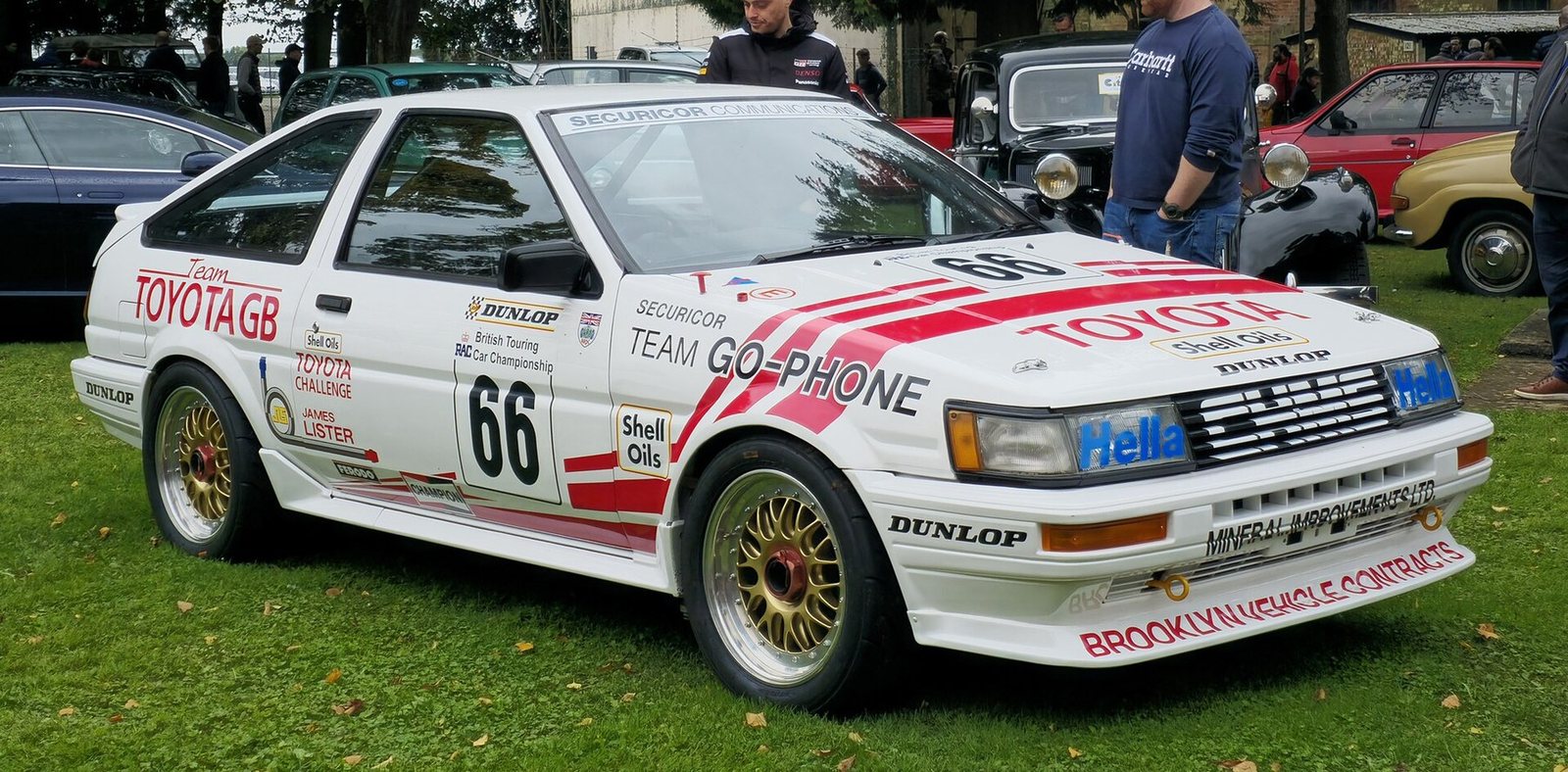
Toyota Corolla
About This Book
This is a working reference for the rear-drive Toyota Corolla Levin and Sprinter Trueno of 1983 to 1987, the car the world calls the AE86, along with the Corolla SR5 and GT-S that North America got instead. It is written for the person who owns one, is about to buy one, or is trying to keep one honest. Its central claim is that on this car identity and structure decide everything, and that the engine, which is the part everybody talks about, is the part least likely to cost you money.
1.1 What this car is, and why it needs a book of its own
Start with what Toyota was actually doing. The E80 Corolla programme moved the mainstream range to front-wheel drive, and the coupes, "for which packaging efficiency wasn't a major selling point, would remain RWD for another model cycle" (source: ateupwithmotor.com/model-histories/ae86-corolla-levin-sprinter-trueno/). So the AE86 carries the floorpan of the older E70 car inside E80 sheet metal, and it is the last production Corolla with rear-wheel drive (source: en.wikipedia.org/wiki/Toyota_AE86). It was a mass-market economy car with a good engine in it: the 4A-GE, Toyota's first mass-produced twin-cam sixteen-valve four, 1,587 cc from 81.0 by 77.0 mm (source: club4ag.com/faq_and_tech_pages/4A-GE_technical_specifications.htm).
Then the culture arrived. Keiichi Tsuchiya's mid-1980s drift videos established the chassis, and the Initial D manga from 1995 and anime from 1998 created demand in markets that had never sold the car, a premium Wikipedia calls the "Takumi tax" (source: en.wikipedia.org/wiki/Toyota_AE86; jdmbuysell.com/learn/toyota/ae86/). That is the tension this book exists to handle. Accident damage is common on these cars specifically because of how the Initial D generation drove them, with mismatched panel gaps and fresh paint the published red flags (source: projectjdm.org/vehicle-guides/buyers-guide-ae86), and the two specific frauds are an AE85 fitted with a 4A-GE and an AE86 fitted with a later engine, both externally indistinguishable (source: jdmbuysell.com/learn/toyota/ae86/). Japanese shops sell a hakogae service that transfers every part from a damaged car onto a restored shell (source: tomisatoracing.jp/ae86ボディ販売/). A Re-shell here is something to expect, not something to be shocked by.
Meanwhile the price has moved from 3,000 to 5,000 dollars in 2005 to a spread running past 55,000, with dated results including a 114,000-mile 1985 GT-S at 40,000 dollars and a one-owner UK Corolla GT at 46,250 pounds (source: jdmbuysell.com/learn/toyota/ae86/; japanesenostalgiccar.com/1985-toyota-corolla-gts-ae86-sells-for-40000/; motoringresearch.com/car-news/toyota-corolla-ae86-auction-record/). Money that size, on a car with no factory build-record lookup and no public registry (source: driftworks.com/forum/threads/ae86-vin-plate-tracking.35124/), is why a careful book is worth writing.
1.2 How this book handles a source
Every factual claim here carries its source inline, in the form you have been reading. Where sources disagree, both figures are printed and the chapter says which carries the weight of evidence, rather than quietly averaging them. Where a figure could not be established, the book says so instead of borrowing one. That is not fastidiousness. On this car the disagreements sit exactly on the numbers that cost money, and four examples will teach you how to read the rest of the book.
The right number on the wrong fastener. The figure circulating everywhere as the 4A-GE cylinder head bolt torque, 610 kg-cm, 44 ft-lb, 60 N-m, is the main bearing cap torque from page EM-146 of the factory engine manual. The head takes a three-stage angle procedure at EM-117 and EM-118: 300 kg-cm, then 90 degrees, then a further 90 degrees (source: files.aeu86.org/manuals/4A-GEManual.pdf, EM-117, EM-118, EM-146; mr2oc.com/threads/torque-specs-for-4age-16v-head-bolts.56861). A head pulled to 44 ft-lb and stopped is nowhere near clamped. Two chapters of this book had to correct that independently, and the tell is a source quoting a manual it did not open.
The North American VIN inversion. The firewall chassis code reads AE86 on every United States car, but the VIN prefixes ran JT2AE85 for the DX, JT2AE86 for the SR5 and JT2AE88 for the GT-S (source: en.wikipedia.org/wiki/Toyota_AE86). Read that twice. A US car with AE86 in the VIN is the single-cam SR5. The twin-cam GT-S is a VIN AE88 car and an AE86 chassis car at the same time. A seller offering "AE86 in the VIN" as proof of a twin-cam is offering evidence of the opposite.
130 PS is a ruler, not a measurement. Every article opens with 130 PS at 6,600 rpm. It is a JIS gross figure, taken at the engine without accessories and running roughly fifteen percent above installed net; restated net the same engine is 120 PS, and Toyota's own modern quotation is about 111 PS (source: ateupwithmotor.com/model-histories/ae86-corolla-levin-sprinter-trueno/2/ and /3/). Nothing changed inside the engine between those three numbers. Worse, the most-quoted specification table in the community footnotes itself: its power figures "are not actual power ratings but ones posted in catalogs at the time of sale" (source: club4ag.com/faq_and_tech_pages/4A-GE_technical_specifications.htm). This book prints 130 PS as the period Japanese catalogue figure and says what kind of figure it is.
The database that has not read a manual. One aggregator publishes 146 torque specifications for a 1985 AE86, and its job list includes ABS Module, ABS Pump, ABS Wheel Speed Sensor and ABS Tone Ring (source: openlaborproject.com/torque-specs/toyota/ae86/). The AE86 has no ABS. The fault is the category rather than the page: a site publishing a full specification set for every car ever built has not opened a manual for each one, and the giveaway is a component the car does not have.
1.3 What is not in this book
Said once, here, so that no chapter has to pretend.
Per-variant production counts do not exist in accessible sources. There is no published split of Levin against Trueno, coupe against liftback, GT against GT-V against GT-APEX, or zenki against kouki. The only firm per-variant figures anywhere are 400 Sprinter Trueno GT-APEX Black Limiteds and roughly 20 dealer-built convertibles (source: aeu86.org/2015/01/08/ae86-trivia-all-sprinter-trueno-ae86-black-limited-facts/). Anyone quoting a Trueno liftback production number should be asked where it came from.
Some figures simply are not there. Engine oil capacity is unresolved, because the lubrication section is missing from the circulating copy of the engine manual and public values span more than a litre on a sump holding under five, so this book says fill to the dipstick rather than print a number (source: mymotorlist.com/engines/toyota/4a-ge/; enginecrux.com/exploring-the-toyota-4a-ge-engine-specs-reliability/). Front and rear disc diameters appear in neither factory document read. Neither does a brake or clutch master cylinder bore. And a single caster figure could not be pinned down: the factory row splits four ways by engine and by power steering, and the scan is tight enough that this book prints the range it spans, 2 degrees 45 minutes to 3 degrees 40 minutes, rather than pick a number out of it (source: files.aeu86.org/manuals/AE86Manual.pdf, page A-7).
Several 2026 prices are absent rather than invented. No citable current quote was obtained for an annual service, a clutch job, a suspension refresh or a respray, and three vendors block automated access so no live prices from them reached these pages (source: nengun.com/gazoo-racing/gr-heritage-parts-ae86). Gather local quotes. A printed total is wrong within a year and indefensible when a reader takes it to a shop.
1.4 What to carry into a viewing
Two things decide an AE86 purchase, and neither is the engine.
The first is rust, in specific structural places. This is a thin-gauge unibody where the sill is the frame and the strut tower is a suspension mounting point, so a small hole is usually a large soft area (source: toyotanation.com/threads/major-rust-repair-floor-pan-strut-well-etc.1163969/). Front strut towers and the tower-to-apron seam, sills and rockers, floor pans with the carpet actually lifted, the rear four-link and lateral rod brackets whose bolts torque to 1,200 kg-cm into a forty-year-old weld, and the inner rear arches. Rust in the frame rails or strut towers is a walk-away (source: jdmbuysell.com/learn/toyota/ae86/), because bodywork plus paint on a bad car exceeds the price of a good one.
The second is establishing that the car is what it is claimed to be. Twin cam covers with 4A-GE cast in, and a T-VIS plate on the intake manifold rather than a later small-port manifold. Then the parts an engine swap does not replace: hydraulic clutch against cable, rear discs against drums, a 6.7 inch differential against the smaller S-series unit, the rear anti-roll bar (source: en.wikipedia.org/wiki/Toyota_AE85). In the United States, an S-series axle with rear drums means an SR5-based car whatever the badges say (source: doctoredgarage.com/ae86-rear-axles-and-upgrades/). Verify a limited-slip differential physically, by jacking both rear wheels and turning one by hand, rather than on trust. And read the shell for a half-cut or a re-shell: transverse weld lines, spot welds that differ in spacing and finish from a stretch you know is original, seam sealer that is glossier or brush-applied where the factory bead is gun-applied.
Chapter 04 owns the procedure, the costs and the checklist. Chapter 02 owns the identification sequence and the paperwork. This chapter only insists that you do both before the money moves.
1.5 One fact that reframes ownership
This engine has no hydraulic lifters. Clearances are set by shim, shim-over-bucket, and Toyota put the procedure in the tune-up chapter rather than the repair chapter, which makes it scheduled work (source: files.aeu86.org/manuals/4A-GEManual.pdf, EM-35 to EM-37). Wear between lobe and follower opens the clearance, which is the cold tick these cars are known for, and left long enough the slapped bucket damages the camshaft (source: billzilla.org/engvalve.htm).
That is what separates the AE86 from the hydraulic-lifter cars elsewhere in this series. Cold figures are intake 0.15 to 0.25 mm and exhaust 0.20 to 0.30 mm, seventeen shim sizes in 0.05 mm steps, and a formula that targets the middle of each range rather than an edge (source: files.aeu86.org/manuals/4A-GEManual.pdf, EM-35 and EM-36). Budget the time, and budget access to a shim library, because a real valve adjustment almost never finishes with one shim on the bench. Ownership of this car includes a job that most of its contemporaries let you forget.
1.6 How this book is arranged
Chapter 02 is history and identity: the E70-in-E80 architecture, Levin against Trueno, the grade ladder that gets inverted constantly, zenki against kouki, market by market, the production arithmetic shown rather than asserted, and a five-step sequence for pinning down what a car actually is.
Chapter 03 is the specification reference, broken out by market, body and measurement standard rather than averaged into one column, and it closes with a plain list of what could not be established.
Chapter 04 is known issues and the survey guide. Rust location by location with costs, the tells of forty years of drifting, the engine and driveline faults, the government record and how to read it against the car's actual architecture, then a pre-purchase checklist ordered by what kills the deal first.
Chapter 05 is the engine and driveline as engineering: the induction split that decides which parts fit, T-VIS and what it really does, the interference question and its mechanism, the torque figures, the swaps this community performs, and the rear axle that becomes the project the moment power rises.
Chapter 06 is systems and diagnosis, organised around one question per system: how does it work here, how do you test it, and what should the reading be. Chapter 07 is maintenance: what keeps the car alive in priority order, the intervals that are published and the ones that are not, the full torque reference, alignment, storage and running costs.
Chapter 08 is parts and sourcing, which on this car begins with the fact that Toyota went back into production for it under GR Heritage Parts, and turns on what that list does not contain. Chapter 09 covers the community, the free factory archive, and a method for ranking one source against another.
1.7 Safety, and the documents behind this book
Items marked as safety-relevant are marked because a failure there hurts someone. Brake and fuel lines, seat belts, seat mountings, ball joints, the handbrake mechanism inside a rear caliper, and the shell around any of them.
This is not a replacement for the factory manuals, and on this car those are free. The community archive indexes seven Toyota documents, and two of them are the spine of this book: the May 1983 Corolla FR chassis and body repair manual, served as AE86Manual.pdf, and the 4A-GE engine repair manual, served as 4A-GEManual.pdf, alongside the Body Repair Manual, the AE80/AE82/AE86 Collision Damage Repair manual, and wiring diagram sets for the European, Australian and United States cars (source: aeu86.org/technical/ae86-manuals/). Every torque figure, clearance and factory procedure in Chapters 03 through 07 was read out of those scans by page code. Go and get them.
Then verify against your own car. Three markets, two faces, two induction systems and forty years of modification mean the figure that applies to a Japanese GT-APEX may not apply to a United States GT-S, and the factory tables themselves are headed AE, AT and AW, of which only the AE column is yours (source: files.aeu86.org/manuals/4A-GEManual.pdf, page A-17). Check the column heading, check the market, check the build window, and check what is physically bolted to the car in front of you. On an AE86, documentation is worth more than mileage, and that is as true of a source as it is of a car.
History and Identity
The AE86 is a rear-drive car hidden inside a front-drive model range, sold under two names, in two bodies, with two faces, across markets that each got different hardware. Identification is not pedantry here: it decides which engine, brakes and differential the car should have, and in North America the VIN and the chassis plate flatly contradict each other. This chapter covers the family, the model matrix, the production arithmetic, authentication, and what the 2026 market is really paying.
2.1 An E70 chassis in E80 clothes
The E80 Corolla and Sprinter programme began under chief engineer Fumio Agetsuma in March 1979, and the decision to move the mainstream Corolla to front-wheel drive came eight months later, in November 1979 (source: aeu86.org/2023/05/14/happy-40th-birthday-levin-and-trueno-ae86/). Sedans and hatchbacks went first, while "the coupes, for which packaging efficiency wasn't a major selling point, would remain RWD for another model cycle," keeping an updated live-axle chassis but taking the front-drive cars' rack-and-pinion steering and A-series engines (source: ateupwithmotor.com/model-histories/ae86-corolla-levin-sprinter-trueno/).
The car carries the floorpan of the fourth-generation E70 Corolla, not the E80 front-drive structure (source: aeu86.org/2023/05/14/happy-40th-birthday-levin-and-trueno-ae86/): an E70 chassis in E80 sheet metal, inside a "mostly front-engine/front-wheel-drive fifth generation Corolla (E80) range," and the last production Corolla with rear-wheel drive (source: en.wikipedia.org/wiki/Toyota_AE86). Its front-drive twin, the AE82, became the Corolla FX16 GT-S in North America and took over the hot-Corolla slot, which is why for 1987 and 1988 two different cars wore a Corolla GT-S badge there (source: toyotanation.com/threads/fx16-vs-gt-s.33213/).
The engine was the 4A-GE, Toyota's first mass-produced twin-cam sixteen-valve four (source: projectjdm.org/blog/history-ae86-complete-story), 1,587 cc from 81.0 x 77.0 mm at 9.4:1 (source: club4ag.com/faq_and_tech_pages/4A-GE_technical_specifications.htm). The Japanese 4A-GEU ran Denso port injection, a manifold-pressure sensor and T-VIS variable intake geometry; the North American 4A-GEC substituted a vane air-flow meter for California emissions (source: en.wikipedia.org/wiki/Toyota_AE86; ateupwithmotor.com/model-histories/ae86-corolla-levin-sprinter-trueno/3/).
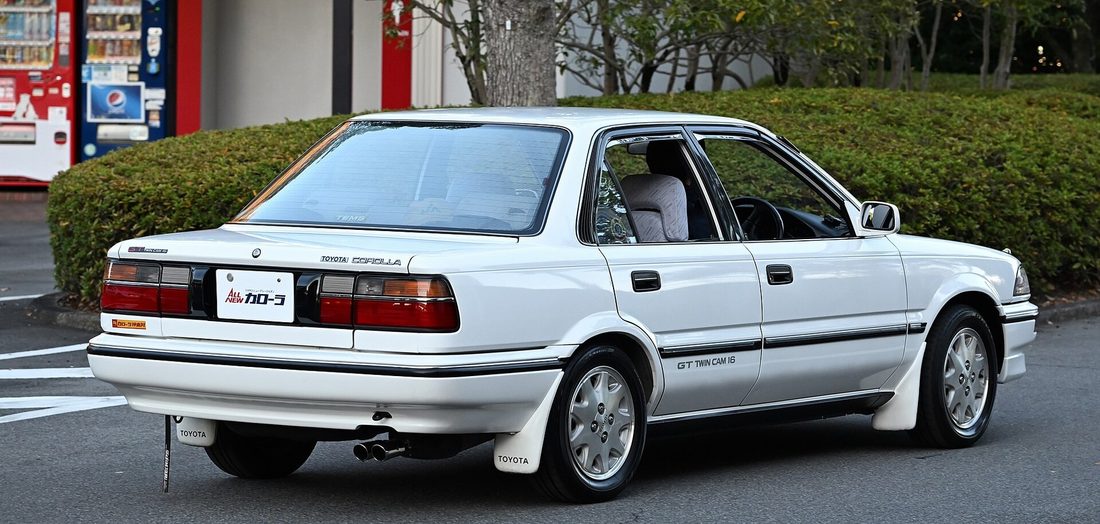
2.2 Levin, Trueno, and the grade ladder
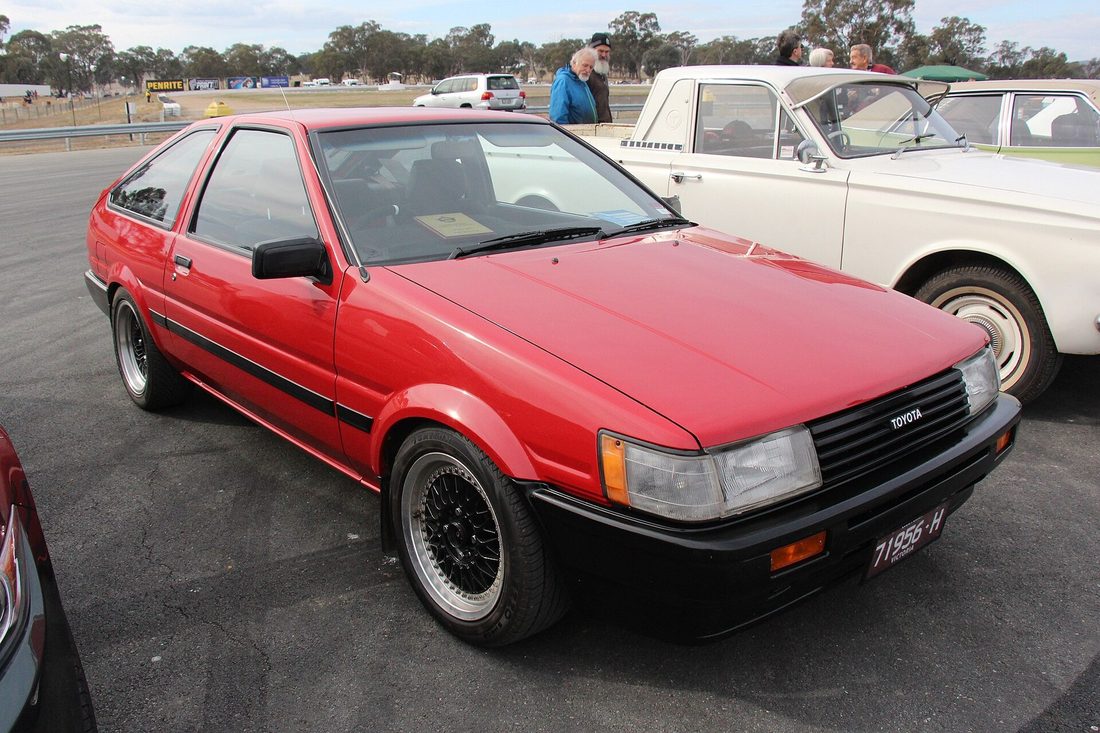
The one rule that never fails: Corolla Levin has fixed rectangular headlamps, Sprinter Trueno has retractable pop-ups (source: en.wikipedia.org/wiki/Toyota_AE86). They also sold through different Japanese dealer chains (source: motor-fan.jp/article/1480611/).
Both nameplates came as a two-door coupe and a three-door liftback (source: en.wikipedia.org/wiki/Toyota_Corolla_Levin). A 2026 buyer's guide states flatly that the Levin was "2-door coupe only" (source: jdmbuysell.com/learn/toyota/ae86/). It is wrong, and not marginally: Japanese used-market data for 2023 counted 19 three-door Levins among 55 listings (source: carsensor.net/contents/market/category_1491/_67382.html).
At the 12 May 1983 launch the Trueno line ran eight grades: three-door in 1600 GT-APEX and GT-V plus 1500 SR, two-door in 1600 GT-APEX and GT plus 1500 SE, from 1,060,000 yen (source: meisha.co.jp/?p=10638; motor-fan.jp/article/1480611/). Across the run the ladder went GL, GL-Lime, XL and XL-Lisse, then SE and SR, then GT, GT-V and GT-APEX (source: en.wikipedia.org/wiki/Toyota_Corolla_Levin).
The top of that ladder gets inverted constantly. GT-APEX was the equipment-laden top grade; GT-V was the lighter three-door-only sporting grade, priced "around 10% less than a three-door GT APEX"; GT was the plain twin-cam (source: ateupwithmotor.com/model-histories/ae86-corolla-levin-sprinter-trueno/3/). The same guide that lost the Levin liftback calls GTV the "Trueno hatchback, top-spec interior" (source: jdmbuysell.com/learn/toyota/ae86/), reversing the two.
2.3 Zenki and kouki, and what actually changed
Zenki (early) runs May 1983 to April 1985, kouki (late) May 1985 to April 1987 (source: retro-motors.jp/post-1412/). English Wikipedia also dates the facelift to May 1985 (source: en.wikipedia.org/wiki/Toyota_AE86); Ate Up With Motor puts it in July 1985 (source: ateupwithmotor.com/model-histories/ae86-corolla-levin-sprinter-trueno/3/). Two Japanese sources and Wikipedia say May, one careful English source says July, and nothing read for this book resolves it.
Front indicators went from small units to large wrap-around lenses, and Trueno gained cornering lamps in the bumper corners. Tail lamps were redesigned, with no interchangeability at all between early and late. Interior colour policy went from vivid two-tones to monochrome black and grey. GT-APEX instruments changed from a digital speedometer with bar-graph tachometer to an analogue twin-dial pack. The block gained seven reinforcing ribs. Halfshaft splines went from roughly 24 mm (0.94 in) to roughly 25 mm (0.98 in) because the thinner early shafts were twisting off under load, and the differential side gears changed to match, so those parts do not interchange. The four-speed automatic, previously AE85-only, was extended to GT and GT-APEX (source: retro-motors.jp/post-1412/), though no export 4A-GE ever had one (source: ateupwithmotor.com/model-histories/ae86-corolla-levin-sprinter-trueno/3/). Halogen headlamps became standard (source: en.wikipedia.org/wiki/Toyota_AE86).
Two limited runs are the only variants in this car's story with firm numbers. The Sprinter Trueno GT-APEX Black Limited of 1986 ran to 400 units, all three-door Truenos, with paint code 204 unavailable elsewhere, gold Snowflake alloys, gold door livery and an orange-accented cabin; oddly for a late car it used the early gauge cluster, and replicas circulate, one reportedly built almost entirely from genuine parts, with no published way to authenticate one (source: aeu86.org/2015/01/08/ae86-trivia-all-sprinter-trueno-ae86-black-limited-facts/). Roughly 20 convertibles were also built by a Toyota dealer in Tama in early 1987, at about a 50 percent premium (source: curbsideclassic.com/blog/cc-capsule/cc-capsule-1987-toyota-sprinter-trueno-ae86-cabriolet-they-eighty-sixed-the-roof/).
2.4 North America, and the VIN inversion
North America took left-hand drive: Corolla Sport SR5 and DX with the single-cam 4A-C from the 1984 model year, then the GT-S with the 4A-GE from around mid-calendar 1984 for the 1985 model year, through 1987, at 9,298 and 9,538 US dollars for coupe and three-door, 1,200 to 1,300 above an SR5 (source: ateupwithmotor.com/model-histories/ae86-corolla-levin-sprinter-trueno/3/; blog.consumerguide.com/1985-1987-toyota-corolla-gt-s/). Wikipedia's "added August 1984" and Consumer Guide's 1985 to 1987 model years are the same fact on two calendars.
Now the part that catches out almost every American buyer. The firewall chassis code reads AE86 or AE86L on all of them, but the first seven VIN characters were JT2AE85 for the DX, JT2AE86 for the SR5 and JT2AE88 for the GT-S, with the fourth character of the model code giving trim: D for DX, X for SR5, Q for GT-S (source: en.wikipedia.org/wiki/Toyota_AE86).
Read that twice. A US car with AE86 in the VIN is the single-cam SR5, rated 70 hp in 1984 and 74 from 1986, not a twin-cam. The twin-cam GT-S is a VIN AE88 car and an AE86 chassis car simultaneously. A seller offering "AE86 in the VIN" as proof of a twin-cam is offering evidence of the opposite, and the only way through is the engine bay and the rear axle.
The North American engine was rated 112 hp SAE net (84 kW) at 6,600 rpm with 97 lb.ft (132 N.m) at 4,800 rpm, and Car and Driver measured 9.5 seconds to 60 mph and 113 mph (source: blog.consumerguide.com/1985-1987-toyota-corolla-gt-s/), against 70 hp (52 kW) for the 1984 single-cam and 74 hp (55 kW) from 1986 (source: en.wikipedia.org/wiki/Toyota_AE86). The GT-S had four-wheel discs and, per Consumer Guide, a limited-slip differential as standard, which conflicts with the option-only Japanese description and is best read as a separate market specification.
Three published GT-S weights refuse to reconcile: 2,450 lb (1,111 kg) for the hatchback (source: same), roughly 2,350 lb (1,065 kg) generally (source: ateupwithmotor.com/model-histories/ae86-corolla-levin-sprinter-trueno/3/), and 2,264 lb (1,027 kg) for the coupe from a source that also calls the coupe only 35 lb lighter than the hatch, contradicting itself (source: thetruthaboutcars.com/2010/05/curbside-classic-the-legendary-1985-toyota-corolla-ae86-gt-s/). None states whether it is kerb, dry or JIS, which is the real problem. North American cars were 4,285 mm (168.7 in) long, 85 mm (3.3 in) more than the Japanese car, on the same 2,400 mm (94.5 in) wheelbase, and both body styles carried Trueno retractable headlamps with Levin tail lamps, which is the combination unique to that market (source: en.wikipedia.org/wiki/Toyota_AE86). That matters practically as well as visually: a North American car has the retractor motors, links and relay covered in chapters 04 and 06, and the 1987 United States wiring diagram draws that circuit.
2.5 Europe, Australia and the rest
Europe took right-hand drive for the UK and Ireland and left-hand drive for the continent, badged Corolla GT, Corolla GT Twin Cam 16 or Corolla GTi by market (source: en.wikipedia.org/wiki/Toyota_AE86). European cars ran 10.0:1 compression without a catalyst (source: ateupwithmotor.com/model-histories/ae86-corolla-levin-sprinter-trueno/3/). Output is quoted three ways and nothing read here reconciles them: 124 PS (122 hp, 91 kW) DIN uncatalysed (source: en.wikipedia.org/wiki/Toyota_AE86), 120 PS (118 bhp, 88 kW) for the German GTI Twin Cam 16 (source: carfolio.com/toyota-corolla-coupe-gti-twin-cam-16-742511), and 116 to 120 PS catalysed (source: handwiki.org/wiki/Engineering:Toyota_AE86).
Australia got the car badged simply Toyota Sprinter: three-door liftback only, fixed lamps, the carburetted 4A-C at 59 kW (about 78 hp), a 6.38 inch differential, quoted as 6.4 in some sources, and rear drums, arriving mid-1983 and cleared out ahead of the unleaded changeover in early 1986 (source: en.wikipedia.org/wiki/Toyota_AE86; ateupwithmotor.com/model-histories/ae86-corolla-levin-sprinter-trueno/3/). New Zealand received a limited number of 4A-GE cars, also fixed-lamp, which is the tell separating a New Zealand car from an Australian one, and the Gulf states took a Corolla GT liftback with North American styling (source: en.wikipedia.org/wiki/Toyota_AE86).
130, 120 or 111 PS: one engine, three yardsticks
The Japanese figure is 130 PS (128 hp, 96 kW) at 6,600 rpm with 149 N.m (110 lb.ft, 15.2 kgm) at 5,200 rpm (source: en.wikipedia.org/wiki/Toyota_AE86; motor-fan.jp/article/1480611/). That is JIS gross, taken at the engine without accessories, and it runs roughly 15 percent above installed net. Japan did not switch to JIS net until 1986 and 1987, and did so incoherently, gross and net figures coexisting inside one model range; restated net the same engine is 120 PS with 105 lb.ft, and Toyota's own later quotations put it at about 111 PS net (82 kW) (source: ateupwithmotor.com/model-histories/ae86-corolla-levin-sprinter-trueno/2/ and /3/). Nothing changed inside the engine between those three numbers except the ruler.
Club4AG's specification table adds the harder point: its power figures "are not actual power ratings but ones posted in catalogs at the time of sale" (source: club4ag.com/faq_and_tech_pages/4A-GE_technical_specifications.htm). This book quotes 130 PS as the period Japanese figure and says what kind of figure it is.
Two circulating errors follow. A 2026 guide gives "128 PS at 7,600 rpm" (source: jdmbuysell.com/learn/toyota/ae86/): 128 is the horsepower conversion of 130 PS, not a PS figure, and the peak is 6,600 rpm. And Japanese Wikipedia's 140 ps at 7,200 rpm belongs to the later AE92 engine, because that article spans every Trueno generation (source: ja.wikipedia.org/wiki/トヨタ・スプリンタートレノ).
2.6 The AE85, and why it is not an AE86
The AE85 is the 1.5 litre car: 1,452 cc 3A-U single-cam eight-valve with a carburettor, Japan only, never exported, at 77 PS JIS gross early and 85 PS after the mid-1985 update (source: en.wikipedia.org/wiki/Toyota_AE85; ateupwithmotor.com/model-histories/ae86-corolla-levin-sprinter-trueno/3/). Externally it is the same car, so the differences that survive an engine swap are the honest test (source: en.wikipedia.org/wiki/Toyota_AE85):
| Item | AE85 | AE86 (4A-GE) |
|---|---|---|
| Engine | 1.5 3A-U single cam, carburettor | 1.6 4A-GE twin cam, injection |
| Gearbox | K50, cable clutch | T50, hydraulic clutch |
| Front brakes | Solid disc | Ventilated disc |
| Rear brakes | Drum | Disc |
| Differential | S302 / S312, 6.38 in | T282 open or T283 LSD, 6.7 in |
| Rear anti-roll bar | None except SR liftback | Fitted |
| Instruments | No tachometer on GL/XL | Tachometer standard |
North American DX and SR5 cars used the single-cam 1,587 cc 4A-C and carry AE86 body codes while being nothing of the sort mechanically (source: en.wikipedia.org/wiki/Toyota_AE86). Privateer racers routinely bought an AE85 and converted it to AE86 specification because it was cheaper (source: en.wikipedia.org/wiki/Toyota_AE85). Those cars still exist and are still traded.
2.7 Production: showing the arithmetic
The headline is that "over 360,000 AE86s are estimated to have been built" between May 1983 and July 1987, at Takaoka in Toyota City and Kanto Auto Works Higashi-Fuji in Susono, with about 28 percent from Higashi-Fuji (source: en.wikipedia.org/wiki/Toyota_AE86). The club's own pages name Tahara instead (source: aeu86.org/2023/05/14/happy-40th-birthday-levin-and-trueno-ae86/); Takaoka was the Corolla plant of the period and Tahara, opened 1979, built larger cars, so this book prints Takaoka and notes the club's usage.
Those club "production data" tables get quoted everywhere as unit counts and they are not: they are monthly serial-number ceilings, and they only make sense once the plant prefix comes off. Plant 0, the Takaoka prefix, reached serial 262,548 by December 1986; plant 5, the Higashi-Fuji prefix, reached 5,079,063 by February 1987, which is serial 79,063 behind a leading 5 (source: aeu86.org/technical/ae86-and-ae85-production-data/). Add those and you get roughly 341,600 cars to those dates, with Takaoka still running to July 1987, which lands neatly under "over 360,000."
The method checks itself on the AE85, where the same tables give about 38,461 at Takaoka through April 1987 and 40,317 at Higashi-Fuji through February 1987 (source: same), against an independent 79,036 total from 38,642 and 40,394 (source: en.wikipedia.org/wiki/Toyota_AE85). Two unrelated sources agreeing to within roughly 250 units is as solid as this car's record gets, and it is what licenses the same arithmetic on the AE86. One larger figure needs separating out: the club cites 323,876 cars from one plant and 119,405 from the other for 443,281 total, about 10 percent exported (source: aeu86.org/2023/05/14/happy-40th-birthday-levin-and-trueno-ae86/), which almost certainly covers AE86 plus AE85 plus other rear-drive E80-era Levins and Truenos. Do not blend it with the AE86-only total.
Beyond that, per-variant counts genuinely do not exist: no published split of Levin against Trueno, coupe against liftback, GT against GT-V against GT-APEX, or zenki against kouki, and a search specifically for one returns nothing (source: search across en.wikipedia.org/wiki/Toyota_AE86, handwiki.org, aeu86.org). The only firm per-variant numbers are the 400 Black Limiteds and the roughly 20 convertibles. Anyone quoting a Trueno liftback production figure should be asked where it came from.
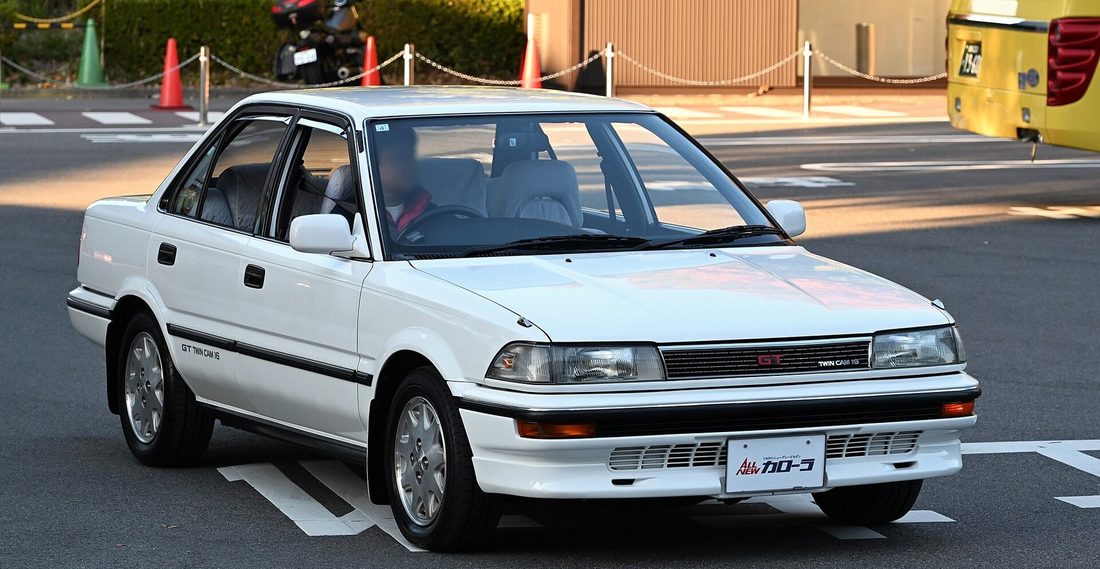
2.8 Identifying and authenticating a car
The firewall ID plate carries a model code, which is not the VIN, and it is the plate that says what Toyota built. It reads positionally: engine family, platform letter (E for Corolla), model number, drive-hand letter, then after the dash body style (G three-door hatch, L liftback, E sedan, W wagon), transmission (M five-speed floor manual), grade (Q highest), engine type (F twin-cam EFI high performance) and destination (A for USA and Canada, W for Europe, blank for Japan) (source: aeu86.org/technical/toyota-firewall-id-codes/). Toyota's catalogue shows a real one, AE86-FCMQF, for a Sprinter Trueno built 05.1983 to 04.1987 (source: amayama.com/en/genuine-catalogs/epc/toyota-japan/sprinter_trueno/ae86/23426/body/5801).
The frame number takes the form AE86-0012345, stamped into the firewall around the plate, and the leading serial digit gives the plant, 0 for Takaoka and 5 for Higashi-Fuji (source: en.wikipedia.org/wiki/Toyota_AE86). Feeding it into the club tables returns a build year, month and plant (source: aeu86.org/technical/search-production-data-of-your-ae86/), the closest thing this car has to a factory record. There is no Toyota build-record lookup and no public registry, so a chassis plate cannot be matched to a factory file the way a Porsche Kardex can (source: driftworks.com/forum/threads/ae86-vin-plate-tracking.35124/).
Work the checks in order, because the bodies are identical and the plate only proves what left the factory:
- Open the bonnet. Two cam covers with 4A-GE cast in means twin-cam; a single-cam 3A-U or 4A-C means it did not start life as one (source: jdmbuysell.com/learn/toyota/ae86/). Confirm the intake manifold carries the T-VIS plate, which is what a period big-port engine has; no plate means a later small-port engine and a swap (source: mr2wiki.com/MKI/LargePortAndSmallPort/).
- Read the firewall code and frame number against the paperwork, then against the production tables for a plausible plant and date (source: aeu86.org/technical/search-production-data-of-your-ae86/).
- Check what a swap does not usually touch: hydraulic clutch against cable, rear discs against drums, a 6.7 inch (170 mm) differential against a 6.38 inch (162 mm) one, and the rear anti-roll bar (source: en.wikipedia.org/wiki/Toyota_AE85). In the United States an S-series axle with rear drums means an SR5-based car whatever the badges say (source: doctoredgarage.com/ae86-rear-axles-and-upgrades/).
- Verify the differential claim. T283 indicates a limited-slip unit and T282 an open one (source: toymods.org.au/forums/threads/20512-ae86-lsd-in-T-series-diff), then jack both rear wheels and turn one by hand. The factory unit is clutch-type (source: aeu86.org/technical/ae86-specifications/), not the Torsen-type one 2026 guide claims, and it was optional on twin-cam manual cars rather than Trueno-only (source: jdmbuysell.com/learn/toyota/ae86/).
- On Japanese imports read the export auction sheet, and walk the shell for signs of a changed body: mismatched panel gaps, non-factory welds, brush-applied seam sealer (source: motoiq.com/project-ae86-repairing-the-chassis/).
One widely read specification page needs naming, because a reader could act on it and lose money. It carries at least seven demonstrable errors: a carburetted early 4A-GE with "dual Mikuni-Solex" carburettors, an SR5 given a 4A-GE, rear drums on the GT-S, length 4,125 mm, wheelbase 2,350 mm, front track 1,380 mm and a 48 litre fuel tank (source: projectjdm.org/blog/toyota-ae86-corolla-trueno-specs). The 4A-GE was injected from launch, the SR5 is a 4A-C car, the GT-S has four-wheel discs (source: blog.consumerguide.com/1985-1987-toyota-corolla-gt-s/), the wheelbase is 2,400 mm (94.5 in) with length 4,185 to 4,285 mm (164.8 to 168.7 in) by market and face (source: en.wikipedia.org/wiki/Toyota_AE86), and the tank is 50 litres (13.2 US gal, 11.0 imp gal) (source: aeu86.org/technical/ae86-specifications/). What makes it dangerous rather than merely wrong is that its T50 gearbox ratios and 53:47 weight distribution agree with better sources, so it reads as authoritative. The 2026 buyer's guide quoted through this chapter carries four of its own: the coupe-only Levin, the inverted GT-V and GT-APEX, the 128 PS at 7,600 rpm and the Torsen differential (source: jdmbuysell.com/learn/toyota/ae86/).
Two smaller disagreements stand unsettled: the coupe's drag coefficient, 0.38 against 0.37 with the liftback at 0.35 in both (source: en.wikipedia.org/wiki/Toyota_AE86; ateupwithmotor.com/model-histories/ae86-corolla-levin-sprinter-trueno/3/), and kerb weights spanning 900 to 1,065 kg (1,984 to 2,348 lb) with no stated basis (source: en.wikipedia.org/wiki/Toyota_AE86). A car's own plate outranks any table, this book's included.
2.9 Motorsport, and the Initial D effect
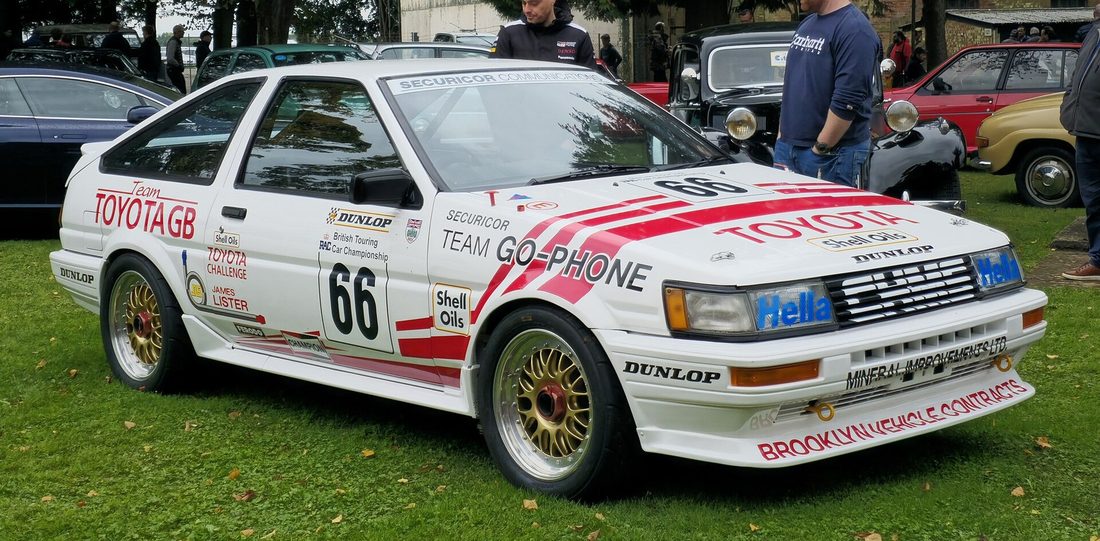
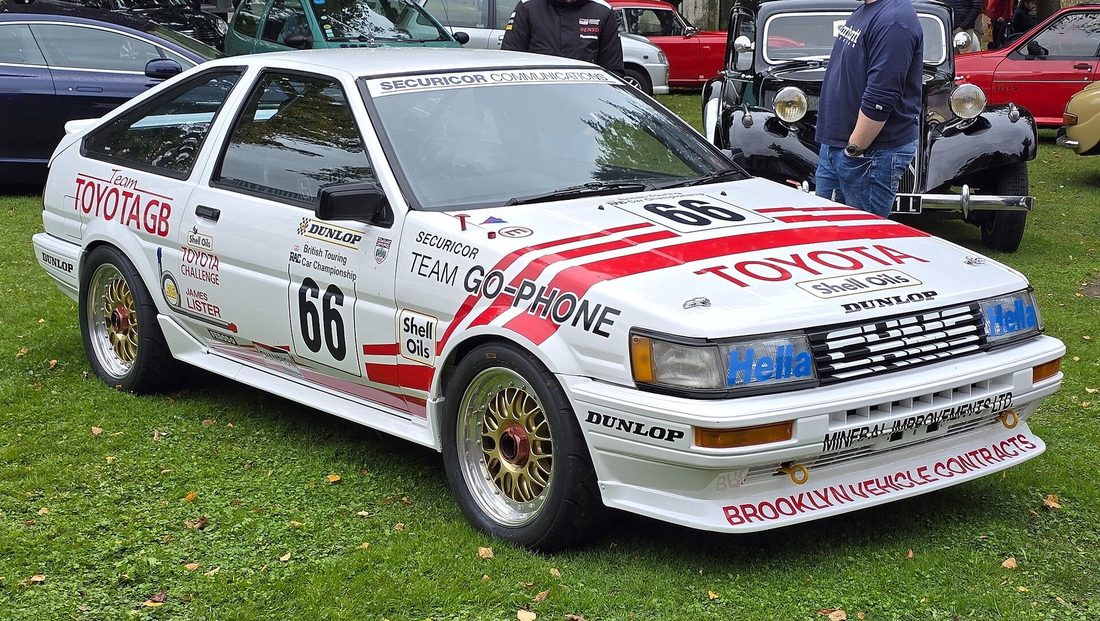
Toyota won the 1986 European Touring Car Division 1 manufacturers championship with 267 points, Chris Hodgetts took the British Touring Car Championship in 1986 and 1987 in an AE86, and the car dominated the under-2.0-litre class of the Australian Touring Car Championship from 1985 to 1988 (source: handwiki.org/wiki/Engineering:Toyota_AE86). The brief was competition-shaped from the start: a Tsukuba lap of 1 minute 18 seconds for a naturally aspirated sub-1600 car (source: aeu86.org/2023/05/14/happy-40th-birthday-levin-and-trueno-ae86/). In February 1985 Road & Track put the Corolla GT-S first in a six-car comparison including the Golf GTI and Civic S (source: ateupwithmotor.com/model-histories/ae86-corolla-levin-sprinter-trueno/3/).
The demand behind today's prices, though, is cultural. Keiichi Tsuchiya's mid-1980s drift videos established the chassis in Japanese car culture, and the Initial D manga from 1995 and anime from 1998, whose protagonist drives a white and black panda Sprinter Trueno three-door, created demand in markets that never sold the car (source: jdmbuysell.com/learn/toyota/ae86/). Wikipedia calls the resulting premium the "Takumi tax," Toyota invokes the lineage in the 86 of 2012 onward, and in November 2021 it restarted limited parts production for the hachiroku, initially steering knuckles, brake calipers and half shafts (source: en.wikipedia.org/wiki/Toyota_AE86).
2.10 The 2026 market, the drift tax and the clones
Dated results are firmer ground than guide ranges. A 1985 GT-S with 114,000 miles made 40,000 US dollars on Bring a Trailer on 7 May 2021, then the highest AE86 auction price in the United States, and it had repainted panels, rust spots, corroded lower rockers, a reupholstered interior and a 1994 theft and recovery behind it; it did have the factory limited-slip differential (source: japanesenostalgiccar.com/1985-toyota-corolla-gts-ae86-sells-for-40000/). A one-owner 1987 UK Corolla GT with 92,000 miles made 46,250 pounds, about 64,179 dollars at the time, on 27 July 2021 (source: motoringresearch.com/car-news/toyota-corolla-ae86-auction-record/).
One aggregator's highest result is 50,625 pounds for a 1987 car in August 2026, alongside a median of 25,541 pounds, a low of 13,391 and a 73 percent sell-through rate (source: theclassicvaluer.com/cars/toyota/corolla-ae86). The caveat belongs before the number: the same page tracks only 8 sold vehicles, which cannot support a median or a sell-through rate.
Guide ranges spread wide, and the spread is the finding. One 2026 guide gives 12,000 to 55,000 dollars with a median around 24,000, clean unmodified GT-APEX Trueno three-doors at 25,000 to 40,000 plus, against 3,000 to 5,000 for the same car in 2005 (source: jdmbuysell.com/learn/toyota/ae86/). Another runs 20,000 to 30,000 for a project up to 65,000 to 80,000 plus for a collector car (source: projectjdm.org/vehicle-guides/buyers-guide-ae86), a table sitting above the model's auction record that cites no results and shares a publisher with the specification page corrected above. Japan reads differently again: 3 to 6 million yen for general condition and 8 to 10 million for excellent cars (source: retro-motors.jp/post-1412/), while a May 2023 survey found Levin listings at 1.79 to 6.88 million yen across 55 cars and Trueno listings at 2.78 to 4.98 million across just 18, the cheapest still above the original new price (source: carsensor.net/contents/market/category_1491/_67382.html).
What moves those numbers is consistent everywhere: rust-free structure first, because structural repair can exceed the purchase price, then originality, body and grade, mileage, documentation and a verified factory limited-slip differential (source: jdmbuysell.com/learn/toyota/ae86/). The three-door is the scarce body, and the early panda three-door, the Initial D silhouette, carries its own premium (source: carsensor.net/contents/market/category_1491/_67382.html). No source gives a clean numeric zenki-against-kouki delta.
The clone problem follows from all of it. Most survivors have been drifted, raced or engine-swapped, and the two specific frauds are an AE85 fitted with a 4A-GE, and an AE86 fitted with a supercharged 4A-GZE, a 20-valve 4A-GE, a 2ZZ-GE or a 3S-GE, all externally indistinguishable (source: jdmbuysell.com/learn/toyota/ae86/). Black Limited replicas built from genuine parts circulate too (source: aeu86.org/2015/01/08/ae86-trivia-all-sprinter-trueno-ae86-black-limited-facts/). And the premium cuts both ways: period-correct Initial D replicas in panda paint on Watanabe wheels command strong money of their own (source: projectjdm.org/blog/toyota-ae86-corolla-trueno-buyers-guide), rewarding a cosmetic presentation rather than originality, which is exactly what makes cloning worth doing.
Import status gates nothing now: 1983 cars cleared the United States 25-year rule in 2008 and 1987 cars in 2012, so the whole run is eligible, and Canada admitted them from 1998 (source: jdmbuysell.com/learn/toyota/ae86/). The waiting is over. The shortage is of straight, honest cars.
Glossary
- 4A-Ge
- Toyota's 1,587 cc twin-cam sixteen-valve four, belt driven, and the only engine that makes a car an AE86 in the sense enthusiasts mean. Its output figures are quoted against three different measurement standards, which is the source of most confusion about this car.
- Ae85
- The single-cam 1.5 litre sister car, sharing the AE86's rear-drive shell and almost nothing else that matters. It is the car most often sold as an AE86, and telling them apart is the first job of any inspection.
- Ae86
- Toyota's internal chassis code for the twin-cam rear-drive E80 Corolla and Sprinter, 1983 to 1987. In North America the code is stamped on the firewall of every car in the family, including the single-cam ones, which is why the firewall plate alone does not establish what a car is.
- Air Flow Meter
- A vane-type meter that measures the volume of air entering the engine by the deflection of a spring-loaded flap carrying a potentiometer. Fitted only to North American cars, tested as a resistance network, and frequently misdescribed as a mass air flow sensor, which it is not.
- Auction Sheet
- The inspection document a Japanese auction house issues with a car, grading condition and mapping damage and repairs onto a diagram. It is the closest thing to a service record for an imported car and can be retrieved after the sale.
- Bigport
- The larger-port cylinder head casting used on every rear-drive 4A-GE, as against the smallport head that arrived with the front-drive AE92. It matters when buying a reissued heritage head, because that head is the smallport casting.
- Blower Resistor
- The resistor pack that drops voltage to the heater fan motor to give its lower speeds. When it fails the fan usually works on high only.
- Brake Booster
- The vacuum servo that multiplies pedal effort. Two no-tool tests establish whether it is working, and a hard pedal that never softens points at the booster or its vacuum supply rather than the pads.
- Check Connector
- The diagnostic connector where terminals are bridged to put the engine management into a defined state, which is how base ignition timing is set on this car. With the bridge out, the ECU applies correction and the timing light reads higher.
- Circuit Opening Relay
- The relay that powers the fuel pump only once the engine is turning or the air flow meter plate has moved. It is a safety interlock, and it is also why a car with a failed relay cranks but never fires.
- Cold-In Thermostat
- A thermostat whose opening temperature is lower than the factory part's, sold on the theory that it runs the engine cooler. The factory figure is 80 to 84 C with full opening at 95 C, and a lower-temperature part keeps the engine below the temperature its fuelling was calibrated for.
- Din
- The German standard for measuring engine output. It is not interchangeable with JIS or SAE, so the same engine honestly reads as several different numbers depending on which book the figure came from.
- Ecu
- Engine control unit, the computer managing fuel and ignition. On this car the ECU differs by market alongside the induction system, so a Japanese unit and a United States unit are not interchangeable.
- Epc
- Electronic parts catalogue, the dealer database mapping part numbers to chassis and build dates. It is the authority when a supplier listing and a forum thread disagree about what fits.
- Four-Link
- The rear suspension layout locating the live axle with four longitudinal links plus a lateral rod. Its mounting brackets are welded to the floor and are a structural inspection point.
- Gr Heritage Parts
- Toyota's programme reissuing discontinued parts for selected heritage models, this car among them. It covers brakes, axles, gearbox internals, harnesses and small lamps, and covers no body panels, glass, seats or weatherstrip at all, which is exactly this car's parts problem.
- Gt-Apex
- The top Japanese-market trim, combining the twin-cam engine with the fuller equipment list. Trim hierarchy on this car is routinely reported backwards, so establish it from the build plate rather than from a listing.
- Hachiroku
- Japanese for eight-six, the enthusiast name for this car. Useful when searching Japanese-language sources, where it is often the only name used.
- Hakogae
- Japanese for changing the box, the practice of moving a car's identity to a fresh shell. The Japanese term is worth knowing because it appears in auction and forum records that an English search misses.
- Half-Cut
- A front or rear section of a donor car, cut and shipped as a unit. Common in Japanese exports, useful for repairs, and a reason a car's front and rear halves can have different histories.
- Hypoid
- A bevel gear set whose pinion axis is offset from the crown wheel centre, used in the rear axle. It needs an extreme-pressure oil, which is where the GL-4 and GL-5 argument starts.
- Ic Regulator
- The solid-state voltage regulator built into the alternator, holding output to a usable voltage as engine speed and load vary. A failing one either undercharges the battery or cooks it.
- Igniter
- The ignition module that switches the coil primary current on the signal from the distributor. It fails with heat and age, and it is the part between a good coil and no spark.
- Jis Gross
- The Japanese standard that measured an engine on a bench without its accessories, giving a figure roughly fifteen percent above what the same engine makes installed. The famous 130 PS is a JIS gross number, which is why Toyota now quotes about 111 PS net for the identical motor.
- Junction Block
- The consolidated fuse and relay box behind the dashboard. On a car this age its connectors and grounds cause more faults than the components they feed.
- Kerb Weight
- The weight of the car with fluids but no driver or luggage. Published figures for this car spread widely because sources rarely state whether they mean kerb, dry or JIS weight.
- Kouki
- Japanese for late period, meaning the facelifted cars. The facelift date is given as May 1985 by some sources and July 1985 by others, and the lamps, bumpers and some part numbers change with it.
- Lateral Control Rod
- The transverse link locating the live rear axle. Its bracket is welded to the body, and a failed weld there has been reported as severing a brake line, which makes it a safety inspection rather than a rust one.
- Lateral Rod
- See lateral control rod: the transverse link that locates the rear axle sideways.
- Liftback
- The three-door hatchback body, as against the two-door coupe. It was sold as both Levin and Trueno, contrary to guides that call the Levin coupe-only.
- Limited-Slip Differential
- A differential that resists a large speed difference between the driven wheels, sending torque to the wheel with grip instead of spinning the unloaded one.
- Lsd
- Limited-slip differential, which resists a large speed difference between the driven wheels so torque goes to the wheel with grip. Fitment varies by market and trim, and the factory unit is clutch-type rather than Torsen-type whatever some guides say.
- Macpherson Strut
- A suspension layout combining the damper, spring and upper location in one telescopic unit. Used at the front of this car, and its geometry is what changes most when a car is lowered.
- Map Sensor
- Manifold absolute pressure sensor, which reads manifold vacuum so the ECU can calculate airflow from pressure, temperature and engine speed. Japanese, European and Australian cars use this method rather than measuring air directly.
- Non-Interference
- An engine design in which the valves and pistons never occupy the same space, so a broken camshaft belt stops the engine without bending anything. The sixteen-valve 4A-GE is non-interference, though generic engine lists get this wrong, and skimmed heads, thin gaskets or wild cams narrow the margin.
- Nos
- New old stock, meaning genuine factory parts that were manufactured years ago and never sold. On a car this age, NOS and reproduction are the only two categories for much of the body and trim.
- Panhard Rod
- The lateral link that locates a live rear axle sideways relative to the body. Its bushes and mounting points are load-bearing, so corrosion there is structural rather than cosmetic.
- Proportioning Valve
- The hydraulic valve limiting rear brake pressure so the rear wheels do not lock before the fronts. The factory book carries no test for it, which is a gap in the procedure rather than evidence that the car has no such part.
- Re-Shell
- Moving a car's identity, and usually its plates and running gear, onto a different bodyshell. Common on a car with forty years of competition use, and the reason a careful buyer reads seam sealer and spot welds rather than paperwork alone.
- Sae Net
- The American standard for measuring engine output, taken with the engine's own accessories fitted. A SAE net figure is the lowest of the three standards quoted for this engine and the most representative of what the car actually makes.
- Seam Sealer
- The flexible compound the factory laid along body seams. Its texture and continuity are how a repaired or re-shelled car is detected, because a repair almost never reproduces the factory bead.
- Shim-Over-Bucket
- A valve adjustment layout with the clearance shim sitting on top of the bucket, so shims can be changed with the camshafts in place. The 4A-GE uses it, and one otherwise careful source calls the engine shim-under-bucket.
- Smallport
- The smaller-port cylinder head casting introduced with the front-drive AE92. No AE86 left the factory with one, but the reissued heritage head is this casting, so a bigport owner ordering it gets the wrong part.
- Speed Density
- The method of calculating airflow from manifold pressure, air temperature and engine speed rather than measuring it directly. Used on Japanese, European and Australian cars, and the reason their diagnostic procedure differs from a North American car's.
- Sst
- Special service tool, a Toyota-specific tool the factory procedure assumes you have. Several jobs on this engine, valve shim replacement among them, are far harder without the right one.
- Steering Axis Inclination
- The angle of the steering axis viewed from the front of the car, which together with camber and caster sets how the steering self-centres. It is a factory alignment figure, not an adjustment, and a wrong reading usually means bent or worn parts.
- T-Series
- The Japanese-market rear axle family, identified by a ten-bolt carrier flange, as against the eight-bolt S-series used on Australian-delivered cars. Which family a car has decides which shafts, differentials and brake parts fit.
- T-Vis
- Toyota Variable Induction System, which closes one of the two inlet runners per cylinder below a threshold to keep port velocity up at low engine speed. Sources give the switch point as 4,300 and as 4,400 rpm.
- T50
- The five-speed manual gearbox fitted to this car. Its rear shaft length and spline count differ across the family, so a half-and-half swap needs both halves matched.
- Thermo Time Switch
- The temperature-sensitive switch that limits how long the cold start injector operates. Its resistance specification is quoted two ways above 40 C, at 40 to 60 ohms and 40 to 80.
- Viscous Fan
- A belt-driven cooling fan with a temperature-sensitive fluid coupling. The single-cam SR5 has one and the 4A-GE car has an electric fan instead, so a re-engined shell often carries the wrong fan for its engine.
- Zenki
- Japanese for early period, meaning the pre-facelift cars. Zenki and kouki panels interchange, but part numbers split by build window, so ordering needs the build date rather than the model year.