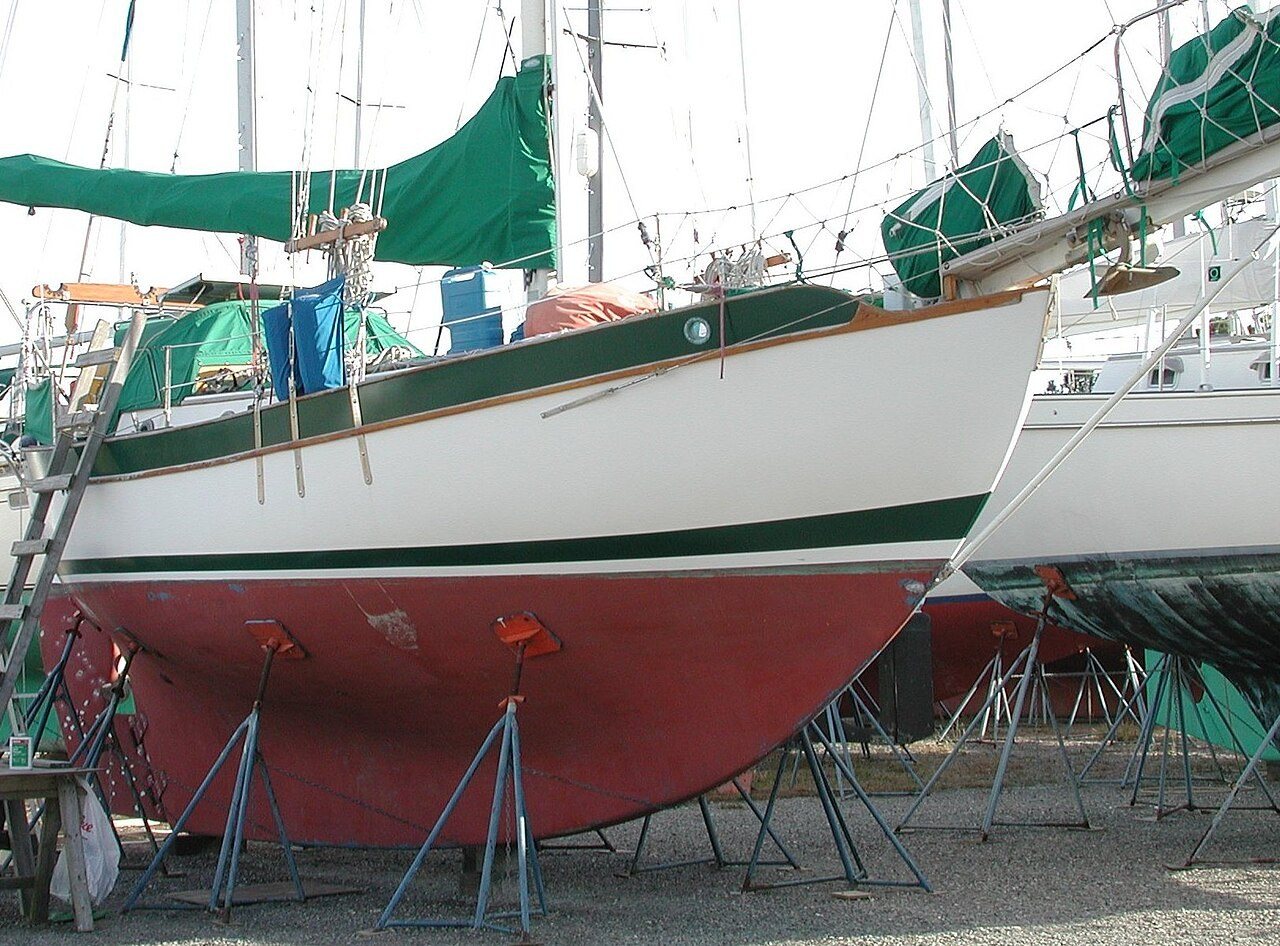
Westsail 32
About This Book
Welcome aboard. This book is a complete owner's reference for the Westsail 32, the heavy, full-keel, double-ended cutter that came to define the American offshore-cruising dream of the 1970s. Before you read another page, understand the one fact that shapes everything else here: no two Westsail 32s are the same boat, so the most useful thing this book can do is teach you to survey the specific hull in front of you.
1.1 What this boat is
The Westsail 32 is an archetype. It is a Bermudan cutter with a bowsprit reaching forward and a boomkin extending aft, roughly 32 feet on deck, about 11 feet of beam, 5 feet of draft, and close to 10 tons of displacement (near 19,500 to 20,000 pounds) on a 27.5-foot waterline. It is a double-ender in the Colin Archer tradition, its lines passing from Archer's Norwegian rescue boats through William Atkin's 1928 Eric to W.I.B. Crealock's fiberglass adaptation, which became the Westsail 32 in 1971. Westsail Corporation of Costa Mesa, California built roughly 830 of them through about 1980, and a 1973 Time magazine feature turned the boat into a genuine cultural phenomenon, the "cult boat" that launched a hundred imitators.
The hull is famously overbuilt: solid hand-laid fiberglass, commonly described as twelve alternating layers of woven roving and chopped mat in polyester, ranging from about half an inch thick to nearly a full inch. On top of a full keel with encapsulated ballast and a transom-hung rudder, the result is a boat with an easy, sea-kindly motion (a Brewer comfort ratio near 42.9) and a well-earned blue-water reputation. It is also slow. The old line, "built like a tank, but unfortunately sails like one too," is fair: expect about 6 to 6.5 knots in favorable conditions, modest light-air and upwind performance, and better going off the wind. This is a boat chosen for toughness and comfort over passage times, and understanding that trade before you buy will save you disappointment later.
1.2 The one fact that changes how you read everything
Here is the identity fact that sets the Westsail 32 apart from almost every other production boat of its era: about half of all Westsail 32s left the factory as kits. They were sold as bare hull-and-deck moldings, or at various stages short of complete, and were finished by their owners. Roughly three-quarters of the boats still sailing today were owner-completed. The molded hull and deck are factory fiberglass, uniformly heavy and stout, and they almost never fail. Everything else, the bulkheads tabbed to the hull, the wiring, the plumbing, the tankage, the engine installation, and the interior joinery, was done by amateurs of wildly differing skill over months or years in backyards and boatyards across the country.
The practical consequence is enormous. A beautifully finished kit boat can exceed a factory boat in quality; a rough backyard boat can hide serious deficiencies behind the same gorgeous teak and bronze. The owner community's own verdict says it best: you cannot categorically call kit boats better or worse than factory boats, because it depends entirely on the particular boat, and far more important than the origin is what has happened to it since. Two Westsail 32s can sit in the same brokerage row at the same price and be, structurally, completely different boats.
So the headline of this entire book is short: survey THIS hull, not "the Westsail 32." Every chapter that follows assumes you will inspect systems individually rather than trust a factory spec, because on this boat, more than on almost any other, the "factory spec" may never have existed on your particular hull.
1.3 The axes that define your particular boat
As you evaluate a specific Westsail 32, a handful of variables place it on the map:
Factory-finished versus kit or owner-finished. This is the first question to answer, and the answer changes what you inspect most carefully. Ask for the boat's history, look at the consistency and quality of the interior joinery and the wiring, and treat owner-installed systems (tanks, seacocks, grounding, bulkhead tabbing) as unknowns until proven.
Which engine is fitted. The original factory diesels were the Volvo Penta MD2B (a 25-horsepower, 2-cylinder engine, widely considered underpowered for the boat's weight), the Volvo Penta MD3B (35 horsepower, 3 cylinders, a better match), and the Perkins 4-108 (about 50 horsepower, 4 cylinders, generally regarded as the optimal original choice). Many boats have since been repowered. Identify what is actually in the boat, because it drives everything from motoring range to the notorious engine-mount vibration issue covered later in this book. (One secondary source claims an "Atomic 4" gasoline engine was original; the primary Westsail sources describe diesels only, and that claim appears to be an error.)
Hull number and build era. Several construction details changed over the production run. The earliest boats (up to about hull #120) used a wooden sheer clamp with a putty-sealed hull-to-deck joint that can leak. Hulls up to about #625 were laid up in a two-piece mold that leaves cosmetic centerline crazing. The ballast recipe changed in late 1974. Knowing roughly where your hull falls tells you which issues to expect.
1.4 Check these first
Later chapters go deep on known issues. For orientation, here are the items that are both specific to this boat and important enough to look at before anything else. Several of these are rig-droppers, so treat them as safety-critical.
- The individual build quality. Because this is the defining variable, it comes first. Inspect the bulkhead tabbing, wiring runs, seacocks, plumbing, and engine beds individually. Do not assume a clean-looking boat is a well-built one.
- The boomkin, bowsprit, and bobstay end structures. On a double-ended cutter, the standing rig loads pass through wood-and-metal fittings at the very ends of the boat that a fin-keel sloop simply does not have. The boomkin stay tang is the classic rig-dropper: early boats used a narrow tang whose failure "has caused the loss of the entire rig on a number of instances" (source: westsail.com) [SAFETY]. The wooden crosspiece on the earliest boats can rot and drop the mast (source: westsail.com) [SAFETY]. The carries close to 10,000 pounds of compression through three bronze bolts, and owners have "pulled the bowsprit bolts and found them to resemble a bent letter S" (source: westsail.com) [SAFETY]. The bobstay fitting sits at the waterline and gets eaten by electrolysis. These are the items to inspect first, every haulout.
- Chainplates. The chainplates are external, bolt-on 304 stainless. They suffer cracks radiating from the bolt holes and crevice corrosion on the hidden backside where the plate meets the hull. Stainless "does not reveal its weakness until it fails," so for an offshore boat, remove at least one and inspect the backside (source: westsail.com) [SAFETY].
- Exterior teak and deck-core leaks. The Westsail 32 carries massive exterior teak (bulwarks, caprails, bowsprit, boomkin, sampson posts, boom gallows, handrails, and on many boats a deck overlay). This is a large, ongoing upkeep burden and the leading pathway for water into the plywood deck core. On a boat now 45 to 55 years old, assume all deck-hardware bedding needs renewal, and moisture-meter the sidedecks and cabintop.
Keep the rest of the field checklist in mind too: the mast-compression support post, the (rusty bilge water can mean water reaching steel ballast punchings through a cracked glass overlay, not just an old-boat nuisance) [SAFETY], hull blisters (usually cosmetic on this thick, solid hull), and the engine mounts.
1.5 How to use this book, and a word on responsibility
Read this book the way you would use a chart: as informed guidance, not as a guarantee. Every substantive claim here is drawn from the research assembled for this title, above all the Westsail and Worldcruiser Yacht Company service manual by Bud Taplin, an unusually authoritative model-specific technical library. Where sources disagree, this book gives you both figures and tells you to verify. Where a claim is soft, it says so. Prices, tankage numbers, and any individual-boat spec should be confirmed against the actual boat, because on a fleet that was half owner-finished, the printed number and the real boat may simply differ.
This book cannot inspect your boat, and it is not a substitute for a qualified professional. Before you buy, and periodically while you own her, hire a competent marine surveyor, ideally one who knows this model (Worldcruiser offers a Westsail-specific survey and a low-cost "mini-survey" of the critical failure points). Rig work, structural repairs, and any decision that bears on the safety of people at sea are yours to make with professional help, not on the strength of a book alone. Use these pages to know what questions to ask and where to look. Then go look, on your specific hull. That is the whole spirit of this book, and of owning a Westsail 32.
History & Identity
The Westsail 32 is the boat that taught a generation of Americans they could quit their jobs, sell the house, and sail over the horizon. It is heavy, salty, slow, and stubbornly seaworthy, and for a brief stretch in the 1970s it was the most talked-about sailboat in the country. To understand the boat sitting in front of you, whether you are a curious admirer or a serious buyer, you need to understand three things: where its shape came from, who built it and why the whole thing caught fire, and why no two of these boats are quite alike.
Let's take those in order.
2.1 A hull shape with a hundred-year pedigree
Before there was a Westsail, before there was fiberglass, there was a shape. The double-ender hull, pointed at both ends like a canoe stretched to 32 feet, is the visual signature of this boat and the oldest part of its story.
That shape traces back to Colin Archer, a Norwegian naval architect working in the late 19th century. Archer designed sturdy pilot and rescue boats, the redningsskøyte, meant to survive the worst the North Sea could throw at them while working through gales that sent other craft running for shelter. The pinched, canoe-like stern was the key idea: it lets a following sea pass cleanly under and around the boat rather than slamming into a broad transom, which made these boats famously steady and forgiving when running before heavy weather.
One small point worth clearing up, because you will see it stated both ways. Some sources describe Archer as Scottish, others as Norwegian. Both are technically defensible. Archer was born in Norway to Scottish parents, so the two labels circulate side by side. The standard identification, and the one to use, is Norwegian. The substance of his contribution is not in dispute.
Archer's working boats were the raw material. The next hand to shape the lineage belonged to an American.
2.2 William Atkin and the boat named Eric
In 1928, the American designer William Atkin took Archer's ideas and adapted them for pleasure sailing. He drew a roughly 32-foot double-ender he named Eric, scaled down and refined from one of Archer's larger, roughly 47-foot rescue-boat designs. Eric is the direct ancestor of the boat you are reading about. If you want to point at a single grandparent, this is it.
Atkin kept refining the design. A later version, Thistle, swapped the old gaff rig for a Bermudan rig (you will also hear this called a marconi rig), the tall triangular mainsail arrangement that is now standard on nearly every sailboat afloat. Thistle also adopted a cleaner trunk-cabin deck. These were the lines that would eventually be traced into fiberglass.
One honest caveat here. Sources vary on exactly how the original Atkin boats were rigged, with some calling Eric a ketch, others a cutter, and the most common description being a gaff-rigged double-ender. Treat the precise rig of the 1928 original as a secondary detail, unsettled at the margins. What matters for you is the hull and the heritage, both of which are solid.
There is one more piece of pedigree that Westsail owners love to bring up, and with good reason. In 1968 and 1969, Robin Knox-Johnston completed the first solo non-stop circumnavigation of the globe, winning the Golden Globe Race aboard Suhaili, a roughly 32-foot ketch built to Atkin's Eric design. That voyage is repeatedly cited as living proof that this family of boats can go anywhere and survive anything. When someone tells you a Westsail is a "real" offshore boat, Suhaili is a large part of what they are leaning on.
So far, though, every boat in this story is made of wood, and built one at a time. The revolution that made the Westsail possible was fiberglass.
2.3 The Kendall 32: the fiberglass first draft
Around 1968, a Costa Mesa, California boatwright and carpenter named Larry Kendall set out with a small group to build what they called "the ultimate offshore sailboat." Their plan was to take Atkin's wooden Thistle lines and render them in FRP, fiberglass-reinforced plastic, the material that was then transforming boatbuilding by making it possible to pop out identical hulls from a mold.
To do the conversion, Kendall hired the naval architect W.I.B. "Bill" Crealock, a name you will see stamped on the Westsail's design credit for the rest of its life. Crealock's job was to translate a set of wooden boat lines into a fiberglass hull and deck, a genuinely different engineering problem.
Crealock is said to have looked at the project and told Kendall, more or less, "you might sell ten or a dozen." Hold onto that line. It becomes one of the great wrong predictions in production sailboat history.
Kendall Yacht Corporation built a modest run of these boats and then went bankrupt around 1971. Exactly how many Kendall 32s were built is one of the small conflicts in the record. Good Old Boat's history says "about 25 boats" came out before the bankruptcy, while the Westsail Owners Association hull registry counts 31 Kendall 32 hulls. Call the Kendall count roughly 25 to 31. Either way, it was a commercial failure, and when the company collapsed, its molds went up for auction. That auction is where the real story begins.
2.4 Enter the Vicks
The molds were bought out of bankruptcy by a husband-and-wife team, Snider Vick and Lynne Vick, who founded Westsail Corporation in Costa Mesa.
A note on the founder's name, because you will genuinely see it spelled two ways. Good Old Boat and the Westsail Owners Association both render it "Snider Vick." A Wikipedia-derived summary renders it "S. Snyder Vick." On the spelling, Snider versus Snyder, the weight of the more authoritative sources favors "Snider," and that is what this book uses, but do not be surprised to find "Snyder" in print elsewhere. Snider Vick is described as an electrical engineer; Lynne Vick ran her own advertising business and, crucially, drove the marketing.
The purchase price is a nice piece of boatyard legend, and it too comes with a small conflict. Good Old Boat and the Owners Association both say the Vicks got the molds for $1,000 at the asset auction. The history at nereus32.com says $1,800. Either way, it was a spectacular bargain for the tooling behind what would become one of the best-known cruising sailboats ever made. Wikipedia dates the purchase to February 1971 and notes that the deal kept Larry Kendall and five employees on board.
Crealock was brought back to finish the job properly for volume production. He designed a modified deck with a proper trunk cabin to open up interior volume, plus a new interior "loosely based on Atkin's Eric." The result, introduced in 1971, was the Westsail 32.
That layered history is why the design credit is genuinely shared, and why you will see it attributed different ways depending on who is writing. The honest full chain is: Colin Archer created the type, William Atkin drew Eric and Thistle, and W.I.B. Crealock adapted those lines into fiberglass and shaped the Westsail's deck and interior. Some listings simply credit "Atkin/Crealock" jointly, which is a fair shorthand.
2.5 "Westsail the world"
Here is where Lynne Vick's advertising background changed everything. The Vicks did not just build a boat and wait for orders. They sold a dream, and they sold it harder and more professionally than anyone in the production sailboat business had before.
The campaign mantra was "Westsail the world." The company produced full-color, four-page brochures at a time when that was lavish. It published a quarterly owners' newsletter called Windbag, which is cited as reaching more than 5,000 subscribers. It set up city "cruising stations" staffed by actual sailors rather than salespeople, and it wrapped all of it in imagery of palm trees and white-sand beaches and the open horizon.
The pitch was not "buy this boat." The pitch was "change your life." And in the early 1970s, with a generation questioning the nine-to-five and looking for an exit, that pitch landed. Then a single magazine article turned a strong sales run into a national phenomenon.
2.6 The Time article and the cult
In 1973, Time magazine ran a feature on the cruising life, and the Westsail 32 was its poster child, complete with a large photograph of the boat in an exotic setting. This article is repeatedly credited as the inflection point, the moment the Westsail stopped being a well-marketed sailboat and became "the cult boat." For nearly two decades afterward, the heavy full keel double-ender was, in the American imagination, simply what a serious cruising sailboat looked like.
I want to be careful and honest about the details of this article, because the sources do not fully agree. A search summary of the nereus32.com history gives the date as June 1973 and describes a four-page spread. Good Old Boat mentions the Time feature "complete with a full-page photo" but gives no date at all, and places it in the context of the Westsail 42 and 43 announcements around 1974. So the exact month, and whether it was one page or four, remain unsettled. What is not in doubt is that a major Time feature happened in this window and that it ignited the boom. If you want the precise issue for a framed clipping, verify it against the actual magazine before you trust "June 1973." A Playboy feature is also documented, in July 1976, which tells you just how far into the mainstream this boat had traveled.
The cultural aftershock is the clearest measure of the boat's impact. The Westsail 32 spawned an entire school of imitators. For years, builders felt they had to offer a heavyweight full-keel double-ender in its image to be taken seriously: Hans Christian, Tayana, the Baba/Tashiba/Panda family, Lord Nelson, CT, Pacific Seacraft, and more. When you look at a marina full of stout, salty, pointy-sterned cruisers from the late 1970s and 1980s, you are looking at the Westsail's children.
2.7 How many were built, and the kit problem
Now the number, and the single most important thing a buyer needs to understand about this boat.
The headline production figure is around 830 Westsail 32s, with roughly half sold as kits for owners to finish themselves. That "about 830" is the most commonly cited number, appearing in Wikipedia and Good Old Boat, and it sits alongside the company's other models: roughly 120 Westsail 42s, 60 Westsail 43s, 78 Westsail 28s, and a handful of Westsail 39s.
The Westsail Owners Association hull registry gives a more granular and slightly messier count. It lists the W32 as "825 by Westsail/Westsail International, plus 9 by P & M Worldwide," which totals about 834, while a "803 total" figure also appears in the same summary. Those two numbers are internally inconsistent, so the honest framing is that the W32 count is somewhere around 825 to 834, and the round "830" is a perfectly good number to carry in your head. The figures that circulate are 830 (common), roughly 825 to 834 (registry), and an internal 803. For context, the registry's totals across all Westsail models come to roughly 1,105 hulls.
Now the caveat that matters more than any single spec in this book. Because about half the fleet was sold as kit boats, at every stage of completion from a bare hull-and-deck all the way up to a nearly sailaway boat, finish quality varies enormously from one Westsail 32 to the next.
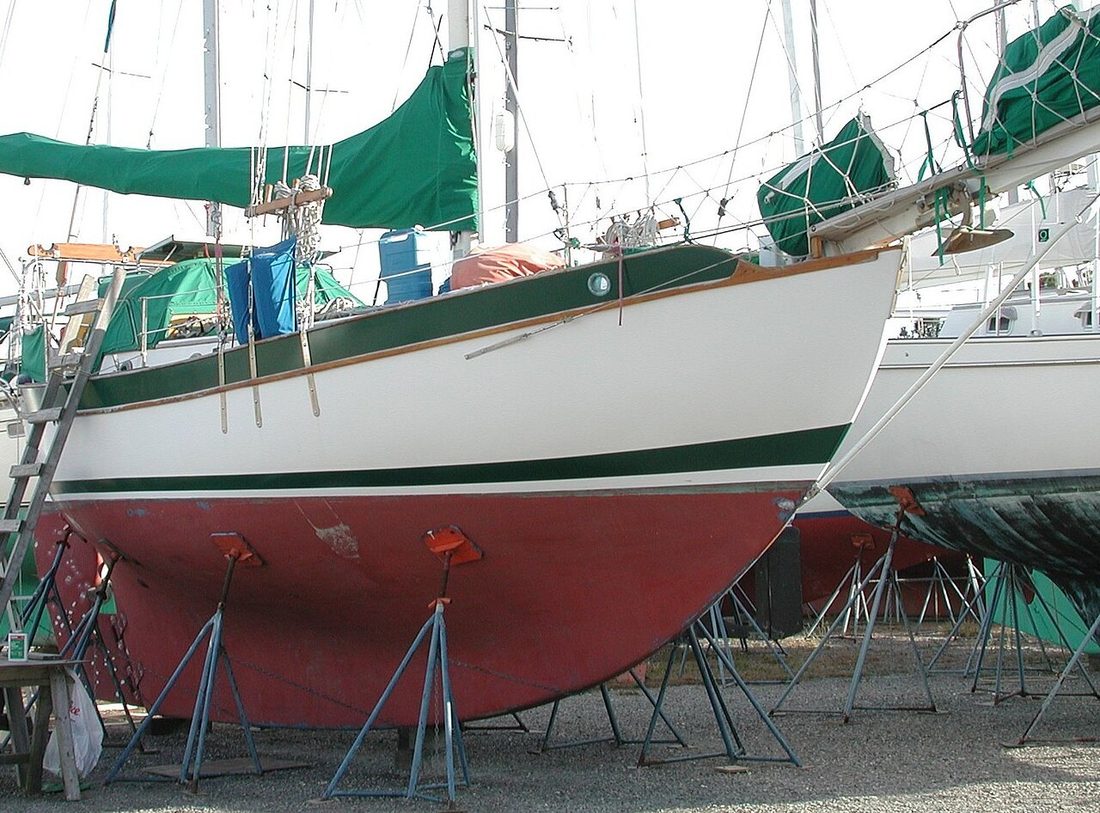
This is the defining identity fact for anyone buying one. The molded hull and deck, the part the factory made, are uniformly heavy and stout across the whole fleet. That is the good news, and it is why even a neglected Westsail rarely has a structurally suspect hull. But the joinery, the tankage, the wiring, the engine installation, and the rigging on a kit boat were completed by owners or third parties to wildly differing standards. A skilled, patient, well-funded amateur could produce a boat that exceeds the factory's own work. A rushed or underfunded one could hide serious deficiencies behind a pretty coat of varnish.
So the practical rule, which this book will return to again and again, is simple: evaluate each Westsail 32 as an individual boat, not as a model. Two boats with the same hull number range can be worlds apart below the gelcoat. When you get to the survey and systems chapters, this is the lens to keep.
2.8 Slow, heavy, and hard to sink: the reputation
Let's talk honestly about how this boat sails, because the reputation is a mix of fact and folklore and you deserve the real version.
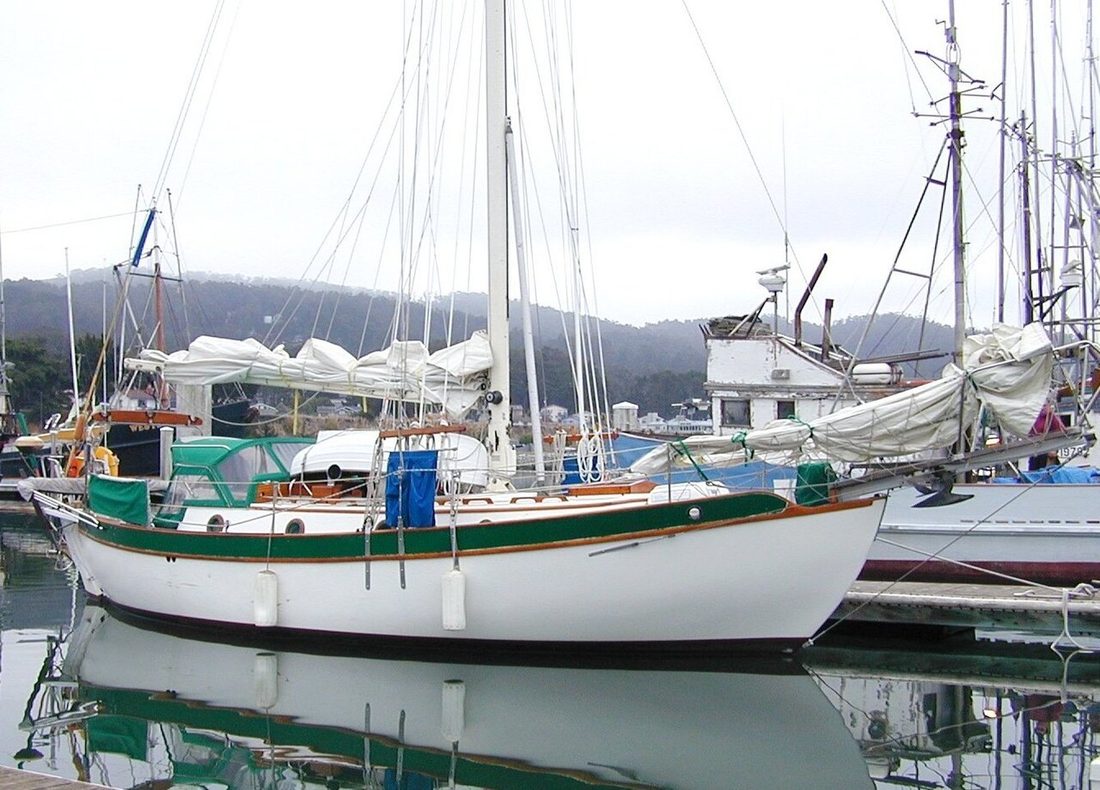
The Westsail 32 is heavy. Not "a bit heavy for its size" but genuinely, deliberately, old-fashioned heavy. On a 27.5-foot waterline it displaces close to 10 tons, right around 19,500 pounds, often rounded to 20,000. Its displacement/length ratio works out to about 419, where anything over 350 is considered very heavy by modern standards. This is one of the heaviest production cruisers of its size you will ever encounter. The ballast is around 7,000 pounds (lead on later boats, and a lead-and-steel mix on many early ones, a point the survey chapter returns to), giving a ballast-to-displacement ratio of roughly 36 percent, which is moderate rather than extreme. The boat's stability comes as much from its hull form and sheer mass as from a deep lead bulb.
What does all that weight buy you? Two things, one you will feel every day and one you will only appreciate in bad weather.
The everyday cost is speed, or the lack of it. With a sail-area-to-displacement ratio of about 16.7, this is not a light-air flyer. In a gentle breeze, faster and lighter boats will sail away from you and you will watch them go. The theoretical hull speed is around 7 knots, and getting there takes real wind. The research literature puts it plainly: the Westsail is "not known for being a fast boat, but rather for being a sturdy and reliable one." That is not a knock. It is the trade you are making.
The payoff shows up when conditions turn ugly. The boat's comfort ratio, a rough measure of how sea-kindly the motion feels, comes out around 42.9, which is very high. It moves through a seaway with a slow, easy, reassuring motion instead of the sharp snappy jerk of a light boat. Its capsize screening formula value is about 1.6, comfortably under the 2.0 threshold that is generally considered the dividing line for offshore suitability. All that displacement also means the boat can carry a heavy load of stores, water, fuel, and gear without noticeably changing how it sails, which is exactly what you want for long passages far from a chandlery.
And here is the part that quietly rebuts the "slow tank" caricature. These boats have actually raced, and won. David King's Westsail Saraband won the 1988 Pacific Cup. Carter Cordner's Kemancha took First Overall in the 1995 Marion-Bermuda race as the smallest boat in a fleet of 77. A Westsail will not win around the buoys on a breezy afternoon, but over a long offshore course, sailed well and steadily, it is far more competitive than its reputation suggests.
2.9 What you are actually looking at
Put it all together and the identity of the Westsail 32 is remarkably coherent. It is a cutter, meaning a single mast flying a mainsail plus two headsails, with a bowsprit reaching forward off the bow and a short boomkin (you will also see it spelled bumkin) reaching aft to carry the backstay. It has a full keel with the rudder hung on the transom at the very back, high protective bulwarks around the deck, small and famously bullet-proof bronze ports, and often a mast set in a tabernacle so it can be lowered. The hull is thick solid hand-laid fiberglass. Everything about it says "built to go to sea and come home."
The company that built it did not last. Despite strong sales, Westsail was chronically undercapitalized, and the story ends the way many boatbuilding stories do. The 1974 launch of the larger Westsail 42 and 43 stretched the company's finances. Mid-1970s oil-crisis inflation drove up material costs so sharply that boats were sometimes sold near or below cost. Payment-on-delivery terms opened up widening credit gaps. Westsail filed for bankruptcy in the spring of 1977, reportedly owing around $10 million. The operation restarted under new ownership and limped along, with W32 production tailing off around 1980 and successor entities building only a handful more.
The exact end date is, fittingly, one last conflict. Wikipedia-derived sources say production "ceased finally in 1981," Good Old Boat says "by early 1980," and the Owners Association frames it as the spring 1977 bankruptcy followed by a wind-down. The safe and honest framing to carry forward is this: main production ran from 1971 to about 1980, the corporate bankruptcy came in 1977, and residual or successor builds trickled into the early 1980s.
None of that corporate turbulence changes what is sitting at the dock. The Westsail 32 outlived the company that made it by half a century and counting. It has crossed every ocean, circled the globe more than once, and kept a devoted owners' association active and a used-boat following passionate long after the last hull left the mold. That is the boat's real legacy, and it is why you are reading this book.
Now that you know where it came from and what it is, let's look closely at the boat itself.
Glossary
- Aperture
- The cutout in the deadwood or rudder of a full-keel boat through which the propeller turns, protecting the prop and shaft.
- Ballast
- Heavy material, usually lead or iron, placed low in the keel to lower the boat's center of gravity and provide the righting force that keeps a sailboat upright and counteracts the heeling force of the wind on the sails.
- Barrier Coat
- A series of epoxy coatings applied below the waterline to seal the hull laminate against water absorption and osmotic blistering.
- Beam
- The width of the boat at its widest point.
- Bermudan Rig
- The common triangular mainsail rig (also called Marconi), as opposed to a gaff rig.
- Beta 38
- A 38 hp Beta Marine diesel, a common Kubota-based repower for older sailboats including the Westsail 32.
- Bobstay
- A stay (wire or solid rod) from the end of the bowsprit down to the stem at the waterline, countering the upward pull of the headstay on the bowsprit.
- Boomkin
- A short spar projecting aft from the stern, here used to anchor the backstay.
- Boomkin Stay Tang
- The metal fitting anchoring a stay to the boomkin; a rig-critical load point on the Westsail 32.
- Bowsprit
- A spar projecting forward from the bow that carries the headstay and forward sails, lengthening the effective rig.
- Bronze Rudder
- A rudder built with bronze fittings or frame; on full-keel boats the rudder often hangs on bronze gudgeons and pintles.
- Bulkhead
- A structural partition across the hull that stiffens it and divides the interior; chainplates often attach to bulkheads.
- Bulwark
- A raised solid rail around the deck edge, higher than a toerail, giving footing and security.
- Bung
- A tapered plug; on a boat this is most often a small teak or softwood plug glued over a countersunk fastener in a wood deck, or a spare wooden plug kept to seal a failed through-hull.
- Caprail
- The finishing rail, often teak, capping the top of the bulwark or hull-deck joint.
- Capsize Screening Formula
- A simple design ratio (beam divided by the cube root of displacement in cubic feet) used to gauge a boat's resistance to capsize. A value under 2.0 is generally considered acceptable for offshore use; higher numbers suggest a boat more easily knocked down.
- Chainplate
- A strong metal strap or fitting bolted to the hull or a structural bulkhead to which the standing rigging (shrouds and stays) attaches, transferring the enormous loads from the mast and rig into the boat's structure.
- Chopped-Strand Mat
- A fiberglass reinforcement of short random fibers, used between layers of woven roving in a hull layup.
- Comfort Ratio
- Ted Brewer's index estimating a boat's motion comfort at sea from its displacement, beam, and waterline.
- Cone Clutch
- A friction clutch using cone-shaped mating surfaces to transmit torque, used in some marine transmissions (such as certain Yanmar gearboxes) to engage forward and reverse drive smoothly.
- Crevice Corrosion
- A localized form of corrosion that attacks stainless steel in tight, oxygen-starved gaps, such as under fittings or inside swage terminals, where the protective oxide layer cannot renew itself. It is a common hidden failure mode in rigging and chainplates.
- Cutless Bearing
- A water-lubricated sleeve bearing, with a grooved rubber inner surface, that supports the propeller shaft where it exits the hull; it wears out and must be replaced periodically.
- Cutter
- A single-masted sailboat that sets two headsails at once (a jib and an inner staysail), dividing the foretriangle for easier handling.
- Deadlight
- A fixed non-opening window, or a protective cover over a portlight.
- Deck Core
- The lightweight core (balsa or plywood) between the deck's fiberglass skins; it rots if water gets in around hardware.
- Deckbeam
- A transverse structural beam supporting the deck.
- Dezincification
- A form of corrosion in which zinc is selectively leached out of a brass alloy, leaving behind a weak, porous copper structure. It is why ordinary brass gate valves are unsuitable below the waterline and why marine seacocks use dezincification-resistant bronze.
- Displacement-Length Ratio
- A number comparing a boat's weight to its waterline length; the Westsail's very high value marks it as heavy.
- Displacement/Length Ratio
- A number comparing a boat's weight to its waterline length; low values indicate a light boat, high values a heavy cruiser.
- Double-Ender
- A boat with a pointed stern as well as a pointed bow, like the Westsail 32.
- Draft
- The depth of the boat below the waterline, the minimum water it needs to float.
- Dye Penetrant
- A liquid dye used to reveal hairline cracks in metal fittings such as chainplates and tangs.
- Encapsulated Ballast
- Ballast (iron or lead) sealed inside the molded fiberglass keel cavity rather than bolted on, so there are no keel bolts, but a grounding that breaches the glass can let water reach the ballast.
- Exhaust Elbow
- The metal fitting where cooling water joins the engine's exhaust; it corrodes internally and is a common failure point.
- Feathering Propeller
- A propeller whose blades rotate to align with the flow under sail, cutting drag.
- Forestaysail
- The inner staysail of a cutter, set on the inner forestay.
- Freeboard
- The height of the hull above the waterline.
- Frp
- Fiber-reinforced plastic, the fiberglass a hull is built from.
- Full Keel
- A long keel running most of the length of the hull; it gives a trawler directional stability and protects the propeller and rudder, at the cost of maneuverability.
- Gaff Rig
- An older four-sided mainsail set on a gaff spar, as opposed to the triangular Bermudan rig.
- Gelcoat
- The pigmented resin outer layer of a fiberglass hull or deck that provides a smooth, glossy, waterproof finish and protects the underlying laminate from UV and water. It can craze, chalk, or blister with age.
- Ground Tackle
- The anchor and its associated gear (rode, chain, shackles) used to moor or anchor a boat.
- Gudgeon
- The fixed socket on the hull or transom that a rudder pintle drops into, forming the rudder hinge.
- Headstay
- The forwardmost stay, from the masthead to the bow or bowsprit end, carrying the jib.
- Heat Exchanger
- A component in a freshwater-cooled (indirect) engine cooling system where engine coolant is cooled by raw seawater flowing through a bundle of small tubes, transferring heat without the two fluids mixing, much like an automotive radiator cooled by water instead of air.
- Hull Speed
- The theoretical maximum efficient speed of a displacement hull, roughly 1.34 times the square root of the waterline length in feet, beyond which the boat must climb its own bow wave and required power rises steeply.
- Impeller
- The flexible rubber, vaned rotor inside a raw-water pump that draws seawater through the engine's cooling system. Its vanes wear and can shear off, so it is a routine maintenance-replacement item; running the pump dry destroys it quickly.
- Indirect Injection
- A diesel design that injects fuel into a pre-combustion chamber rather than directly into the cylinder; quieter but slightly less efficient.
- Inner Forestay
- A stay from the mast to the deck inboard of the headstay, carrying a cutter's staysail.
- Kit Boat
- A boat sold as a hull-and-deck or partial package for the owner to finish, so quality varies by builder.
- Loa
- Length overall: the boat's total length including any bow pulpit or swim platform.
- Lod
- Length on deck: the hull length measured along the deck, excluding overhangs such as a bow pulpit.
- Lwl
- Load waterline length, the hull length at the waterline, which sets a displacement boat's hull speed.
- Md2B
- The Volvo Penta MD2B, a roughly 25 hp two-cylinder raw-water-cooled diesel fitted to many Westsail 32s.
- Motor Mount
- The flexible mounts that carry the engine and control vibration and shaft alignment.
- Osmotic Blistering
- The formation of fluid-filled blisters in a fiberglass hull below the waterline when water gradually permeates the gelcoat and reacts with soluble compounds in the laminate, creating acidic fluid pockets. Often called boat pox, it is treated by drying, grinding, and re-laminating the affected areas.
- Outboard Rudder
- A rudder hung on the transom or the aft end of the keel, outside the hull, rather than under it.
- Perkins 4-108
- The Perkins 4.108, a British four-cylinder roughly 50 hp marine diesel widely fitted to 1970s-80s cruisers.
- Pintle
- The pin on the rudder that drops into a hull-mounted gudgeon to form the rudder hinge.
- Portlight
- A cabin window, fixed or opening; on heavily-built cruisers often a bronze one.
- Pre-Combustion Chamber
- A small antechamber in an indirect-injection diesel where fuel first ignites.
- Propeller
- The bladed screw that drives the boat through the water.
- Racor
- A common brand of fuel filter/water separator, so ubiquitous the name is used generically.
- Raw-Water Cooling
- Engine cooling that pumps seawater directly through the engine, as opposed to a closed fresh-water loop; simpler but harder on the block over decades.
- Raw-Water Impeller
- The flexible rubber vane wheel in the raw-water pump; a routine wear item.
- Repower
- Replacing a boat's engine with a new one.
- Rope Seal
- A rope-type crankshaft seal, such as the Perkins 4-108's chronic-weeping rear main seal.
- Rudder
- The underwater blade, turned by tiller or wheel, that steers the boat.
- Running Backstays
- Adjustable stays led aft from the mast, set and released when tacking, that support the mast against an inner forestay.
- Sacrificial Anode
- A block of a less-noble metal (zinc, aluminum, or magnesium) bolted to underwater metal so that it corrodes first, protecting the propeller, shaft, and other fittings; also called a zinc.
- Sail Area/Displacement Ratio
- A number comparing a boat's sail area to its weight; a rough index of how easily the rig drives the hull (higher is more powered up in light air).
- Sampson Post
- A stout post through the foredeck used to make off anchor and mooring lines.
- Seacock
- A robust shutoff valve mounted on a through-hull fitting that allows a below-waterline opening (for cooling water intake, drains, or heads) to be closed, isolating the boat's interior from the sea. Marine seacocks are made of corrosion-resistant bronze or reinforced polymer.
- Sheer Clamp
- The longitudinal timber or laminate at the sheer where hull and deck join.
- Standing Rigging
- The fixed wires or rods (shrouds and stays) that hold the mast up and in position. Unlike running rigging, it is not routinely adjusted while sailing and is a critical structural system with a finite service life.
- Staysail
- The inner headsail of a cutter, set on the inner forestay between the jib and the mast.
- Stuffing Box
- The fitting where the propeller shaft exits the hull, packed with greased flax or fitted with a seal to keep the sea out while allowing the shaft to spin; also called a packing gland.
- Sump
- The lowest bilge cavity where water collects for the bilge pump.
- Swage
- A wire terminal fitting attached by compressing (swaging) a metal sleeve tightly onto the end of a wire rope under high pressure. Swage terminals are common on standing rigging but can develop cracks or crevice corrosion over time.
- Tabernacle
- A hinged mast-base fitting on deck that lets the mast be pivoted up and down for trailering.
- Tang
- A metal fitting on the mast or hull to which a stay or shroud attaches.
- Teak
- The dense, oily tropical hardwood used for decks and trim; durable but demanding to keep bright.
- Toggle
- A universal-joint link at a stay's lower end that lets the fitting align with load in any direction.
- Transom
- The flat aft face of the hull, where an outboard bracket or rudder often mounts.
- Turnbuckle
- A threaded fitting at the base of a stay or shroud used to adjust rigging tension.
- Velvet Drive
- A widely used marine transmission (originally Borg-Warner, now Regal) fitted behind engines like the Ford Lehman.
- Volvo Penta Md2B
- The Volvo Penta MD2B, a roughly 25 hp two-cylinder raw-water-cooled diesel.
- Waterline
- The line along the hull where it meets the water at design load.
- Westsail 32
- The subject of this book: a heavy roughly 32-foot full-keel double-ended cutter built by Westsail Corporation in the 1970s.
- Westsail Owners Association
- The owner community and knowledge network for Westsail boats.
- Whisker Stay
- A stay bracing the bowsprit sideways against the pull of the headsail.
- Whisker Stays
- Stays bracing the bowsprit sideways against the pull of the headsail.
- Windlass
- A deck winch for hauling the anchor chain or rode.
- Worldcruiser Yacht Co
- Bud Taplin's company, the successor parts and knowledge authority for Westsail boats.
- Worm Gear
- A steering gear using a worm-and-sector drive, as on some Westsail 32 helms.
- Woven Roving
- A heavy woven fiberglass reinforcement used to build up hull thickness.
- Yankee
- A high-cut jib set on the headstay of a cutter, above the staysail.
- Zinc
- The common name for a sacrificial anode, a block of zinc bolted to underwater metal that corrodes preferentially to protect propellers, shafts, and other metals from galvanic corrosion. (Also the metal leached out during dezincification of brass.)