🚧 This site is under construction. You're welcome to look around, the full storefront goes live August 10, 2026.
Founding early access is open, reserve your place
Garage, Galley & Hangar
GG&H
Technical Owner's Manual
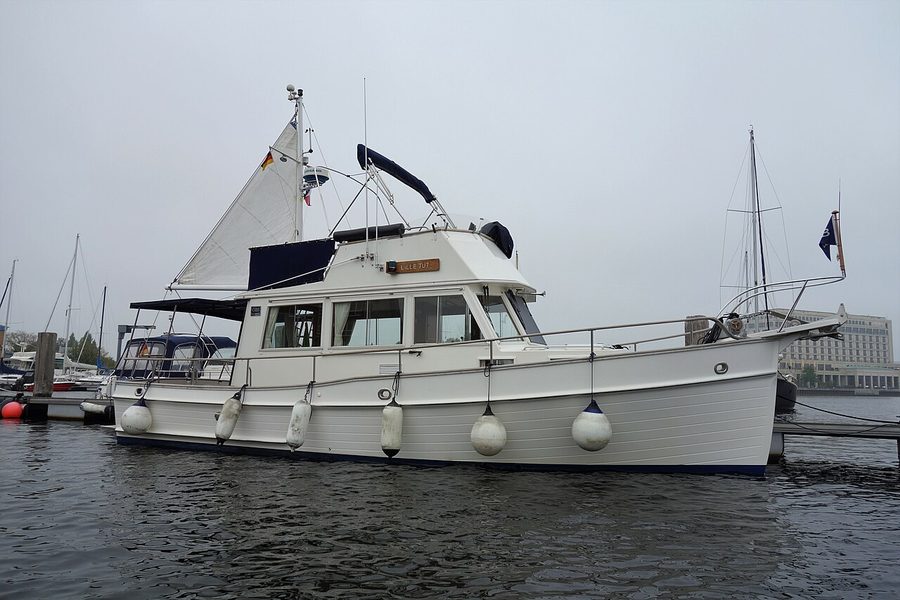
Grand Banks 32 ClassicFIG. 1
32' 0"
GRAND BANKS (AMERICAN MARINE LTD.)
Grand Banks 32 Classic
The Complete Owner's Reference
REV 1.0 · 170 PP
TRAWLER · 32' 0"
GARAGE, GALLEY & HANGAR
9 chapters · 45-term glossary · 107-entry index
Trawler · Grand Banks (American Marine Ltd.)

Grand Banks 32 Classic

The Grand Banks 32 is the smallest and most numerous of American Marine's founding 1965 trio (861 built), a Kenneth Smith semi-displacement trawler that switched from wood to fiberglass around 1973 and stayed in production for three decades. Near-universally a single-screw Ford Lehman boat, it suits a liveaboard-capable couple who want a miserly, teak-trimmed classic trawler with standing headroom in a hull under 32 feet, not a fast or twin-engine powerboat. This reference is honest about its named weak spots: the black-iron fuel tanks that rust hidden under the side decks, the single engine and running gear with no get-home backup, the corroding exhaust elbow, and the screwed-down teak decks that wick water into the plywood core.

Digital book $29 · hardcover $149
Customize it to my vessel · $260 →Read a free sample →

Buying any book unlocks the owners-only library membership ($20/mo, every volume).

Free · 10 things to check before you buy →

A sample of what's inside

Specifications

Length overall32 ft 0 in (~9.75 m)
Beam11 ft 6 in (3.50 m)
ConfigSingle-screw semi-displacement trawler; wood hull through 1973, solid fiberglass from 1974
EngineSingle Ford Lehman 120 (later 135 hp), 6-cyl naturally aspirated diesel; ~7 to 8 kn cruise on ~2.5 gph
Fuel~200 to 250 US gal in twin ~125-gal tanks (original black iron, often reduced when re-tanked)
Used market~$30k to $110k, condition and wood-vs-glass driven

Known issues, covered honestly

  • The black-iron fuel tanks are the 32's named Achilles' heel: they rust from deck-fill leaks and hide the failing face at the back, tucked under the side decks where you cannot see it without pulling them.
  • With one engine, one shaft, one prop, and one rudder, the whole power train is a single point of failure with no second engine to limp you home, so it carries disproportionate survey weight.
  • The stainless exhaust mixing elbow corrodes internally and develops pinhole leaks that can flood the muffler or push water back at the engine; it must be inspected by removal, never by flashlight.
  • The screwed-down teak decks sit over a plywood-cored subdeck that wicks water from every leaking screw, delaminates, and eventually drips a brown stain through the cabin headliner.

…and the full survey guide, service schedules, systems, and parts sourcing in the complete volume.

Custom Edition

Make it your boat.

We fold in your year, your engine, your electronics and refits, your hull number, and your vessel name and your own boat's photo on the cover. The book stops describing the boat that left the factory and starts describing the one in your slip.

$260
personalized to your vessel