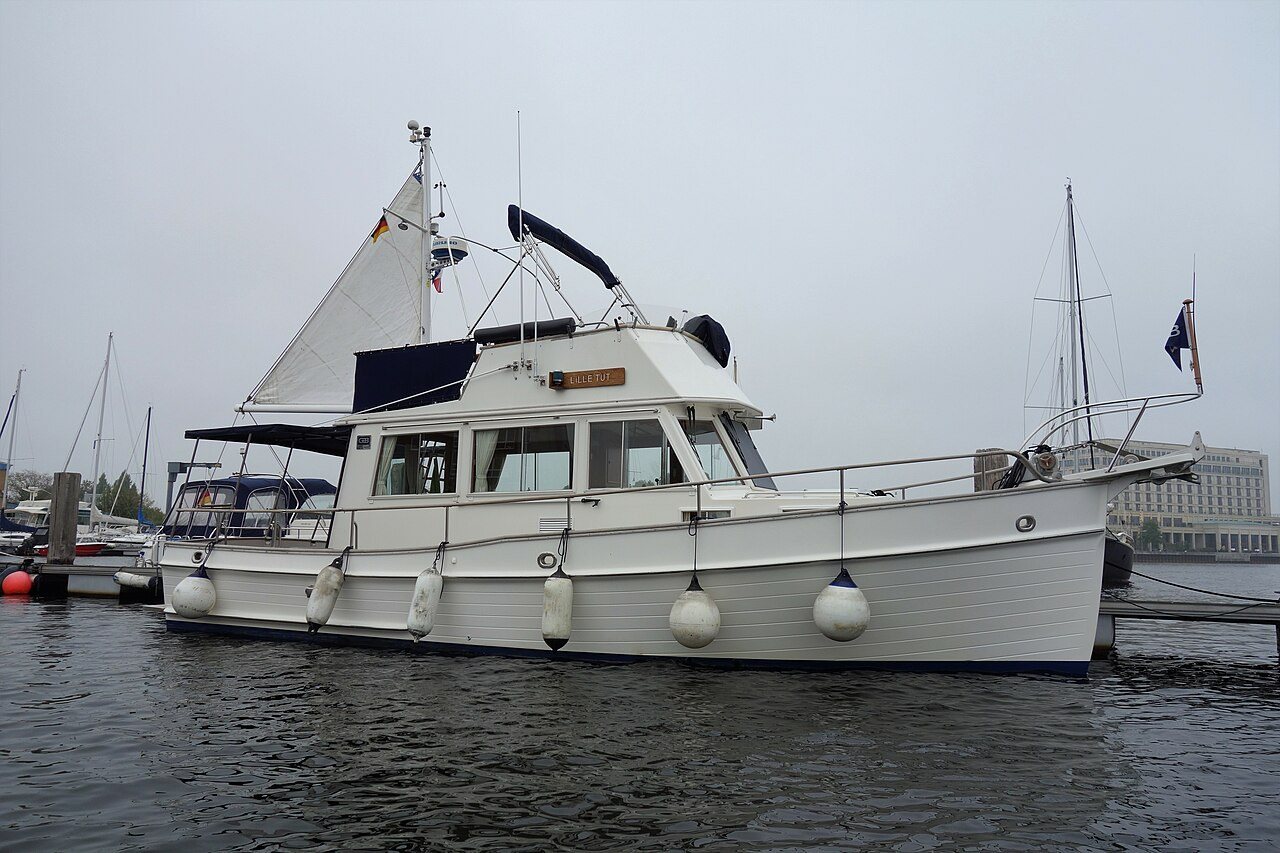
Grand Banks 32 Classic
About This Book
This is a deeply researched owner's companion to the Grand Banks 32 Classic, written by people who love these boats. It is not a factory service manual, and it is not a substitute for a qualified surveyor or mechanic. Before you use a single fact in these pages, do one thing first: positively identify which Grand Banks 32 you actually own, because "a GB32" is really several very different boats wearing the same graceful lines.
1.1 What this book is, and what it isn't
The Grand Banks 32 is the smallest of the classic Grand Banks trawlers, and by a wide margin the most numerous. It was one of the three founding models American Marine launched together for the 1965 model year (a 32, a 36, and a 42), and it stayed in production for roughly three decades, with 861 hulls built before the last one was splashed in the mid-1990s (source: soundingsonline.com). Over that long run it was built in wood and then in fiberglass, powered by a single diesel that grew a little over the years, and wired to more than one standard. American Marine engineered the fiberglass boats to look just like the wood ones, so a well-kept wooden 32 and an early glass 32 can be genuinely hard to tell apart by eye. That single fact is the reason this book opens the way it does.
This book is a companion: a place to understand your boat's history, its systems, its known weaknesses, and the questions worth asking before you spend money. We have chased every claim to a source, and we tell you when the sources disagree.
This book is not a few things, and it is important to be honest about them up front:
- It is not a factory service manual. We do not reproduce torque specs, wiring diagrams, or step-by-step overhaul procedures for your specific hull. Where a job is safety-critical, we tell you what to know and then send you to the manufacturer's documentation and a professional.
- It is not a substitute for a surveyor. A marine surveyor who knows these boats, ideally one who knows wood boats if yours is pre-1974, will find things no book can. Buy the survey. Read it. Argue with it.
- It is not a substitute for a mechanic or a certified marine electrician. Anything involving fuel, exhaust, through-hulls, or the DC system deserves qualified hands.
1.2 How to use this book
Read this chapter first, all the way through, and complete the "know your hull" checklist below. Everything downstream depends on it. After that, the book is built to be dipped into: engine and propulsion, electrical, fuel, steering, plumbing, and a frank chapter on known issues and what surveyors look for.
Throughout, you will see a recurring phrase: "typical, verify against your vessel." We mean it literally. These boats are forty to sixty years into a life of refits, repowers, rewiring, and re-tanking, and no two are identical. When we describe a system, we are describing the common arrangement, not a promise about your boat. First uses of specialized terms are marked for the glossary so you can find them again.
1.3 The most important idea in this book: identify YOUR boat
Before anything else, establish exactly which GB32 you have. There are four questions that change almost everything about maintenance, parts, value, and risk. Get them wrong and you will buy the wrong parts, budget for the wrong problems, and read the wrong half of this book.
1. Wood or fiberglass?
The GB32 began in the 1965 model year as a wood boat: carvel planking on sawn frames, hand-built the way its bigger sisters were. Around the 1973/1974 model-year boundary it transitioned to hand-laid fiberglass, tracking the same family-wide changeover as the 36. Our sources place the exact line slightly differently and we will not pretend to a precision they don't support: the well-documented framing is that 1974 was the first fiberglass model year, with wood hull designs abandoned in late 1973 ahead of it, while some looser accounts say "the mid-1970s" and at least one places the last full wood year a season earlier (source: yachtworld.com / oxfordyachtagency.com). The safe reading is wood through roughly the 1973 model year, glass from 1974, and you must confirm your boat's construction from its year and hull record, not by eye, because a well-cared-for wooden 32 is difficult to tell from a later fiberglass one (source: soundingsonline.com).
Two 32-specific details are worth carrying with you. First, wood 32s were being built in Singapore, not only in the early Hong Kong shop: a documented 1973 wooden Sedan was built by American Marine Ltd. in Singapore, which also puts real wood boats right up against the '73/'74 line. Second, that same boat shows Iroko planking below the waterline and mahogany above, rather than the "mahogany throughout" sometimes told for the earliest boats. Treat that as one documented example, not a fleet-wide rule (source: devalk.nl).
Why it matters: a wood hull carries classic wood-boat liabilities (plank replacement, refastening, dry rot around keel bolts, rudder posts, shaft logs, and fuel-fill ports) and trades at a large discount for exactly that reason, which on the cheap, small 32 means more neglected project boats in the fleet. A fiberglass hull avoids those, but do not imagine it is maintenance-free: every GB32, wood or glass, has genuine teak decks and teak trim, and the screwed-down teak deck over a plywood-cored subdeck is a chronic, expensive problem regardless of hull material.
2. Which engine? Read the data plate, and never mix parts.
The 32 has almost always been powered by a single 6-cylinder, naturally aspirated Ford Lehman diesel, and there are two classic versions that look and sound alike but are different blocks:
- Ford Lehman 120: the early and classic default, a marinized Ford 2715E, about 120 hp.
- Ford Lehman 135: the common later single, built on the Ford 2725E, a different engine from the 120 (a 2007-repowered boat in our research carries a "2725E, 134.8 hp") (source: devalk.nl).
Read the data plate on the engine and confirm the model before you order a single part. These are not interchangeable, and buying "Lehman parts" without knowing which Lehman is a fast way to waste money.
Two more wrinkles are specific to the 32. Some early wood-era boats were delivered with smaller or alternative diesels than the 120 (community references include a roughly 68 hp single and even a twin Perkins 4-108 on a commercial-spec boat); treat any specific fitment as boat-by-boat, not standard. And because the 32 has such a long-lived engine, higher-hour survivors are sometimes repowered with a John Deere or Cummins diesel. Whatever is bolted in, the data plate is the truth and the brochure is not.
3. Single screw or twin? (Almost certainly single, so no get-home.)
Here is the axis that most distinguishes the 32 from its bigger sisters: the 32 is essentially always single-screw. Its modest beam and small hull make a single centerline diesel the near-universal configuration, and the twins that do exist are, in owners' words, "thankfully rare" and considered cramped and undesirable (source: trawlerforum.com). If you are looking at a twin 32, you are looking at the exception.
This matters more than a spec line suggests. On a twin boat, a dead engine limps you home. [SAFETY] A single 32 has no such redundancy, and no get-home engine (source: trawlerforum.com). That raises the stakes on the one engine's health and on everything downstream of it (the single shaft, cutless bearing, prop, and rudder), because any one of those failing strands the boat. Give the running gear disproportionate weight. The single screw also shapes handling: these boats are hard to back in close quarters and walk to port, so many owners add a bow thruster to compensate. That is a buyer expectation to set, not a defect. On the plus side, a single centerline install makes for a cleaner repower and, notably, lets the fuel tanks come out with the engine in place.
4. 32-volt or 12-volt DC?
Many older American Marine boats of this era were factory-wired as 32-volt DC systems rather than 12V, and a great many have since been converted, partly converted, or run a hybrid. So the important electrical question on any older GB is: what voltage is this boat actually on, end to end?
The 32-specific good news is that this trap appears less prevalent on the 32 than on the 36. Most 32s in today's market present as 12-volt (12V house and engine banks, with lithium-house upgrades common on refit boats), possibly because the smaller, simpler, single-engine boats were converted early or shipped 12V to begin with (source: curtisstokes.net / seattle.boatshed.com). No source firmly states the 32's original system voltage by year, so early hulls still deserve the question. Do not assume either way: count and read your batteries, check the panel and breaker labels, and look at the alternator and windlass nameplates. If you find 32V, that shapes every electrical decision you make, from chargers to electronics to whether you convert.
1.4 Your "know your hull" checklist
Before you go further in this book, walk your boat with a notepad and settle these:
- [ ] Data plates / builder's plate: engine model (2715E vs 2725E; Lehman 120 vs 135, or a Deere/Cummins repower), transmission, and any hull/builder plate.
- [ ] Year and HIN: find the HIN (hull identification number) and the model year, then place your boat on the wood-vs-glass timeline. Confirm construction from the record, not by looking.
- [ ] Confirm single or twin, and count the shafts and rudders. If single (almost certainly), remember there is no get-home engine, so weigh the running gear accordingly.
- [ ] Count the batteries and read them: how many, what nominal voltage, wired in series or parallel. Decide 32V vs 12V vs hybrid, and confirm it against the DC panel labels. Expect 12V, but verify.
- [ ] Note the layout: the standard single-forward-stateroom Sedan, or the rarer rear-entry Europa, same hull, different saloon access.
- [ ] Write down what's already been refit: fuel tanks (original black-iron, or replaced, and to what capacity?), wiring, steering, water tank, decks.
Keep those answers somewhere permanent. They are the key that tells you which parts of every following chapter apply to your boat.
1.5 A note on honesty, and the disclaimer
We have worked hard to source every fact, to give you both numbers when the record disagrees, and to attribute anything that rests on a single account. Where you see a value called "typical," treat it as a starting point to verify, not a specification. Where the boat can hurt you or your wallet (fuel, exhaust, DC wiring, through-hulls, bilge pumping on a wood hull), we err toward caution.
And the plain disclaimer, in our own voice: this book is for understanding and orientation, not for authorization. Nothing in these pages certifies that any statement is true of your particular boat, and nothing here replaces a professional inspection or repair. Boats float on unforgiving water; fuel, electricity, and the sea do not grade on effort. Before you rely on anything you read here for a decision that affects safety, seaworthiness, or a purchase, verify it against your actual vessel and have the safety-critical work inspected, done, or blessed by a qualified surveyor, mechanic, or ABYC-certified marine electrician. Use good judgment, and when in doubt, get a professional aboard.
Now, go find out which Grand Banks 32 is yours. The rest of the book is waiting for that answer.
History & Identity
Your Grand Banks 32 is the smallest of the three boats that started it all, and the most numerous. It was born in 1965 alongside the 36 and the 42, it sold better than any other small classic Grand Banks, and it is its own boat from the keel up, not a shortened 36. Understanding where it sits in the family, and which side of the 1973 wood-to-fiberglass line your particular hull falls on, tells you more about what you own than any brokerage listing ever will.
2.1 A bottling plant in Hong Kong
The company that built your boat began, improbably, in a parking lot. In 1956, Robert J. Newton and his two sons, John and Whit, founded American Marine Ltd.American Marine, Ltd. in Hong Kong. Robert Newton was then the manager of a Bireley's soft-drink bottling plant, and the family, as the record has it, started out building boats on the plant's parking lot.
By 1962 the operation had moved to a proper yard at Junk Bay, near the village of Hang Hau, and there American Marine did work that would surprise anyone who thinks of Grand Banks as a production builder: it built custom, one-off yachts and sailboats to the designs of the leading naval architects of the day, Sparkman & Stephens and William Garden among them. The house ethos was traditional hand craftsmanship, many carpenters building each boat individually.
This is the pivot point of the company's identity, and it is worth holding onto as you read the rest of this chapter. American Marine began as a custom yard and became a production builder only when it committed to a family of boats. That family was the Grand Banks, and your 32 was one of its three founders.
2.2 Kenneth Smith, the Spray, and the founding trio
In the early 1960s the Newtons commissioned the naval architect Kenneth Smith to design a diesel-powered cruising boat with workboat lines, a proper little ship rather than a yacht. Smith's 36-foot design was launched as a prototype named Spray in 1963, and it is the seed from which the whole Grand Banks line grew. The 36 was the first hull launched under the Grand Banks trademark. But American Marine did not stop at one size.
For the 1965 model year the yard launched three boats at once: a 32, a 36, and a 42 (source: powerboatguide.com). These founding models, later joined by a 49, are the boats Grand Banks markets today under its Heritage Series banner, and they are widely credited with creating the recreational trawler category from nothing. Your 32 was there at the very beginning, not a later addition to fill out the range. American Marine, as one history puts it, launched the 36 and then "quickly added a very popular 32-footer" (source: powerboatguide.com).
In 1964 the Newtons had already made the decision that changed the company: they abandoned custom yacht building altogether to focus on producing this one line. Everything that followed, the moves between countries, the switch from wood to glass, the three decades of the 32, flows from that single commitment.
2.3 The yard, the countries, and where the wood 32s were built
Over the life of the Grand Banks line the boats were built in more than one country, and the 32 is caught up in that geography just as its bigger sisters are. The earliest boats came out of Hong Kong (Junk Bay) in wood, built by hand in the plank-on-frame tradition American Marine had carried over from its custom-yacht days. American Marine expanded to Singapore by the late 1960s, and it was Singapore that became the center of fiberglass production.
For the 32 specifically, there is a useful documentary datapoint. A 1973 wooden GB32 Sedan on the brokerage market is recorded as built by American Marine Ltd. in Singapore (source: devalk.nl). That confirms two things at once: wooden 32s were being built right up to the 1973/74 boundary, and at least some of those late wood 32s came out of Singapore, not only Hong Kong. Keep that in mind if you own or are shopping a late wood boat, because the "all the wood boats were Hong Kong boats" shorthand is not quite right for the 32.
A caution about the moves, the same one that applies across the family. It is tempting to say quality rose or fell as the yard relocated, but no solid source quantifies any such change, and this book will not assert one. What the record does support is that the hand craftsmanship and the teak-lavished joinery carried across every move. The defensible line is continuity of workmanship, not a quality drop or climb tied to a border.
2.4 The wood-to-fiberglass changeover on the 32
Here is the single most important thing to understand about your boat, and the one fact that reshapes almost every practical decision you will make as an owner: the Grand Banks 32 began life as a wooden boat and became a fiberglass one right around 1973 to 1974. Which side of that line your hull sits on changes its maintenance, its known failure modes, its survey checklist, and its value.
The 32 followed the exact same family changeover documented for the 36 and the 42. Broker and review sources describe it plainly: the 32 was "initially built of wood but transitioned to fiberglass construction in the mid-1970s" (source: oxfordyachtagency.com; soundingsonline.com). The community and listing consensus pins the boundary tightly for the 32:
- 1974 was the first model year for fiberglass hulls on the Grand Banks 32.
- Wood-hull designs were abandoned in late 1973, prior to the 1974 model year (source: yachtworld.com; thehulltruth.com).
So the safe framing, and the one this book uses, is: wood through the 1973 model year, fiberglass from the 1974 model year, with the physical switch occurring in late 1973. Do not let anyone, including a listing for your own boat, tell you a single day or a single hull number is the definitive dividing line as established fact.
What the wood 32s were. The original 32 hulls were traditional carvel plankingcarvel-planked, plank-on-frame wooden boats. One well-documented late example, that 1973 Singapore-built Sedan, carries a wood specification worth flagging: Iroko planking below the waterline, mahogany above (source: devalk.nl). That is slightly different from the "Philippine mahogany throughout" story often told for the earliest 36s. It is one documented boat, not a confirmed fleet-wide pattern, but if you are surveying a wood 32 it is worth knowing that the below-waterline planking may not be mahogany at all.
Why the switch is nearly invisible. The detail that still fools people at the dock is that the styling and joinery carried straight across the material change. On a well-kept boat it is genuinely "difficult to tell a well-cared-for wooden model from a later fiberglass boat" (source: soundingsonline.com). The company built a fiberglass 32 and made it look like the wooden 32 it replaced. You cannot reliably tell the two apart by eye, which is exactly why you must establish material from documentation and survey, not appearance.
What this means for you. [SAFETY] A wood 32 carries every classic wooden-boat liability: expect to inspect for plank replacement, dry rot, and galvanic corrosion around the keel bolts, rudder post, shaft log, and fuel-fill ports, plus fastening deterioration, the places water and time do their work on a plank-on-frame hull (source: soundingsonline.com). A fiberglass 32 sheds the wooden hull, but not the wooden everything-else. Like every classic Grand Banks, even a glass 32 wears a full teak wardrobe: teak decks, rails, trim, and interior joinery. The 1974-and-later boats escaped the wooden hull; they did not escape the maintenance that teak demands.
2.5 The production run and the numbers
The 32 enjoyed one of the longest production lives of any small trawler ever built, roughly three decades (source: soundingsonline.com; oxfordyachtagency.com). It debuted for the 1965 model year with the founding trio and ran into the mid-1990s.
How many were built. The hard number is 861 hulls. As one account of the model's end puts it, "when the last one was splashed in 1996, 861 of these venerable cruisers had been built" (source: soundingsonline.com; oxfordyachtagency.com). A looser figure of "nearly 900" appears elsewhere (source: powerboatguide.com); it reconciles fine with 861, so treat 861 as the firm count and "nearly 900" as round-number color.
When production ended. The sources split on the exact final year, so this book shows both:
- 1996, "the last one was splashed in 1996" (source: soundingsonline.com), and a 1996 GB32 Classic is offered on the brokerage market, which supports a 1996 last year (source: dailyboats.com).
- 1995, the model designation used by at least one powerboat guide is "Grand Banks 32 Sedan (1965 to 95)" (source: hmy.com).
The reconciliation, and the framing this book uses: production ran from 1965 into the mid-1990s, with the final hulls splashed in 1995 to 1996. The 1996 date is the more specific and better-corroborated claim, so lean on it, but verify against your own boat's paperwork if you own a very late one.
For scale within the family, the production tallies as of the late 1990s were roughly GB32 = 861, GB36 = 1,124, and GB42 = 1,400. The 32 was the smallest boat of the three and, in absolute terms, the fewest hulls, but relative to its class it was a runaway success: it is repeatedly described as one of the best-selling small trawler designs ever built (source: powerboatguide.com; oxfordyachtagency.com). Whatever the exact end year, the point stands. This was a genuinely mass-produced boat by trawler standards, with a deep pool of surviving hulls, parts knowledge, and owner experience behind it. Your 32 is the opposite of an orphan.
2.6 The identity that matters most: the 32 is its own boat
Now for the single most important framing in this chapter, and the thing that trips up nearly every newcomer. You will hear the 32 described as "a 36 with the back cut off." That is a helpful mental shortcut for the accommodations, and a wrong one for the hull. Keep the two ideas separate.
On accommodations, the shorthand is fair. The 32 is, functionally, a single-cabin version of the classic Grand Banks idea. As owners put it, the 32 "is the exact same as the 36 except it does not have a rear stateroom and head, only a forward V-berth and head" (source: trawlerforum.com). The 36 Classic is an aft-cabin boat, two staterooms and a second head; the 32 gives that up entirely.
On the hull, the shorthand is false. The 32 is its own shorter hull, not a cut-down 36. The 36 Classic is built on Grand Banks' 35-foot-2-inch hull; the 32 is a genuinely different, shorter design with its own lines and its own dimensions (source: mby.com; hmy.com). Nobody sawed a 36 in half to make a 32. When you read the specifications chapter, you are reading the numbers of a distinct boat, not a truncated bigger one.
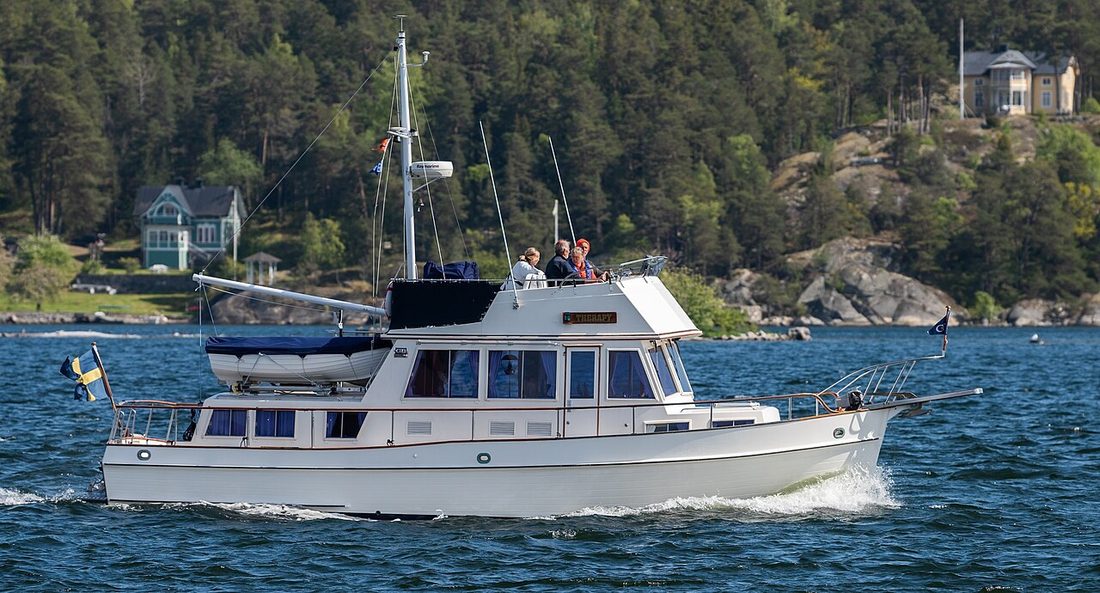
What the 32 gives you in exchange for the aft cabin it lacks is a more open, single-level saloon and a smaller, more affordable boat to buy and to keep. The standard 32 is a Sedan with a single forward stateroom: a teak interior, a forward V-berth master with an enclosed head and shower, the galley up in the saloon, a lower helm to starboard, and settees that convert to sleep guests. Above sits the classic Grand Banks flybridge with an upper helm. It sleeps around four or five in a hull under 32 feet, with standing headroom of about 6 feet 3 inches, a full galley, and an enclosed head and shower. In other words, a genuine liveaboard-capable couple's boat in the smallest classic-GB package there is (source: yachtdatabase.com; devalk.nl; hmy.com).
A rarer variant is worth knowing about. A "32 Europa" exists, with a rear door leading directly into the saloon rather than the side entrance of the standard Sedan, an arrangement some owners strongly prefer (source: trawlerforum.com). Most 32s, though, are the standard side-entrance Sedan, so if you have one of those you have the mainstream boat.
2.7 Sisterships and the place in the family
Your 32 was the smallest of American Marine's founding 1965 trio, all sharing the same Kenneth Smith workboat-trawler DNA but each its own hull:
- GB32 (yours), LOA 32 feet, beam 11 feet 6 inches (3.50 m); a single forward stateroom; near-universally single-screw; 861 built; the entry point and best-seller of the small classics.
- GB36, the middle child and the archetype that "sold the world's boaters" on the eight-knot trawler, built on the 35-foot-2-inch hull with the two-cabin aft-cabin layout; roughly 1,124 built by the late 1990s; the flagship of the classic pair.
- GB42, the largest of the three, widely called the "gold standard" traditional trawler; its wood-to-glass switch is documented at a specific point, "beginning with hull number 353 in 1973" (source: hmy.com); around 1,400 built.
That hull-numbered changeover on the 42 is not just trivia about a bigger boat. It is the hard evidence that the wood-to-glass switch happened family-wide, right around 1973, which is why you can trust the late-1973 date for your 32 even though the 32's own hull boundary is community-estimated rather than documented from a factory record.
Positioned against its sisters, the 32's role is clear. It is the smallest, most numerous, and most affordable way into a real Grand Banks. The 36 asks you to buy and maintain more boat for the second cabin; the 42 more still. The 32 gives you the same teak-trawler soul, the same eight-knot unhurried character, and the same hand-built pedigree in a boat one adult can wash down in an afternoon and one modest engine can push economically for hundreds of miles.
2.8 The reputation, honestly
What owners love. The 32's headline virtue is frugality. With its near-universal single diesel it cruises at roughly 7 to 8 knots on something like 2.5 gallons per hour, good for a range on the order of 500 nautical miles, which is why it earns the affectionate label of the "miserly" trawler (source: soundingsonline.com). Add the flawless teak joinery, the seaworthy semi-displacement hull, and a long service life, and you have a boat owners keep for decades. It routinely appears on "favorite boat" and "boats always in demand" lists, and its solid layup and quality construction are cited as reasons it holds its value well (source: oxfordyachtagency.com; powerboatguide.com).
The flip side, said plainly. Teak everywhere means relentless maintenance; the same wardrobe that makes a 32 beautiful makes it a demanding boat to keep. Wood-hull examples carry real structural risk. And the 32 shares the classic-GB weak spot you will meet again in the systems and known-issues chapters: the original black-iron fuel tanks are prone to leaking with age (source: hmy.com), the recurring complaint on these boats just as on the 36. None of that is a mark against the design. It is simply the honest cost of owning a hand-built teak trawler that is now decades old.
2.9 What to establish about your own boat
Because the wood and fiberglass 32s are visually near-identical, and because the family history is easy to blur, resolve the following before you trust any listing:
- Wood or fiberglass? This is the master question. Do not judge by the planking-look hull; the styling carried straight across the material change. Establish it from the model year (wood through 1973 MY, glass from 1974 MY, changeover in late 1973), from documentation, and from survey. Nearly every later chapter of this book forks on the answer.
- How late in the run? If your boat is a very late one, confirm whether it is a 1995 or a 1996 hull, since the sources disagree on the final year and your paperwork is the tiebreaker.
- Standard Sedan or Europa? Confirm whether you have the mainstream side-entrance Sedan or the rarer rear-door Europa layout. Both are single-forward-cabin 32s, but they live differently.
- Remember what the 32 is not. It is not a cut-down 36. It is its own shorter hull with a single forward stateroom, and the specifications, tankage, and range in the next chapter are the 32's own numbers, not a scaled version of a bigger boat's.
Get these straight and you will understand your Grand Banks 32 better than most listings that try to sell one, because you will know not just what the badge says, but which side of the boat's one defining line you are standing on, and why the smallest classic Grand Banks was also, for thirty years, the most popular.
Glossary
- 32-Volt Dc
- An older 32-volt direct-current electrical system fitted to many early Grand Banks and other trawlers; it predates the 12-volt standard, and its bulbs, motors, and chargers are now scarce and expensive.
- Air Draft
- The height of the highest fixed point on the boat (mast, hardtop, or radar arch) above the waterline, which sets the lowest bridge the boat can pass under.
- American Diesel Corp
- A Virginia-based specialist widely regarded as the leading authority and parts source for the Ford Lehman marine diesel.
- American Marine
- American Marine Ltd., the company founded by Robert Newton that built Grand Banks trawlers, first in Hong Kong and later in Singapore and Malaysia.
- American Marine Ltd.
- The full name of the original builder of Grand Banks trawlers, founded by Robert Newton in Hong Kong in 1956.
- Black Iron
- Uncoated mild steel pipe or fittings; on older boats it appears in fuel systems and tanks, where it eventually rusts and is a known long-term corrosion and contamination concern.
- Black-Iron
- Uncoated mild steel; the original fuel tanks on many older boats were black iron, which rusts over time and is a common replacement item.
- Bow Thruster
- A small propeller mounted in a transverse tunnel through the bow that pushes the bow sideways, giving a single-screw boat much more control when docking in wind or current.
- Bung
- A tapered plug; on a boat this is most often a small teak or softwood plug glued over a countersunk fastener in a wood deck, or a spare wooden plug kept to seal a failed through-hull.
- Carvel Planking
- Hull planks laid edge-to-edge for a smooth outer skin, the method used on the pre-1973 wooden Grand Banks hulls.
- Chain-And-Sprocket
- A traditional steering linkage in which the wheel turns a chain over a sprocket, passing the motion through cables to the rudder.
- Cutless Bearing
- A water-lubricated sleeve bearing, with a grooved rubber inner surface, that supports the propeller shaft where it exits the hull; it wears out and must be replaced periodically.
- Data Plate
- The manufacturer's metal or plastic identification plate on the boat or engine, listing model, serial number, and specifications.
- Delaminates
- Separates into layers; in a cored deck or hull, delamination is the loss of bond between the fiberglass skins and their core, usually from water intrusion.
- Exhaust Riser
- A curved, elevated section of the exhaust pipe at the engine that carries exhaust up before it drops to the muffler, keeping cooling water from running back into the engine's cylinders.
- A social-media platform that hosts several active Grand Banks owner groups used for advice, parts, and community support.
- Fiberglass
- Glass-reinforced plastic: glass fibers set in resin, the material of Grand Banks hulls from about 1973 onward.
- Ford Lehman
- The Ford Lehman marine diesel, a British Ford industrial engine marinized by Lehman Power; the 120 hp version is the classic Grand Banks 36 powerplant.
- Ford Lehman 120
- A 120-horsepower marine diesel built by American Marine on the Ford 2715E (Dorset) industrial block; the most common single engine in this class of trawler.
- Gbparts.Com
- The Grand Banks factory parts website, a source for some retired-model parts and factory-recommended substitutions.
- Glossary
- An alphabetical list of specialized terms with plain-language definitions, such as this one.
- Grand Banks Yachts
- The modern name of the builder of Grand Banks trawlers, successor to American Marine Ltd.
- Heat Exchanger
- A device that transfers heat between two fluids without mixing them; on a marine engine it uses raw seawater to cool the engine's internal (closed) coolant, like a car radiator cooled by seawater instead of air.
- Heat-Exchanger
- A device that transfers engine heat to raw seawater without mixing the two, letting the engine run on a closed coolant loop; the marine equivalent of a car radiator.
- Hin
- Hull Identification Number; the unique 12-character serial number molded or affixed to a boat's transom, identifying its builder and build date.
- Hydraulic
- Using pressurized fluid to transmit force; hydraulic steering, a common Grand Banks upgrade, replaces cables with fluid lines to a ram at the rudder.
- Loa
- Length overall: the boat's total length including any bow pulpit or swim platform.
- Marine Surveyor
- A professional who inspects a boat's condition and value; a buyer relies on the survey before purchase and an insurer before coverage.
- Mixing Elbow
- The fitting at the end of the exhaust riser where cooling seawater is injected into the hot exhaust stream, cooling the gas and carrying the water overboard; it clogs with carbon and corrosion over time.
- Negboa
- The New England Grand Banks Owners Association, a regional owners' club.
- Non-Skid
- A textured deck surface, molded or grit-added, that provides grip underfoot when wet.
- Oil-Canning
- The flexing or popping of a thin, unsupported panel in and out under load, like the bottom of an oil can.
- Psgboa
- The Pacific Northwest Grand Banks Owners Association, a regional club known for its annual Roche Harbor rendezvous.
- Racor
- A common brand of fuel filter/water separator, so ubiquitous the name is used generically.
- Rendezvous
- An organized gathering of owners of the same type of boat, typically an annual social and technical get-together.
- Sacrificial Anode
- A block of a less-noble metal (zinc, aluminum, or magnesium) bolted to underwater metal so that it corrodes first, protecting the propeller, shaft, and other fittings; also called a zinc.
- Semi-Displacement
- A hull form between full-displacement and planing; it can exceed normal displacement hull speed with more power, giving trawlers a modest turn of speed without true planing.
- Stuffing Box
- The fitting where the propeller shaft exits the hull, packed with greased flax or fitted with a seal to keep the sea out while allowing the shaft to spin; also called a packing gland.
- Teak Deck
- An exterior deck surfaced with teak planks screwed and bedded over the fiberglass structure; handsome but a major source of leaks and upkeep on Grand Banks.
- Trans Atlantic Diesels
- A Virginia diesel specialist and source of used and reconditioned Ford Lehman parts.
- Trawlerforum
- TrawlerForum.com, the largest online community of trawler owners and the richest source of Grand Banks discussion.
- Varnish
- A clear, glossy finish applied in many coats to protect and show off exterior teak; beautiful but needing frequent renewal.
- Velvet Drive
- A widely used marine transmission (originally Borg-Warner, now Regal) fitted behind engines like the Ford Lehman.
- Wayback Machine
- The Internet Archive's web-archiving tool (web.archive.org), useful for reading now-defunct forums and owner sites.
- Wet Exhaust
- A marine exhaust system that injects raw cooling seawater into the exhaust stream to cool and quiet it, then carries the water-and-gas mixture overboard.