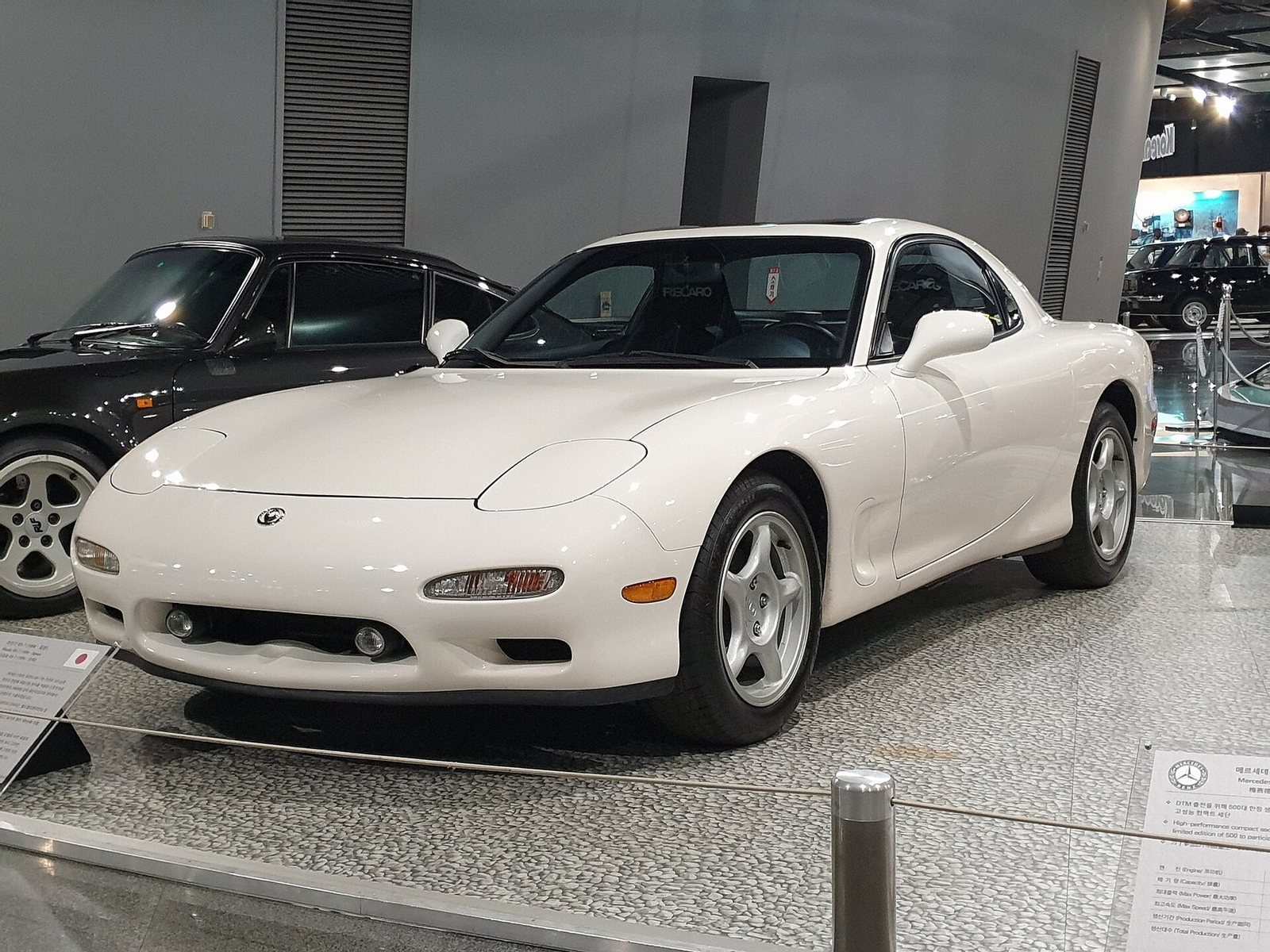
Mazda RX-7
About This Book
This is a working reference for the third-generation Mazda RX-7, the FD, built in Japan from late 1991 to August 2002 and sold new in North America for only three of those years. It is written for the person who owns one, is about to buy one, or is trying to keep one alive. Its central claim is that the FD's reputation for fragility is half earned and half a maintenance story, and that telling those two halves apart is worth more than anything else in these pages.
1.1 What this book is, and what it is not
It is an owner's reference: what the car is, which version you are looking at, what the factory numbers are, what breaks, how you find it before you pay for it, what it costs to keep, and where the parts come from. It draws on factory documentation where that exists and on the record of rotary specialists and long-term owners where it does not, every claim carrying its source.
It is not a replacement for the, and that record is good and mostly free: the 1993 manual with the 1994 and 1995 supplements, because Mazda documented later changes as supplements rather than reissues, plus a separate 1993 wiring diagram book (source: rotaryheads.com/PDF/3rd_gen/). Anything you are about to torque, wire or reassemble belongs there. Nor is it a valuation guide: prices appear where they change a decision, but the book does not pretend to price your example.
1.2 What the FD actually is
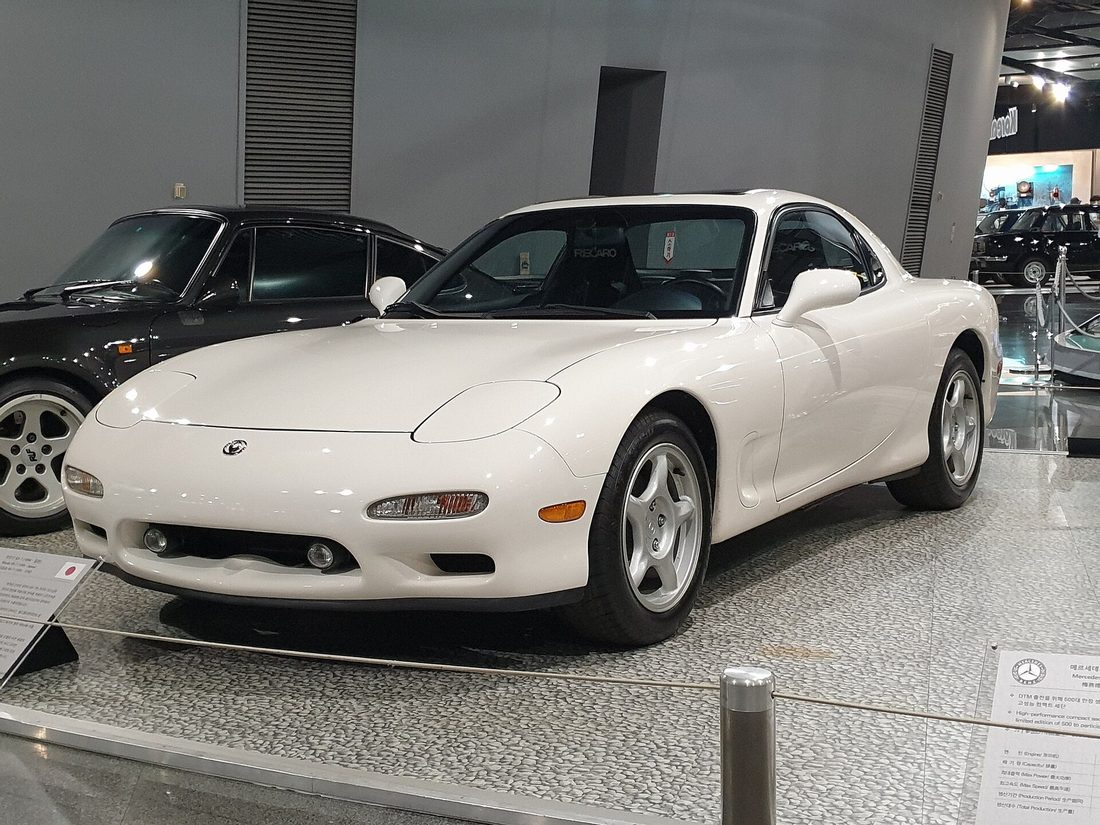
The FD is the last and most complete expression of the production rotary sports car. Under the nose is the 13B-REW, a two-rotor Wankel engine of nominally 1,308 cc, with no pistons, no valves and no camshafts, sealed at the tips of two triangular rotors and lubricated in part by oil injected into its combustion chambers (source: projectjdm.org/blog/rx7-fd-specs). Feeding it is a sequential twin-turbo installation developed with Hitachi, described by Mazda as "the first-ever mass-produced sequential twin-turbocharger system to be exported from Japan" (source: en.wikipedia.org/wiki/Mazda_RX-7): one turbocharger from low rpm, the second brought up to speed and handed the load part way through the range.
The rest of the car was built to keep that engine's advantages. The brief was mass before power, and the result sits between roughly 1,250 and 1,300 kg depending on specification, on double wishbones at the front, a multi-link rear and aluminium suspension arms (source: jdmbuysell.com/learn/mazda/rx-7/fd3s).
Then the two halves of its life diverge, and that fact resolves most of the confusion in FD listings. North America took the car for the 1993, 1994 and 1995 model years only, left-hand drive, roughly 500 cars for the final year, discontinued due to slow sales; Europe took 1,152 official cars before Euro 2 emissions work was judged too expensive (source: en.wikipedia.org/wiki/Mazda_RX-7). Japan kept building and developing it for another seven years, to 26 August 2002, ending with the Spirit R (source: ja.wikipedia.org).
1.3 The series split is the spine of the car's identity
Because of that divergence, "RX-7 FD" is not one car. The English-speaking world counts three series and Japan counts six model types: Series 6 is Types 1 to 3, Series 7 is Type 4, and Series 8 is Types 5 and 6 (source: ja.wikipedia.org).
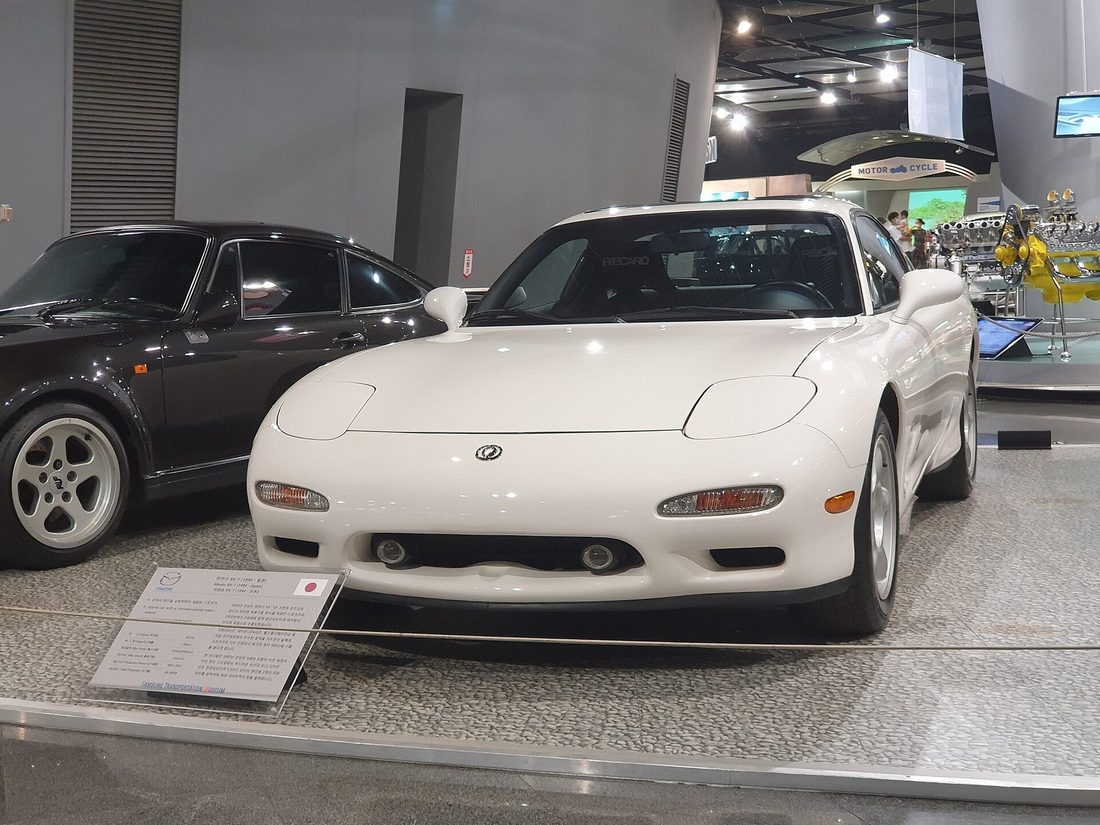
Series 6 is the only series sold new in North America. Series 7 was right-hand drive only. Series 8 was Japan-only in every account consulted (sources: en.wikipedia.org/wiki/Mazda_RX-7; jdmbuysell.com/learn/mazda/rx-7/fd3s/). The differences between them are not trim. Series 7 brought revised, less brittle vacuum routing and a 16-bit ECU worth 10 PS on manual cars; Series 8 changed the turbochargers and intercooler, enlarged the brakes, added EBD on the last cars, and ran a different final drive on some grades (sources: en.wikipedia.org/wiki/Mazda_RX-7; jdmbuysell.com/learn/mazda/rx-7/fd3s). A Series 6 vacuum diagram will not map onto a Series 7 car, and Series 6 advice can be actively wrong on a Series 8 one.
So the series is not a detail to settle later. It is the first thing to settle, before you diagnose, order a part, or accept a number in an advertisement.
1.4 The proposition this book rests on
The FD's reputation is that it eats engines. The honest version is more useful and less romantic.
Two of the car's problems are genuinely designed in: the rotary's finite-life seals and housings, and a cooling package Mazda itself had to revisit under two federal fire recalls inside three years (sources: repairpal.com/mazda/rx-7/recalls; rx7.org/public/3RD.html). Almost everything else on an FD is an ordinary thirty-year-old car problem sitting on top of an engine with no tolerance for neglect. A piston engine that runs hot sacrifices a head gasket. A rotary that runs hot distorts a rotor housing, exposes a coolant seal to combustion pressure, and becomes a rebuild (source: pettitracing.com/pages/the-guide-to-performance-and-longevity).
The consequence is a car with almost no middle ground. A well-maintained 13B-REW is generally expected to run 80,000 to 120,000 miles before apex seal replacement, while a fresh rebuild driven hard and cooled badly can fail in under 20,000 (source: projectjdm.org/blog/engine-13b-rew-deep-dive). A rebuild is $4,000 to $8,000 installed (source: projectjdm.org/blog/mazda-rx7-fd3s-buyers-guide). An FD maintained to a rotary's standard is a reliable car. An FD maintained to a normal car's standard is a rebuild waiting for a date. Separating those two cars, on a forecourt and then in your own garage, is what this book is for.
1.5 The two things that decide a purchase
Two findings outrank everything else, and both belong in a rather than in a hopeful first month of ownership.
The first is compression, measured properly: a rotary-specific tester, or a piston gauge with the Schrader valve removed, because each rotor presents three faces in turn and the test has to show all three pressure pulses rather than holding one peak (source: fd3s.net/compression_test.html). Six readings on a warm engine, with the spread and the pattern read alongside the level. A single figure from a conventional gauge tells you almost nothing about the most value-critical part of the car.
The second is the condition of the cooling system, because on this engine an overheat destroys rather than inconveniences. That is a mechanism, not a caution: heat concentrates in the combustion chamber, the housing distorts, and there is no head gasket to fail first (source: pettitracing.com/pages/the-guide-to-performance-and-longevity).
One thing to carry into a viewing. A coolant seal failure produces coolant symptoms, not necessarily a compression pattern, so a car can pass a compression test and still need the engine out (source: fd3s.net/o-ring_failure.html). Chapter 04 owns the procedure, the numbers and the checklist; this chapter only insists that you do not skip them.
1.6 Who this book is for
Owners and prospective owners of any FD, in any market, at any level of mechanical confidence. But the readership is changing.
The 25-year rule has opened the American market to cars Mazda never sold there. Series 7 cars from 1996 to 1998 have been eligible since 2017, and Series 8 has been arriving in annual instalments, with model year 2001 and earlier eligible in 2026 and the 2002 cars, most of the Spirit R run among them, following in 2027 (source: jdmbuysell.com/learn/mazda/rx-7/fd3s/). Confirm eligibility by build date with a customs broker, not by model year.
Those owners have a specific problem: a right-hand-drive car whose factory documentation does not exist in English. No US owner's manual, no US service manual, a kilometre speedometer, Japanese switchgear, and often no service history a local shop can read (source: rotaryheads.com/PDF/3rd_gen/). Meanwhile the American knowledge base, from independent shops to twenty years of forum threads, was built on Series 6 cars. This book flags the series applicability of what it tells you for exactly that reason.
1.7 How this book is organized
Chapter 02 covers history and identity: development, the two numbering systems, the year-by-year changes, every variant with its dates and disputed counts, market by market, the import wave, the 2026 market, and a sequence for pinning down what a car actually is.
Chapter 03 is the specification reference, broken out by series and market rather than averaged into one column, and it ends with a plain list of what could not be established.
Chapter 04 is known issues: what breaks, how you find it, what it costs. It opens with compression, then the three faults that decide purchases, then the federal safety recalls and factory bulletins, then the rest by system, closing with a pre-purchase inspection checklist and a method for weighing what it turns up.
Chapter 05 is the engine and propulsion: rotary architecture on its own terms, the sequential turbo system and why its hose network is the structural weakness, oil injection and the premix argument, rebuild economics and the driveline. Chapter 06 covers the car's systems and their diagnosis.
Chapter 07 is maintenance: the factory schedule against the specialist schedule, cooling as the primary preventative work, vacuum hoses as scheduled rather than reactive work, compression testing as monitoring, storage, and running costs. Chapter 08 is parts and sourcing, which on this car begins with choosing a rebuilder rather than a parts counter. Chapter 09 covers the community and the wider resources, including the documentation archives the later cars depend on.
1.8 A frank word on sources
Where sources disagree, this book names both figures and says which carries the weight of evidence rather than quietly picking one. That is not fastidiousness. On an FD the disagreements sit on the numbers that cost money.
Four examples set the standard. A circulated owner summary gives the compression minimum as "6.0 kg/cm2, about 85 psi or 690 kPa" (source: rx8ownersclub.co.uk/forum/viewtopic.php?t=78484). Those cannot all be true, because 690 kPa is 7.0 kgf/cm2, and the pairing has to be unpicked because Mazda genuinely revised the minimum between the 1993 and 1994 manuals (source: fd3s.net/compression_test.html). Four chapters of this book had to correct that independently, and it sits on the car's most value-critical number.
Second, "255 hp" and "255 PS" are different claims: 255 PS converts to 252 hp, sources swap the two freely, and no US output figure traceable to a Mazda North America document, with its measurement standard stated, could be found for this book (source: jdmbuysell.com/learn/mazda/rx-7/fd3s/). Third, there is no factory six-speed for any FD, though one buyer guide says otherwise; Mazda's own Series 8 release lists a five-speed manual and a four-speed automatic (source: newsroom.mazda.com/en/publicity/release/1998/9812/981215be.html). Fourth, total production is given as 68,589 and as approximately 53,000, with neither source stating its basis (sources: en.wikipedia.org/wiki/Mazda_RX-7; ja.wikipedia.org).
One limitation belongs stated plainly rather than buried. Every valuation aggregator approached for this book refused access, the Hagerty valuation tool, Bring a Trailer, Classic.com, Cars and Bids and Hemmings among them, so the 2026 pricing here rests on published guide ranges and dated individual results, not on a computed average. Read it as orientation, not appraisal.
1.9 A word on voice
The aim throughout is plain language and no false confidence. Technical terms are marked at their first use in each chapter and collected in the glossary at the back, because a rotary asks a reader to learn a genuinely different vocabulary and there is no sense hiding it. Costs are in 2026 US dollars and given as ranges, because that is how they behave.
Where something is a factory figure, this book says so. Where it is a specialist's practice or an owner's experience, it says that instead, and neither is dressed as the other. Where an answer could not be established, it says so rather than borrowing a figure from an earlier RX-7, which is the habit that matters most on a car whose folklore is louder than its documentation.
History and Identity
The FD RX-7 was built for close to eleven years in three distinct series, and only the first of the three ever reached a North American showroom. Which series sits in front of you decides the output, the vacuum plumbing, the brake sizing, the paperwork and the price, so identifying it correctly is the first job of ownership. This chapter covers the development, the year-by-year changes, every variant with its dates and disputed counts, the import wave reshaping who owns these cars, and a sequence for pinning down what an example actually is.
2.1 Development and design
Mazda announced the third-generation RX-7 on 16 October 1991, began production that month, and opened Japanese sales on 1 December 1991 (sources: en.wikipedia.org/wiki/Mazda_RX-7; ja.wikipedia.org).
The body came out of an internal design competition between four Mazda studios, in Hiroshima, Yokohama, Irvine and Europe. Irvine won. The design was created by Wu-Huang Chin with assistance from Tom Matano, and chief designer Yoichi Sato developed it into production form (source: en.wikipedia.org/wiki/Mazda_RX-7). A second account credits the production body to Sato and reads the shape as function-led, a roofline low for aerodynamics and fenders "swollen to clear wide tires" (source: projectjdm.org/mazda-legends/history-rx7-fd-complete-story), at a drag coefficient of 0.31 (source: ultimatespecs.com/car-specs/Mazda/7613/Mazda-RX-7-FD-Twin-Turbo.html).
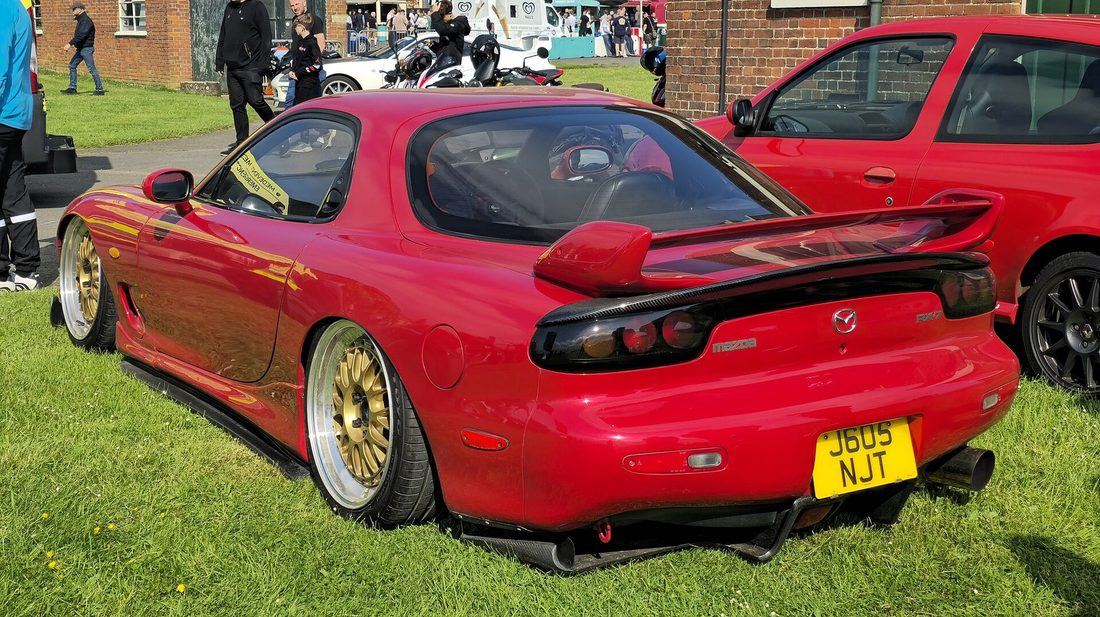
The brief was mass before power. One source names Takao Kijima as FD3S project chief, priorities weight first and power second, and puts the car between 1,230 and 1,310 kg depending on specification (source: projectjdm.org/mazda-legends/history-rx7-fd-complete-story). Treat that attribution carefully: the same page says Kijima "would later lead the NA Miata program", chronologically doubtful given the NA Miata's 1989 launch and uncorroborated elsewhere. The weight range is quoted elsewhere as 1,218 to 1,340 kg (source: en.wikipedia.org/wiki/Mazda_RX-7).
In Japan the car sold through Mazda's Efini channel as the Efini RX-7; when Efini was wound up in October 1997 the badges changed to the corporate logo and the name became simply Mazda RX-7 (source: ja.wikipedia.org). Recognition came fast: Motor Trend Import Car of the Year for 1993 and Car and Driver Ten Best for three years running (source: en.wikipedia.org/wiki/Mazda_RX-7).
Under the nose sat the 13B-REW, a twin-rotor Wankel of nominally 1,308 cc, fed by what Mazda called "the first-ever mass-produced sequential twin-turbocharger system to be exported from Japan" (source: en.wikipedia.org/wiki/Mazda_RX-7). The sequential twin-turbo system has a chapter of its own; what matters to identity is that its control hardware changed between series, and so did the power.
2.2 Two numbering systems
Japan tracks the FD in six model types; the English-speaking world continues the Series numbering that began with the FC. Series 6 covers Types 1 to 3 (December 1991, August 1993, March 1995), Series 7 is Type 4 (January 1996), and Series 8 covers Types 5 and 6 (January 1999, September 2000) (source: ja.wikipedia.org).
Those type dates are the most precise figures available, and the Series boundaries themselves are quoted inconsistently: December 1991 to August 1995, then to January 1999, then to October 2002 in one account (source: projectjdm.org/mazda-legends/history-rx7-fd-complete-story); the rounder 1992-1995, 1996-1998 and 1999-2002 in another (source: jdmbuysell.com/learn/mazda/rx-7/fd3s/); and Wikipedia calls Series 8 a 1998-2002 car in one passage and a 1999-onward car elsewhere (source: en.wikipedia.org/wiki/Mazda_RX-7). This book uses the rounded Western years in headings and the type dates where precision matters.
2.3 Series 6, 1992-1995: the only cars sold in North America
Japanese launch grades were Type S (four-speed automatic optional), Type X (sunroof) and Type R, on 225/50R16 front and rear (source: ja.wikipedia.org). Every North American and European FD is from this series, and all are left-hand drive.
Type 2, August 1993, brought increased body rigidity, larger dampers and revised suspension settings, and renamed the grades: Type S to Touring S, Type X to Touring X (automatic only), plus Type R-2 as a new two-seater. Type 3, March 1995, dropped Touring S, promoted Type RZ and Type R Bathurst to catalogue models, renamed Type R as Type R-S, and changed the rear wing from four-post to a two-post "dolphin" type, a fast tell for a late Series 6 car (source: ja.wikipedia.org).
North America took 1993 to 1995 with trims of Base, Touring, R1 and R2. The R1 of 1993-1994 carried upgraded springs and Bilstein shocks, an extra engine oil cooler, an aero package, faux-suede seats and Pirelli Z-rated tyres, and deleted cruise control; the R2 of 1994-1995 ran slightly softer suspension; the Touring package meant moonroof, fog lights, leather, rear wiper and the Bose Acoustic Wave system (source: en.wikipedia.org/wiki/Mazda_RX-7). A second guide describes R1 and R2 the same way, Bilstein and limited-slip equipped, with no sunroof or leather (source: jdmbuysell.com/learn/mazda/rx-7/fd3s/). These cars also carry three factory safety recalls, 94V-094, 95V-069 and 96V-149, covered in the known-issues chapter and worth confirming on paper (sources: repairpal.com/mazda/rx-7/recalls; auto-recalls.justia.com/mazda/rx-7/1995/96v149000).
2.4 Series 7, 1996-1998: Japan and other right-hand-drive markets
From January 1996 manual cars gained 265 PS through a 16-bit ECU, revised intake piping and increased boost. Meter illumination changed from amber to green, the rear lamps went to the round three-lamp design, the spoiler was redesigned, Type RB and Type RB Bathurst appeared, Type R-S became Type RS, and Type RZ cars of this era gained larger rotors and 17-inch BBS wheels (sources: ja.wikipedia.org; en.wikipedia.org/wiki/Mazda_RX-7).
Series 7 was right-hand drive only, with no official left-hand-drive market. Its practical advantage over Series 6 is the plumbing: Series 7 cars have "revised vacuum routing that is less brittle" (source: jdmbuysell.com/learn/mazda/rx-7/fd3s/). That is also an ordering trap, since a Series 6 vacuum diagram will not map onto a Series 7 car and the 8-bit and 16-bit ECUs run different boost targets (source: jdmbuysell.com/learn/mazda/rx-7/fd3s).
One otherwise useful history page states that Series 7 was "Sold in North America as the 1993-1995 RX-7 Turbo" (source: projectjdm.org/mazda-legends/history-rx7-fd-complete-story). That is wrong: those were Series 6 cars, and the error shows how routinely the series split gets garbled.
2.5 Series 8, 1999-2002: the Japan-only cars
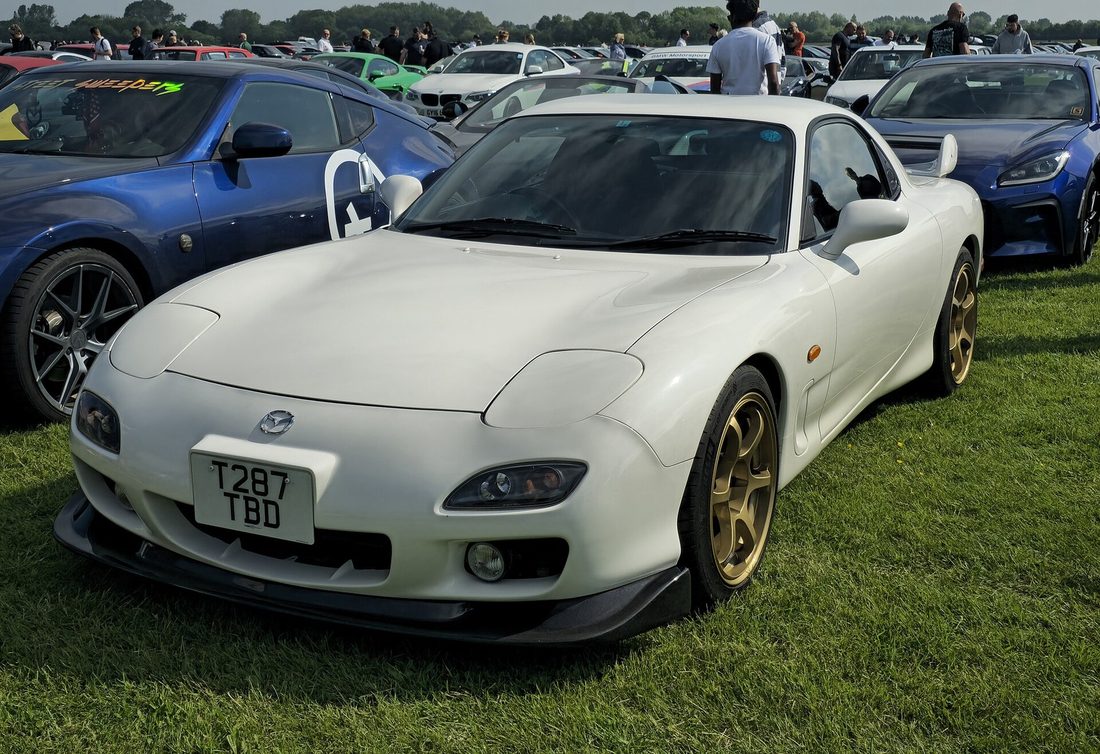
Type 5, January 1999, is the substantial refresh. Output rose to 280 PS on manual Touring and Type R variants with torque to 32 kgf.m, while Type RB stayed at 265 PS and automatics at 255 PS. Body rigidity increased again, suspension and steering geometry changed, the front bumper adopted a five-sided opening with revised lamps, the rear wing gained 14.5-degree adjustability, dual airbags and ABS became standard across all grades, the radiator was enlarged, turbocharger specification changed, the power plant frame was strengthened and the muffler redesigned. Touring X and Type RZ were deleted, and Type RB gained an S package (source: ja.wikipedia.org).
Behind the power increase were more efficient turbochargers with abradable compressor seals, a less restrictive muffler, and better intercooling from the new fascia; brakes went to 314 mm (12.4 in) rotors front and rear, front rotor thickness up from 22 mm to 32 mm (source: en.wikipedia.org/wiki/Mazda_RX-7).
Type 6, September 2000, upgraded ABS control from 8-bit to 16-bit, added EBD, whitened the meter faces and returned illumination to amber, with no engine changes (source: ja.wikipedia.org). Owners add that higher Series 8 grades brought better brakes, model-specific suspension, a 4.3 final drive, twin oil coolers and a front strut brace (source: rx7club.com/3rd-generation-specific-1993-2002-16/series6-series-8-differences-612102/). One contradiction stands: the Japanese record says Type RZ was deleted at Type 5, while Wikipedia lists a 325-unit Type RZ in October 2000 (source: en.wikipedia.org/wiki/Mazda_RX-7). The natural reading is that the RZ returned during Type 6, but no source says so.
Series 8 was Japan-only in every account consulted (sources: en.wikipedia.org/wiki/Mazda_RX-7; jdmbuysell.com/learn/mazda/rx-7/fd3s/). Put plainly: the US market for the FD ended after the 1995 model year, while Japanese production ran on another seven years to 2002. That sentence resolves most of the confusion in FD listings.
2.6 Output, and the 280 PS ceiling
The Japanese-market progression runs 255 PS (188 kW; 252 hp) for Series 6, 265 PS (195 kW; 261 hp) for Series 7 and 280 PS (206 kW; 276 hp) for the top Series 8 grades, with torque rising from 294 N.m (217 lb-ft) to 314 N.m (232 lb-ft) on the Series 8 Type RS (source: en.wikipedia.org/wiki/Mazda_RX-7, corroborated at en.wikipedia.org/wiki/Mazda_Wankel_engine and projectjdm.org/wiki/specs/rx7-fd).
Two qualifications get dropped from most summaries. The Series 7 gain came from simplified vacuum routing, a 16-bit ECU and an improved intake, and applied only to manual cars because the extra power arrived above 7,000 rpm, the automatic's redline; automatics stayed at 255 PS (sources: en.wikipedia.org/wiki/Mazda_RX-7; ja.wikipedia.org). And 280 PS was never universal in Series 8: Mazda's own release gives 280 PS JIS net at 6,500 rpm with 32.0 kg-m for Type RS and Type R, 265 PS for the Type RB manual and 255 PS for the Type RB automatic (source: newsroom.mazda.com/en/publicity/release/1998/9812/981215be.html).
The 280 PS figure is a ceiling, not a coincidence: Japanese manufacturers operated a gentlemen's agreement that no production car would exceed 280 PS (276 hp; 206 kW), and it ended in 2005 (source: en.wikipedia.org/wiki/Gentlemen%27s_agreement). That source gives no start date or rationale, so the commonly repeated 1989 start is not asserted here. The FD sat exactly on the ceiling for its final four years. Other markets differed: European cars 239 PS (176 kW; 236 hp), the Australian RX-7 SP 277 PS (204 kW; 273 hp) (sources: en.wikipedia.org/wiki/Mazda_RX-7; ultimatespecs.com/car-specs/Mazda/7613/Mazda-RX-7-FD-Twin-Turbo.html).
US figures need the most care. One guide states flatly that "US models (1993-1995): 255 hp" (source: jdmbuysell.com/learn/mazda/rx-7/fd3s/), while the JDM Series 6 figure of 255 PS converts to 252 hp. The numbers are close enough that sources swap them freely, and a shared "255" is not evidence the two were rated identically. A community specification sheet also quotes 255 bhp at 6,500 rpm for the US car (source: rx7club.com/3rd-generation-specific-1993-2002-16/rx7-fd3s-specs-all-youll-ever-need-694523), but no figure traceable to a Mazda North America document, with its measurement standard stated, could be found for this book. Check it against a 1993-1995 US brochure or window sticker before quoting it as fact.
2.7 Variants and special editions
Catalogue grades were Type S, Type X, Type R, Type R-2, Touring S, Touring X, Type R-S, Type RS, Type RB, Type RZ and Spirit R in Japan; Base, Touring, R1 and R2 in North America; RX-7 SP and Bathurst R in Australia (source: en.wikipedia.org/wiki/Mazda_RX-7). The limited runs, conflicts stated:
- Type RZ, October 1992: 300 cars, two-seat, stiffened suspension, revised gearing, Recaro carbon-shell buckets, roughly 30 kg lighter (sources: ja.wikipedia.org; en.wikipedia.org/wiki/Mazda_RX-7).
- Type RZ, October 1993: 150 cars, Torsen limited-slip differential, Bilstein dampers, BBS wheels (sources as above).
- Type R-II Bathurst: 350 cars, marking three consecutive Bathurst 12 Hour wins, dated August 1994 by the Japanese record and September 1994 by Wikipedia (sources as above).
- Type R Bathurst: unresolved on count and date. Wikipedia gives 777 cars in July 1995; the Japanese record gives 500 units in December 1995, and puts a separate Type R Bathurst X in July 1995 (sources as above). Both cannot be right, and neither is better supported.
- Type RB Bathurst, January 1997: 700 units per Wikipedia, while the Japanese record describes a Type RB Bathurst X of that date (sources as above).
- RS-R, October 1997: 500 cars, Bilstein suspension and 17-inch wheels, in yellow and black special colours (sources as above).
- Type RZ, October 2000: 325 units (source: en.wikipedia.org/wiki/Mazda_RX-7).
- Type R Bathurst R, August 2001: 650 cars per Wikipedia against 500 per the Japanese record, with Showa adjustable dampers (sources as above).
- Type R Bathurst, December 2001: added as a catalogue special edition (source: ja.wikipedia.org).
The run ended with the Spirit R of April 2002 in three configurations: Type A, two-seat, five-speed manual with Recaro buckets; Type B, four-seat, five-speed manual; Type C, four-seat, four-speed automatic. All three had BBS 17-inch wheels, red calipers, cross-drilled rotors and exclusive interior panels, at 3,998,000 yen for Types A and B and 3,398,000 yen for Type C, with Titanium Grey on 719 cars (sources: ja.wikipedia.org; en.wikipedia.org/wiki/Mazda_RX-7).
Spirit R production is counted three ways. Wikipedia gives 1,504 total, split 1,044 Type A, 420 Type B and 40 Type C (source: en.wikipedia.org/wiki/Mazda_RX-7); the Japanese record gives 1,500 total across the three (source: ja.wikipedia.org); and one guide tabulates Type A 1,504, Type B 700 and Type C 500 while also claiming a 1,500 total, which is internally inconsistent and should not be used (source: jdmbuysell.com/learn/mazda/rx-7/fd3s/). A fourth source says only that Type A ran to 1,500 built (source: projectjdm.org/mazda-legends/history-rx7-fd-complete-story). The 1,044/420/40 split is the only internally coherent breakdown and is the best figure to work from, but the sources plainly disagree and no Mazda document settling them could be found. The same guide credits the Spirit R Type A with a six-speed manual; every other source, Mazda's own release included, lists only a five-speed manual and a four-speed automatic for any FD, so that is an error (source: newsroom.mazda.com/en/publicity/release/1998/9812/981215be.html).
Australia's RX-7 SP of 1995 ran to 25 cars with a further 10 for homologation, rated 277 PS with carbon-fibre upgrades (source: en.wikipedia.org/wiki/Mazda_RX-7). SP detail beyond count and output could not be retrieved: the club page carrying it returned a 404.
2.8 Market by market
Japan built the FD from December 1991 to 26 August 2002, sales continuing to April 2003; the last car built was a Spirit R Type A in Titanium Gray Metallic, kept by Mazda as a commemorative display vehicle (source: ja.wikipedia.org).
North America took 1993 to 1995, Series 6, left-hand drive, in the United States and Canada, with approximately 500 cars for the final 1995 model year before the car was discontinued due to slow sales (source: en.wikipedia.org/wiki/Mazda_RX-7). The 1993 base car launched around 32,500 dollars with loaded Touring examples near 36,000 (source: jdmbuysell.com/learn/mazda/rx-7/fd3s/). Full-year US sales for 1993 to 1995 could not be established: both sales databases approached returned no model-level data.
Europe took the 239 PS car and only 1,152 examples through the official network, led by Germany with 446, the United Kingdom with 210 and Greece with 168, and sales in most of Europe ended after 1995 because re-engineering for Euro 2 emissions would have cost too much. By 1998, helped by the new SVA scheme, more parallel and grey imports had come into Britain than Mazda UK ever imported (source: en.wikipedia.org/wiki/Mazda_RX-7), so the UK population is mostly Japanese-market cars, not the 210 official ones.
Australia and New Zealand received the 1995 RX-7 SP and Series 7 cars (source: en.wikipedia.org/wiki/Mazda_RX-7), and one guide reports an FD3S-E chassis-code suffix for Australian delivery, a single-source claim (source: jdmbuysell.com/learn/mazda/rx-7/fd3s/). End-of-sales dates for both are unestablished.
2.9 Total production, and the number that will not settle
Total third-generation production is given as 68,589, corroborated for 1991 to August 2002 by a second publisher (sources: en.wikipedia.org/wiki/Mazda_RX-7; projectjdm.org/mazda-legends/history-rx7-fd-complete-story). The Japanese-language article gives approximately 53,000 (source: ja.wikipedia.org). Neither states its basis. The most plausible reconciliation is that one counts worldwide production and the other Japanese domestic sales, but no source says so, so both figures stand here rather than one being chosen quietly.
Per-series production counts, how many Series 6 against Series 7 against Series 8 cars were built, do not exist in any accessible source; one publisher states outright that it does not provide series counts beyond the Spirit R Type A figure (source: projectjdm.org/mazda-legends/history-rx7-fd-complete-story). Anyone quoting a Series 8 production number should be asked where it came from.
2.10 Imports: the 25-year rule is changing who owns these cars
Series 7 and Series 8 cars, never sold new in the United States, are now arriving legally under the 25-year rule. One guide states that cars of this chassis first became eligible in 2017, that 1996 to 1998 Series 7 cars are legal now, and that Series 8 becomes eligible progressively through 2027, with model year 2001 and earlier eligible in 2026 and the 2002 cars, most of the Spirit R run among them, following in 2027 (source: jdmbuysell.com/learn/mazda/rx-7/fd3s/). The same publisher's generation overview instead says the FD3S is eligible from model year 1997 onward, contradicting the 2017 date on its own detail page (source: jdmbuysell.com/learn/mazda/rx-7/). The NHTSA page setting out how the 25 years is measured returned a 403 during research, so the month-of-manufacture mechanic importers work to is not asserted here. What can be said safely: as of August 2026 the great majority of Series 7 and 8 cars are eligible, while the December 2001 Type R Bathurst and the April to August 2002 Spirit R sit at or just beyond the boundary. Confirm eligibility by build date with a customs broker, not by model year.
The consequence for this book's readership is direct. A first-time FD owner in 2026 is now quite likely to have a right-hand-drive Series 7 or 8 car with no factory documentation in English: no US owner's manual, no US service manual, a kilometre speedometer, Japanese switchgear, and often no service history a US shop can read. English factory documentation covers Series 6 well, principally the 1993 service manual with the 1994 and 1995 supplements, since Mazda documented later changes as supplements rather than reissues (source: rotaryheads.com/PDF/3rd_gen/). For Series 7 and 8 there is no equivalent at all, which is why the UK and Japanese forums carry disproportionate value on those cars. The American knowledge base was built on Series 6, and the Series 8 differences above, turbochargers, brake sizing, EBD, vacuum routing, the 4.3 final drive, gauge packs, mean Series 6 advice can be actively wrong on a later car (source: jdmbuysell.com/learn/mazda/rx-7/fd3s).
2.11 The 2026 market
Published ranges vary widely, and the variation is itself the finding. A guide updated 3 April 2026 puts the FD market at 30,000 to 140,000 dollars, with premiums for Spirit R cars, low mileage and rare colours, and modified cars trading below comparable stock examples (source: jdmbuysell.com/learn/mazda/rx-7/fd3s/), while the same publisher's generation overview puts standard examples at 35,000 to 50,000 (source: jdmbuysell.com/learn/mazda/rx-7/).
A second publisher gives 2026 bands of 25,000 to 35,000 dollars for a good Type R, 40,000 to 60,000 for an excellent Type RZ and 70,000 to 100,000 for a low-mileage Spirit R (source: projectjdm.org/wiki/specs/rx7-fd), while its own history page gives 60,000 to 90,000 for a clean Series 8 Type RS with service history and says low-mileage original-paint Spirit R Type A cars have sold for 150,000 to 200,000 at US auctions (source: projectjdm.org/mazda-legends/history-rx7-fd-complete-story). Two pages from one publisher disagree by a factor of two on the Spirit R, reason enough to treat any single Spirit R number as an asking price rather than a value.
Dated public results give firmer ground. The Bring a Trailer record is a 1994 R2 five-speed at 148,000 dollars on 9 June 2023 (source: theautopian.com/this-might-be-the-most-expensive-mazda-rx-7-sold-on-bring-a-trailer/), against a modified 123,000-mile car at 39,000 on 14 July 2026 (source: aol.com/1994-mazda-rx-7-bring-202400797.html). Published commentary puts the FD's excellent-condition value up 363.4 percent on ten years ago, the best cars around 34,500 dollars, and running cars of varying quality from 7,500 to about 20,000 (source: hagerty.com/media/market-trends/hagerty-insider/the-1993-95-mazda-fd-rx-7-is-a-fully-matured-modern-collector-car/).
One caveat belongs with all of it: no aggregated auction average could be captured for this book, because every valuation aggregator approached, the Hagerty valuation tool, Bring a Trailer, Classic.com, Cars and Bids and Hemmings among them, refused automated access, so the pricing here rests on published guide ranges and individually dated results rather than a computed average.
What sets the floor under every transaction is the rebuild, 6,000 to 12,000 dollars depending on parts specification (source: jdmbuysell.com/learn/mazda/rx-7/fd3s/). The value drivers are consistent across sources: series, grade, originality, documentation and compression. On this model documentation is worth more than mileage.
2.12 Identifying the car in front of you
Work this sequence in order, and do not skip a step because the seller has already answered it.
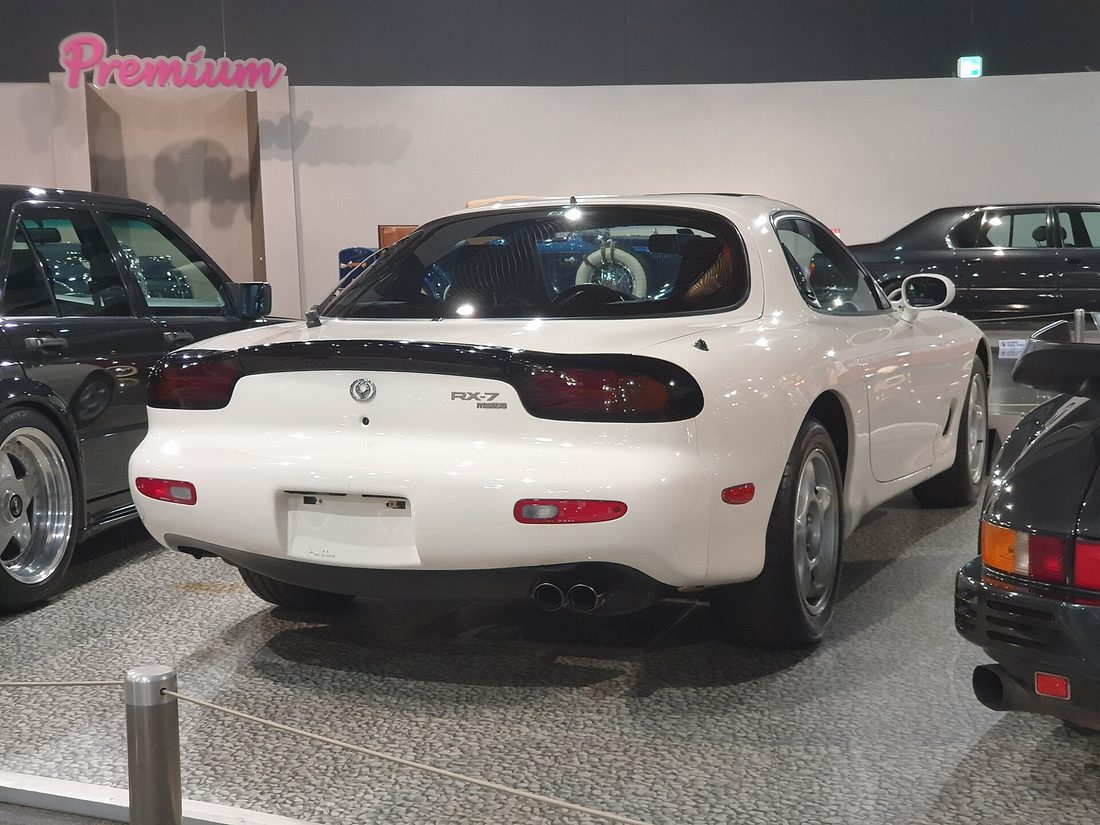
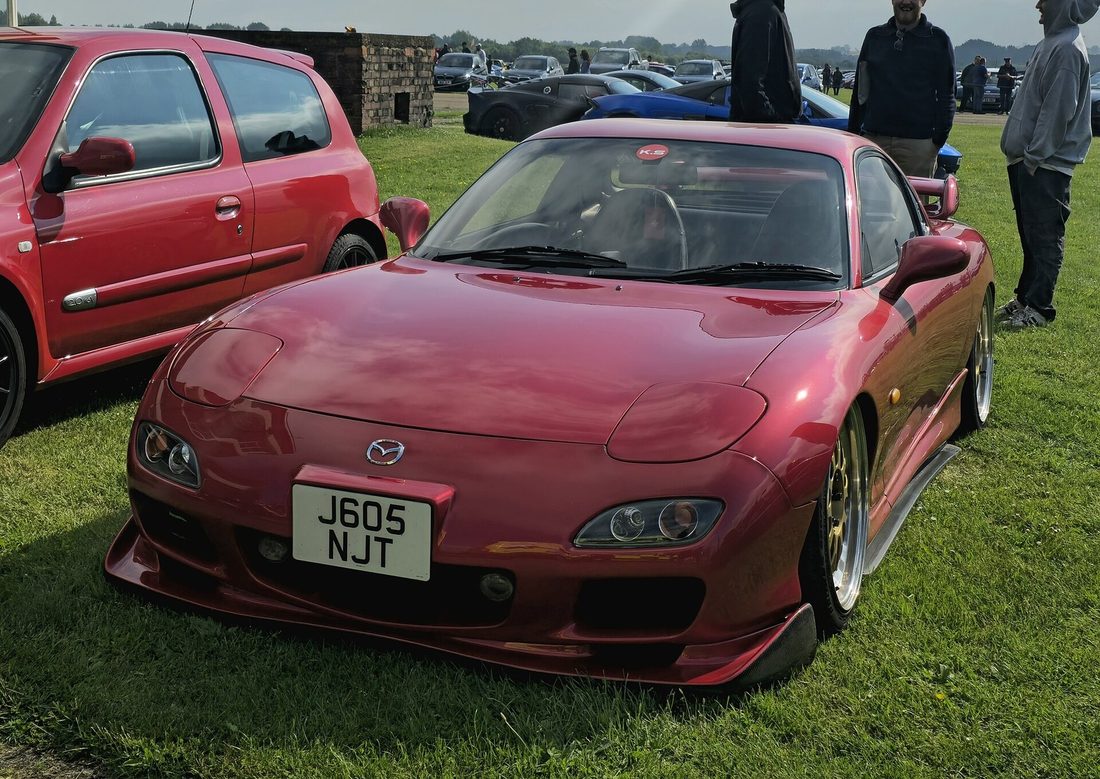
- Series. Take it from build date and the visual tells, not the advertisement. Four-post wing and amber gauges: early Series 6. Two-post dolphin wing: late Series 6. Green illumination and round three-lamp tail lights: Series 7. Five-sided bumper opening, adjustable wing and twin airbags: Series 8, black gauges for Type 5 and white gauges with chrome rings for Type 6.
- Market. Left-hand drive means a Series 6 car for North America or Europe; right-hand drive means Japan or another right-hand-drive market, and a right-hand-drive Series 7 or 8 car is an import by definition. On a US car check for California emissions hardware, and check R12 against R134a air conditioning by build date rather than model year (source: fd3s.net/engine_codes.html).
- Output claim against series and market. 280 PS is credible only on a manual Series 8 Touring or Type R family car. 265 PS means a manual Series 7 or Series 8 Type RB. Any automatic is 255 PS. A European car is 239 PS, an Australian SP 277 PS. A US Series 6 car is quoted at 255, unconfirmed against a Mazda document.
- Transmission. Five-speed manual or four-speed automatic, the automatic on selected trims including Type RB, Touring X and Spirit R Type C. There is no factory six-speed, so a six-speed claim means a mistake or a swap.
- VIN and import paperwork. Confirm the series from VIN and build date and match it to the correct vacuum diagram, ECU and turbochargers before ordering a part. On a US Series 6 car confirm recalls 94V-094, 95V-069 and 96V-149 were completed. On an import, ask for the customs paperwork and check the eligibility date against build date, and check for salvage history.
- Documentation. Ask for a dated warm compression test with all six face readings, oil and coolant records, and clarity on whether the car runs a factory ECU or a standalone tune with air-fuel and boost logs behind it. Establish whether the oil metering system is intact or deleted and whether the car is premixed. A heavily modified FD with no records is the case the guides single out to avoid: an unknown tune plus ageing vacuum lines is how an apex seal lets go (source: jdmbuysell.com/learn/mazda/rx-7/fd3s/).
Three published figures deserve a warning, because they appear in listings and none is settled: wheelbase, 2,425 mm (95.5 in) from two independent sources against 2,446 mm (96.3 in) from Wikipedia; fuel tank capacity, 76 litres (20.1 US gallons) from two sources against 70 litres (18.5 US gallons) from one; and Series 8 Type RS kerb weight, quoted both as 1,280 kg and as 1,270 kg (sources: projectjdm.org/wiki/specs/rx7-fd; ultimatespecs.com/car-specs/Mazda/7613/Mazda-RX-7-FD-Twin-Turbo.html; ja.wikipedia.org; en.wikipedia.org/wiki/Mazda_RX-7). On the first two, 2,425 mm and 76 litres carry the weight of evidence, but the disagreements are real, and a car's own build plate and paperwork outrank any table, this book's included.
Glossary
- 13B-Rew
- The 1.3 litre twin-rotor engine fitted to every FD, with sequential twin turbochargers. Two rotors of 654 cc each, so its displacement is quoted as 1,308 cc even though its output belongs to a much larger piston engine.
- 25-Year Rule
- The United States exemption that lets a vehicle 25 or more years old be imported without meeting the federal standards it was never built to. It is the reason Japanese-market Series 7 and Series 8 cars, which Mazda never sold in America, now arrive there in annual instalments.
- 280 Ps
- The voluntary output ceiling Japanese manufacturers observed until 2004. Japanese-market cars are quoted at 280 PS whatever they actually made, so a JDM figure is a limit rather than a measurement.
- Abs
- Anti-lock braking system, which releases and reapplies brake pressure many times a second to stop a wheel locking. The FD's changed hardware across its run, so the system on a late car is not the system on an early one.
- Air Separator Tank
- The small tank at the top of the cooling system that separates air out of the coolant and lets it collect where it can be purged. A broken or neglected one appears repeatedly in the community record of overheated and destroyed engines, because trapped air in a rotary's cooling system concentrates heat exactly where the housings distort.
- Apex Seal
- The sprung strip at each tip of a rotor, sealing one combustion chamber from the next as the rotor turns. It is the wear item that defines rotary ownership: worn seals cost compression first and the engine second, which is why a compression test matters more here than on any piston engine.
- Apex Seals
- See apex seal: the sprung strips at the tips of each rotor that seal one combustion chamber from the next.
- Bridge Port
- A port modification that joins the intake ports with a bridge of material removed from the rotor housing, raising airflow and power. It costs idle quality, fuel consumption and seal life, so it is a decision about what the car is for rather than a straightforward upgrade.
- Changeover
- The handover from the primary turbocharger to both turbochargers, around 4,500 rpm. Everything that goes wrong with this car's boost behaviour goes wrong here, and the road test for it is specific: a clean, seamless step rather than a sag, a flare or a car that feels like it has one turbo.
- Charge Control Valve
- The valve that admits exhaust gas to the secondary turbine as the changeover begins, so the second turbocharger is already spinning when it is asked to work. A stuck one gives the classic sag at the handover.
- Charge Relief Valve
- The valve that vents charge pressure from the secondary compressor while it is still spooling, so it does not fight the primary. It can be bench-tested: applied vacuum should pop it open crisply, and the owner figure of 7 to 9 inHg brackets the quoted 22.7 to 30.7 kPa specification.
- Check Valve
- A one-way valve that lets pressure or vacuum pass in one direction only. On this car they isolate the vacuum chamber and the pressure tank, so a single tired check valve quietly disables part of the turbo changeover.
- Coolant Seal
- The rubber O-ring sealing the water passage between rotor housing and end plate. When it hardens or the housing distorts, coolant enters the combustion chamber, which is why a rotary can lose coolant with no external leak and no obvious symptom until compression goes.
- Corner Seal
- The small round seal at each corner of a rotor face, working with the apex and side seals to close the combustion chamber. It is replaced as a matter of course in any rebuild.
- Ebd
- Electronic brake force distribution, which varies front-to-rear brake pressure with load and grip instead of leaving it to a fixed proportioning valve. Fitted only to the last cars, so its presence helps date a chassis.
- Eccentric Shaft
- The rotary engine's equivalent of a crankshaft. The rotors orbit its offset lobes, converting their motion into rotation, and its bearings are among the parts a rebuild decision turns on.
- Ecu
- Engine control unit, the computer that runs fuel, ignition and, on this car, the whole sequential turbocharger changeover. Mazda moved from an 8-bit to a 16-bit unit partway through the run, which is worth about 10 PS on a manual car and means diagnostic data does not transfer between series.
- Fd3S
- Mazda's internal chassis code for the third-generation RX-7, 1991 to 2002. Commons files, Japanese parts listings and forum threads all index the car by this code rather than by model year.
- Jis
- Japanese Industrial Standards, the measurement basis behind Japanese-market output figures. A JIS net figure is not directly comparable with an SAE or DIN number, which is part of why this car's power ratings look inconsistent across markets.
- Leading Plug
- The lower of the two spark plugs in each rotor housing, fired first. Each rotor has a leading and a trailing plug, so the engine takes four, and the two positions take different plug specifications.
- Limited-Slip Differential
- A differential that resists a large speed difference between the driven wheels, sending torque to the wheel with grip instead of spinning the unloaded one.
- Oil Metering Pump
- The pump that injects engine oil directly into the combustion chambers to lubricate the apex seals, feeding injectors in the rotor housings. It is the part owners disable when they fit an aftermarket intake or convert to premix, and starving the seals of oil ends in a rebuild.
- Power Plant Frame
- The rigid beam tying the engine and gearbox assembly to the differential, so driveline torque reactions are contained in the structure instead of twisting the chassis. Also written powerplant frame and commonly abbreviated PPF.
- Premix
- Adding two-stroke oil to the fuel tank to supplement the oil metering pump's supply to the seals. Whether it is necessary on a healthy car is one of the long-running arguments in this community, and the book reports both positions rather than settling it.
- Pressure Tank
- A small reservoir that stores boost pressure so the turbo control system has a pressure signal available when it needs one. An engine under boost cannot make vacuum, so the changeover depends on this tank and the vacuum chamber both holding their charge.
- Ps
- Pferdestarke, metric horsepower, the unit Japanese and German figures are quoted in. One PS is very slightly less than one SAE horsepower, so a PS figure always reads a little higher than the same engine's hp figure.
- Pulsation Damper
- The device that damps the pressure spikes made by the fuel injectors opening and closing. It ages, it leaks, and a vendor's own description of the consequence is blunt about underhood fires, which makes it a safety item rather than a maintenance one.
- Rat'S Nest
- The FD's engine bay vacuum and boost control plumbing, a dense network of hoses, solenoids, valves and reservoirs. It is the car's structural weakness: the parts are cheap, the diagnosis is not, and almost every boost complaint starts here.
- Rats Nest
- See rat's nest: the FD's dense vacuum and boost control hose network.
- Restrictor Pill
- A small insert that meters flow in the wastegate and pre-control lines, tuning how fast those actuators respond. They are frequently missing on cars that once ran an electronic boost controller, and their absence changes boost behaviour in ways that look like a failed component.
- Rotary
- An engine in which a triangular rotor orbits inside a housing rather than pistons reciprocating in cylinders. Compact, smooth and light on parts count, and unforgiving of heat, poor oil supply and lost compression.
- Rotor Housing
- The epitrochoidal case the rotor turns inside, carrying the trochoid running surface, the ports and the spark plugs. It is the most expensive consumable in the engine and its condition decides whether a rebuild is economic.
- Sequential Twin-Turbo
- Two turbochargers used one after the other rather than together: a small primary for response low down, then a second brought in around 4,500 rpm for top-end airflow. The result is a wide, flat torque curve delivered by a control system with a great many ways to fail.
- Sequential Twin-Turbocharging
- See sequential twin-turbo: a small primary turbocharger for low-speed response, joined by a second at higher engine speeds.
- Side Seal
- The seal running along each side face of a rotor, working with the apex and corner seals to close the combustion chamber against the end plates.
- Thermoswitch
- The temperature-sensitive switch that brings the cooling fan on. The US-spec car holds a minimum operating temperature of 92 C (197.6 F), and as the switch heat-cycles it needs progressively higher temperatures to act, so running temperatures drift up without anything appearing to break.
- Torsen
- A torque-sensing limited-slip differential using worm gearing rather than clutch packs, so it biases torque to the wheel with grip without needing to slip first.
- Torsen Limited-Slip Differential
- A torque-sensing limited-slip differential using worm gearing rather than clutch packs, biasing torque to the wheel with grip rather than clamping after the fact.
- Trailing Plug
- The upper of the two spark plugs in each rotor housing, fired after the leading plug to complete the burn as the chamber stretches. It takes a different specification from the leading plug, and mixing the two up is a common cause of a rough-running engine after a service.
- Trochoid
- The running surface inside the rotor housing that the apex seals slide against. It is not a chrome coating sprayed onto aluminium: a steel insert is pressed into the trochoid shape, which is why a scored housing is replaced rather than refinished.
- Vacuum Chamber
- A small reservoir that stores manifold vacuum for the turbo control system to draw on. An engine under boost makes no vacuum of its own, so the changeover depends on this chamber holding its charge behind a one-way check valve.
- Wankel
- The rotary engine layout patented by Felix Wankel, in which a triangular rotor orbits inside an epitrochoidal housing instead of pistons reciprocating in cylinders. It is the reason almost nothing about servicing this car transfers from piston-engine experience.
- Wastegate
- The valve that bypasses exhaust gas around a turbine to cap boost pressure. A sticking wastegate either overboosts the engine or strangles it, and on this car its actuator and control lines are part of the same fragile hose network as everything else.