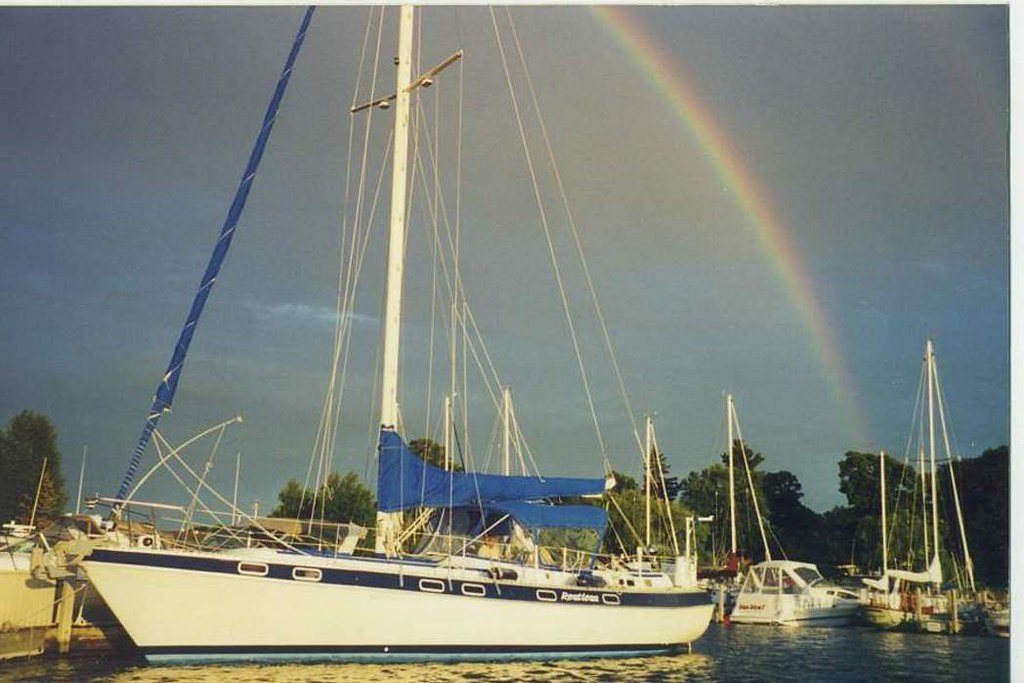
Morgan Out Island 41
About This Book
Welcome aboard. If you own a Morgan Out Island 41, are shopping for one, or have just spent an afternoon on somebody else's and cannot stop thinking about it, this book was written for you. It is a practical owner's reference: a place to look things up, a checklist for the haul-out, a second opinion before you write a check, and a companion for the long list of jobs that comes with any boat built in the 1970s.
Let us be clear about what this book is not. It is not the factory manual. Morgan Yacht Corporation did not send one home with every hull, and the ones that survive are thin. It is not a broker's listing, so you will not find breathless prose about teak-trimmed sunsets. And it is not a substitute for a qualified marine surveyor, a diesel mechanic, or a rigger. It is the book we wish had been sitting in the nav station when we started: honest, specific, and written peer to peer by people who respect the boat without romanticizing it.
1.1 What kind of boat this is
The Out Island 41 is a heavy, beamy, shoal-draft center cockpit cruising ketch that Charley Morgan drew for comfort and volume rather than speed. It draws only about four feet, carries a huge interior for its length, sleeps seven or eight across a tri-cabin layout with two heads, and was built in enormous numbers, well over a thousand hulls from about 1971 into the 1980s. It is the boat that launched the modern Caribbean bareboat charter business, and a large share of the fleet went straight into charter service before landing in private hands. All of that shapes the character you are buying into. This is a stable, forgiving, roomy home on the water that gunkholes into thin anchorages a deeper boat cannot reach, and it is genuinely comfortable in a seaway. It is also under-canvassed and slow to windward, it will make leeway when you ask it to point, and it rewards patience over ambition. Nobody bought an Out Island to win races. People bought them, and still buy them, to live well and cruise far on a modest budget. If you understand and accept that trade, the boat makes a great deal of sense.
1.2 How this book is organized
The book runs in nine chapters, arranged roughly the way you would get to know the boat:
- About This Book (this chapter): what you are holding and how to use it.
- History and Model Guide: Charley Morgan, the yard in St. Petersburg, the charter story, and how to tell the Out Island 41 apart from its many cousins.
- Hull, Deck and Structure: the solid fiberglass layup, the encapsulated shoal keel, and the structural details that decide whether a given hull is sound.
- Rig and Sails: the ketch and sloop rigs, standing and running rigging, and how to get the most out of a modest sail plan.
- Engine and Propulsion: the Perkins 4-108 and its relatives, the tight propeller aperture, access, and the repower question.
- Systems: tankage, plumbing, electrical, and the other services that were often built cheaply and have usually been rebuilt at least once.
- Steering and Underbody: the rudder, the steering gear running back from the center cockpit, and through-hulls.
- Buying and Surveying: what to look for before you own one, written around the fact that no two of these boats are alike.
- Ownership, Upgrades and Resources: living with the boat, sensible improvements, and where to find parts, knowledge, and other owners.
You do not need to read them in order. Each chapter is meant to stand on its own so you can open the book to the job in front of you.
1.3 The one thing to remember
If you take away a single instruction from this entire book, take this one: your boat is not the boat in these pages. These hulls are now forty-five to fifty-plus years old. Many started life as charter boats built deliberately down to a price, then passed through a long line of owners, some meticulous and some not. Two Out Island 41s of the same model year can be genuinely different boats, depending on how they were originally specified and on everything that has happened since. Engines have been swapped. Tanks have been cut out and replaced with smaller ones. Wiring has been added to piecemeal for decades. Decks have been recored, rudders rebuilt, and interiors refitted, sometimes well and sometimes not.
So treat every specification, dimension, and diagram in this book as a starting point, never as gospel for your particular vessel. Before you drill, cut, load, or trust anything, verify it against the actual boat in front of you: measure it, open it up, and look. The original factory figures themselves were inconsistent, and the boats have only diverged further with age. When this book gives a number, it is telling you what is typical, not what is true of your hull. You are the only one who can confirm that.
1.4 How we sourced this
There is no single authoritative service manual for these boats, so this book is built from the best of what exists: the accumulated knowledge of the owner community and its forums, published used-boat reviews and surveyor write-ups, class and builder history, and the hard-won experience of people who have done the work. Where good sources agree, we state the point plainly. Where they disagree, and on a boat this old and this varied they often do, we tell you so rather than pretending to a certainty we do not have. A displacement figure, a tank capacity, an engine horsepower: when the record is muddy, we say the record is muddy and give you the range. That honesty is more useful to you than false precision.
1.5 A word about safety
Boats bite. The Out Island 41 carries several systems that demand respect, and none of them forgive carelessness.
- Diesel fuel and the exhaust system it feeds run hot and can leak; older foamed-in or aging tanks are a known weak point on these boats and deserve real scrutiny.
- Propane, if the galley has been converted to it, is heavier than air and pools in the bilge. It wants a proper locker, a solenoid, and a leak test, not a shortcut.
- Shore power and the AC system on a hull this age are often a patchwork of decades of additions. Corroded, undersized, or ungrounded wiring is both a fire risk and a shock hazard in the water around the boat.
- Through-hulls and seacocks are the difference between a boat that floats and one that does not. Every one of them is a hole in the hull, and on a forty-five-year-old boat many are original.
Throughout the book we flag the jobs where a mistake can hurt you, sink the boat, or both. When you reach one of those, and you are not certain you have the skill and the tools, stop and bring in a professional. There is no shame in it, and it is a great deal cheaper than the alternative.
With that said, turn the page. There is a lot to like about these boats, and a great deal you can do yourself once you know what you are looking at.
History & Identity
If you own a Morgan Out Island 41, or you are thinking about buying one, the single most useful thing you can do is understand what this boat was built to be. It was not built to win races. It was not built to point high or slip through light air. It was built to hold a lot of people in a lot of comfort, to float in shallow water, and to be cheap enough that a charter company could buy a fleet of them. Everything good and everything frustrating about the boat flows from that one decision. Get the identity right and the rest of this manual makes sense.
2.1 Charley Morgan, the man behind the name
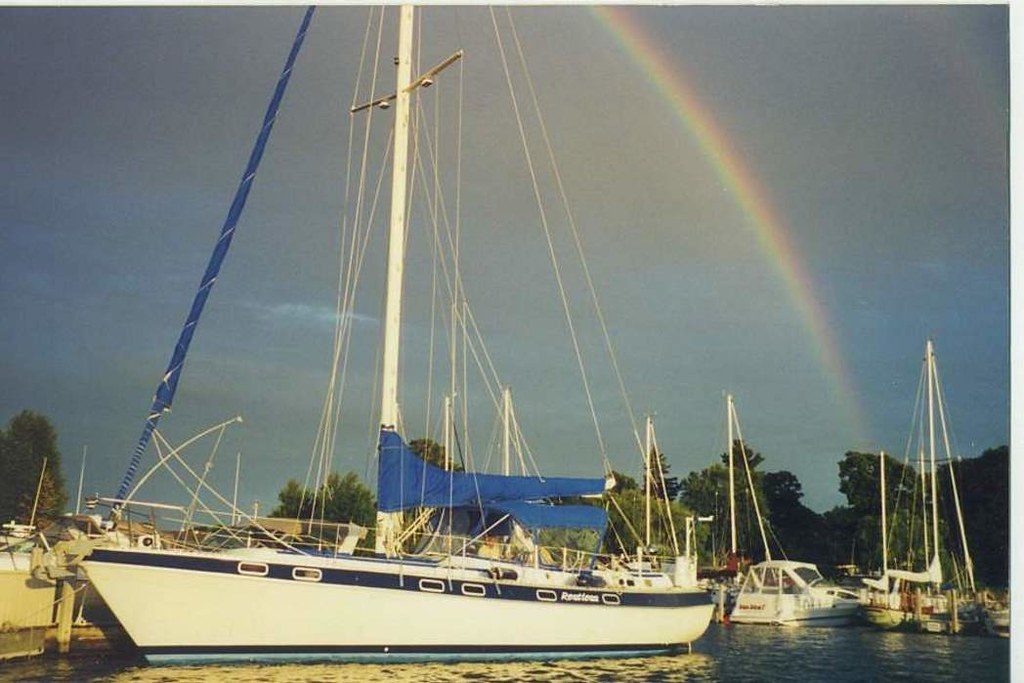
The boat carries the name of Charles E. "Charley" Morgan (1929 to 2023), a Florida sailmaker, designer, and builder who spent his career blurring the line between all three. Morgan studied aeronautical engineering at the University of Tampa, worked briefly for a telephone company, then went to work at Johnson Sails in Tampa. In 1952 he opened his own loft, Morgan Racing Sails, in St. Petersburg, Florida (source: Good Old Boat, "Charley Morgan and the Fiberglass Factory"; Wikipedia, "Charley Morgan").
Sailmaking led naturally to design. Morgan's first boat was the 31-foot-6-inch Brisote, a plywood hull built over a steel backbone. He followed it with the 40-foot yawl Paper Tiger, which won honors at the Southern Ocean Racing Conference (SORC) in 1961 and again in 1962, back to back. That was the result that made his name in the racing world (source: Good Old Boat).
When he could not find a builder willing to produce his 28-foot Tiger Cub, Morgan did what a certain kind of person does: he built it himself. That decision turned Morgan Racing Sails into Morgan Yacht Corporation, a full production boatbuilder in St. Petersburg that would eventually turn out everything from shoal-draft centerboard cruisers to offshore racers. Morgan also built the 12-Metre Heritage, which he skippered in the 1970 America's Cup defender trials. Over his career he is credited with designing more than 50 sail and power boats (source: Wikipedia, "Charley Morgan"; Cruising World, "Morgan's Magic"). He was, in short, a serious racing designer, which makes the boat he is best remembered for a little ironic.
2.2 Corporate history, and why it matters for dating your hull
The ownership chain behind Morgan Yacht matters more than you might expect, because it helps you date and place your particular boat.
Morgan merged his company into Beatrice Foods in 1968 and stayed on as chairman of Morgan Yacht Corporation (source: Good Old Boat). Some secondary sources give the corporation's founding as 1965, so the exact incorporation date is not settled; the 1968 Beatrice merger and the St. Petersburg location are both well attested.
Morgan retired from active operations on June 6, 1972, a date he recalled precisely, having found corporate life a poor fit (source: Good Old Boat). This is the origin of the often-repeated line that "Morgan left Morgan Yachts in 1972." The boats kept his name and his designs after he stepped away.
Ownership then passed down the corporate chain. One account routes it through Thor Industries before landing at Catalina Yachts, which acquired the company in 1984 and continued a redesigned Out Island 41 as the "Morgan Classic 41" into the late 1980s and early 1990s (source: Good Old Boat; Wikipedia, "Morgan Out Island 41"). The sources differ on the intermediate owner: Good Old Boat names Thor Industries in the chain, while the Wikipedia summary compresses it to "Beatrice sold to Catalina in 1984." Both agree that Catalina took over in 1984. For your purposes, the practical takeaway is simple: a 1970s Out Island 41 is a Beatrice-era Morgan-built boat, and a late-1980s Classic is a Catalina-built boat, and the two are not the same design (more on that below).
2.3 The genesis of the Out Island concept
The Out Island 41 is dated to 1970 on paper, with the first hulls launched in 1971 (source: sailboatdata; Wikipedia). The story of how it came to be is worth telling because it explains the whole boat.
In 1970 the International Offshore Rule (IOR) supplanted the older Cruising Club of America (CCA) rule as the dominant racing measurement system. The oft-repeated account is that Morgan, rather than chase the new rule, "conceived this boat in a fit of pique" and aimed it squarely at cruisers and the emerging charter market instead (source: Wave Train, "Morgan Out Island 41: Affordable and Comfortable," 2010; Wikipedia). Whether or not the "fit of pique" framing is literal, the design intent is not in doubt.
In Morgan's own words: "We tried to create a commodious and comfortable tri-cabin arrangement. We designed and aimed it at cruisers as well as the charter-boat market" (quoted in Good Old Boat). The concept was a deliberate trade. Take a big, beamy, shoal-draft hull, fill it with three cabins and two heads, price it aggressively, and accept that it will not sail like a thoroughbred. Reviewers put it more bluntly: the Out Island 41 was "one of the first center-cockpit boats to blatantly discount sailing performance in favor of maximum accommodation space" and "one of the first designs targeted at the emerging bareboat charter industry" (source: Wave Train).
The market answered immediately. The boat competed head to head with Gulfstar and was an instant success. Morgan recalled: "It came out at the Annapolis Boat Show and was an instant sellout. We built, in the first calendar year, over $4 million worth, 120 units" (quoted in Good Old Boat). A marine surveyor cited by Wikipedia first mocked the boat's "pudgy appearance," then conceded it had become "the most popular boat over 40' ever built" (source: Wikipedia).
2.4 Production timeline and hull numbers
The scale of production is central to the Out Island 41's identity, and it is very good news for owners today. At its peak the St. Petersburg plant ran two assembly lines producing roughly one complete boat per day, employing somewhere between 400 and 600 people (source: Wikipedia; Good Old Boat).
Over about 15 years the yard built more than 1,000 base Out Island 41s (source: Good Old Boat). Counting the later 415, 416, and Classic derivatives, the total across the whole family is cited as over 1,450 (source: sailboatdata; Wikipedia). The sources do not agree on exactly what the 1,450 figure covers: some apply it to the base Out Island 41 alone, others to the entire family. The statement this manual uses, and the safe one, is roughly 1,000 base Out Island 41s and about 1,450 across all Out Island 41 variants.
Either way, the point stands. This is one of the best-selling cruising sailboats over 40 feet ever built. That volume means a large active owner community, a deep pool of donor boats for parts, and a used market where you can afford to be picky.
2.5 The charter fleet story, and what it did to these boats
The Out Island 41's real claim to fame is that it more or less founded the modern Caribbean bareboat charter industry.
It was the first type of charter boat commissioned by The Moorings, and roughly 30 to 35 percent of total production went straight into charter service, with some accounts putting it at "nearly half" (source: Wave Train; Wikipedia). The Moorings was founded in the late 1960s by Charlie and Ginny Cary in the British Virgin Islands and grew into the world's largest bareboat charter operation, with the Out Island 41 as its bareboat of choice in the Virgin Islands (source: Moorings Ownership, "Moorings Heritage"; Wave Train). Exact Moorings fleet counts are not documented.
It is easy to see why the boat fit the job. The shoal draft (about 4 feet) let it work reefs and thin anchorages that would ground a deeper boat. The enormous interior volume slept a lot of paying guests in privacy. The forgiving, stiff handling was safe in the hands of novice charterers. And the low build cost made a fleet of them affordable. This is the boat that, in Wikipedia's phrase, "introduced countless sailors to sailing through charter opportunities."
One point of confusion to clear up: Caribbean Sailing Yachts (CSY) was a separate builder and charter operator that produced its own similar boats for the same market. CSY hulls are not Morgans. Do not conflate the two.
The charter connection cuts both ways for a buyer today. On one hand, hard charter use meant deferred maintenance, tired systems, and a lot of hours on tired original diesels. On the other, charter economics meant the boats were often built to a lower spec to save money: lightly tabbed bulkheads, minimal and mediocre deck hardware, undersized fittings held by self-tapping screws, and Formica over non-marine plywood in places (source: SpinSheet, "Morgan Out Island 41 Used Boat Review"; Wave Train). None of this is fatal, and the basic hull is heavily built and sound, but it means an ex-charter Out Island 41 must be inspected hard and judged on its refit history, not its badge. Chapter by chapter, this manual returns to that theme.
2.6 Factory specifications and the boat's shape
The core hull dimensions are consistent across the major sources (source: sailboatdata; sailboat-cruising.com; Wikipedia):
- Length overall: 41 feet 3 inches (12.57 m)
- Waterline length: 34 feet 0 inches (10.36 m)
- Beam: 13 feet 10 inches (4.21 m), which is very wide for the length
- Draft: 4 feet 2 inches (1.27 m), shoal
- Displacement: about 24,000 lb (10,886 kg)
- Ballast: about 10,500 lb of encapsulated lead (4,763 kg)
- Sail area: roughly 775 sq ft (about 72 m2)
- Headroom: about 6 feet 4 inches
- Sleeps: 7 to 8
The hull is hand-laid solid fiberglass with teak trim, riding on a long shoal keel with encapsulated lead ballast. The rudder mounting is one point where the published record does not agree: most sources describe the original Morgan-era boat as carrying a rudder attached to the aft end of the long keel, while some spec listings call it skeg-hung. The model histories tie a true skeg-hung rudder behind a deeper fin keel specifically to the later Catalina-era Classic. Do not settle this from a brochure; confirm the configuration on the actual hull, because it changes both the grounding story and the steering-gear story (see the known-issues chapter).
The displacement and ballast figures do not agree between sources. Sailboatdata and the Wikipedia spec box give 24,000 lb displacement over 10,500 lb ballast. The Good Old Boat saildata sheet for the ketch configuration lists 27,000 lb displacement over 9,000 lb ballast (source: Good Old Boat, "Morgan OI 41 Ketch"). The heavier 27,000 lb figure also matches the later 415 and 416 variants, so it may reflect a heavier or later hull, or the difference between design and loaded displacement. Treat the base boat as roughly 24,000 lb light and up to about 27,000 lb as measured, and verify on your own boat.
Those numbers describe a heavy, stiff, beamy cruiser. Worked through the standard formulas, the boat has a hull speed near 7.8 knots, a displacement-to-length ratio around 272 (rising toward 305 at the heavier weight), a sail-area-to-displacement ratio near 14.8, and a ballast ratio around 44 percent (these are calculations from the sourced dimensions, not published figures). In plain terms: initially stiff and stable, good righting for a shoal boat, and noticeably under-canvassed. Sailboatdata's own characterization is "a heavy sailboat which is under powered." That is the boat, and it is not a flaw so much as the design working as intended.
2.7 Rig and layout variants
The base Out Island 41 was offered as a masthead sloop standard, with an optional ketch rig (source: sailboatdata; sailboat-cruising.com). The ketch is the iconic charter configuration and is very common on the used market, offered from 1972 onward. On the ketch, the mizzen (roughly 122 to 124 sq ft, cut with no roach) takes area aft, so the mainsail is shorter-footed than the sloop's. Total sail area lands near 775 sq ft either way, because the sloop simply carries one larger mainsail and no mizzen (source: Good Old Boat; Wikipedia).
One rig figure to flag: the sources give two different values for the mainsail foot dimension E. The Good Old Boat ketch sheet lists E at about 12 feet, while the Wikipedia sloop spec box lists 17 feet. The shorter foot fits the ketch main; the longer one fits the larger sloop main. Use roughly 12 feet for a ketch and roughly 17 feet for a sloop.
Down below, the signature arrangement is the tri-cabin, center-cockpit layout (source: Wikipedia; Good Old Boat):
- A forward cabin with a double V-berth
- A main saloon with an L-shaped settee and drop-leaf table
- An L-shaped galley, originally a two-burner alcohol stove and an icebox
- A nav station with a second icebox
- A center cockpit with ship's-wheel steering
- An aft cabin, the "owner's cabin," reached by a passageway, with a large double berth
- Two heads with showers, roughly 14 opening ports, teak trim throughout, and about 6 feet 4 inches of headroom
That three-cabin, two-head layout was genuinely revolutionary for privacy in 1971, and it is exactly what made the boat a charter and liveaboard favorite. Tankage was sized for the same mission. The widely cited charter-spec figures are 138 US gallons of fuel and 170 US gallons of water (source: Wikipedia; handwiki.org), though the Good Old Boat sheet lists smaller "60+" fuel and "100+" water figures. Which was the factory-standard default is not documented, and tank sizes very likely varied by year and by charter versus private order. Note both when you assess a specific boat.
2.8 How to identify exactly which boat you have
This is where owners and buyers get tripped up, so slow down here.
The big trap: Out Island 41 versus Morgan 41. There are two entirely different Morgan 41s. The Morgan 41 (also written Morgan 40/41, built roughly 1967 to 1972, about 350 built) is an aft-cockpit centerboard racer-cruiser: much narrower at 11 feet 3 inches of beam, lighter at 19,500 lb, with a long keel plus a jackknife centerboard giving about 4 feet 2 inches of draft board-up and about 9.5 feet board-down, a transom-hung rudder, and originally a gasoline Atomic 4 (30 hp). It actually sails well; reviewers call impeccable balance its hallmark (source: Practical Sailor, "Morgan 41 Used Boat Review"). If you read a "Morgan 41" review praising the boat's sailing manners and quoting an 11-foot-3-inch beam, a 19,500 lb displacement, an Atomic 4, or a 9.5-foot centerboard draft, that review is about the racer-cruiser, not your boat. The two share a length and a builder and almost nothing else.
Distinguishing the Out Island family members. Within the Out Island line itself (source: Wikipedia; sailboatdata):
- Out Island 41 (about 1971 to 1984, roughly 1,000 built): the base boat. Masthead sloop or ketch, long shoal keel, a rudder most listings show attached to the keel (though the sources split, per the note above), about 10,500 lb ballast. PHRF cited around 192.
- Out Island 415 (1975 to 1981, roughly 300 built): a "walk-through" interior update on a heavier hull, listed at 27,000 lb displacement and 9,000 lb ballast. Sloop and ketch.
- Out Island 416 (1981 to 1985): the mast raised roughly 7 feet taller for more sail area and better performance, at 27,000 lb and 9,000 lb, and the variant sometimes rigged as a cutter.
- Out Island 41 Classic / Morgan Classic 41 (roughly 1986 to the early 1990s, about 150 built): the post-Catalina redesign, and a genuinely different boat. It has a fin keel and a skeg-mounted rudder, is lighter at about 23,000 lb over 8,500 lb ballast, and came with Yanmar power. It sails better than the original full-keel boat. Sailboatdata lists it as a separate model.
So the quick field test: a long, shallow full-keel hull, a masthead rig, and a 1970s build year is a base Out Island 41. A "walk-through" interior points to a 415. A noticeably taller rig, or a cutter, points to a 416. A fin keel with a separate skeg-mounted rudder and Yanmar power is a Classic, not one of the original charter boats. The end-of-production date is cited variously as 1984, 1991, and 1993, depending on whether you count the Catalina-era Classic. The safe framing is base Out Island 41 through about 1984, and the family, through the Classic, into the early 1990s.
2.9 Reputation, then and now
The Out Island 41's reputation has been remarkably stable for 50 years, precisely because the boat is honest about what it is.
What people love: space, comfort, and shoal-draft gunkholing. The tri-cabin layout, standing headroom, two heads, and huge tankage make it a superb liveaboard and a forgiving trade-wind cruiser. The heavy, stiff, high-ballast hull tracks well and feels solid, and the solid hand-laid fiberglass has proved durable enough that more than 1,000 are still sailing. Significant structural problems are, in SpinSheet's words, "very rare" (source: SpinSheet).
What people knock: windward performance and light-air speed. The boat is under-canvassed and slow to weather, it makes leeway with that shoal keel, and it is at its worst trying to point in a chop. It is best off the wind, which, again, is exactly the charter use case (source: sailboatdata; Wave Train). The other honest criticism is build quality in places, driven by charter economics: undersized deck hardware fastened with self-tapping screws, thin glass around portlight surrounds, mast-step corrosion, and hull-to-deck joint issues on pre-1975 boats, where the joint sat on the topsides and is prone to separation. From 1975 the joint moved to the sheer edge and is notably better (source: SpinSheet). Owner debates over true bluewater capability continue, and they are opinion rather than settled fact; the fair summary is a comfort-first cruiser that has crossed oceans in patient hands rather than a bluewater performer.
2.10 Where it sits in the used market today
For a buyer, the Out Island 41 occupies a specific and useful niche: it is the affordable path into a big, comfortable, shoal-draft cruising boat that you finish and customize yourself. The brand itself gives you almost nothing, since Morgan-brand OEM parts are effectively orphaned, but the volume built means the boat is well supported in every way that matters. The signature Perkins 4-108 diesel has an outstanding aftermarket, generic marine gear replaces almost every original fitting, and the large owner community fills the knowledge gaps. The one genuinely custom, budget-eating item is the tankage, because the original polyethylene water and holding tanks were fitted before the deck went on and are very difficult to access and replace when they crack with age (source: SpinSheet). That single issue, more than any other, separates a good buy from a money pit, and it is covered in detail later in this manual.
The honest bottom line is the same one the charter companies understood in 1971. This is a lot of comfortable, shoal-draft boat for the money, built simply and heavily, that will never sail fast to weather and was never meant to. Buy it for what it is, inspect the hard-used ones hard, budget for the tanks, and it will reward you.
Glossary
- Anode
- A sacrificial piece of zinc, aluminum, or magnesium bolted to underwater metal that corrodes in place of the propeller, shaft, and other fittings; replaced as it wastes away.
- Backing
- A plate or block behind a deck fitting that spreads the load across the laminate so hardware does not tear out or crush the core.
- Ballast
- Heavy material, usually lead or iron, placed low in the keel to lower the boat's center of gravity and provide the righting force that keeps a sailboat upright and counteracts the heeling force of the wind on the sails.
- Balsa
- End-grain balsa wood used as a lightweight core between fiberglass skins; strong and stiff dry, but it rots if water reaches it.
- Barrier
- A barrier coat, an epoxy layer applied below the waterline to slow water absorption into the hull laminate and guard against blistering.
- Barrier Coat
- A series of epoxy coatings applied below the waterline to seal the hull laminate against water absorption and osmotic blistering.
- Beam
- The width of the boat at its widest point.
- Bladder
- A flexible fuel or water tank that can be folded through a small opening and filled in place, one workaround when a rigid tank cannot be removed.
- Blister
- A fluid-filled bubble in a fiberglass hull's gelcoat or laminate, caused by water permeating the resin (osmosis); widespread blistering can indicate laminate saturation.
- Brightwork
- Varnished or polished exterior wood (and sometimes bright metal) that needs regular upkeep to stay sound and good-looking.
- Bulkhead
- A structural partition across the hull that stiffens it and divides the interior; chainplates often attach to bulkheads.
- Capsize-Screening-Formula
- A rough number from beam and displacement that estimates a hull's resistance to capsize; under 2 is generally considered suitable for offshore work.
- Center Cockpit
- A cockpit set amidships rather than aft, giving an aft cabin below and a long steering-cable or linkage run to the rudder.
- Centerboard
- A retractable fin that pivots or slides down through a slot in the hull to increase lateral resistance and reduce leeway when sailing, and retracts to reduce draft for shallow water or trailering. Distinct from a fixed keel, though some boats combine both.
- Chainplate
- A strong metal strap or fitting bolted to the hull or a structural bulkhead to which the standing rigging (shrouds and stays) attaches, transferring the enormous loads from the mast and rig into the boat's structure.
- Charter
- Commercial rental use; a charter or ex-charter boat has been hired out to many crews and typically shows hard, high-hour wear.
- Comfort-Ratio
- Ted Brewer's index from displacement, length, and beam that estimates motion comfort at sea; higher numbers mean an easier, slower ride.
- Cutless
- A cutless bearing, a water-lubricated rubber-and-brass sleeve that supports the propeller shaft where it exits the hull or strut.
- Cutless Bearing
- A water-lubricated sleeve bearing, with a grooved rubber inner surface, that supports the propeller shaft where it exits the hull; it wears out and must be replaced periodically.
- Cutter
- A single-masted sailboat that sets two headsails at once (a jib and an inner staysail), dividing the foretriangle for easier handling.
- Damper
- A device that absorbs vibration or shock, such as the flexible damper plate between a diesel engine and its transmission.
- Dc
- Direct current, the 12-volt electrical system aboard most boats.
- Deferred
- Deferred maintenance, upkeep that a previous owner or charter operator postponed, leaving tired systems for the next owner to catch up.
- Delamination
- Separation of the bonded layers in a fiberglass laminate or cored panel, often from water intrusion or impact; it shows up as soft spots or a dull sound when tapped.
- Diesel
- A compression-ignition engine burning diesel fuel, safer than gasoline afloat because the fuel does not readily form explosive vapor.
- Encapsulated
- Describing ballast cast inside a molded hollow in the keel and sealed over with fiberglass, so there are no external keel bolts.
- Fiberglass
- Glass-reinforced plastic: glass fibers set in resin, the material of Grand Banks hulls from about 1973 onward.
- Full-Keel
- A long keel running much of the hull length with the rudder hung on its aft edge, favoring tracking and protection over maneuverability.
- Furling
- A system for rolling up a sail, most often around the headstay (roller furling) or inside the mast or boom, to shorten or stow it.
- Gasket
- A compressible seal between two parts that keeps out water or air.
- Gelcoat
- The pigmented resin outer layer of a fiberglass hull or deck that provides a smooth, glossy, waterproof finish and protects the underlying laminate from UV and water. It can craze, chalk, or blister with age.
- Genset
- A marine generator set, an engine-driven alternator that supplies AC power independent of shore power.
- Heat Exchanger
- A component in a freshwater-cooled (indirect) engine cooling system where engine coolant is cooled by raw seawater flowing through a bundle of small tubes, transferring heat without the two fluids mixing, much like an automotive radiator cooled by water instead of air.
- Holding
- A holding tank that stores sewage aboard until it can be legally pumped out or discharged offshore.
- Hull Liner
- A large one-piece molded fiberglass inner shell dropped into the hull that forms furniture, berths, and cabin surfaces in a single part, instead of building them from separate pieces of wood and glass.
- Hydraulic
- Using pressurized fluid to transmit force; hydraulic steering, a common Grand Banks upgrade, replaces cables with fluid lines to a ram at the rudder.
- Impeller
- The flexible rubber, vaned rotor inside a raw-water pump that draws seawater through the engine's cooling system. Its vanes wear and can shear off, so it is a routine maintenance-replacement item; running the pump dry destroys it quickly.
- Inverter
- A device that converts the boat's DC battery power into household AC power for onboard outlets and appliances.
- Keel-Stepped
- A mast that passes through the deck and steps on the keel, as opposed to deck-stepped.
- Ketch
- A two-masted rig with a smaller mizzen mast stepped forward of the rudder post.
- Liner
- A large one-piece molded fiberglass interior pan bonded into the hull that forms furniture, sole, and structure but hides the hull skin behind it.
- Liner Pan
- The molded fiberglass interior structure dropped into the hull as a unit; it stiffens the boat but blocks access to tanks, wiring, and the hull below it.
- Macerator
- A pump that grinds sewage before discharging it from the holding tank.
- Mast Step
- The fitting or structure the base of the mast sits on, on deck over a compression post or on the keel.
- Osmosis
- The process by which water permeates a hull's gelcoat and forms blisters in the laminate.
- Osmotic
- Relating to osmosis, the water-driven process that forms fluid-filled blisters in a gelcoat and laminate over years of immersion.
- Polyethylene
- A tough molded plastic used for water, fuel, and holding tanks; durable but it can crack or craze with age and is hard to repair.
- Propane
- A liquefied petroleum gas (LPG) used for cooking and heating; heavier than air, so leaks sink into the bilge, which is why marine propane systems have strict storage and safety requirements.
- Quadrant
- A fan- or pie-shaped fitting clamped to the top of the rudder post that steering cables or a ram act on to turn the rudder.
- Racor
- A common brand of fuel filter/water separator, so ubiquitous the name is used generically.
- Roller Furling
- A system that rolls a sail around a rotating stay or foil so it can be set or stowed from the cockpit.
- Rudder
- The underwater blade, turned by tiller or wheel, that steers the boat.
- Sail-Area-To-Displacement
- A ratio comparing sail area to boat weight that indicates how easily a hull is driven; low numbers mean an under-canvassed, sluggish light-air performer.
- Seacock
- A robust shutoff valve mounted on a through-hull fitting that allows a below-waterline opening (for cooling water intake, drains, or heads) to be closed, isolating the boat's interior from the sea. Marine seacocks are made of corrosion-resistant bronze or reinforced polymer.
- Shoal
- Shoal draft, a shallow keel configuration that lets a boat float in less water, trading some windward ability for access to thin water.
- Sloop
- A sailboat with a single mast carrying one mainsail and one headsail (jib or genoa). It is the most common modern sailboat rig, valued for simplicity and good upwind performance.
- Stainless Steel
- A chromium alloy steel that resists rust in air but can corrode in the starved-oxygen conditions of a wet, sealed fitting.
- Standing Rigging
- The fixed wires or rods (shrouds and stays) that hold the mast up and in position. Unlike running rigging, it is not routinely adjusted while sailing and is a critical structural system with a finite service life.
- Steering
- The system that turns the rudder, on this boat a long cable or hydraulic run from a center-cockpit pedestal aft to the rudder quadrant.
- Stuffing Box
- The fitting where the propeller shaft exits the hull, packed with greased flax or fitted with a seal to keep the sea out while allowing the shaft to spin; also called a packing gland.
- Swage
- A wire terminal fitting attached by compressing (swaging) a metal sleeve tightly onto the end of a wire rope under high pressure. Swage terminals are common on standing rigging but can develop cracks or crevice corrosion over time.
- Tabbing
- Fiberglass strips that bond a bulkhead or component to the hull; failed tabbing lets structure move.
- Tiller
- A lever attached to the rudder head used to steer, as opposed to a wheel.
- Toe-Rail
- The low rail or raised strip running along the deck edge that gives footing and an anchor point for blocks and jacklines.
- Transmission
- The gearbox behind the engine that provides ahead, neutral, and astern.
- Winch
- A drum-shaped device that gives the crew mechanical purchase to trim a line.
- Windlass
- A deck winch for hauling the anchor chain or rode.
- Yawl
- A two-masted rig with a small mizzen mast stepped aft of the rudder post; a factory option on some Tritons.
- Zinc
- The common name for a sacrificial anode, a block of zinc bolted to underwater metal that corrodes preferentially to protect propellers, shafts, and other metals from galvanic corrosion. (Also the metal leached out during dezincification of brass.)