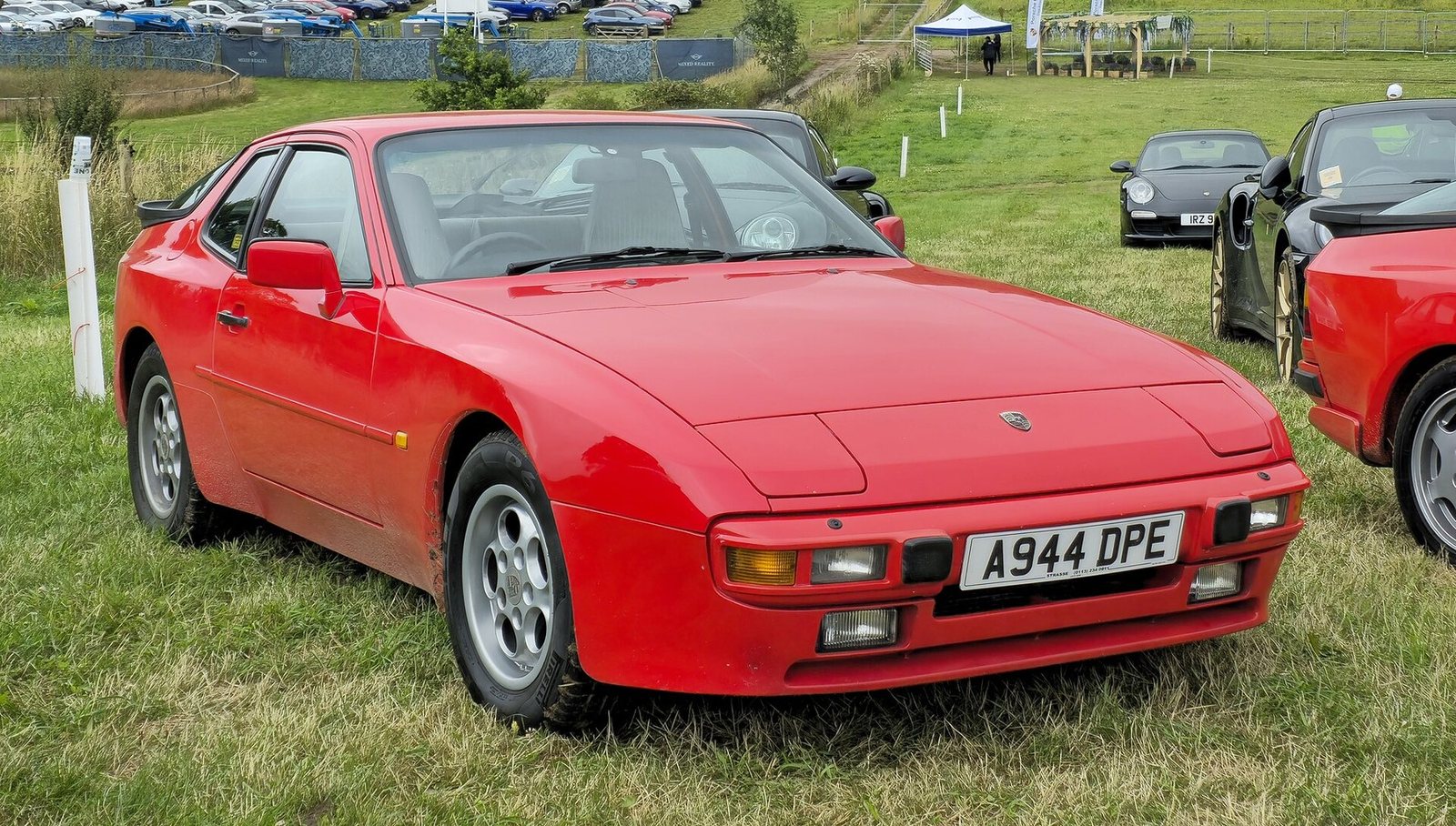
Porsche 944
About This Book
The 944 is the fastest and best engineered Porsche that most people can still afford, and it arrives with one condition attached which decides everything else about owning it. This chapter sets out what the book covers and what it deliberately does not, what a 944 actually is behind a badge that hides at least four different cars, and how a book built from a contradictory published record handles the places where its own sources refuse to agree.
1.1 What this book is, and what it is not
This is an owner's reference for the transaxle-era Porsche 944, the car built at Neckarsulm from 1982 until production ended in July 1991 (source: porsche.com/stories/innovation/everything-about-the-porsche-944; retrooutlaws.com/blogs/porsche944/the-essential-porsche-944-buyers-guide). It covers the whole range: the 2.5 and 2.7 litre eight-valve base cars, the sixteen-valve 944S and 944S2, the Turbo, known internally as the 951, and the 1988 Turbo S, in coupe form throughout and cabriolet form from 1989.
It is written to do four jobs. Help you identify and inspect a car before you buy it. Explain how the major systems work well enough that you can talk to a specialist as an equal. Set out the maintenance programme honestly, including the parts of it that owners skip. And map where the parts and the knowledge live in 2026.
It is not a workshop manual. Torque figures, clearances and procedures appear here as reference and as sanity checks, never as a substitute for the factory Porsche Maintenance and General Repairs Manual for the chassis in front of you. It is not a restoration guide, not a tuning guide, and not a marque history written for its own pleasure.
1.2 What a 944 actually is
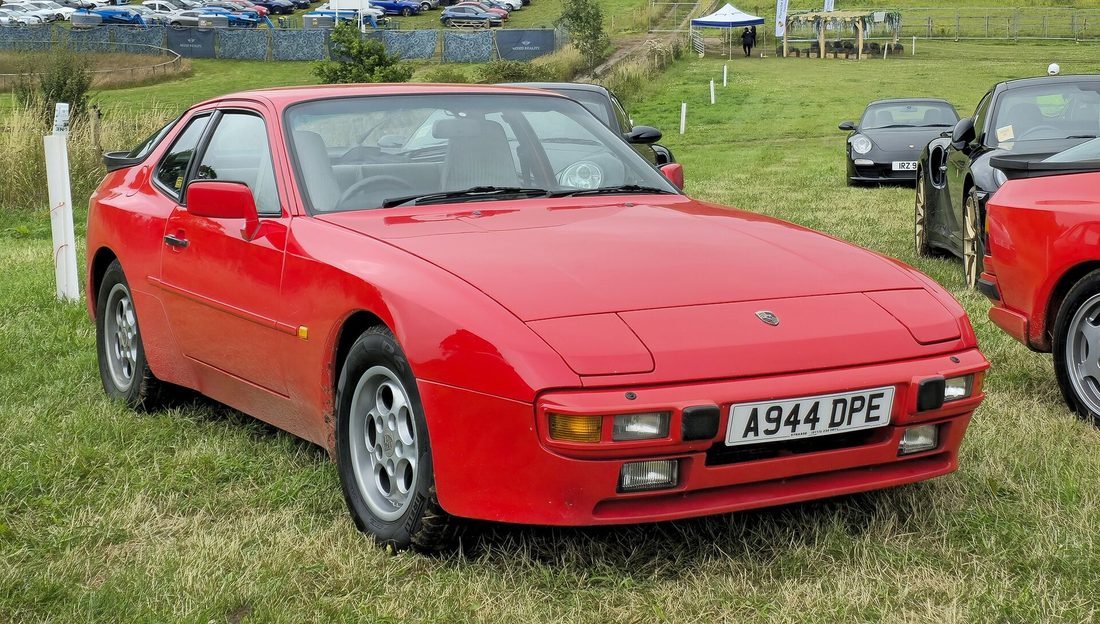
Engine at the front, water-cooled, gearbox at the back, the two tied together by a rigid torque tube. That arrangement, which the factory calls a transaxle layout, made the 944 the third such Porsche after the 924 and the 928 (source: porsche.com/stories/innovation/everything-about-the-porsche-944). It bought a near-even weight split, 50.7 percent front and 49.3 percent rear (source: en.wikipedia.org/wiki/Porsche_944), and it is the reason a 944 still flatters an average driver on a bad road.
It was also Porsche's volume model. Whichever grand total you accept, the 944 was the most successful sports car in the company's history until the Boxster and the 997 Carrera (source: en.wikipedia.org/wiki/Porsche_944; porsche.com/stories/innovation/everything-about-the-porsche-944), peaking in 1984 at 26,539 cars with roughly 60 percent of them going to the United States (source: ateupwithmotor.com/model-histories/porsche-924-944-968-part-2). Bodies and final assembly were at Audi's former NSU plant at Neckarsulm, engines at Porsche's own Zuffenhausen works (source: porsche.com/stories/innovation/everything-about-the-porsche-944).
The important point for a buyer is that one badge covers four distinct engine families, not one engine in four states of tune. The base 2.5 litre eight-valve ran from 1982 to 1989. A 2.7 litre version of it existed for a single model year in 1989, rated at 165 PS (source: en.wikipedia.org/wiki/Porsche_944). The 944S of 1987 and 1988 brought sixteen valves and a head derived from the 928 S4, rated 190 PS DIN (source: en.wikipedia.org/wiki/Porsche_944; ateupwithmotor.com/model-histories/porsche-924-944-968-part-2). The S2 that followed took the same twin-cam design out to 2,990 cc and 211 PS, the largest production four-cylinder engine of its time (source: en.wikipedia.org/wiki/Porsche_944). And the Turbo, launched as range topper in January 1985 (source: porsche.com/stories/innovation/everything-about-the-porsche-944), made 220 PS on a single water-cooled KKK turbocharger, then 250 PS as the 1988 Turbo S, which the factory rated at 162 mph and which was the fastest four-cylinder production car of its period (source: ateupwithmotor.com/model-histories/porsche-924-944-968-part-2; stuttcars.com/porsche-944-turbo-s).
Those cars do not share brakes, suspension, engine management, bodywork or diagnostic procedure. A 1983 base coupe and a 1988 Turbo S share a silhouette, a layout and a philosophy, and remarkably little else. Cutting across the variants is one more line worth learning before you read any further, the mid-1985 revision usually written as 1985.5, which changed the dashboard, the door panels, the fuse and gauge layout, the cooling fan circuit, the alternator and the front and rear control arms (source: en.wikipedia.org/wiki/Porsche_944; clarks-garage.com/shop-manual/repair-procedure-index4.htm).
1.3 The proposition, and the condition attached
Here is the whole argument of this book in one paragraph, because it is the honest sales pitch and the honest warning at the same time.
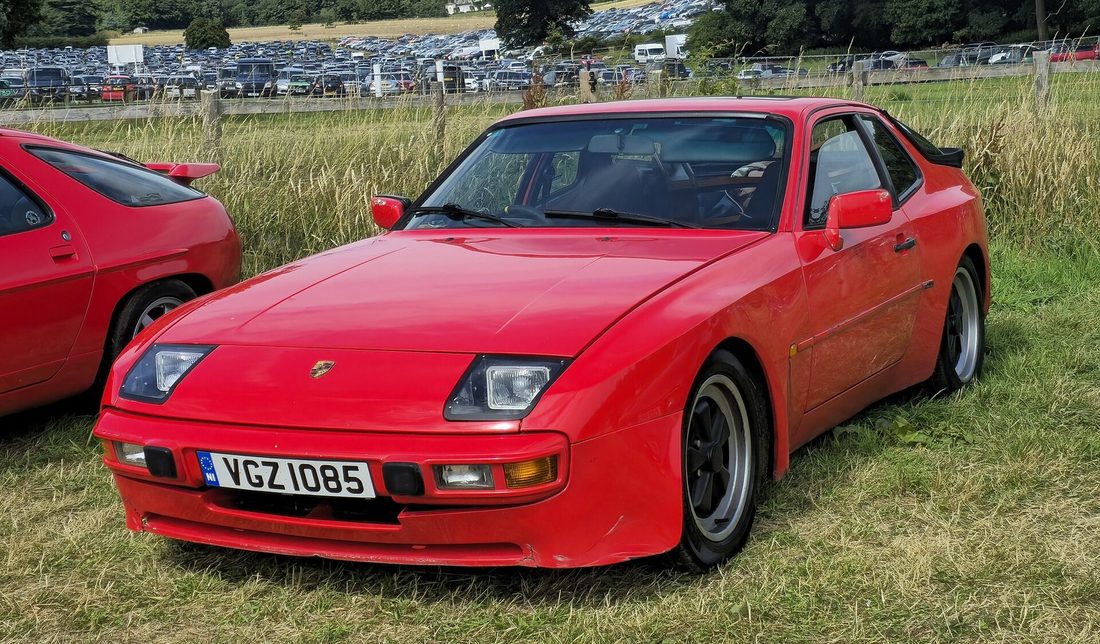
A 944 is a genuinely fast, genuinely well engineered Porsche available for very little money. Base cars still sit among the cheapest fifth to third of collector cars tracked by the auction databases, and sell-through rates across all four variants say the market is liquid rather than speculative (source: theclassicvaluer.com/buyers-guide/porsche/944). That is the pitch. The condition is that every 944 engine is an interference engine: the camshaft is driven by a toothed rubber belt, a second belt drives the pair of counter-rotating balance shafts that cancel the shake of a four this large, and the valves and pistons occupy the same space at the wrong moment. When a belt or a tensioner lets go, the engine does not simply stop. A documented tensioner failure, where the tensioner roller stud sheared flush with the block, bent all four exhaust valves and gouged every piston dish (source: clarks-garage.com/tensioner.htm).
The belt service is therefore not maintenance in the ordinary sense, it is the price of admission. Porsche's own interval moved over the years from 30,000 miles to 45,000, while specialist and club practice layers a time limit on top, typically 30,000 miles plus three to five years, on the reasoning that these cars now cover only three to five thousand miles a year and rubber ages whether you drive it or not (source: pca.org/tech/944-timing-belt-change-interval; atlanticmotorcar.com/casestudies/porsche-944-and-951-timing-belt-service-doing-it-right). Both camps agree on the only sentence a buyer needs: a belt of unknown age is a belt to replace.
So: a cheap 944 with no belt history is not a bargain. It is a deposit on an engine.
1.4 Three things decide a purchase
Everything else on a 944 is negotiable. Three items are not, and each has a chapter behind it. First, documented belt service that names the balance shaft belt, its roller and its tensioner, not just a receipt reading "timing belt", because those parts have historically been left in place and "rarely make it to the next service, resulting in significant engine damage when they fail" (source: atlanticmotorcar.com/casestudies/porsche-944-and-951-balance-shaft-alignment-during-timing-belt-service). Second, the torque tube bearings, four sealed ball bearings in the tube between engine and gearbox, whose dry squeal or grating at idle in neutral is the most commonly missed four-figure fault on the car (source: clarks-garage.com/shop-manual/ts-05.htm). Third, the battery tray, which rusts through when its drain clogs and then lets water drip onto the engine wiring and into the DME case in the passenger footwell (source: clarks-garage.com/shop-manual/body-06.htm).
The mechanism, the sound, the test and the cost of each belong to chapter 4, along with a full pre-purchase inspection checklist. What matters here is that you know the three before you look at a single advertisement.
1.5 Who this book is for
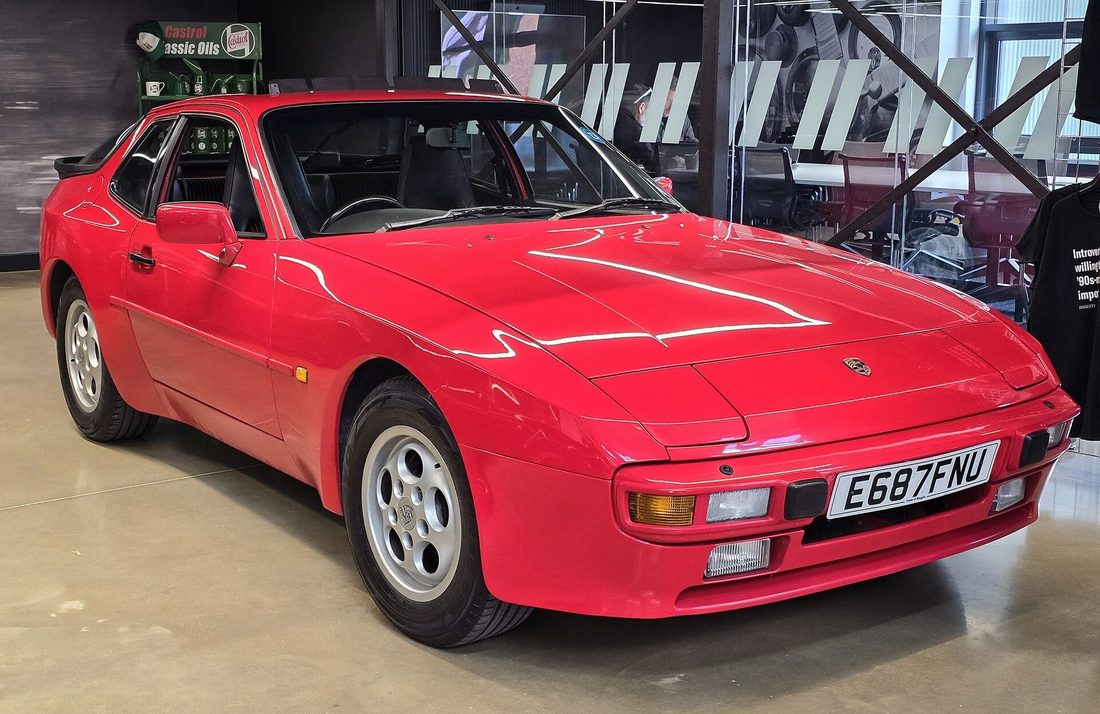
Four readers, in rough order of how often the book will be opened. The buyer working out whether the car in the photographs is a bargain or a project. The new owner who has bought one and wants to understand what is under the bonnet before the first bill arrives. The long-term owner who does some of the work and wants figures, intervals and part sourcing in one place. And the specialist or club member who wants to know where the published record is contested, and why.
It assumes you can read a specification table and follow a torque figure, and nothing else. Where a job is beyond a home workshop, the book says so plainly rather than flattering you.
1.6 A frank word on sources
Every factual claim in this book carries its source inline, in the form (source: domain.com/path). That is unusual in an owner's book and it is deliberate, because the 944's published record is genuinely inconsistent, and a reference that hides its working cannot be checked.
Three examples set the pattern. The grand production total comes four ways: 163,192 is the most widely repeated figure, Porsche's own account says 163,302, one enthusiast production table sums to 173,238 by adding the Turbo S and Turbo Cabriolet as separate lines on top of a Turbo total that already includes them, and one respected history uses approximately 157,000 (source: en.wikipedia.org/wiki/Porsche_944; porsche.com/stories/innovation/everything-about-the-porsche-944; stuttcars.com/porsche-944-production-numbers; ateupwithmotor.com/model-histories/porsche-924-944-968-part-2). The base 944's power output is worse: European cars without a catalyst were rated 163 PS DIN and US cars 143 hp SAE, while printed US specifications give 150 hp for 1983 and 1985.5, 143 bhp for 1986 and 147 bhp for 1987, and a two-step 150 then 160 bhp history elsewhere (source: ateupwithmotor.com/model-histories/porsche-924-944-968-part-2; excellence-mag.com/resources/specs/1; conceptcarz.com/s9948/porsche-944.aspx; stuttcars.com/porsche-944-coupe). No authoritative table reconciles them. And several widely circulated figures turn out to be variant-mismatched at the source: one specification database serves its 944S page under a URL describing a 220 hp turbocharged car, and one Turbo torque figure in print, 178.5 lb-ft, looks like a unit conversion error against a consensus of 243 lb-ft (source: auto-data.net/en/porsche-944-2.5-turbo-220hp-6683; supercars.net/blog/1985-porsche-944-turbo).
This book reports those disagreements rather than smoothing them. Where the sources conflict, both figures appear and the better-supported one is named. Where a figure could not be established, the book says so instead of borrowing one from a neighbouring variant.
Two further warnings about repeated claims that do not survive checking. Bentley Publishers is routinely named as the 944 owner's manual of record, and this book will not assert that such a book exists: the publisher's site refused connections, and an Open Library title search for "Porsche 944" returned no Bentley imprint at all, while confirming a 1987 Haynes manual by Larry Warren (source: openlibrary.org/search.json). And one widely read enthusiast article describes the 944S block as cast iron, when the M44 is all-alloy in every version, a detail that changes how the engine tolerates overheating (source: holtmotorsports.com/posts/the-1987-1988-porsche-944s). Neither error is malicious. Both are the reason this book cites as it goes.
1.7 A word on voice
You will find no enthusiasm here that the car has not earned, and no discouragement it does not deserve. The 944 is a fine machine with a small number of expensive habits, all of them known, most of them documented, and none of them mysterious. Where the news is good, this book says so. Where a fault will cost more than the car is worth, it says that too, in the same tone.
The rest of the book follows the shape of ownership. Chapter 2 covers history and identity, including how to work out what the car in front of you actually is. Chapter 3 gathers the specifications and names the numbers the sources fight over. Chapter 4 is the known issues survey and the pre-purchase inspection. Chapter 5 covers the engine and the transaxle driveline in depth. Chapter 6 works through the electrical, fuel, cooling, brake and body systems and how to diagnose them. Chapter 7 sets out the maintenance programme. Chapter 8 maps parts and sourcing as of 2026. Chapter 9 closes with the community, the clubs and the reference material, including Clark's Garage, a donation-funded technical archive frozen somewhere between 1998 and 2004 that remains the first link a 944 owner is handed, and remains correct, because the car stopped changing in 1991 (source: clarks-garage.com/shop-manual/index.pdf).
History and Identity
The 944 was the third and most successful of Porsche's front-engine, rear-transaxle cars, built at Neckarsulm from 1982 to July 1991 in something close to 163,000 examples. It arrived to fix the 924's credibility problem with an engine Porsche actually designed, and it left as the 968 when a 1990 attempt at a 944 S3 turned into a different car. Almost every headline number attached to it, output, production total, overall length and kerb weight, is quoted differently by different reputable sources, so this chapter reports the spread rather than pretending to a single figure.
2.1 A layout Porsche did not invent
The 944 was the third Porsche to put its engine at the front and its gearbox at the back, the arrangement the factory calls a transaxle layout, following the 924 and the 928 (source: porsche.com/stories/innovation/everything-about-the-porsche-944). The layout did not begin as a Porsche idea. The 924 started as Project EA425, a joint Volkswagen and Porsche programme intended as VW's flagship sports car. VW shelved it after the 1973 oil crisis, then abandoned it in favour of the Golf-based Scirocco, and Porsche bought the design back to replace the ageing 914 (source: en.wikipedia.org/wiki/Porsche_924).
The rear-mounted gearbox paid for itself in balance: 48/52 front to rear in the 924, a slight rear bias that helped traction and brake balance (source: en.wikipedia.org/wiki/Porsche_924), refined in the 944 to a near-even 50.7 percent front and 49.3 percent rear, engine and gearbox tied together by a rigid torque tube (source: en.wikipedia.org/wiki/Porsche_944; porsche.com/stories/innovation/porsche-transaxle-models).
The 924's problem was never its chassis, it was its parts bin. Off-the-shelf Volkswagen components, above all an engine borrowed from VW's LT31 van, destroyed the car's credibility with enthusiasts (source: ateupwithmotor.com/model-histories/porsche-924-944-968-part-2). The bridge to the 944 was the 1980-81 924 Carrera GT, a Group 4 homologation special built in 406 examples including prototypes, 75 of them right-hand drive for the UK (source: en.wikipedia.org/wiki/Porsche_924). Its restyled nose, widened arches and revised suspension became the template for the production 944 (source: ateupwithmotor.com/model-histories/porsche-924-944-968-part-2).
The engine was the point of the whole exercise. Instead of another VW unit, Porsche built a 2,479 cc all-alloy inline four conceptually derived from the 4,664 cc V8 of the contemporary 928, although very few parts actually interchange (source: ateupwithmotor.com/model-histories/porsche-924-944-968-part-2). Twin counter-rotating balance shafts running at twice engine speed cancelled the secondary vibration inherent in a four this large, under a Mitsubishi patent on which Porsche paid a royalty given as 8 dollars per engine (source: ateupwithmotor.com/model-histories/porsche-924-944-968-part-2; topspeed.com/cars/porsche/1982-porsche-944). It ran in public before the road car did, in the 1981 924 GTP Le Mans prototype that finished seventh overall (source: en.wikipedia.org/wiki/Porsche_944). Body panels were zinc-coated and the drag coefficient was 0.35 (source: stuttcars.com/porsche-model-research/porsche-944-research), and Car and Driver named the car Best Handling Production Car in America in 1984 (source: porsche-mania.com/porsche-944).
2.2 Who drew it, and why the answer is not settled
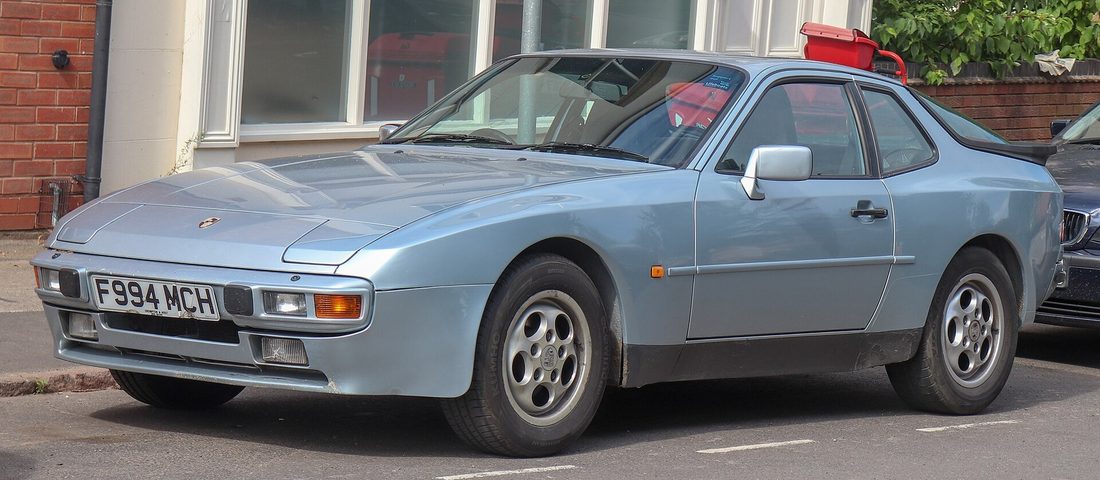
Porsche's own account credits head designer Anatole Lapine with overseeing the 944's design, worked up from a 1979 wide-bodied 924 Carrera GT prototype (source: porsche.com/stories/innovation/everything-about-the-porsche-944). A widely used enthusiast reference credits Harm Lagaay instead (source: stuttcars.com/porsche-model-research/porsche-944-research). Both men worked in the Weissach studio in the period, so the credit is genuinely contested rather than a simple error by one side. The better-supported attribution is Lapine, on the grounds that it comes from the manufacturer, but the disagreement is real and this book does not claim to settle it.
The car was unveiled at the Frankfurt Motor Show in September 1981 and went on sale in 1982, with Peter W. Schutz as president and chief executive. Bodies and final assembly were at Audi's former NSU factory at Neckarsulm, about 50 km north of Stuttgart, through to 1991, while engines came from Porsche's own Zuffenhausen plant (source: porsche.com/stories/innovation/everything-about-the-porsche-944).
Whichever grand total is used, the 944 was the most successful sports car in Porsche's history until the Boxster and the 997 Carrera (source: en.wikipedia.org/wiki/Porsche_944; porsche.com/stories/innovation/everything-about-the-porsche-944). The peak year was 1984 at 26,539 cars, about 60 percent to the United States, and US pricing climbed hard: a base car opened at 18,980 dollars and passed 26,000 by 1987, while the Turbo reached about 30,000 dollars in the US and DM 72,500 in Germany (source: ateupwithmotor.com/model-histories/porsche-924-944-968-part-2).
2.3 The variant ladder
This is where owners and sellers routinely go wrong. There are four distinct engine families here, not one engine in four states of tune.
944, 2.5 SOHC eight-valve, 1982-1989. 2,479 cc, bore 100 mm, stroke 78.9 mm (source: en.wikipedia.org/wiki/Porsche_944; excellence-mag.com/resources/specs/1). Consensus production is 113,070 cars, with base-car US exports given as 56,921 (source: en.wikipedia.org/wiki/Porsche_944; porsche-mania.com/porsche-944). Its output is the single most contested figure in the car's history, treated separately below.
944 2.7, 1989 only. Engine M44/12, bore opened to 104 mm on the original 78.9 mm stroke with a siamesed-cylinder block and larger valves, 165 PS (source: en.wikipedia.org/wiki/Porsche_944), quoted as 162 hp in US trim (source: stuttcars.com/porsche-model-research/porsche-944-research). It lasted one model year, because the S2 with the 3.0 arrived alongside it and then took over (source: en.wikipedia.org/wiki/Porsche_944).
944S, 2.5 DOHC sixteen-valve, 1987-1988. The head was derived from the 928 S4 (source: en.wikipedia.org/wiki/Porsche_944). Output is normally given as 190 PS DIN, 188 hp SAE (source: ateupwithmotor.com/model-histories/porsche-924-944-968-part-2), or 190 bhp at 6,000 rpm with 170 lb-ft at 4,300 rpm on 10.9:1 compression and a 6,800 rpm redline (source: stuttcars.com/porsche-944-s-coupe), a figure a specification database independently supports at 190 hp and 230 Nm at 4,300 rpm (source: auto-data.net). Two sources dissent: one gives 192 PS (source: porsche-mania.com/porsche-944) and another gives 188 hp with only 158 lb-ft (source: holtmotorsports.com/posts/the-1987-1988-porsche-944s). The weight of evidence sits with 190 PS and 170 lb-ft, and readers should know the other pair of figures is in print. The S brought Motronic 2.1 with dual knock sensors to support 10.9:1, magnesium intake tract and valve cover, and stiffer suspension, while keeping the base car's floating single-piston calipers (source: en.wikipedia.org/wiki/Porsche_944; stuttcars.com/porsche-944-s-coupe). Production is given as 12,936 cars including 8,815 US (source: en.wikipedia.org/wiki/Porsche_944) against 12,831 including 8,703 US (source: porsche-mania.com/porsche-944). One database runs the S into 1989 while European S production is elsewhere dated to July 1988 (source: auto-data.net; automobile-catalog.com/car/1988/2684060/porsche_944_s.html).
944S2, 3.0 DOHC sixteen-valve, 1989-1991. Engine M44/41, 2,990 cc, bore 104 mm, stroke 88 mm, 10.9:1, 211 PS (155 kW, 208 hp) at 5,800 rpm and 280 Nm (207 lb-ft) at 4,100 rpm, described as the largest production four-cylinder engine of its time (source: en.wikipedia.org/wiki/Porsche_944; excellence-mag.com/resources/specs/280; auto-data.net). The S2 took the Turbo's rounded nose, integrated front bumper and rear valance, plus Turbo-derived brakes and suspension, and a UK-only S2 SE ran to just 15 cars (source: stuttcars.com/porsche-model-research/porsche-944-research; stuttcars.com/porsche-buyers-guides/porsche-944-buyers-guide). Coupe production is given as 14,071 including 3,650 US (source: en.wikipedia.org/wiki/Porsche_944), but one source lists only 6,439 (source: conceptcarz.com/z19718/porsche-944.aspx), a gap of more than half the model's output that no available source reconciles.
944 S2 Cabriolet, 1989-1991. The first open 944, launched in May 1989. Bodies were converted by ASC (American Sunroof Company) at Weinsberg: coupes came off the Neckarsulm line, were reinforced, cut and fitted with the top mechanism, went back to Neckarsulm for paint and drivetrain, then returned to ASC for trim and top assembly. The build split runs 16 US cars in 1989, 3,938 globally in 1990 of which 1,824 US, and 561 in 1991, for 5,656 total including 2,402 US (source: stuttcars.com/porsche-944-s2-cabriolet; en.wikipedia.org/wiki/Porsche_944).
944 Turbo, internally 951 in left-hand drive and 952 in right-hand drive, 1985-1991. Porsche had a turbocharged version of the new four running before the naturally aspirated car even launched, and used the SCCA's Nelson Ledges 24-hour race in 1983 and 1984 to shake down engine and chassis (source: ateupwithmotor.com/model-histories/porsche-924-944-968-part-2). The Turbo launched as range topper in January 1985, with 178 cars built that first calendar year and none going to North America; the production car properly appeared in late 1985 as a 1986 model, with UK deliveries from November 1985 (source: porsche.com/stories/innovation/everything-about-the-porsche-944; deancent.com/porsche-944-turbo; retrooutlaws.com/blogs/porsche944/the-essential-porsche-944-buyers-guide). Engine M44/51: 2,479 cc, 8.0:1, a single water-cooled KKK K26/6 turbocharger at up to 0.75 bar (10.9 psi), 220 PS DIN or 217 hp SAE at 5,800 to 6,000 rpm (source: ateupwithmotor.com/model-histories/porsche-924-944-968-part-2; deancent.com/porsche-944-turbo). Torque is normally 243 lb-ft (329 to 330 Nm) at 3,500 rpm (source: conceptcarz.com/s9948/porsche-944.aspx; stuttcars.com/porsche-944-turbo-coupe), against a lone 178.5 lb-ft (242 Nm) (source: supercars.net/blog/1985-porsche-944-turbo) that looks like a conversion error but is in print. More than 30 internal engine components were changed against the naturally aspirated unit (source: deancent.com/porsche-944-turbo). The Turbo was the first Porsche production car with ceramic exhaust port liners and forged pistons, the first to make identical output with and without a catalytic converter, and, for 1987, the first production car anywhere with driver and passenger airbags as standard, gaining standard ABS at the same point; brakes were 911-derived Brembo four-piston fixed calipers on 12-inch discs at both ends (source: en.wikipedia.org/wiki/Porsche_944; deancent.com/porsche-944-turbo). Total production is 25,245, of which 13,982 US, 1,511 Canada and 9,752 other markets (source: en.wikipedia.org/wiki/Porsche_944; deancent.com/porsche-944-turbo), against a dissenting 25,107 (source: conceptcarz.com/z19718/porsche-944.aspx).
944 Turbo S, 1988. Engine M44/52 with a larger KKK K26-8 turbine housing and revised mapping: 250 PS, 247 hp SAE, at 6,000 rpm and 258 lb-ft at 4,000 rpm (source: stuttcars.com/porsche-944-turbo-s; deancent.com/porsche-944-turbo). Hardware included a higher-friction clutch with an external cooler, a 40 percent limited-slip differential and a shorter final drive, the M030 chassis package as standard, Brembo front brakes to 928 S4 specification and 16-inch forged magnesium Fuchs Club Sport wheels. Car and Driver recorded 0-60 mph in 5.5 seconds in June 1988 and the factory claimed 162 mph, making it the fastest four-cylinder production car of the period (source: stuttcars.com/porsche-944-turbo-s; en.wikipedia.org/wiki/Porsche_944). Production was planned at 1,000 cars in the LM3Z appearance package (Silver Rose metallic with burgundy plaid Studio cloth), but 1,635 were built, almost half in other colours and trims. From 1989 the S designation disappeared and the uprated engine became standard on all Turbos, though M030 and the Club Sport wheels did not carry over as standard (source: stuttcars.com/porsche-944-turbo-s).
944 Turbo Cabriolet, 1991. Announced at 600 cars and built February to April 1991 at Neckarsulm, with the Turbo S engine at 250 bhp and 258 lb-ft, 0-60 mph in 5.8 seconds, 162 mph and an ASC soft top, none imported to the Americas. The count is 625 built, of which 100 right-hand drive (50 UK and 50 split between Australia, South Africa and Japan) (source: stuttcars.com/porsche-944-turbo-cabriolet; en.wikipedia.org/wiki/Porsche_944). A separate year-by-year Turbo table gives 938 turbocharged cars in 1991 including 251 Cabriolets, which conflicts with 625 and may be a market subset rather than a global figure (source: deancent.com/porsche-944-turbo).
944 Turbo Cup, 1986-1988. 192 factory race cars, 99 to Canada with WP0AAO VIN prefixes and 93 rest-of-world with WP0ZZZ, the last four VIN digits running 1501 to 1700. Output ran 220 PS with the K26/6 and later 250 PS with the K26/8, with a French series from 1987 to 1990 at 290 PS without catalysts, and roughly 272 kg (600 lb) came out of the car (source: stuttcars.com/porsche-944-turbo-cup).
Callaway 944, 1983. Twenty cars, 284 hp via an IHI RHB6 turbocharger on 8.0:1 compression (source: en.wikipedia.org/wiki/Porsche_944).
2.4 The base 944's output is the worst mess in the car's history
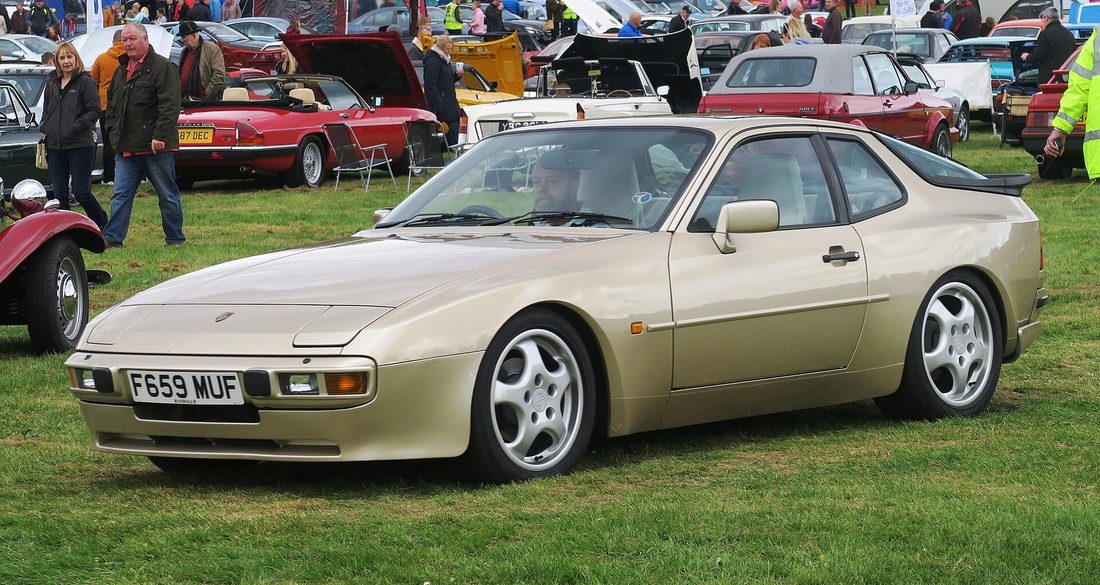
Say it plainly, because a buyer will meet it on the first advertisement they read: nobody agrees what a naturally aspirated eight-valve 944 produced, and no authoritative table reconciles the claims.
The European picture is the cleaner half. A car without a catalytic converter was rated 163 PS DIN (source: ateupwithmotor.com/model-histories/porsche-924-944-968-part-2), with 205 Nm (151 lb-ft) at 3,000 rpm on 10.6:1 compression for 1982-1987 (source: auto-data.net/en/porsche-944-2.5-163hp-6682). European catalyst cars were rated separately at 150 PS and then 160 PS from 1988 (source: auto-data.net/en/porsche-944-model-725).
The US picture is not clean at all. Three sources give three different histories, and their year breakpoints do not line up:
- 143 hp SAE at launch, against Europe's 163 PS (source: ateupwithmotor.com/model-histories/porsche-924-944-968-part-2), with a stepped table of 143 hp for 1982-1985, 147 hp for 1985-1987 and 160 PS (158 hp) for 1988 (source: en.wikipedia.org/wiki/Porsche_944).
- 150 hp at 5,500 rpm with 142 lb-ft at 3,000 rpm on 9.5:1 for both the 1983 and the 1985.5 coupe (source: excellence-mag.com/resources/specs/1 and /4).
- 143 bhp and 137 lb-ft for 1986 but 147 bhp and 140 lb-ft on 9.7:1 for 1987 (source: conceptcarz.com/s9948/porsche-944.aspx; conceptcarz.com/s761/porsche-944.aspx), against a two-step history of 150 bhp with 142 lb-ft for 1982-1987 and then 160 bhp at 5,900 rpm with 155 lb-ft at 4,500 rpm for 1988-1989 (source: stuttcars.com/porsche-944-coupe), the 1988 uplift corroborated at (source: retrooutlaws.com/blogs/porsche944/the-essential-porsche-944-buyers-guide).
The honest summary is a range and a direction of travel: a US eight-valve 944 is somewhere between 143 and 150 hp for most of the 1980s and around 158 to 160 hp for 1988-1989, a European non-catalyst car is 163 PS, and a European catalyst car is 150 PS rising to 160 PS. Anyone quoting a single number for the whole run, including a seller, is quoting one source and not the others.
2.5 The 1985.5 split, and the oval dash
The most useful dividing line in the range has nothing to do with the badge. The pre-revision interior was a carryover from the 924, a square, VW-derived dash (source: rennlist.com/forums/924-931-944-951-968-forum/493001-oval-dash-or-early-model.html), and the same basic dash design ran from the 1977 924 to the mid-1985 944 (source: 924s944.com/2022/03/08/dashboard-fixes-and-replacements). From February 1985 in the UK, and generally described as mid-1985 elsewhere, the car got the oval dash: a completely new instrument panel and door panels, better ventilation and more legroom (source: retrooutlaws.com/blogs/porsche944/the-essential-porsche-944-buyers-guide; stuttcars.com/porsche-944-coupe). Porsche's internal shorthand for the revision is sometimes given as 1985B (source: porsche-mania.com/porsche-944).
It was not a trim change. The same revision brought a windscreen-embedded radio antenna, an alternator upgrade from 90 to 115 amps, a larger oil sump, new front and rear cast alloy control arms in place of stamped steel, a flush-mounted windscreen and a move from cookie cutter to phone dial wheels (source: en.wikipedia.org/wiki/Porsche_944; porsche-mania.com/porsche-944). Fuel capacity grew, listed as 17.4 US gallons for the 1983 coupe against 21.1 US gallons for the 1985.5, and heated power seats became available on North American cars at the same point (source: excellence-mag.com/resources/specs/1 and /4; curbsideclassic.com/curbside-classics-european/curbside-classic-1985-5-porsche-944).
For a buyer the consequences are larger than the aesthetics. The line separates fuse lists, gauge removal procedures, cooling fan circuits and steel versus aluminium control arms, which makes it the single most useful date in 944 ownership (source: clarks-garage.com/shop-manual/repair-procedure-index4.htm). Parts availability runs the opposite way to most people's assumption: square-dash replacements are still obtainable, while a good oval dash is pot luck in the used market or a strip-and-recover job (source: 924s944.com/2022/03/08/dashboard-fixes-and-replacements).
2.6 Market differences
The output gap between markets was structural rather than marketing. Against Europe's 163 PS DIN, US cars ran 143 hp SAE, and European cars claimed under 8 seconds to 60 mph with 137 mph where US cars topped out around 125 mph, the difference attributed to emissions compliance (source: ateupwithmotor.com/model-histories/porsche-924-944-968-part-2). Catalytic converters were fitted for the US from the start, German cars were available without one for the 1983 model year, and rest-of-world cars in markets not requiring a catalyst ran a front muffler and no oxygen sensor (source: pff.de/en/thread/2827911-us-model-catalytic-converter-removal).
Safety equipment ran the other way. The 1987 North American Turbo was the first production car in the world with standard dual airbags, with ABS standard on US Turbos (source: deancent.com/porsche-944-turbo; stuttcars.com/porsche-944-turbo-coupe). Some variants never crossed at all: the Turbo Cabriolet was built for UK and European markets only (source: stuttcars.com/porsche-944-turbo-cabriolet). One documented paperwork quirk is worth knowing before a title search: the first 16 US S2 Cabriolets of 1989 were issued incorrect WP0BA VIN codes, corrected to WP0CB for 1990-1991 (source: en.wikipedia.org/wiki/Porsche_944).
2.7 Numbers that do not add up
Grand total production comes four ways. 163,192 is the most widely repeated (source: en.wikipedia.org/wiki/Porsche_944; stuttcars.com/porsche-model-research/porsche-944-research; porsche-mania.com/porsche-944). Porsche's own account says 163,302 (source: porsche.com/stories/innovation/everything-about-the-porsche-944). A third figure, 173,238, comes from a production-numbers page that adds Turbo S and Turbo Cabriolet as separate lines on top of the 25,245 Turbo total (source: stuttcars.com/porsche-944-production-numbers); both are already inside that Turbo count, so those 1,635 and 625 cars are counted twice and the excess is arithmetic, not history. A fourth source uses approximately 157,000 (source: ateupwithmotor.com/model-histories/porsche-924-944-968-part-2). Use 163,192 or Porsche's 163,302, and treat the 110 cars between them as calendar year against model year.
Annual figures are patchy and one year is badly disputed. 1984 peaked at 26,539; 1986 base-coupe production was 10,901; 1987 totalled 8,346; 1990 was 8,510 with fewer than 2,500 US cars. For 1991 one source gives 830 cars and another says over 4,000 were built and sold, a gap that may reflect calendar against model year but is not resolved by anything available (source: conceptcarz.com/z19718/porsche-944.aspx; en.wikipedia.org/wiki/Porsche_944; ateupwithmotor.com/model-histories/porsche-924-944-968-part-2). Production ended in July 1991 (source: retrooutlaws.com/blogs/porsche944/the-essential-porsche-944-buyers-guide).
Overall length is contested by nose treatment. The narrow-nose base car is given as 4,290 mm (168.90 in) and the Turbo and S2 nose as 4,230 mm (166.5 in) (source: excellence-mag.com/resources/specs/1; excellence-mag.com/resources/specs/280; supercars.net/blog/1985-porsche-944-turbo). A separate table instead gives 4,318 mm for 1986-1988, 4,288 mm for Turbo and S2 and 4,290 mm for 1989-1991 (source: en.wikipedia.org/wiki/Porsche_944). The disagreement is not trivial: the first set has the wide-nose cars shorter than the base car, the second has them longer. Wheelbase, by contrast, is constant across the range at 2,400 mm (94.49 in), with height 1,275 mm (50.2 in) and width 1,735 mm (68.31 in) (source: excellence-mag.com/resources/specs/1; auto-data.net).
Weights spread by roughly 250 lb per variant across five sources, and none of them states whether the figure is kerb weight, dry or DIN. One table gives 1,180 kg (2,601 lb) pre-1988, 1,330 kg (2,932 lb) from 1988, 1,360 kg for the 1986 Turbo and 1,416 kg for 1987-on Turbos (source: en.wikipedia.org/wiki/Porsche_944). Another lists 2,778 lb for the 1983 and 1985.5 coupes and 3,109 lb for the 1990 S2 Cabriolet (source: excellence-mag.com/resources/specs/1, /4, /280). A third gives 1,300 kg kerb for the 944S and 1,465 kg for the S2 Cabriolet, about 120 lb above the previous figure (source: auto-data.net). A fourth gives 2,640 lb base and 2,760 lb turbocharged for 1986-1987 (source: conceptcarz.com/s9948/porsche-944.aspx), and a fifth 1,413 kg (3,115 lb) for the 1986 Turbo (source: supercars.net/blog/1985-porsche-944-turbo). Measurement standard almost certainly explains most of the spread, which is why the standard should be quoted alongside the number and almost never is.
2.8 The 968, and the end
The October 1987 stock market crash did the commercial damage. Worldwide 944 sales, already off their 1986 peak, fell about 20 percent, and management concluded that a rebadged update was needed (source: ateupwithmotor.com/model-histories/porsche-924-944-968-part-2). Engineers began work in early 1990 on a 944 S3 and realised that so many parts were being changed that they had produced an almost entirely new vehicle (source: en.wikipedia.org/wiki/Porsche_944), with 80 percent of the 944's mechanical components significantly modified or completely replaced (source: en.wikipedia.org/wiki/Porsche_968). It launched instead as the 968, with VarioCam variable valve timing, 240 PS (177 kW, 237 hp) at 6,200 rpm and a six-speed manual in place of the 944's five-speed (source: en.wikipedia.org/wiki/Porsche_968).
It did not work. The 968 sold 12,776 cars between 1991 and 1995, against roughly 157,000 944s, because buyers with 40,000 or 50,000 dollars to spend now wanted a rolling status symbol with a proper back seat (source: en.wikipedia.org/wiki/Porsche_968; ateupwithmotor.com/model-histories/porsche-924-944-968-part-2). The 968 and the 928 were both discontinued in 1995, and the mid-engined Boxster of 1996 became the new entry-level strategy (source: en.wikipedia.org/wiki/Porsche_944).
2.9 The 2026 market
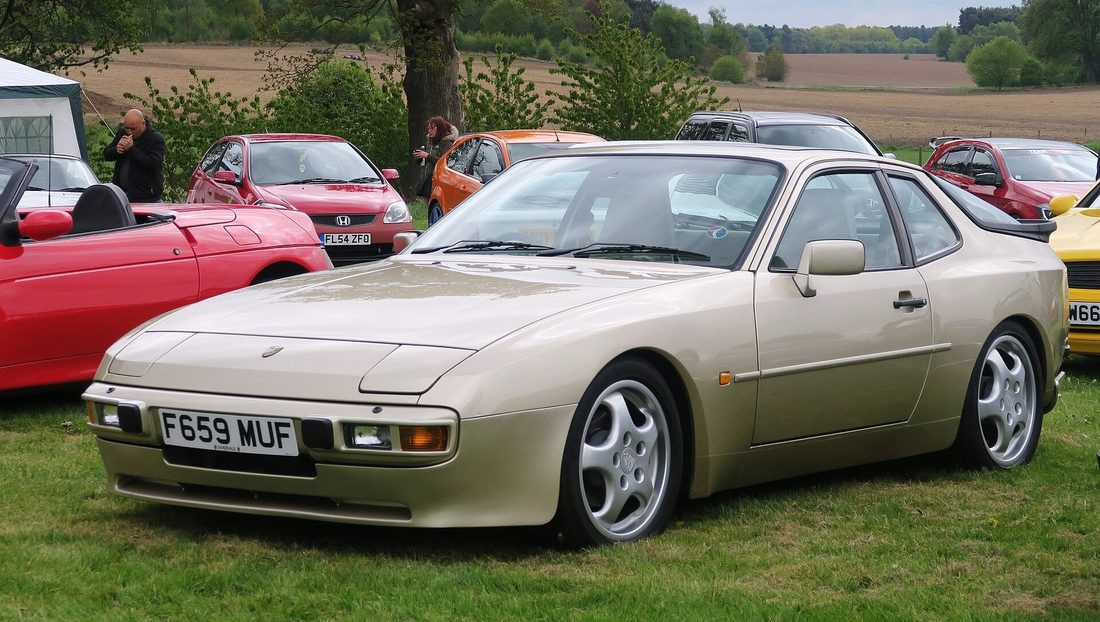
Running auction averages put the 944 overall at 23,453 dollars, the 944S at 16,882, the S2 coupe at 26,194, the Turbo at 28,202, the Turbo S at 29,930 and the Turbo Cup at 110,826, with a recorded high of 202,500 dollars for a 1988 Turbo on 23 November 2025 and a low of 5,000 dollars for a 1986 Turbo on 5 March 2024 (source: classic.com/m/porsche/944/944-turbo). Insurer valuations run higher for the best cars: a Turbo in number 2 excellent condition is put at an even 54,000 dollars, up 54 percent since 2019, a number 3 good S2 is around 30,000, and the S2 Cabriolet, the only factory 944 convertible sold in the US, is up 109 percent since 2020 to a number 3 average of 27,000 (source: hagerty.com/media/market-trends/hagerty-insider/porsche-944-turbo-market-spotlight; hagerty.com/media/buying-and-selling/porsche-944-no-longer-bargain).
Retail guides differ enough to quote side by side. One sets base 1982-1985 cars at 7,500 to 12,000 dollars, base 1985.5-1988 at 10,000 to 15,000, Turbo and S2 at 20,000 to 35,000 and Turbo S at 40,000 and up (source: stuttcars.com/porsche-buyers-guides/porsche-944-buyers-guide). Another's 2026 bands sit higher: base 10,000 to 22,000, 944S 15,000 to 30,000, S2 and Cabriolet 20,000 to 45,000, Turbo and Turbo S 35,000 to 80,000 (source: renndriver.com/guides/porsche-944). Sell-through of 76 to 81 percent across the four main variants says the market is liquid rather than speculative (source: theclassicvaluer.com/buyers-guide/porsche/944).
Deferred maintenance, not the asking price, governs a purchase. Timing belt service falls due every 30,000 to 40,000 miles or five years on an interference engine where failure causes catastrophic damage, and a clutch runs 1,500 to 2,500 dollars (source: stuttcars.com/porsche-buyers-guides/porsche-944-buyers-guide). One UK guide recommends the S2 as the best all-round 944, advises avoiding the 944S on parts scarcity, and rates the 1989-1990 250 bhp Turbos as the best performance value (source: retrooutlaws.com/blogs/porsche944/the-essential-porsche-944-buyers-guide). The 944 is cheap to buy and expensive to buy well.
2.10 Identifying the car in front of you
Work through it in this order, and do not let the badge on the hatch stand in for any step.
- Variant. Establish whether the car is a base 944, a 1989 2.7, a 944S, an S2 coupe, an S2 Cabriolet, a Turbo, a Turbo S or a Turbo Cabriolet, because the faults, the service schedule and the value all follow the variant (source: clarks-garage.com/shop-manual/repair-procedure-index4.htm).
- Engine and displacement. Count the camshafts and confirm the capacity: 2,479 cc eight-valve on a 100 mm bore, the 1989 2.7 eight-valve on a 104 mm bore with the same 78.9 mm stroke, 2,479 cc sixteen-valve in the S, 2,990 cc sixteen-valve in the S2, 2,479 cc turbocharged in the 951. A sixteen-valve car carries a cam chain and tensioner between the camshafts that no eight-valve car has, which is both an identification point and a maintenance liability (source: clarks-garage.com/shop-manual/cam-04.htm).
- Output against the claimed variant. Given the spread above, treat any quoted horsepower figure as a claim to be checked against market and year rather than as identification, and be especially sceptical of a base car advertised at a single confident number.
- Dash generation. Square dash means pre-1985.5, oval dash means 1985.5 or later, and that line also decides fuse numbering, gauge removal, the cooling fan circuit, alternator output and whether the control arms are stamped steel or cast alloy (source: clarks-garage.com/shop-manual/repair-procedure-index4.htm; en.wikipedia.org/wiki/Porsche_944).
- Gearbox. Read the transaxle type code stamped on the top flange near the front of the unit, which needs an inspection mirror and a flashlight: 016J and 016K on the eight-valve car, 016R and 016S on the Turbo, 083D on the 944S and 083F on the S2 (source: clarks-garage.com/shop-manual/trans-04.htm).
- Market specification. Confirm US, Canadian, Japanese or rest-of-world build, because catalyst fitment, lighting and emissions circuits, ABS and airbag content and the rated output all move with it (source: pff.de/en/thread/2827911-us-model-catalytic-converter-removal; en.wikipedia.org/wiki/Porsche_944).
Two cautions on published sources, since a reader will meet both. One supplier site describes the 944S block as cast iron; the whole M44 family is all-alloy. And one specification page carries a 1986 US price range that is plainly corrupt along with a width figure that contradicts itself on the same page, so neither belongs in a valuation or a parts order.
Glossary
- Abs
- Anti-lock braking system, which releases and reapplies brake pressure many times a second to stop a wheel locking. Fitted to later and higher-specification 944s, and its hydraulic unit can seize solid on a car that has stood.
- Balance Shaft
- A counter-rotating shaft driven by its own belt, fitted to cancel the secondary vibration inherent in a large four-cylinder engine. The 944 has two, and their belt is the one shops forget, which is the single most expensive omission in this car's service history.
- Catalytic Converter
- The exhaust device that converts unburnt fuel and oxides of nitrogen into less harmful gases. Fitting one costs power, which is why catalysed and non-catalysed versions of the same engine carry different output figures.
- Certificate Of Authenticity
- Porsche's factory-issued document confirming a car's original specification, colour and option codes from the build record. It is how you prove what a car left the factory as, rather than what a seller believes.
- Din
- The German standard for measuring engine output, quoted in PS. It is measured differently from the American SAE standard, which is why the same engine honestly reads as two different numbers and why cross-market output comparisons on this car are so confused.
- Dme
- Digital Motor Electronics, Bosch and Porsche's name for the engine control unit that manages fuel and ignition. On the 944 it lives in the passenger footwell, which is why water tracking in from the battery tray is an engine-management problem rather than a cosmetic one.
- Expansion Valve
- The air conditioning component that meters liquid refrigerant into the evaporator, dropping its pressure so it can absorb heat from the cabin. A blocked one is a common cause of a system that holds gas but will not cool.
- Final Drive
- The last gear reduction before the driven wheels, expressed as a ratio. It sets how much engine speed a given road speed demands, so two otherwise identical cars with different final drives feel quite different.
- Homologation
- Certifying that a model meets a racing category's rules, including any minimum production requirement, before the competition version may compete.
- Hydraulic Lifter
- A valve-train follower that takes up its own clearance using engine oil pressure, so no periodic adjustment is needed. Every 944 engine uses them, which is why this car has no valve clearance specification at all.
- Interference Engine
- An engine in which the valves and pistons occupy the same space at different moments, so if the camshaft drive fails the valves and pistons collide. The 944 is one, which is why its belt service is not optional maintenance but the condition of ownership.
- Kerb Weight
- The weight of the car with fluids and fuel but without driver or luggage. Published 944 figures spread widely because sources rarely state whether they mean kerb, dry or DIN weight.
- Klr
- The knock and boost control unit fitted to turbocharged cars, working alongside the DME to retard ignition and limit boost when it detects detonation. A failed KLR is both a performance and an engine-safety problem.
- Limited-Slip Differential
- A differential that resists a large speed difference between the driven wheels, sending torque to the wheel with grip instead of spinning the unloaded one.
- Motronic
- Bosch's integrated engine management, combining fuel injection and ignition control in one electronic unit rather than leaving ignition to mechanical advance.
- Oval Dash
- The revised interior introduced partway through 1985, replacing the earlier squarer dashboard and instrument binnacle. It is the clearest single visual split in the 944's run and the fastest way to place an early car.
- Overboost
- A brief boost pressure above the normal maximum, permitted by the control system for short periods. Also, less happily, what a failed wastegate or boost control delivers by accident.
- Parasitic Draw
- A current drain that continues after the car is switched off, flattening the battery over days. On a car of this age it is usually a tired relay, a module that fails to sleep, or corroded wiring rather than the battery itself.
- Pet
- The Porsche Electronic Parts Catalogue, the factory database mapping part numbers to chassis numbers. It is the authority when a supplier listing and a forum thread disagree about what fits.
- Ps
- Pferdestarke, metric horsepower, the unit used in German output figures. One PS is very slightly less than one SAE horsepower, so a PS figure always reads a little higher than the same engine's hp figure.
- Receiver-Drier
- The air conditioning component that stores liquid refrigerant and absorbs moisture from the system. It plugs with debris and is replaced as a matter of course whenever the system is opened.
- Sae
- The American standard for measuring engine output, quoted in horsepower. See DIN: the two standards are not interchangeable and much of the confusion over this car's power figures comes from sources mixing them.
- Semi-Trailing Arm
- A rear suspension layout in which each wheel is carried on an arm pivoting at an angle between fully trailing and fully transverse, so camber and toe change as the suspension moves.
- Slip Clutch
- A coupling designed to give way under excessive torque, protecting what it drives. On this car the term appears in the accessory and pump drives rather than the main clutch.
- Sump
- The oil reservoir at the bottom of the engine. The 944's grew partway through 1985, which is why oil capacity depends on build date as well as variant.
- Thermofan Switch
- The temperature-sensitive switch that brings the electric cooling fan on. A failed switch produces an engine that runs cool at speed and overheats in traffic, which on an all-alloy engine is a serious matter.
- Torque Tube
- The tube running from the engine to the rear-mounted gearbox, carrying the driveshaft on four bearings. Those bearings dry out with age and announce themselves as a squeal or grating at idle in neutral, which sellers routinely dismiss as gearbox whine.
- Torsion Bar
- A long steel bar that resists twisting and acts as a spring. The 944 uses them at the rear, with ride height set by the bar's mounting position on splines.
- Transaxle
- A layout placing the gearbox at the rear axle rather than bolted to the engine, connected here by the torque tube. It is what gives the 944 its unusually balanced weight distribution and its unusual repair bills.
- Vin
- Vehicle identification number, the unique chassis number stamped on the car and recorded in its documents. It is the starting point for confirming model year, market and specification.
- Voltage Regulator
- The device that holds alternator output to a usable voltage as engine speed and electrical load vary. A failing one either undercharges the battery or cooks it.
- Wastegate
- The valve that bypasses exhaust gas around the turbine to cap boost pressure. A sticking wastegate either overboosts the engine or strangles it, and its condition largely determines how a Turbo actually drives.