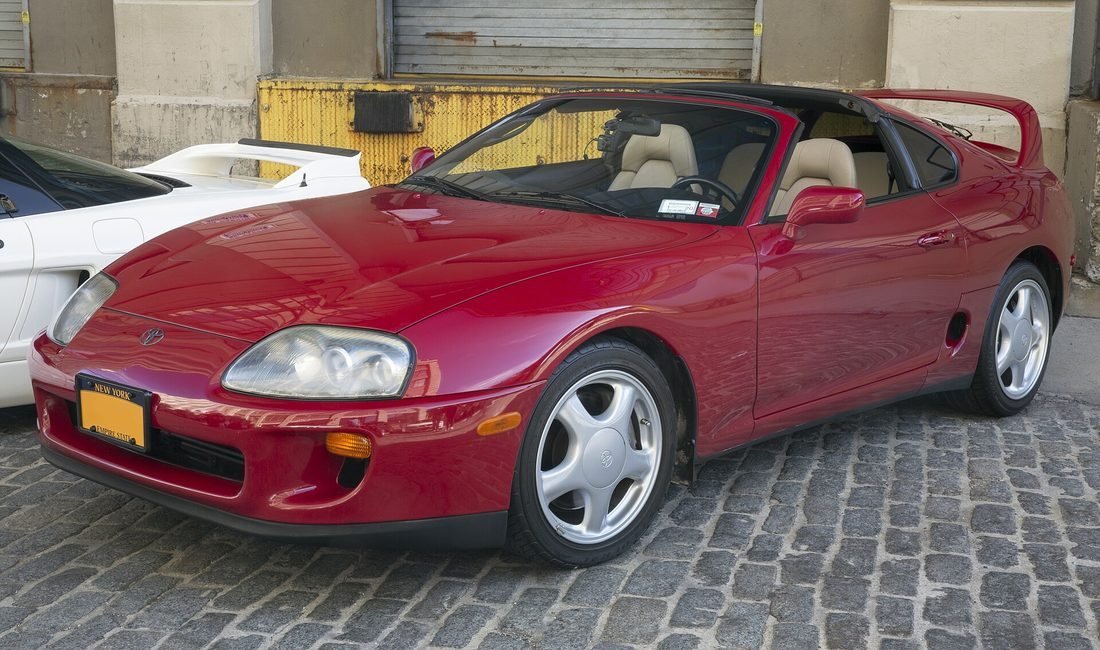
Toyota Supra
About This Book
This is a complete owner's reference for the fourth-generation Toyota Supra, the A80, built from 1993 to 2002 and known to enthusiasts as the Mk4. It covers both the cars Toyota exported to the United States and Europe and the Japanese-market (JDM) cars that carried on after export ended, and it treats both engines the A80 was sold with: the naturally aspirated 2JZ-GE and the twin-turbo 2JZ-GTE.
1.1 What this volume is
This book is a single, organized reference for living with, buying, and understanding the A80 Supra A80. The A80 was the fourth and final "classic" Supra before the nameplate went dormant, returning only in 2019 as the A90 GR Supra. Toyota built it for roughly nine years, from April 1993 to the summer of 2002, and produced about 45,230 cars in total. Around 70 percent of those stayed in Japan, so a large share of the surviving fleet is JDM, and this book is written with that in mind.
The A80 was sold three ways at once. From 1993 to 1998 it went to Japan, the United States, and Europe side by side. US export production ended in 1998, and from 1999 to 2002 the car was JDM-only. Because of that split, and because the collector market now draws cars across borders, this reference deliberately covers all of it: the export "Supra" and "Supra Turbo," and the Japanese trim grades (SZ, SZ-R, RZ, RZ-S, and GZ) you will meet if you shop widely.
Both engines get full treatment. The is the naturally aspirated 3.0 liter inline-six that powered the base cars, rated around 220 hp in US trim. The is the sequential twin-turbo version, famous for the 276 hp (280 PS) Japanese output cap, higher figures for export and European cars, and a legendarily overbuilt block. You do not need to own the turbo car for this book to be useful; the NA cars share most of the chassis, body, and electrical systems, and those chapters apply to both.
1.2 Who it is for
This is for the person who has a stake in a specific car: the owner keeping one on the road, the buyer sizing one up before money changes hands, and the enthusiast who simply wants an honest, single place to understand the A80. When the text talks about checking a car over, it means a pre-purchase inspection you or a trusted shop would perform, the same way you would vet any 20-plus-year-old performance car before buying.
1.3 How to read it
A car this age, sold across three markets over nine years, has generated a lot of published numbers, and those numbers do not always agree. Where good sources disagree, this book gives the best-supported figure and names the disagreement in plain words rather than picking a winner and hiding the doubt: you will see this most around turbo horsepower (the US figure is cited as 320 or 321 hp, while 326 hp is the European number), curb weight, and a few trim and gearbox details. Where a single figure rests on thinner support, the text says so and points you to your own car for confirmation. Safety-related and load-bearing numbers carry their source inline, so you can trace them yourself.
Imperial units come first, with metric in parentheses where the original data provided it. Terms a buyer might not know are defined at first use, and the index marks key model, engine, and spec references so you can navigate straight to what you need.
1.4 A note on independence
Garage, Galley & Hangar is an independent reference publisher. This book is not affiliated with, authorized by, or endorsed by Toyota Motor Corporation. Model names, chassis codes, and trim designations are used only to identify the vehicle. Everything here is compiled from public sources and presented for owners and enthusiasts; it is not a substitute for a factory service manual or the judgment of a qualified mechanic.
History and Identity
The fourth-generation Supra (chassis code A80) was Toyota's deliberate answer to the sports-car establishment: lighter than the car it replaced, overbuilt under the skin, and shaped in California to look like nothing else on the road. This chapter traces how it came to be, what changed across its 1993 to 2002 run, and how to tell one car from another when you are standing in front of it.
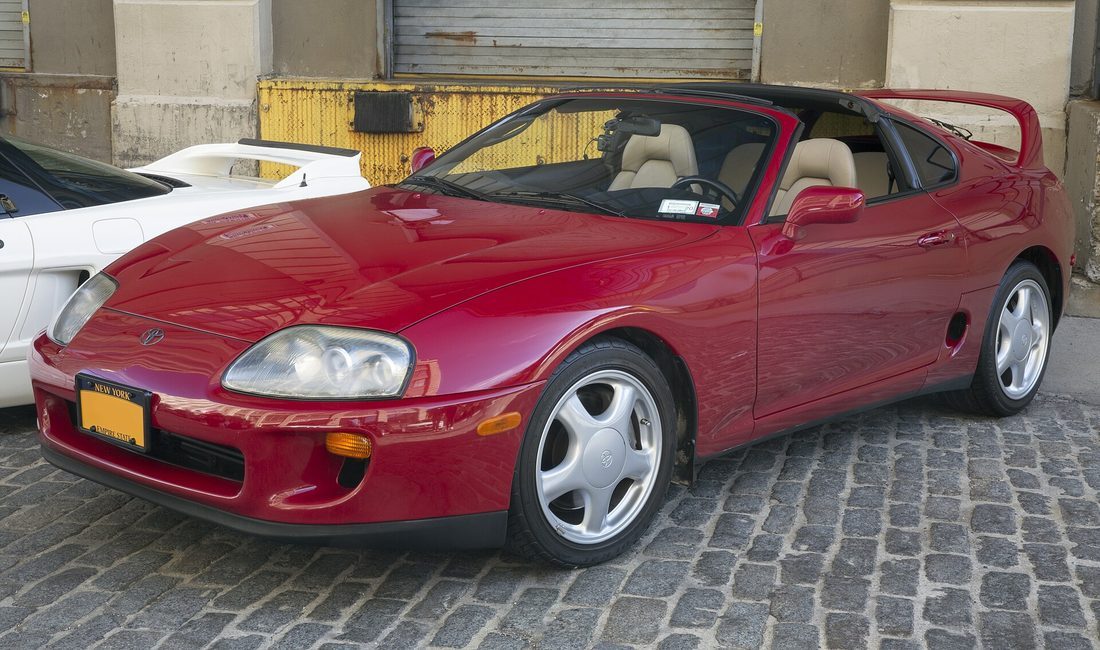
2.1 Where the A80 came from
The Supra name did not start as its own car. It began in 1978 as the Celica SupraCelica Supra, a stretched, six-cylinder version of Toyota's Celica coupe. It became a standalone model, no longer wearing the Celica name, from the third-generation A70 (1986). The car this book covers, the A80, is the fourth and final "classic" Supra before the nameplate went dormant and returned in 2019 as the A90 GR Supra.
The A80 program was led by chief engineer Isao Tsuzuki, the same engineer behind the original Celica and both generations of the MR2. Styling was handled at Calty Design ResearchCalty Design Research, Toyota's California studio, working to a "pure sports car" brief. Calty threw out the A70's pop-up headlights in favor of fixed lamps, and gave the car a long hood, a short deck, pronounced rear haunches, and, on turbo cars, the tall "basket-handle" rear wing that has become the car's signature.
Development ran roughly four years. The project started in February 1989, the design was frozen for production in late 1990, hand-built prototypes followed in 1991, pre-production came in December 1992, and mass production began in April 1993.
The engineering brief was obsessive about weight. The A80 came out about 4.2 inches shorter and roughly 100 to 200 lb lighter than the A70 (sources vary) it replaced, and it did so while making more power. To get there, engineers used hollow carpet fibers, a plastic fuel tank, an aluminum hood, aluminum oil and transmission pans, a gas-injection-molded rear spoiler, and a single exhaust, all in the name of shedding mass.
The car made its public debut at the 1993 Chicago Auto Show, positioned against the Nissan Skyline GT-R, the Mazda RX-7 (FD), the Nissan 300ZX Twin Turbo, and even the Porsche 911. It was eventually discontinued not because it sold poorly but because it had become too expensive to re-engineer for tightening emissions and crash regulations. No direct successor arrived until the 2019 GR Supra. Its later collector-value explosion owes a great deal to the reputation of its twin-turbo engine and to its role as the hero car in The Fast and the Furious.
2.2 The production run, 1993 to 2002
The A80 was built for roughly nine years, from April/May 1993 to July/August 2002. Assembly started at Toyota's Motomachi plant and moved to the Higashi Fuji plant in Susono, Shizuoka, in May 1997.
Total production came to about 45,230 units across the whole run. Roughly 70 percent of those were sold in Japan, and of the Japanese-market cars, about 55 percent were naturally aspirated (non-turbo). By contrast the UK took only 673 cars in total, which tells you how rare the car is outside Japan.
The single most important thing to understand about the timeline is that the US and Japanese markets did not end at the same time. The Supra was sold in Japan, the US, and Europe concurrently from 1993 to 1998. After exports ended, the car continued as a Japan-only model from 1999 through 2002. That gap is why the newest Supras you will find in North America are 1998 cars, while genuine 1999 to 2002 examples are all imports.
The US timeline (1993.5 to 1998)
The Supra launched in the US in 1993, sold as an early car that sources label variously as a "1993.5" or a 1994 model. Wikipedia treats it as a 1994 model-year debut in North America, while US sales records log 1993 sales. Sources genuinely disagree on the exact "1993.5 versus 1994" naming, so do not read too much into a title label alone.
US annual sales volumes (turbo and NA combined) fell off quickly after the first year: 1993 saw 4,504 cars, 1994 saw 2,562, 1995 saw 1,747, 1996 dropped to 534, 1997 recovered to 1,379, and 1998 closed out at 589. Those year-by-year figures come from a single tally and enthusiast counts vary, so read them as close rather than exact.
Two years stand out:
- 1996 was an odd year in the US. The turbo was offered automatic-only, because the 6-speed manual was dropped for the year while Toyota worked through OBD-II certification timing. The targa roof also became standard on the turbo. Canada was withdrawn from the market after 1996.
- 1997 brought the 6-speed manual back on the turbo and a mild refresh: revised tail lights, headlights, and front fascia, plus minor trim changes. Every 1997 US Supra also wore "Limited Edition 15th Anniversary" badging (covered below).
1998 was the final US year, a limited run of 589 units, and export production ended in October 1998.
The JDM timeline (through 2002)
Japan kept getting updates after the US cars stopped:
- May 1995: JDM twin-turbos gained the larger export-spec brakes.
- May 1996 ("Series 2" facelift): a styling and trim refresh, plus Getrag gearbox improvements.
- September 1997: the big one. JDM 2JZ-GTE cars gained VVT-iVVT-i (intake variable valve timing) and updated REASREAS (Relative Absorber System) dampers. Official power stayed pegged at 280 PS, but torque rose and its peak shifted lower in the rev range for a stronger midrange.
By 1999 the range was Japan-only, built around the VVT-i turbo grades (RZ and RZ-S) and the NA grades (SZ and SZ-R). No source isolates a distinct 1999-only change; 1999 cars carry the September 1997 VVT-i and REAS update forward. JDM production ended in July/August 2002, with the final cars being VVT-i RZ-S and limited run-out models.
2.3 Trims and variants
Outside Japan, the car was sold simply. US, UK, and European buyers got the Supra (naturally aspirated) and the Supra Turbo. Every UK car was a twin-turbo.
Inside Japan, the lineup was split into named grades. From least to most focused:
- SZ is the entry naturally aspirated grade, with the 2JZ-GE engine, the 5-speed W58 manual or a 4-speed automatic, smaller brakes, and no big wing as standard. Japan-only base car.
- SZ-R is the sport NA grade: the 2JZ-GE with an upgraded 6-speed manual, a limited-slip differential (LSD) as standard, sport brakes, ABS, and the larger rear wing. This is the enthusiast's naturally aspirated Supra. Sources disagree on whether the SZ-R used a 5-speed or 6-speed manual, and some suggest only certain cars got the six-speed, so verify the gearbox on the specific car.
- RZ is the core twin-turbo grade: the 2JZ-GTE, the Getrag V161 6-speed manual (or the A340E automatic), a Torsen LSD, and the big brakes. This is the most sought-after JDM grade.
- RZ-S is the later, post-VVT-i turbo variant with revised equipment, and it is among the final JDM cars built through 2002.
- GZ is the top luxury turbo grade: automatic-only, with an LSD and the most-loaded equipment list. Catalogs disagree on the GZ's details, and some do not list the grade at all.
A limited-slip differentiallimited-slip differential was standard on the SZ-R, RZ, and GZ grades, with a Torsen unit on the turbo cars.
The 1997 15th Anniversary (US)
The 15th Anniversary edition is often misunderstood as a separate limited model. It was not. 1997 was the Supra nameplate's fifteenth year in the US, so all 1997 US Supras received "Limited Edition / 15th Anniversary" fender badging, along with a rear spoiler, a premium stereo, and special floor mats.
Of the roughly 1,379 US cars built in 1997, about 768 were Twin-Turbo 6-speed manuals, and about 384 were finished in the desirable Deep Jewel Green Pearl (those sub-counts come from enthusiast tallies rather than a factory record). Those turbo-manual 15th Anniversary cars are now among the most valuable US Supras: auction results have run from around $150,000 to more than $176,000.
2.4 How to identify a given car
When you are looking at a Supra in person, work through a few checks in order.
Turbo or NA? This is the first and most valuable question, because it drives everything from value to insurance. The chassis code tells the story: turbo cars carry JZA80, while naturally aspirated cars are commonly designated GA80/JZA80 depending on market. On the car itself, the surest tells are the badging and the exhaust. A turbo car is a 2JZ-GTE with sequential twin turbochargers; an NA car is a 2JZ-GE. Look at the rear wing (the tall basket-handle wing is a turbo signature, though it also appears on the SZ-R), the brakes (turbo cars got large 4-piston front calipers), and the wheels: turbo cars ran 17-inch staggered wheels (235/45ZR17 front, 255/40ZR17 rear [SAFETY, factory tire spec]), while NA cars ran 16-inch wheels. Confirm with the engine itself, since engine swaps are common on these cars and badges can lie.
Which market? US and European turbos were rated higher than the JDM cars. The JDM twin-turbo was officially capped at 276 hp / 280 PS at 5,600 rpm (the Japanese manufacturers' voluntary "gentlemen's agreement" limit, widely believed to be underrated). US-spec turbos were rated at roughly 320 to 321 hp (sources split between the two figures), and European cars at 326 hp / 330 PS. Note that a 326 hp figure means a European car, not a US one. The naturally aspirated 2JZ-GE was rated at about 220 hp in the US, quoted at 220 PS in Japan, and sometimes cited as 225 bhp in the UK, a difference the sources do not fully reconcile.
Manual or automatic, and which gearbox? On turbo cars, the legendary 6-speed manual is a Getrag: the V160 on export cars and the V161 on the JDM RZ (a market-specific final drive on an otherwise closely related unit). The dominant, authoritative usage treats both V160 and V161 as twin-turbo units; one aggregator mislabeled the V160 as an NA gearbox, but treat it as a turbo unit. Naturally aspirated cars used the Toyota W58 5-speed, except for the JDM SZ-R, which offered a 6-speed. A 4-speed A340E automatic was available on both NA and turbo cars. Transmission matters enormously to value: the pecking order runs turbo 6-speed manual well above turbo automatic, above NA manual, above NA automatic.
Which JDM grade? If it is a Japanese import, use the equipment to place it. An NA car with a 6-speed, LSD, ABS, and the big wing is an SZ-R rather than a plain SZ. A turbo manual with a Torsen LSD is an RZ; a turbo automatic loaded with luxury equipment is a GZ. A later turbo with VVT-i (September 1997 onward) narrows it to RZ-S or a late RZ. The presence of VVT-i and updated REAS dampers marks a car as September 1997 or newer, which is a useful way to separate an early JDM turbo from a late one.
Reading the year. For US cars, the 1996 anomaly (turbo automatic-only, standard targa) and the 1997 refresh (revised lights and fascia, plus the 15th Anniversary badging on every car) are the easiest visual anchors. For JDM cars, remember that anything genuinely titled 1999 or later is Japan-only, so a car that appears to be a 2000 or 2001 model is by definition an import, not a US-market survivor.
A final word of caution: the A80's value has climbed steeply enough that originality now matters as much as the badge on the fender. Engine swaps, transmission conversions, and re-shells are all out there, so verify the chassis code, the engine, and the gearbox against each other rather than trusting any single one. The chapters that follow go deeper on the mechanical detail behind each of these identity points.
Glossary
- 25-Year Rule
- The US federal rule that exempts a vehicle at least 25 years old from Federal Motor Vehicle Safety Standards, allowing it to be imported without the costly federalization required of newer cars. It is why Japan-only Supras have become legally importable to the US in recent years, opening up the JDM turbo six-speed cars to American buyers.
- 2Jz-Ge
- The naturally aspirated 3.0-liter inline-six fitted to the base A80 Supra, sharing the 2JZ family's iron block, DOHC 24-valve head, and square 86 by 86 mm bore and stroke but running higher compression (10.0 to 10.5:1) and no turbos. It made roughly 220 hp in US trim and is a common, affordable donor engine for turbo conversions.
- 2Jz-Gte
- The sequentially twin-turbocharged version of Toyota's 3.0-liter inline-six, the halo engine in the A80 Supra Turbo. Rated at 320 hp in US trim (and a famously underrated 280 PS in Japan), its closed-deck iron block is the reason the 2JZ holds 600 to 800 hp on stock internals and became one of the most swapped engines on earth.
- Abs
- The Anti-lock Braking System, which prevents the wheels from locking under hard braking so the driver can keep steering. The turbo Supra came with a four-channel, four-sensor system as standard; a failed wheel-speed sensor is a common cause of an ABS warning light and a disabled traction-control system on aging cars.
- Alternator
- The belt-driven generator that charges the battery and powers the car's electrical systems while the engine runs. On the A80 the main charging path runs through a high-amp fusible link that can corrode and cause a 'no-charge' fault, and the battery lives in the rear hatch area rather than the engine bay.
- Bgb
- Community shorthand for the A80's factory repair manual, from the nickname 'Big Green Book.' Owners use the term for the official Toyota service manual set that documents the car's repair procedures and specifications.
- Bpu
- Basic Performance Upgrade, the near-universal first stage of tuning on a turbo Supra: a free-flowing downpipe and exhaust, a boost controller, and a fuel-cut defencer to raise boost above the factory setting. It is relatively safe on the steel-turbine export cars but is exactly where the fragile ceramic turbines on Japanese-spec cars tend to let go.
- Calty Design Research
- Toyota's California-based design studio, which styled the A80 Supra with a 'pure sports car' brief, giving it the long hood, short deck, muscular rear haunches, and (on turbo cars) the tall 'basket-handle' rear wing. The same studio shaped several landmark Toyotas across the decades.
- Celica Supra
- The Supra's origin: from 1978 it began as the Celica Supra, a longer, six-cylinder version of the Celica, before becoming a standalone model from the third generation onward. Knowing this lineage helps place the A80 as the fourth and final 'classic' Supra before the 2019 revival.
- Closed-Deck
- A cylinder block design where the top of the block around the bores is nearly solid metal, with only small coolant passages, so the cylinders are rigidly tied together and resist flexing under high boost. The 2JZ's closed-deck iron block is the single biggest reason it survives extreme power that would lift the head on a lighter open-deck engine.
- Ecu
- The Engine Control Unit, the computer that manages fuel, ignition, boost, and related functions; on the A80 it sits behind a kick panel in the passenger footwell. Its 1990s electrolytic capacitors leak and corrode the circuit board with age, causing rough running, limp mode, or no-starts, so a preventive 're-cap' is a common and worthwhile service on any un-touched car.
- Electrical Wiring Diagram
- The separate factory publication (often abbreviated EWD) that maps the car's complete wiring, connectors, and circuits, distinct from the main repair manual. It is essential for diagnosing electrical and fuel-injection faults on a car this age, and like the service manual it is available from TechInfo or community mirrors.
- Factory Service Manual
- The official Toyota repair documentation for the car (also called the Toyota Supra Repair Manual or TSRM), giving factory procedures, specifications, and torque figures. For the A80 it is available legitimately through Toyota's TechInfo portal and widely mirrored by the community, and it is the authoritative reference for any serious work.
- Gr Heritage Parts Project
- Toyota's program, run through its Gazoo Racing arm, that reproduces discontinued service parts for select classic models and sells them as new, genuine components. The A80 Supra is a flagship inclusion, most notably a reissued dashboard, so owners of a car this old have unusually good factory parts support.
- Inline-Six
- An engine layout with all six cylinders in a single straight row, inherently smooth-running and, in the 2JZ's case, long enough to make packaging easy in a rear-wheel-drive car. Every A80 Supra uses one, and the configuration's natural balance is part of why the 2JZ feels so refined.
- Interference Engine
- An engine in which the pistons and valves share the same space at different moments, so if the timing belt breaks the pistons can strike open valves and cause serious internal damage. The 2JZ is treated as an interference engine, which is why replacing the timing belt on schedule (with the water pump, tensioner, and idlers) is the most important maintenance job on the car.
- Jza80
- The chassis code for the A80 (fourth-generation) Supra, used across the range and most closely associated with the 2JZ-powered cars. You will see it throughout parts catalogs, service manuals, and import paperwork as the definitive way to identify this generation.
- Limited-Slip Differential
- A rear differential that limits how much one wheel can spin relative to the other, sending torque to the wheel with grip instead of wasting it on the one that has broken loose. On the A80 the sport and turbo grades used a limited-slip unit (a Torsen on the turbo cars), which is a big part of how the Supra puts its power down.
- Na-T
- Short for 'NA-T' or naturally-aspirated-turbo, the popular path of adding turbocharging to a 2JZ-GE (naturally aspirated) car, made straightforward because the GE and GTE share the same basic block and timing architecture. A well-done NA-T is a legitimate build, but such cars are sometimes misrepresented as factory twin-turbos, so the VIN should always confirm what the car left the factory as.
- Nmvtis
- The National Motor Vehicle Title Information System, a US database used to check a car's title history for salvage, rebuilt, flood, or theft brands. Running an NMVTIS report is a key buying step on a high-value Supra, since a branded title heavily suppresses value and can flag a cloned or stolen car.
- Pre-Purchase Inspection
- A thorough evaluation of a specific car by a knowledgeable specialist before you buy it, covering mechanical condition, accident and rust history, and, on a Supra, authenticity of the turbo and title. Given how much clean A80s now cost, a PPI by a marque expert is cheap insurance against an expensive mistake.
- Reas
- The Relative Absorber System, a Toyota suspension feature that hydraulically links the dampers to reduce body roll and pitch for a flatter, more composed ride. It was fitted to certain JDM Supras and updated with the September 1997 changes that also brought VVT-i.
- Sequential Twin-Turbo
- The factory turbo arrangement on the 2JZ-GTE, where two same-size turbochargers work in stages rather than together: only the first spools at low rpm for quick response, then the second stages in around 4,000 rpm for top-end power. The system relies on a web of vacuum lines and actuators that tends to fail with age, which is why many owners convert to true-twin or single-turbo setups.
- Targa
- A body style with a removable roof panel that lifts out and stows in the hatch, giving open-air driving while keeping a fixed rear structure. Most A80s are targa cars, and the panels (along with their seals and drip moldings) are now scarce and prone to leaks and rattles, so condition matters when buying.
- Torsen
- A torque-sensing, gear-type limited-slip differential fitted to the factory turbo Supra, which splits power between the rear wheels mechanically without clutch packs. It is durable and low-maintenance, though on hard, sudden traction changes it can react abruptly and, in extreme high-power use, has been known to stress the axles.
- V160
- The Getrag-designed six-speed manual gearbox fitted to the turbo Supra (the later, closely related revision is the V161), widely regarded as one of the strongest factory manuals of its era and good for well over 600 hp. It was never offered behind the naturally aspirated engine, is now discontinued, and commands high prices, which is why a genuine six-speed turbo car is worth so much more than an automatic.
- Vvt-I
- Variable Valve Timing with intelligence, Toyota's system for continuously adjusting intake camshaft timing based on engine speed and load. Added to the A80's engines from September 1997, it broadens the torque curve and improves the midrange; every 1998-and-later JDM Supra (any '1999' car) has it, and its factory rubber oil-feed line is a known fire and oil-loss risk worth checking.